

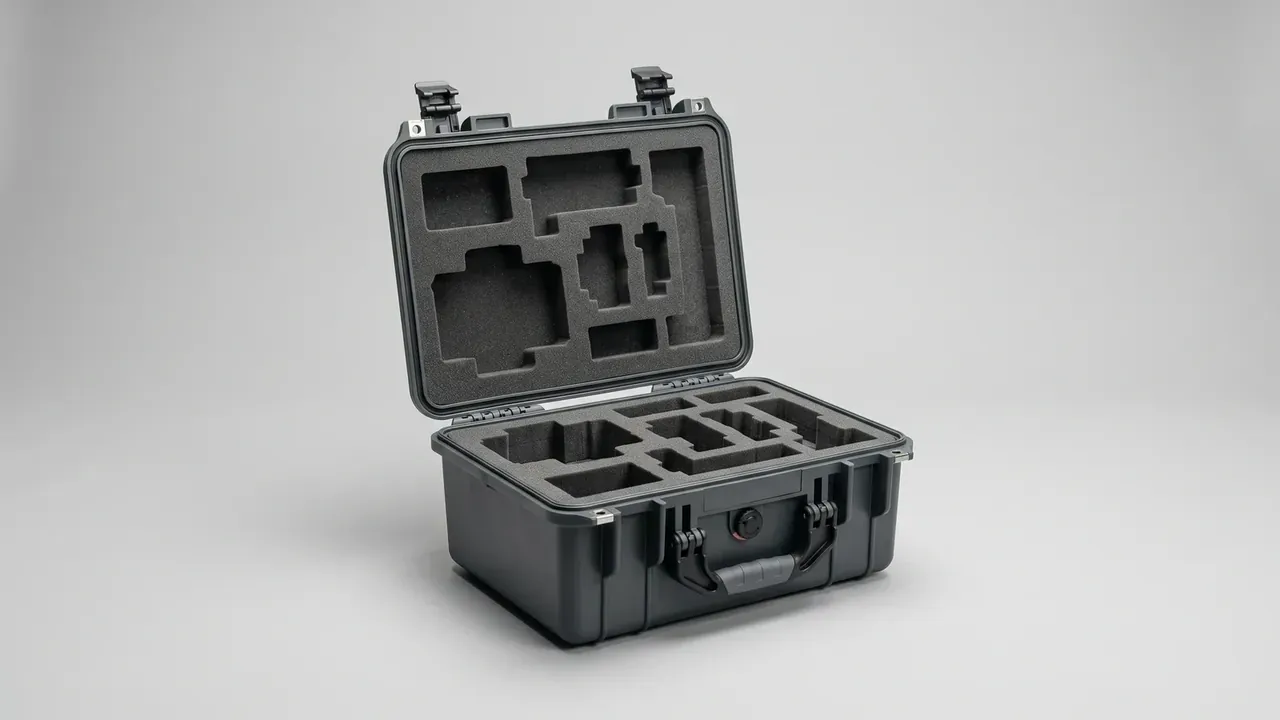
Quick answer: Judge a battery protection case on five measurable points: impact margin, valve cracking point, lining coverage, leak and salt spray records, and how the pack is held. The shell is shared with ordinary cases, so the decision rests on numbers.
Table of contents
- How a Battery Protection Case Is Judged
- Impact: Drop Height and Foam Travel
- Pressure Relief: Cracking Point and Flow
- Fire-Retardant Lining: Rating, Thickness, Coverage
- Acceptance: Leak, Salt Spray, Marking
- FAQ
1. How a Battery Protection Case Is Judged
A battery protection case looks like any other hard case from three metres away: same shell, same latches, same handle. The difference sits in five places a catalogue photo never shows.
Order matters. Impact sets wall thickness and foam travel, the valve sets where the shell is drilled, the lining sets coverage, and leak plus salt spray belong to batch acceptance. Reverse that order and the valve lands on a lining seam.
| Check | Metric | Threshold | Verification |
|---|---|---|---|
| Impact | Corner drop, foam thickness | No crack at 0.9 m | Drop one per lot |
| Valve | Cracking point, flow | Opens at 0.15 to 0.25 bar | Pressurise, watch diaphragm |
| Lining | Rating, coverage | UL94 V-0, 85 percent | Lift lining, check adhesive |
| Leak | Pressure decay | 30 kPa held 60 s | Leak bench or immersion |
| Salt spray | Latch, hinge pin | 48 hours, no red rust | Match report batch |
None can be judged from a sample, so request the report number.
2. Impact: Drop Height and Foam Travel
Impact is not a wall-thickness figure. It is corner drop height read with foam thickness: typically a 4.5 mm polypropylene shell over 15 mm of closed-cell foam. Thicken the shell and thin the foam, and shock still reaches the pack undamped.
Corner drops run harsher: a flat face test at 1.2 m, the same case corner-dropped at 0.9 m, because energy concentrates on one edge. Keep the corner radius above 10 mm, or the impact point whitens.
Foam in a battery protection case must keep travel in reserve. With a 2.8 kg pack dropped from 1.2 m, compression under 30 percent recovers; past 50 percent the second drop has nothing left.
3. Pressure Relief: Cracking Point and Flow
Ask two questions about the valve: at what differential it opens, and how much air moves. Diaphragm valves in this class crack between 0.15 and 0.25 bar, with at least 3 litres per minute at 0.1 bar.
Count follows volume. Below 30 litres one valve is enough; above 60 litres, two placed diagonally. Keep the bore 1.5 mm clear of any lining seam.
Membrane material decides life. A 0.05 mm PTFE diaphragm resists sticking from minus 20 to 55 degrees Celsius; rubber drifts past 0.4 bar.
4. Fire-Retardant Lining: Rating, Thickness, Coverage
Pin three things on the lining: rating, thickness, coverage. A common build is 3 mm retardant foam at UL94 V-0, oxygen index above 28 percent, covering 85 percent of the cavity.

Coverage fails more often than rating. Lid ribs and the backs of corner pads are frequently skipped, leaving channels with no retardant layer. Lift the lining and read the adhesive line: continuity says more than the rating page.
The lining in a battery protection case shares work with the cushioning. Retardant foam at 45 kg per cubic metre handles heat; an 80 kg per cubic metre EVA layer against the pack keeps conformity.
5. Acceptance: Leak, Salt Spray, Marking
Three acceptance lines are enough for a battery protection case: hold 30 kPa for 60 seconds, run 48 hours of salt spray, check model, lot and valve drawing.
Repeat the leak test after thermal cycling: after eight cycles from minus 20 to 55 degrees Celsius, a value that passed cold can drop a grade.
| Item | Sample | Criterion | Record |
|---|---|---|---|
| Leak | 3 to 8 per lot | 30 kPa, 60 s, decay 2 kPa | Pressure curve file |
| Salt spray | 2 per lot | 48 h, no red rust | Report number |
| Thermal cycling | 1 per lot | Leak retest passes | Cycle log |
| Marking | 100 percent | Model, lot, valve drawing | First-article photo |
Conclusion
A battery protection case is chosen by five numbers: drop height, cracking point, coverage, pressure decay, salt spray hours. If any one carries no value, a low price only means an ordinary case was renamed. Write the five into the contract annex and selection becomes a checklist. The battery protection case worth specifying answers all five with figures.
This article discusses only the container (case body) side of specifications and design intent, and does not cover any handling, loading or use of the contents.
Related Reading
- Battery safety case versus alternatives
- Reading shockproof case specifications
- Specifications for custom foam inserts
- Sealing standards for waterproof hard cases
Related Products
- 8 Series — Gun Cases; Military Equipment Cases; Camera Equipment Cases; Drone Cases; Watch Cases; Knife Cases; First Aid Cases; Electronics Equipment Cases
- WL8-2812 PP Gun Case — model WL8-2812
- All protective cases and toolboxes: 7 series, 158 models