

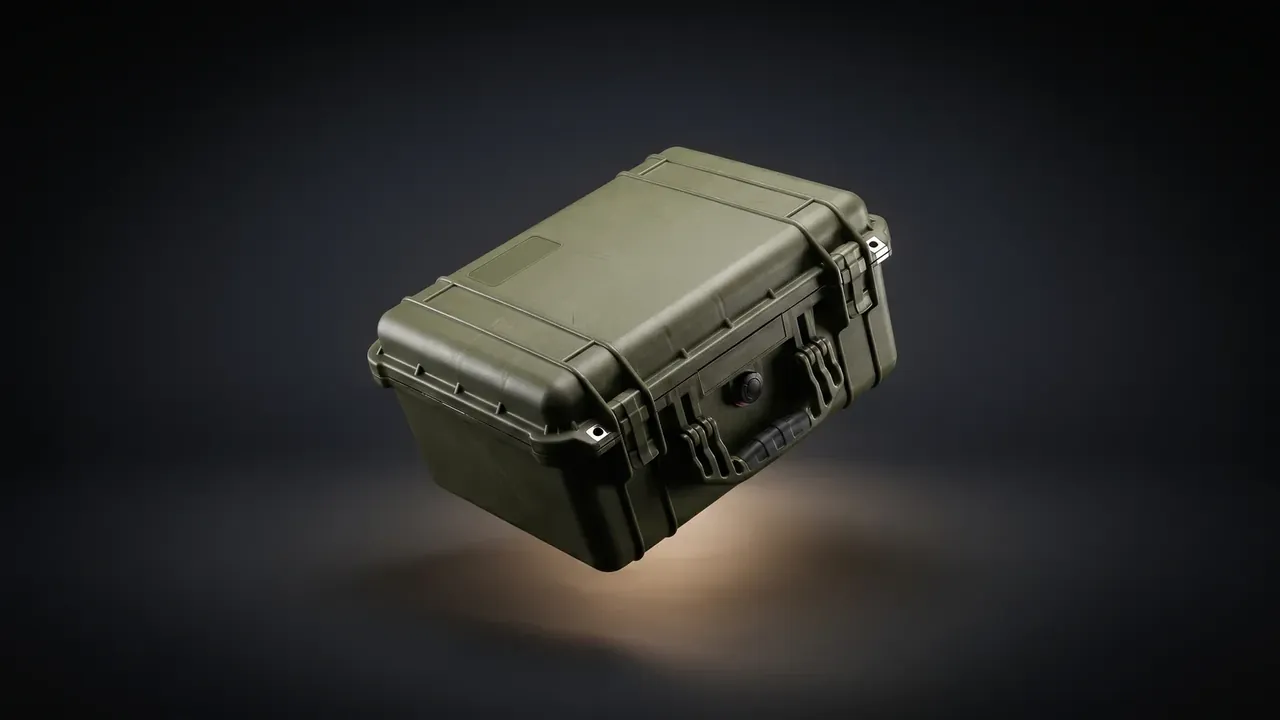
Quick answer: Check a robotic packaging case in five steps: cavity, load and lifting, damping, sealing, then a check sheet. The first two decide whether it lands inside; the last two whether it survives road and sea.
Table of contents
- Sizing the Cavity Around the Transport Pose
- Load Rating and the Lifting Path
- Damping That Survives Road and Sea
- Sealing, Pressure Relief and Ocean Transit
- Putting the Five Criteria on One Sheet
- FAQ
1. Sizing the Cavity Around the Transport Pose
A six-axis arm ships folded. A 1400 mm reach, 180 kg machine envelopes about 1150 by 900 by 780 mm in transport pose, so a robotic packaging case needs a 1350 by 1050 by 900 mm cavity: 100 mm per side, 60 foam and 40 strap channel.
| Machine | Transport envelope (mm) | Suggested cavity (mm) | Clearance (mm) | Interior build |
|---|---|---|---|---|
| 700 mm reach, 45 kg | 620×520×480 | 780×680×600 | 80 | One EVA cradle, two ribs |
| 1400 mm reach, 180 kg | 1150×900×780 | 1350×1050×900 | 100 | Two cradles, strap slots |
| 2000 mm reach, 420 kg | 1600×1200×950 | 1800×1400×1100 | 110 | Timber pallet, four eyes |
Sizing on the working pose adds 400 mm, paid twice over. Depth is the other trap: a 900 mm cavity gives 120 mm of flange relief, 15 mm of arm sag and 40 mm of lid foam, so 725 mm touches the machine.
2. Load Rating and the Lifting Path
A 180 kg arm with pallet and foam is 260 kg, so rate on shipping weight: the floor of the robotic packaging case carries 420 kg static and 320 kg dynamic at a 1.6 factor. Fork pockets are 120 mm clear, 90 mm off the ground.
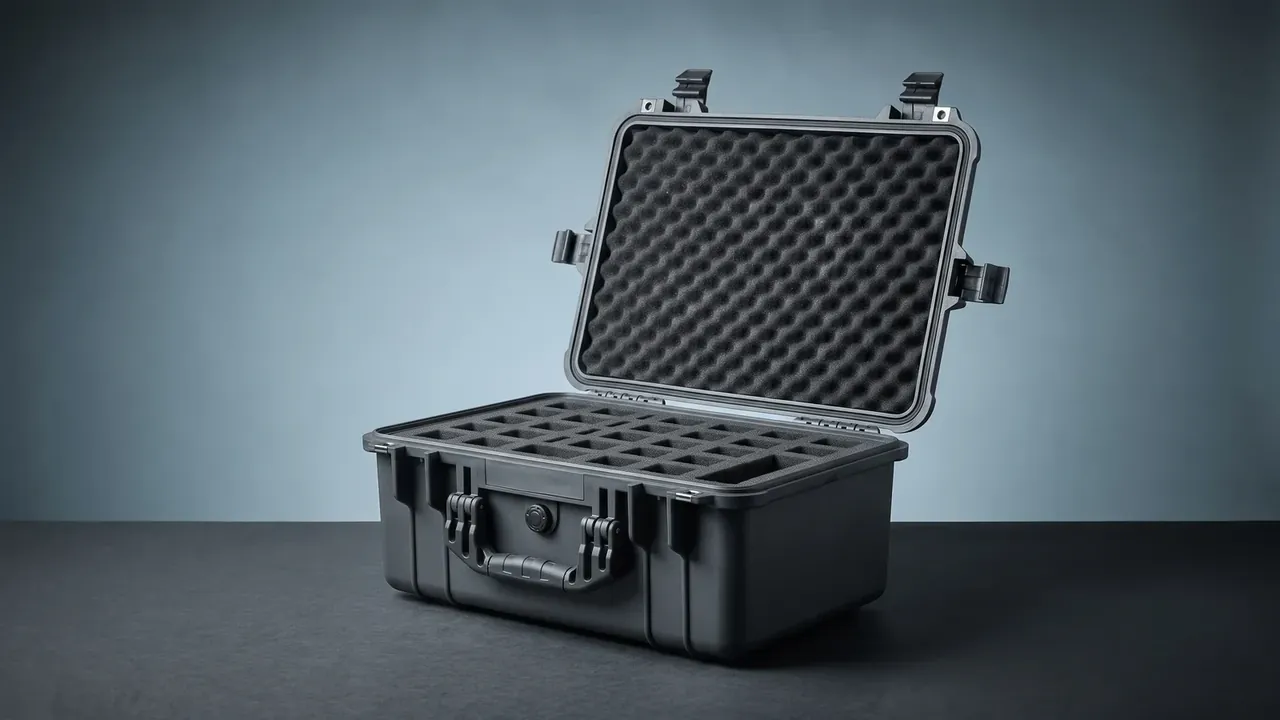
Lift on four eyes, slings at 60 degrees or steeper. At 45 degrees sling load rises 40 percent, which is how a two-tonne sling fails at a corner. Eyes are 5 mm stainless on M12 bolts at 45 N·m, proof-loaded at 1.5 times working weight.
3. Damping That Survives Road and Sea
One 0.5 g shock can deform a harmonic reducer rated at 0.02 mm repeatability. EVA at 30 kg/m³ compressed 25 percent sits near 8 Hz, between the 3 to 5 Hz truck chassis mode and the 12 to 16 Hz ocean band.
| Mode | Dominant frequency | Peak acceleration | Damping approach |
|---|---|---|---|
| Road, full truckload | 3 to 5 Hz | 0.8 g | EVA 30 density, 25 percent |
| Rail | 6 to 9 Hz | 1.0 g | 10 mm rubber pad |
| Ocean | 12 to 16 Hz | 0.5 g | Cradles, straps, desiccant |
Drops run at 1.2 m on a corner and 0.9 m flat. Corner drops concentrate energy along one edge, so ribs on a robotic packaging case must follow it, and an R25 radius cuts local stress by 30 percent. Two millimetres of pre-compression is enough; at 10 mm the foam is bottomed out.
4. Sealing, Pressure Relief and Ocean Transit
On deck the air reaches 60°C by day and 5°C at night. A double-lip gasket with 3 mm lips and a 0.2 bar relief valve holds a 55°C swing under 0.15 bar.
In a 48 hour salt spray the hardware fails first: latches, eyes, hinges. Rotomoulded HDPE resists salt but not ultraviolet — a yard summer chalks a 5 mm wall to 0.1 mm, or 0.03 mm with 2 percent carbon black.
5. Putting the Five Criteria on One Sheet
| Criterion | Weight | Pass line | Usual failure |
|---|---|---|---|
| Cavity | 30 | 80 mm or more per side | Measured on the extended arm |
| Lifting | 25 | Four eyes, slings at 60 degrees | Fork pockets, no eyes |
| Damping | 20 | Outside 3 to 16 Hz | Foam packed solid |
| Sealing | 15 | IP65 with a relief valve | Rating printed, no valve |
| Verification | 10 | One sheet per machine | Counting from memory |
Below 70 out of 100 it is not fit for sea freight; below 55, in-plant only.
When criteria collide, keep cavity and damping: thin foam kills damping, while eyes and valves bolt on later. A robotic packaging case is scored before the order, not after a damaged reducer.
Conclusion
The cavity decides whether the machine fits, the lifting gear whether it moves, sealing whether it powers up at the other end, and the check sheet whether it repeats on machine two. Score the five first, and a robotic packaging case stops being a cosmetic choice.
This article discusses only the container (case body) side of specifications and design intent, and does not cover any handling, loading or use of the contents.
Related Reading
- How export crates and case bodies divide the work
- Where logistics support boxes are used
- Machine tonnage and wall thickness in injection moulding
- Selection criteria for drone cases
Related Products
- 8 Series — Gun Cases; Military Equipment Cases; Camera Equipment Cases; Drone Cases; Watch Cases; Knife Cases; First Aid Cases; Electronics Equipment Cases
- WL8-2812 PP Gun Case — model WL8-2812
- All protective cases and toolboxes: 7 series, 158 models