

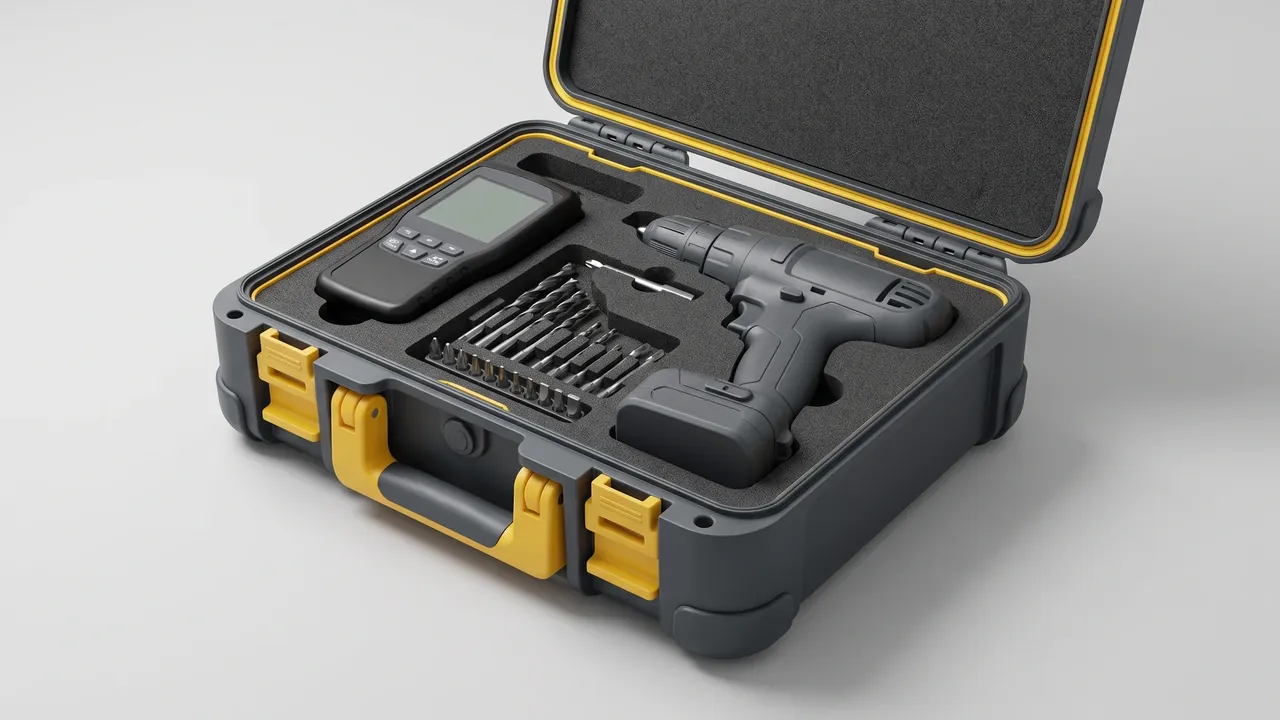
Quick answer: Run five criteria in order: resin for the low-temperature limit, wall and ribs for impact, gasket and latches for the rating, hardware for service life, foam and volume for cost. The step buyers skip is the wall-to-rib ratio, where cracked corners begin.
Table of contents
- The Five Selection Criteria for an Engineering Plastic Case
- Resin Grade and Wall Thickness: Cold and Impact Trade-offs
- Gasket and Latches: Turning a Rating into Numbers
- Hardware and Stacking: Hinges, Handles and Rib Layout
- Foam, Colorant and Batch Economics
- FAQ
1. The Five Selection Criteria for an Engineering Plastic Case
An engineering plastic case is not specified by whoever moulds the thickest wall; five criteria lock in sequence, ordered by rework cost.
| Criterion | Check first | Failure when wrong | Rework cost |
|---|---|---|---|
| Resin grade | Low-end temperature | Corner cracking in a cold drop | Scrap lot, new tool |
| Wall and ribs | Drop height and mass | Sagging lid, bulging side | Tool rework |
| Gasket and latches | Rating, cavity length | Water beads inside | New gasket, insert |
| Hardware | Cycles and load | Rusted pin, pulled handle | Supplier swap |
| Foam and volume | Layout, order size | Misaligned slots, overrun | Secondary rework |
2. Resin Grade and Wall Thickness: Cold and Impact Trade-offs
The workhorse is a PC/ABS alloy: 45 kJ/m² notched Charpy, 105 °C heat deflection, so a 3.2 mm wall survives a 9 kg weight dropped 1.2 m into a corner.
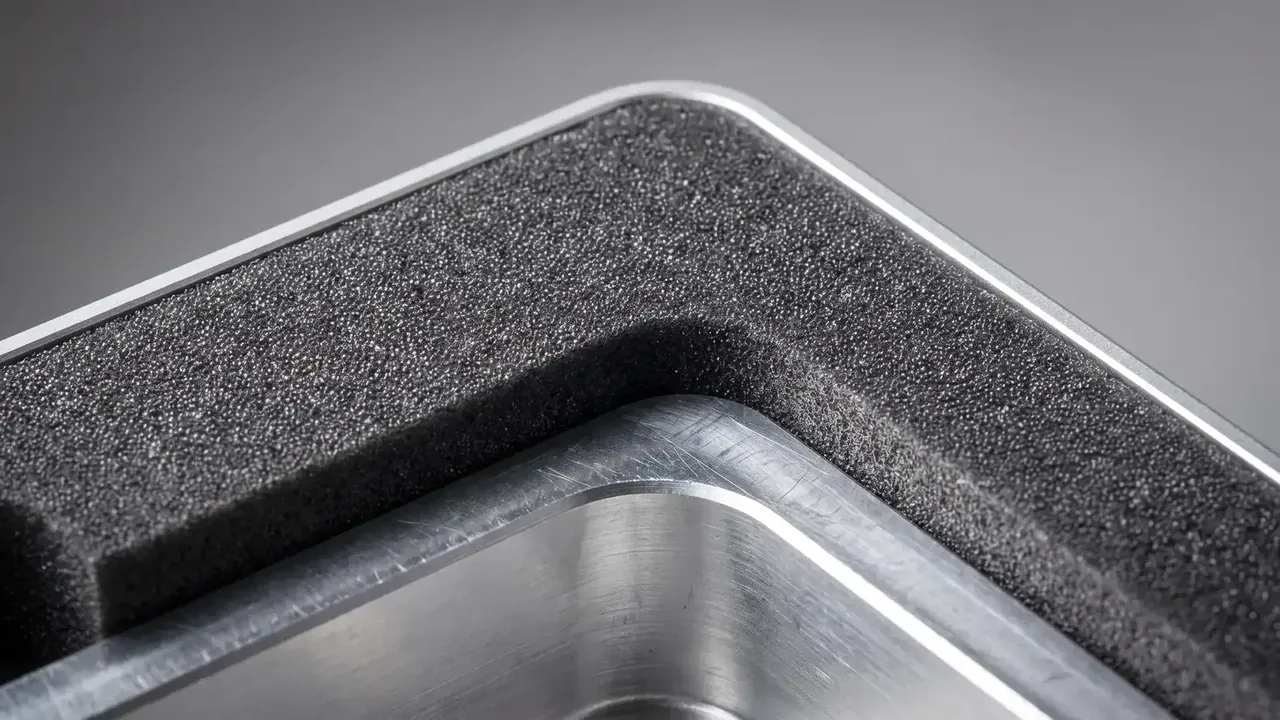
Block PP stays ductile at −30 °C but needs a 4.0 mm wall; rotomoulded HDPE runs 6–8 mm, yet a 60 L body is 11 kg empty.
| Grade | Impact | Temperature | Main wall | Suited case |
|---|---|---|---|---|
| PC/ABS | 45 kJ/m² | −20 to 90 °C | 3.2 mm | Instruments, equipment |
| Block PP | 8 kJ/m² | −30 to 80 °C | 4.0 mm | Cold chain, outdoor |
| HDPE | No break | −40 to 60 °C | 6–8 mm | Large volume, heavy |
| PA66 + 30% GF | 12 kJ/m² | −30 to 150 °C | 2.8 mm | Hot workstations |
Ribs matter more than wall: a 3.2 mm face stepped to a 2.4 mm root on a 110 mm grid lifts section modulus about 40% for 6% more weight.
3. Gasket and Latches: Turning a Rating into Numbers
Sealing rests on compound, compression and groove depth: a 55 Shore A EPDM cord in a 2.6 mm groove lands at 25–30% compression.
IP67 is 30 minutes at 0.5 m without ingress; IP65 is a 12.5 L/min jet for 3 minutes. Past 450 mm an engineering plastic case needs a third latch, each pulling 250 N.
4. Hardware and Stacking: Hinges, Handles and Rib Layout
A 304 hinge pin shows no red rust after 96 hours of salt spray; a zinc-plated carbon pin spots at 48 hours and seizes within three months. Size the handle for 1.5 times the load.
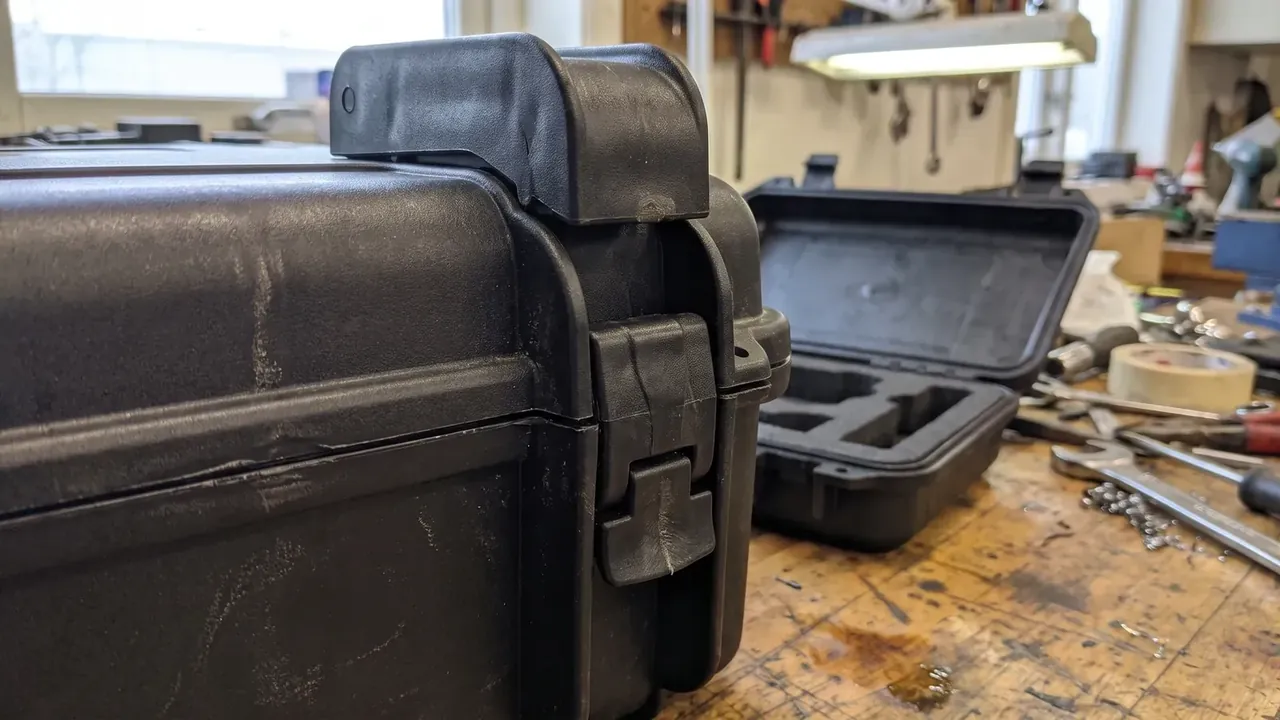
Stacked five high, the bottom unit carries 72 kg, so lid flatness must hold within 0.8 mm or the second tier rocks.
5. Foam, Colorant and Batch Economics
PU at 30 kg/m³ suits light parts, EVA at 45 kg/m³ sharp metal, XPE at 25 kg/m³ is cheapest but sheds crumbs; inserts use a 20 mm base pad.
Each extra point of colorant costs about 2% of notched impact. A 0.31 m² projected area needs 1085 t of clamp at 35 MPa, so a 1300 t press cycles in 78 s.
| Size | Outside | Inside | Wall | Empty |
|---|---|---|---|---|
| Small | 420 × 330 × 180 mm | 380 × 290 × 155 mm | 2.8 mm | 2.6 kg |
| Medium | 565 × 390 × 215 mm | 520 × 345 × 190 mm | 3.2 mm | 4.8 kg |
| Large | 700 × 480 × 320 mm | 650 × 430 × 290 mm | 3.6 mm | 7.9 kg |
| Extra large | 900 × 600 × 420 mm | 845 × 545 × 385 mm | 4.2 mm | 13 kg |
Conclusion
Resin first, then wall and ribs, then gasket, hardware and foam. Get the resin wrong and every later step is wasted; get the rib ratio wrong and corners crack first. Choosing an engineering plastic case is arithmetic done before the tool is cut.
This article discusses only the container (case body) side of specifications and design intent, and does not cover any handling, loading or use of the contents.
Related Reading
- Three decision points in PP case selection
- PP versus ABS case materials
- Selecting an injection moulded protective case
- Fixing protective case dimensions
Related Products
- 8 Series — Gun Cases; Military Equipment Cases; Camera Equipment Cases; Drone Cases; Watch Cases; Knife Cases; First Aid Cases; Electronics Equipment Cases
- WL8-2812 PP Gun Case — model WL8-2812
- All protective cases and toolboxes: 7 series, 158 models