

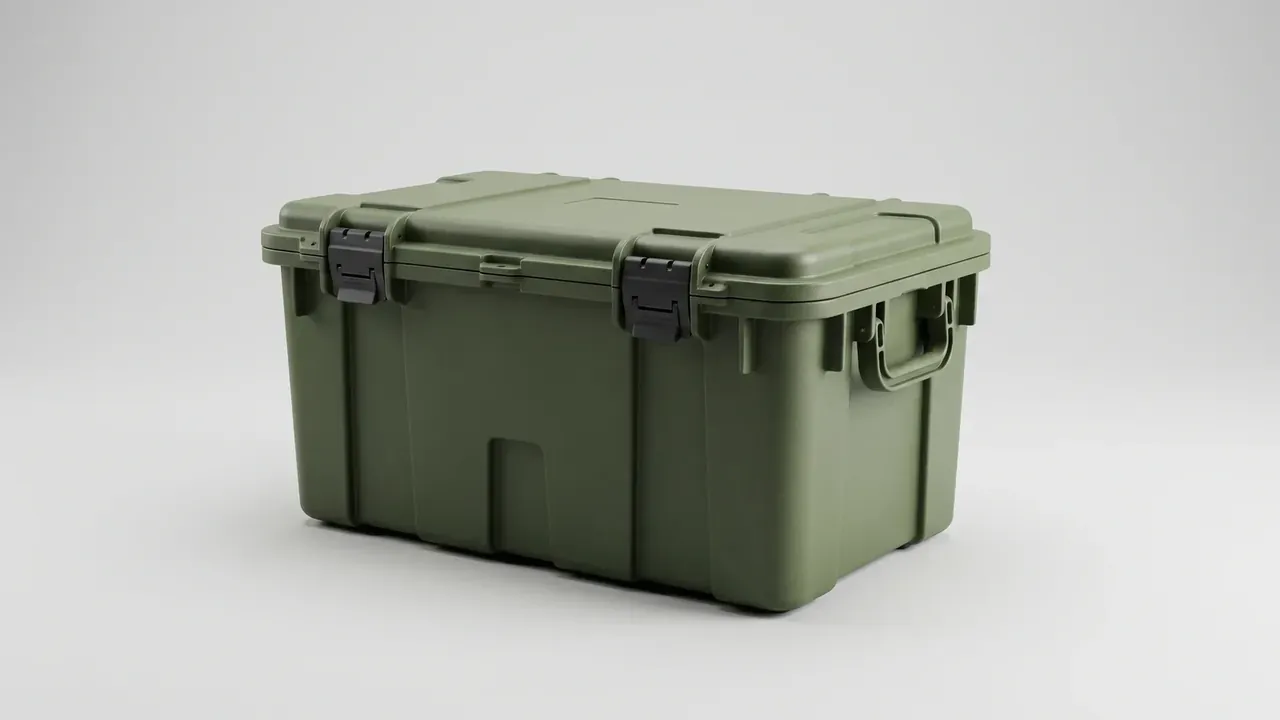
Quick answer: Judge a plastic protective case brand by what it will put in writing: clamp tonnage, mould ownership, resin grade, the part number on each test report, and the tolerance it accepts on an order.
Table of contents
- Five Checks That Separate a Real Plastic Protective Case Brand
- Clamping Force and Who Owns the Mould
- Resin Grade, Wall Thickness and the Paper Trail
- Test Reports That Match the Part Number
- Batch Consistency, Lead Time and Spares
- FAQ
1. Five Checks That Separate a Real Plastic Protective Case Brand
Three suppliers call themselves a plastic protective case brand: the factory that cuts its own moulds, the trader that reboxes, and the workshop that recolours a stock tool. All three hand over a glossy catalogue.
| Check | Factory-type brand | Trader-type brand | What goes wrong |
|---|---|---|---|
| Moulding | Owns 630 t presses | Outsources, tonnage unknown | 0.3 mm flash, latches will not seat |
| Resin | Grade and regrind stated | Writes PP only | Brittle rim in a year |
| Certification | Report matches part number | Borrowed report | Fails incoming check |
| Consistency | Colour measured | Colours customisable | Batches clash |
| Spares | Latches sold loose | Whole cases only | One latch scraps a case |
Any quote that gives outside dimensions but withholds cavity size and wall thickness is discarded at once.
2. Clamping Force and Who Owns the Mould
A 40-litre body with 3.4 mm walls presents about 0.42 square metres of projected area, needing a 630-tonne press at 0.45 tonnes per square centimetre. On a 380-tonne machine flash reaches 0.3 mm, the sealing groove is scraped by hand, and the ingress rating falls from there.
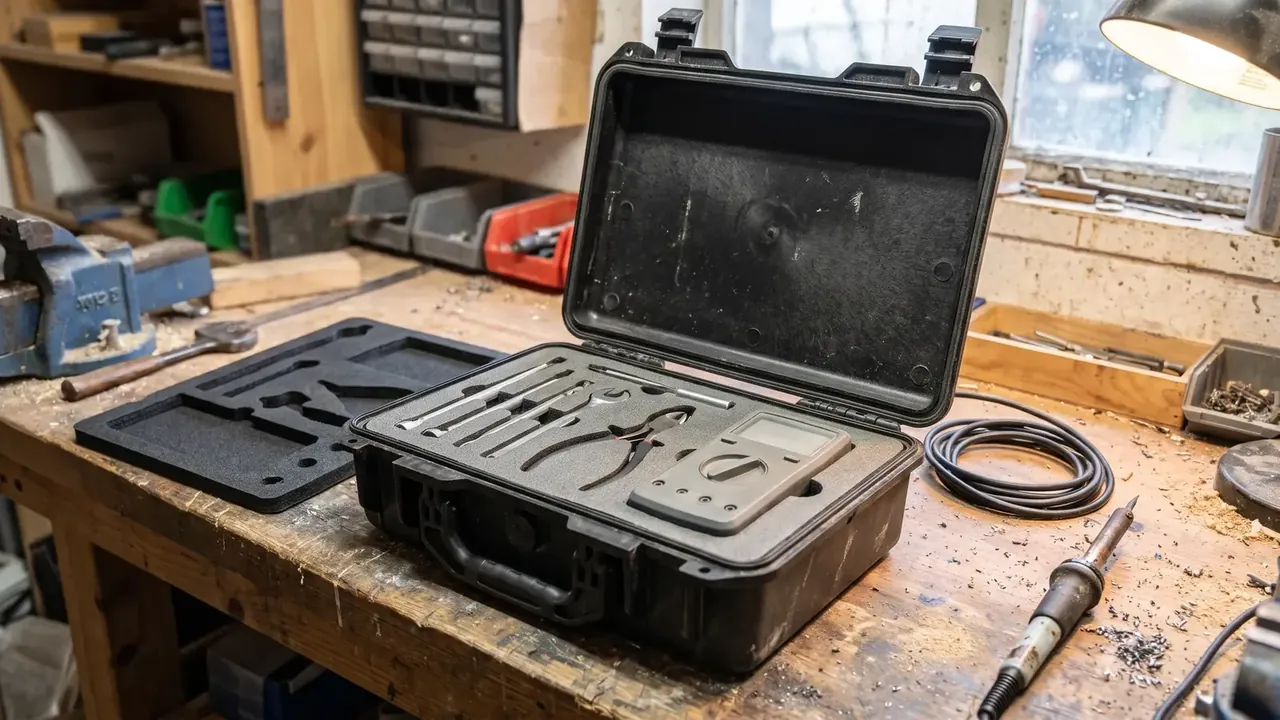
An eight-cavity tool is quoted near RMB 260,000, so ownership and transfer belong in the contract; a plastic protective case brand accepting only "tool retained by supplier" bills for it again later. Twelve wall readings should fall within 0.15 mm; beyond 0.3 mm corners take the load and the rim dishes in six months.
3. Resin Grade, Wall Thickness and the Paper Trail
The material column says PP and stops. Homopolymer and copolymer differ, and an impact modifier moves falling-dart results threefold. Ask for grade, melt index and a 15% regrind cap.
| Resin | Main wall | At low temperature | Typical positioning |
|---|---|---|---|
| PP copolymer | 3.4 mm | Dart passes at -20 °C | General transit |
| HDPE | 4.0 mm | Tough at -30 °C | Outdoor and cold regions |
| ABS | 3.0 mm | Brittle at -10 °C | Instrument panels |
| PP with 20% talc | 3.6 mm | Stiffer, less tough | Heavy stacking |
UV stabilisation is the line most often cut: outdoor storage needs 2.5% masterbatch, or the surface chalks after 18 months of sun. Static load is 40 kg on the lid for 24 hours with at most 1.2 mm of set.
4. Test Reports That Match the Part Number
The common trick is a report belonging to something else. IP67 means one metre of water for thirty minutes, and the part number on page one must match the order.
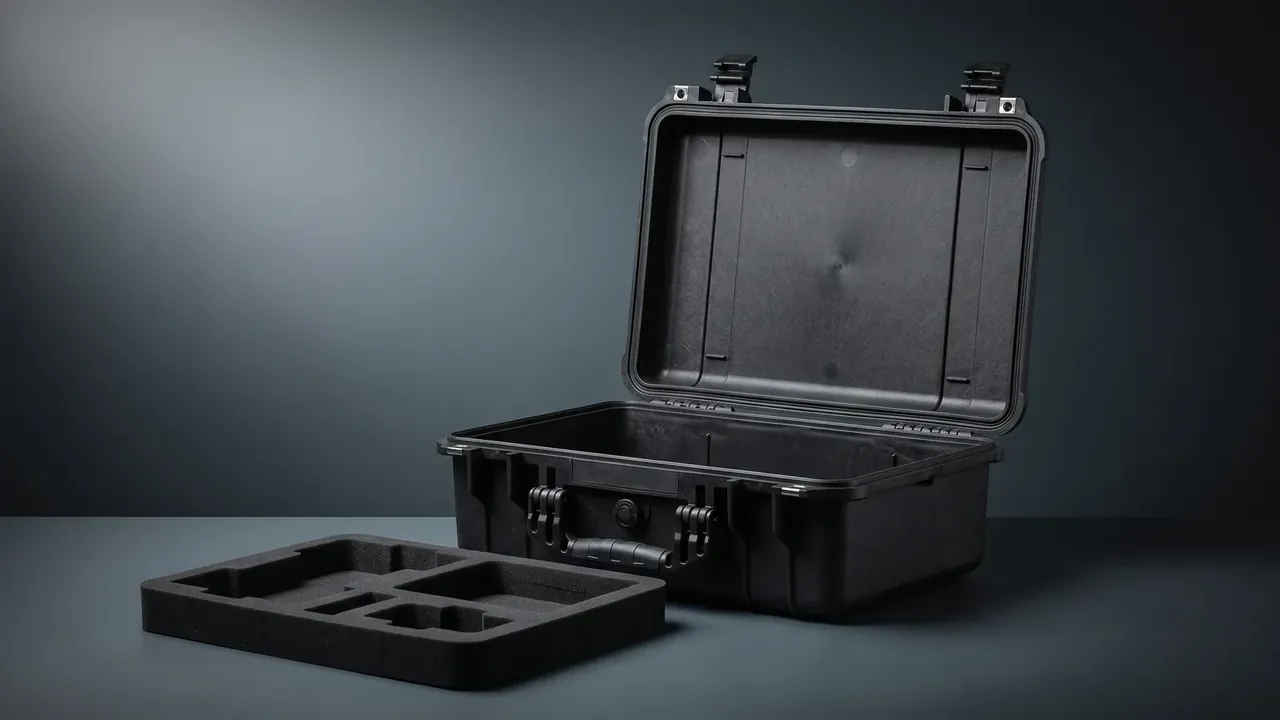
Drop testing runs from 1.2 m onto six faces at 80% of rated load, and no through-crack may appear. Salt spray runs 96 hours on pins and rivets with red rust under 5%; latches cycle 12,000 times.
Reports hold 12 months. Buyers can verify in house: immerse three cases 30 minutes, dry, weigh, fail anything gaining over 2 g.
5. Batch Consistency, Lead Time and Spares
Colour difference should stay within 0.8 inside a batch and 1.2 between batches; past 1.5 it shows. Cavity tolerance runs plus or minus 0.25 mm on length and width, 0.3 mm deep, 0.6 mm rim flatness, and belongs on the drawing.
A plastic protective case brand quote should name minimum order near 200 units, 22 days on a standard tool and 45 on a new one, spares at 2% of latches, and a 12-month warranty. Split the schedule into tool completion, first article, production, inspection and loading; one total number hides the risk.
Conclusion
Ask for clamp tonnage, mould ownership, resin grade, report part numbers, tolerances and delivery as documents before price. If two of the five cannot be produced as measured values, a low price is risk moved to the buyer. Keep the suppliers whose unit 5,000 still matches unit one, the only durable meaning of a plastic protective case brand.
This article discusses only the container (case body) side of specifications and design intent, and does not cover any handling, loading or use of the contents.
Related Reading
- How to read a case factory's qualification standards
- Choosing a PP plastic case
- What a supplier qualification audit covers
- Which parameters belong in an inquiry reply
Related Products
- 8 Series — Gun Cases; Military Equipment Cases; Camera Equipment Cases; Drone Cases; Watch Cases; Knife Cases; First Aid Cases; Electronics Equipment Cases
- WL8-2812 PP Gun Case — model WL8-2812
- All protective cases and toolboxes: 7 series, 158 models