

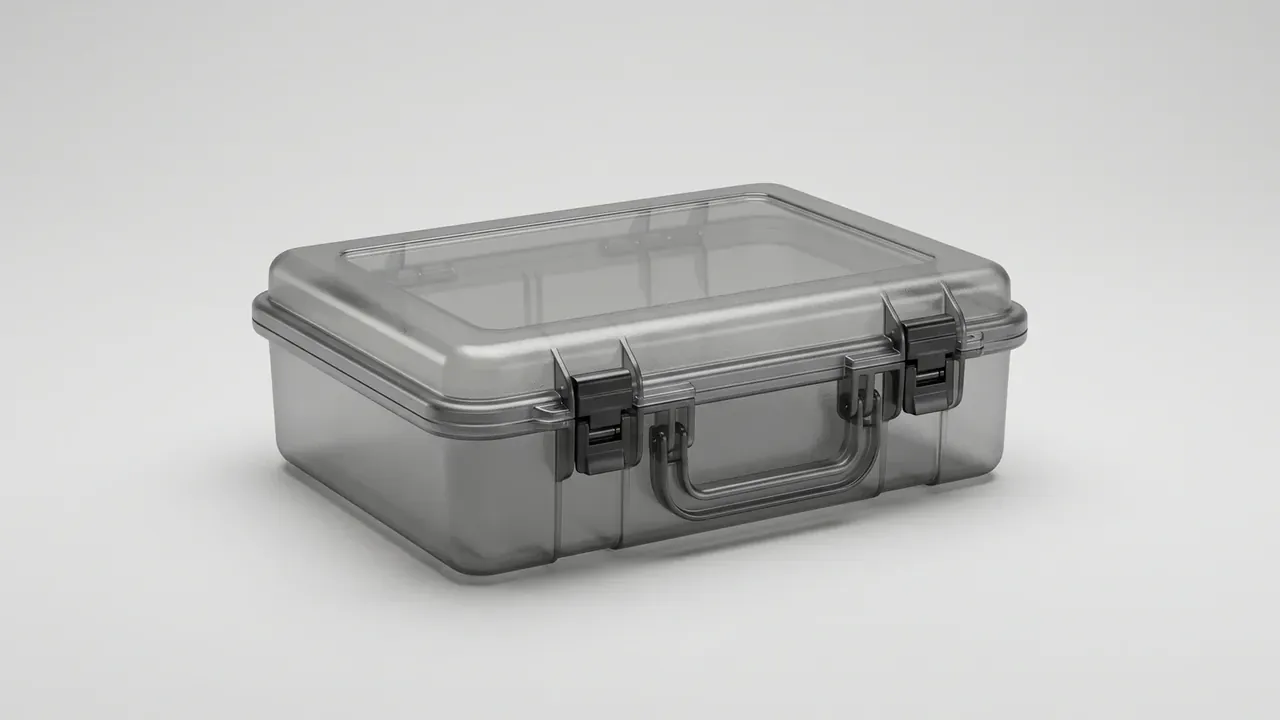
Quick answer: A waterproof tool box is accepted on five fronts — gasket, pressure and immersion, dimensions and wall, latch and hinge durability, temperature and drop. The limits are numbers: no water after 30 minutes at 1 m, no more than 0.5 kPa loss over 60 seconds at 20 kPa, AQL 1.0 on function and 2.5 on appearance.
Table of contents
- What Makes a Waterproof Tool Box Seal
- Immersion Testing and Where the Limit Sits
- Checking Case Dimensions and Wall Thickness
- Latch, Hinge and Handle Durability
- Temperature, Drop and Shipment Sampling
- FAQ
1. What Makes a Waterproof Tool Box Seal
A waterproof tool box does not seal because the latches pull hard. It seals because one continuous EPDM gasket in a groove is compressed 25 to 30 percent, closing the loop.
Groove and cord must match: a 4.2 mm groove takes a 4.0 mm cord, and 0.3 mm either way will block the lid or open the four corners. Corners are where seals fail, so a moulded joint belongs on a straight run.
| Item | Specification | Method | Limit |
|---|---|---|---|
| Gasket | EPDM, shore A 55±5 | Durometer, 5 points | ±5 at any point |
| Cord | 4.0 mm diameter | Profile projector | ±0.15 mm |
| Compression | 25–30% | Feeler gauge, lid closed | 0.05 mm blade must not enter |
2. Immersion Testing and Where the Limit Sits
Production is screened by pressure, not water. Charge the case to 20 kPa, hold 60 seconds and pass anything losing 0.5 kPa or less, equal to the outside load at 2 m of depth, stricter than a 1 m dip.
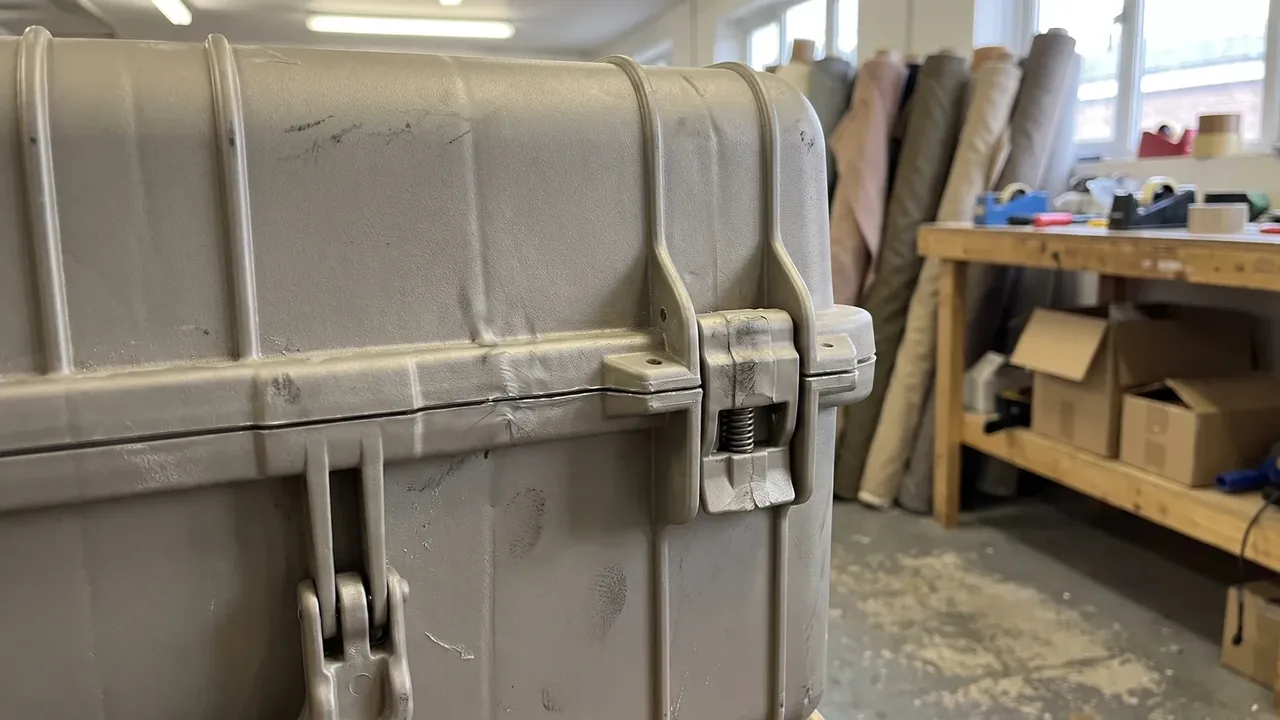
Type testing still uses water: immerse to 1 m for 30 minutes, dry the outside, then open it. No water marks inside, and no colour change on the indicator paper. A waterproof tool box built to IPX8 runs 3 m for 60 minutes, a condition that belongs in the contract.
Sampling is 50 from a 500 lot, AQL 1.0 on function and 2.5 on appearance; a pressure station takes about 25 seconds a case.
3. Checking Case Dimensions and Wall Thickness
Internal length, width and height are judged at plus or minus 1.5 mm, diagonals within 2 mm, at five fixed points named in the inspection instruction.
Wall thickness is read ultrasonically at 3.0 mm nominal and never below 2.7 mm. The thin zones are the base corner and the handle root, where mouldings run 0.2 to 0.3 mm under nominal and need their own entries on the sampling sheet.
Below 2.7 mm, a case loaded to 25 kg deflects over 2 mm at the base after 24 hours, and the lower lid bulges when two units stack. Diagonal error hits the seal directly, since 3 mm leaves one side of the gasket barely touched.
4. Latch, Hinge and Handle Durability
Latch opening force sits between 90 and 150 N: under 90 N a latch pops open in transit vibration, over 150 N a gloved hand cannot work it. Measure four latches on ten cases per lot and record both extremes.
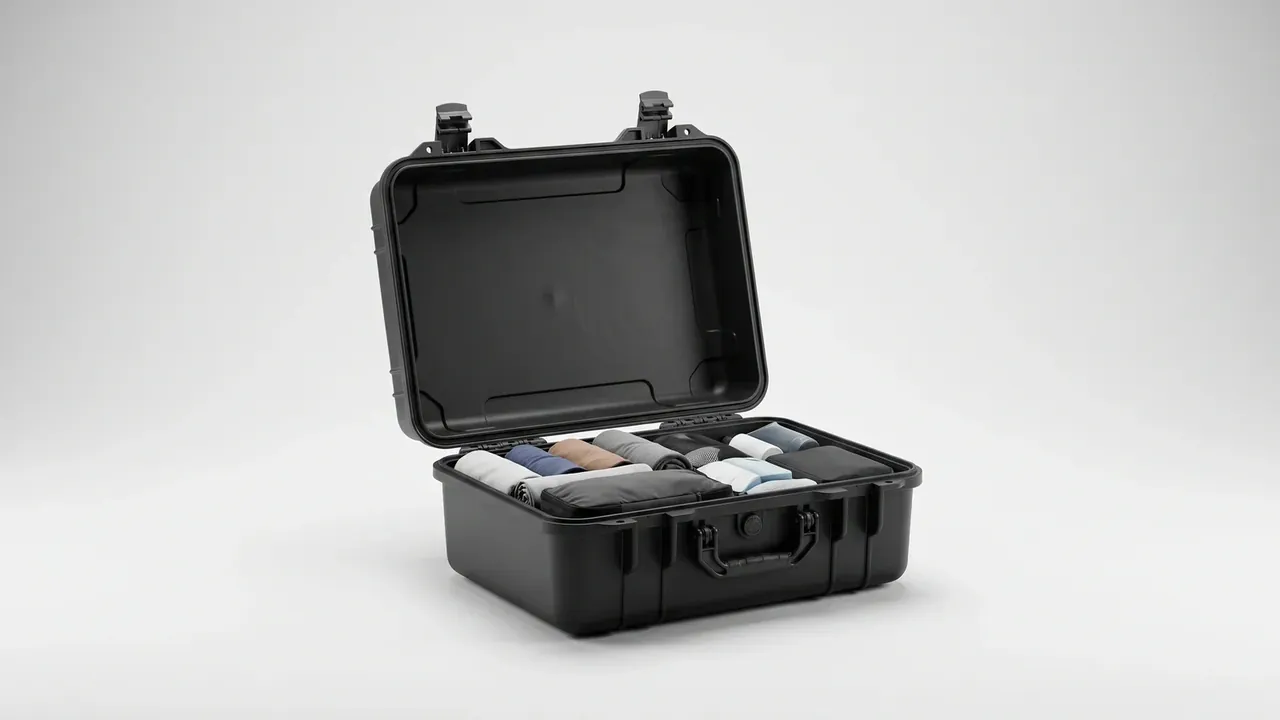
Hinges run 8,000 cycles at 20 per minute, after which shaft play stays under 0.4 mm. Handles take 30 kg for one hour and recover within 1 mm.
Run force, durability and force again on the same samples; a drop above 15 percent on the retest fails the batch.
5. Temperature, Drop and Shipment Sampling
Thermal cycling runs minus 25 to 65 degrees Celsius, five cycles of four hours, then a two-hour settle before the pressure test repeats. Cold stiffens the gasket and exposes compound problems.
Drops run 1.2 m across six faces, three edges and one corner, ten drops at rated load, then the pressure test again; salt spray covers hardware only at 96 hours neutral, grade 9.
| Defect class | Examples | Limit | Action |
|---|---|---|---|
| Critical | Water ingress, pressure loss | Zero accepted | Reject the lot |
| Major | Wall under 2.7 mm, latch force off | AQL 1.0 | Screen and rework |
| Minor | Scratches, colour shift, flash | AQL 2.5 | Accept with concession |
Shipment checks on a waterproof tool box include three-high stacking for 72 hours and interleaving paper between cases; skip it and a long haul scuffs every face.
Conclusion
Acceptance is not about how good one sample looks but how tightly the limits are written. Gasket, pressure drop, minimum wall, latch force, drop and thermal cycling — five items as numbers give both sides one yardstick. Attach the sheet to the contract and most disputes over a waterproof tool box end there.
This article discusses only the container (case body) side of specifications and design intent, and does not cover any handling, loading or use of the contents.
Related Reading
- Setting the protection rating of a hard waterproof case
- Sampling and judgement in military supply case inspection
- Quality control points on the case assembly line
- Selection points for PP plastic cases
Related Products
- 8 Series — Gun Cases; Military Equipment Cases; Camera Equipment Cases; Drone Cases; Watch Cases; Knife Cases; First Aid Cases; Electronics Equipment Cases
- WL8-2812 PP Gun Case — model WL8-2812
- All protective cases and toolboxes: 7 series, 158 models