

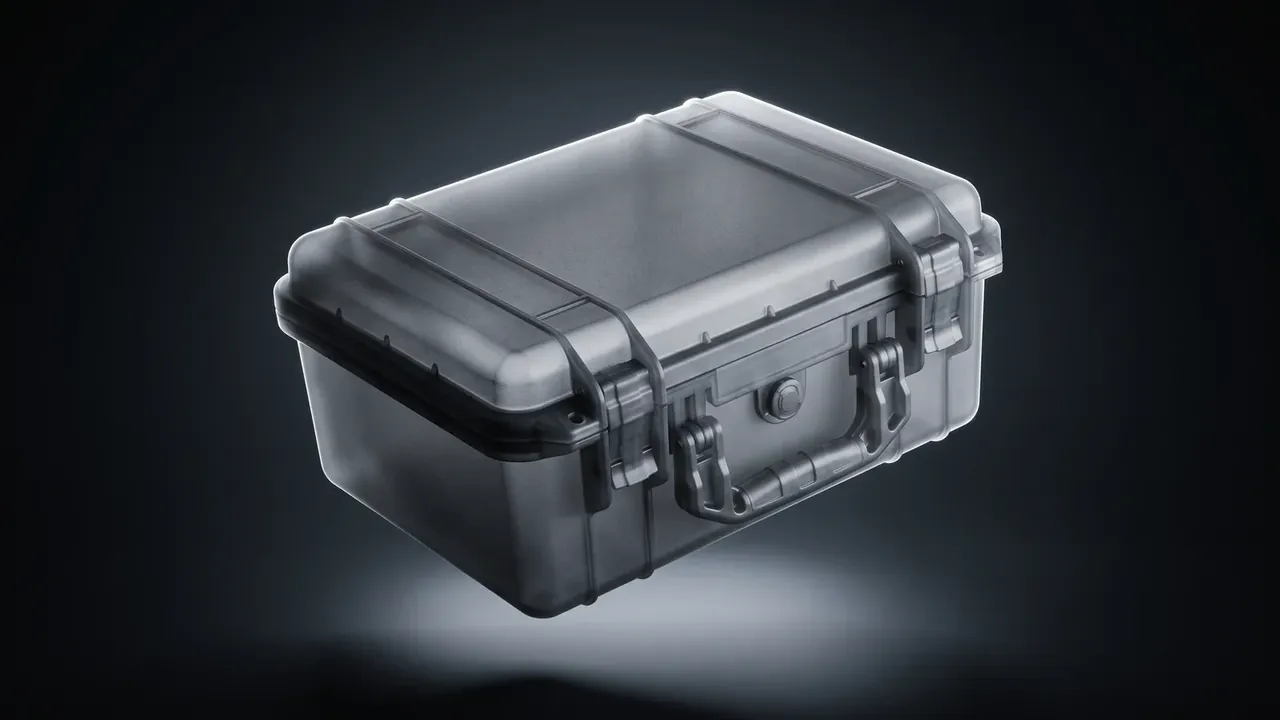
Quick answer: Acceptance runs in two passes. Unit by unit you check the lid seam with a feeler gauge, latch pull, wall thickness, cavity size and marking; per batch you check vacuum hold, spray and one drop. Put the thresholds on the receiving form: two inspectors must read it alike.
Table of contents
- Where waterproof equipment box acceptance starts
- Five hard checks on every unit
- Measuring size and wall thickness
- Sealing and vacuum on the line
- Shipping documents and batch verdicts
- FAQ
1. Where waterproof equipment box acceptance starts
Acceptance of a waterproof equipment box has two layers. Unit inspection reads appearance, lid seam, latches, handle and marking on every piece. Batch sampling reads vacuum hold, spray and one drop, proving this run has not drifted. Passing one says nothing about the other.
Items come from the drawing, the golden sample and the last batch record; when they disagree the sample wins. On a 520 × 290 × 190 mm box the drawing allowed ±3 mm and the sample sat within ±1 mm, so the form was set at ±2 mm, tight enough to catch mould wear.
| Item | Method | Threshold |
|---|---|---|
| Lid seam | 0.15 mm feeler gauge | Gauge does not enter |
| Latch pull | Pull gauge | 60 to 120 N |
| Sealing | Vacuum, 3 per batch | Leak down 1 kPa or less |
2. Five hard checks on every unit
The seam comes first. Close a waterproof equipment box and run a 0.15 mm feeler gauge round the flange; wherever it slips in, the gasket is unloaded and water enters there first.
Latch force is read with a pull gauge, three pulls, median recorded: under 60 N the lid opens itself on a vibration table, over 120 N a gloved hand cannot work it. A 4 mm hinge pin in a 4.05 mm bore leaves 0.3 mm of play. The handle takes 750 N for ten minutes, three times the 25 kg payload.
3. Measuring size and wall thickness
Points are fixed. On a waterproof equipment box, cavity length and width are taken 10 mm below the opening at front, middle and rear; the spread is the taper, and past 1.5 mm the liner sits tight on one side. Depth is read at four corners, smallest value rules.
| Item | Instrument | Threshold |
|---|---|---|
| Cavity length | Tape, 1 mm scale | Range 1.5 mm or less |
| Wall | Ultrasonic gauge | Thinnest 2.8 mm or more |
| Lid flatness | Plate and feeler | 1.5 mm per 300 mm |
Wall thickness is read at six points: nominal 3.0 to 4.5 mm, thinnest no less than 2.8 mm, where the melt arrives last and a drop crack starts. Lid flatness past 1.5 mm over 300 mm lets the gasket middle lift, so vacuum dishes the lid instead of holding it down.
4. Sealing and vacuum on the line
Vacuum is the most reliable shop verdict. Draw 20 kPa through the valve, shut it and wait 60 seconds: a leak down of 1 kPa or less passes, and a fast drop names the side against the feeler result.
Without a rig, spray 4 litres per minute from 300 mm for three minutes and check for wet indicator paper; that screens only. Compression is read from the imprint after 24 hours closed: 25 to 35 percent passes, and foamed silicone aged 168 hours at 70 °C must stay under 25 percent set.
5. Shipping documents and batch verdicts
Each batch of waterproof equipment box carries batch and cavity number, sampled units, raw vacuum data and the inspector's date. Cavity number is most often dropped, yet two cavities of one mould differ by 0.4 mm of wall.
The verdict doubles the sample. Three units to vacuum, all passing release; one failure doubles it to six, and six passes still release with first-round data filed; any later failure rejects the batch. Drop one unit 1.2 m onto concrete, and confirm model, batch, rating and month before release.
| Situation | Action | Record |
|---|---|---|
| Three units pass | Release | Raw data filed |
| One unit fails | Sample six more | First round kept |
| Failure after doubling | Reject batch | Non-conformance report |
Conclusion
A standard is worth only the instruments behind it: a gauge, fixed points and a threshold two inspectors read alike. Unit inspection holds appearance and assembly, batch sampling holds sealing and structure. Write the thresholds on the form, and incoming inspection of a waterproof equipment box stops depending on one person's hand.
This article discusses only the container (case body) side of specifications and design intent, and does not cover any handling, loading or use of the contents.
Related Reading
- Waterproof hard case ratings and test conditions
- Equipment case applications
- How an equipment protection case is built
- Quality control points in case assembly
Related Products
- 8 Series — Gun Cases; Military Equipment Cases; Camera Equipment Cases; Drone Cases; Watch Cases; Knife Cases; First Aid Cases; Electronics Equipment Cases
- WL8-2812 PP Gun Case — model WL8-2812
- All protective cases and toolboxes: 7 series, 158 models