

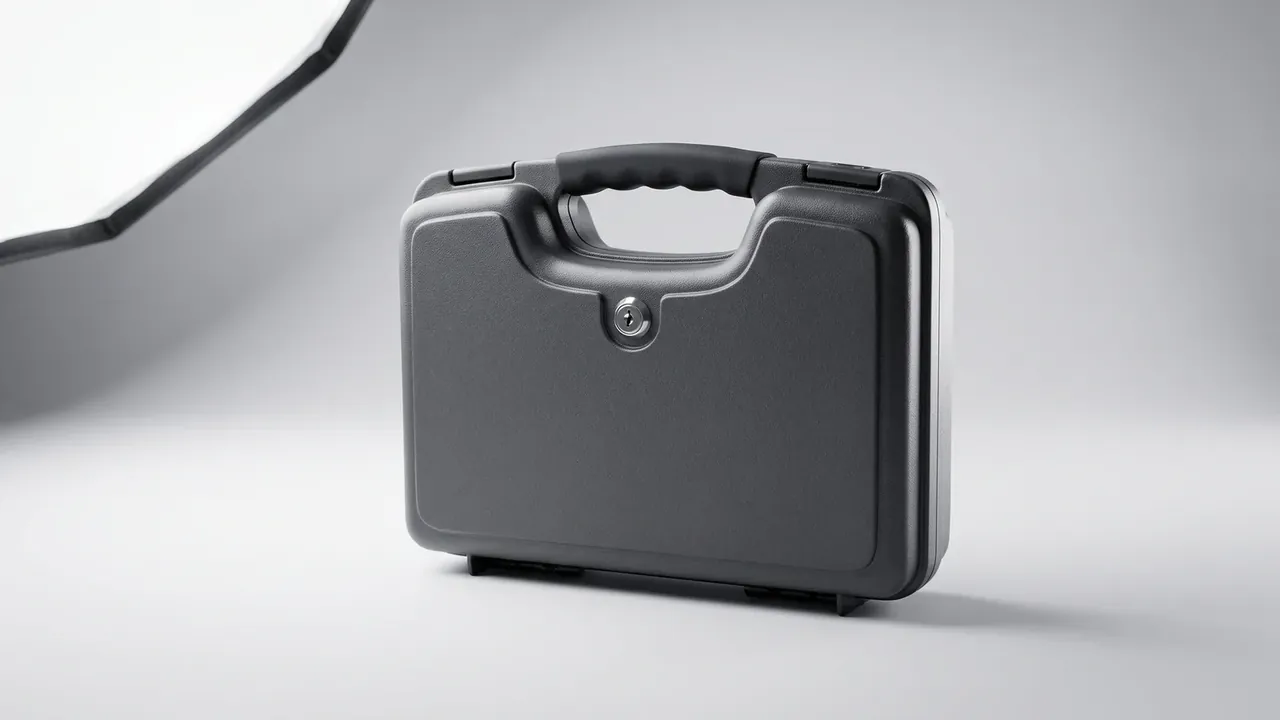
Quick answer: A Waterproof medical case is accepted on four groups: ingress rating, cleaning tolerance, thermal range and load life. Sealing passes at 15 kPa held 30 seconds with a drop under 1 kPa; immersion at 1 metre for 30 minutes with under 1 g of paper gain; the shell survives 500 wipes and a 25 kg handle load.
Table of contents
- Why Acceptance Starts With the Use Scenario
- Sealing Class and the Pressure Test
- Cleanability and Disinfectant Resistance
- Thermal Cycling and Cold Hold
- Handle Load Latch Life and Traceability
- FAQ
1. Why Acceptance Starts With the Use Scenario
No single checklist covers a Waterproof medical case: shoulder carry, a vehicle bracket, ward transfer and an outdoor station push the shell onto different failure points.
Class A is outright failure: a shifted sealing face, a cracked boss, walls under 2.2 mm, any through hole.
| Scenario | Weighted item | Pass line |
|---|---|---|
| Shoulder carry | handle load, 1 m drop, six faces | 25 kg, 10 min, set under 1 mm |
| Vehicle bracket | 2 h vibration, top stacking | fasteners tight at 40 kg |
| Ward transfer | wipe cycles, cleanable cavity | 500 cycles, corners R3+ |
2. Sealing Class and the Pressure Test
IP67 means 1 metre for 30 minutes; IP68 means nothing unless depth and duration are both written in. On a Waterproof medical case the seal is a gasket in a lid groove at 25 to 35 percent compression.
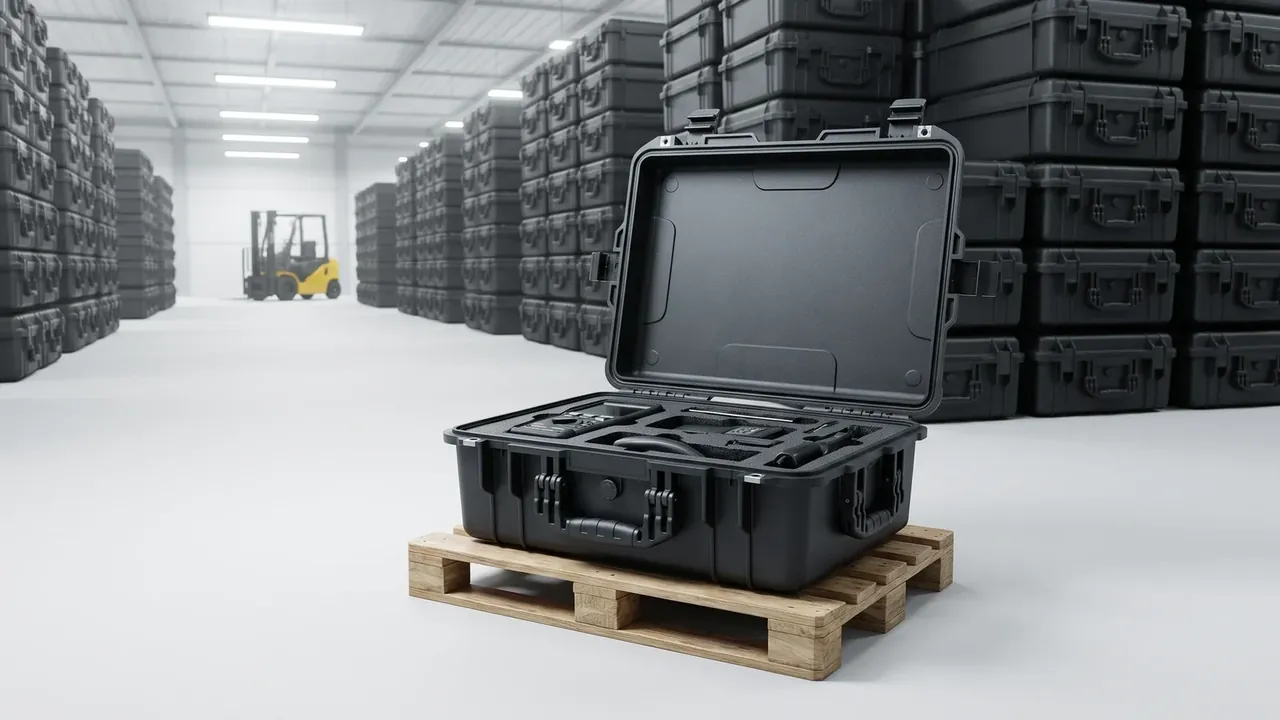
Pressure testing fixes conditions: plug the vent, charge to 15 kPa, hold 30 seconds, accept a 1 kPa drop, about 6 ml per minute. Over that, check gasket flash, then latch preload, then lid flatness.
Immersion puts weighed paper inside a Waterproof medical case, holds 1 metre for 30 minutes and accepts under 1 g. A thermal differential helps: warm the cavity to 40 °C then 5 °C, and the collapsing gasket shows the leaking side.
3. Cleanability and Disinfectant Resistance
Medical use is harder on surfaces. No crevice may be narrower than 3 mm, radii stay at R3 or above, and the gasket comes out in one piece. Roughness is capped at Ra 1.6 µm, since a coarser moulding pushes residue into micro-pores. Liners take 20 washes at 60 °C within 2 percent.
Disinfectant resistance is unique to a Waterproof medical case. Isopropanol at 70 percent and chlorine at 5,000 mg/L each get 500 wipes; the surface must not lift, craze or shift beyond ΔE 1.0.
| Medium | Concentration | Wipes | Pass line |
|---|---|---|---|
| Isopropanol | 70% | 500 | no lift, ΔE ≤1.0 |
| Chlorine | 5,000 mg/L | 500 | no craze, no colour shift |
| Neutral detergent | 1% | 200 | no residue, no whitening |
4. Thermal Cycling and Cold Hold
Thermal cycling mirrors transport: −20 °C to 55 °C, ten cycles of four hours with a 30 minute transfer. Passing means no crack, no permanent gasket set, opening force between 40 and 120 N. Cold embrittles the compound, so the latch boss root cracks first.
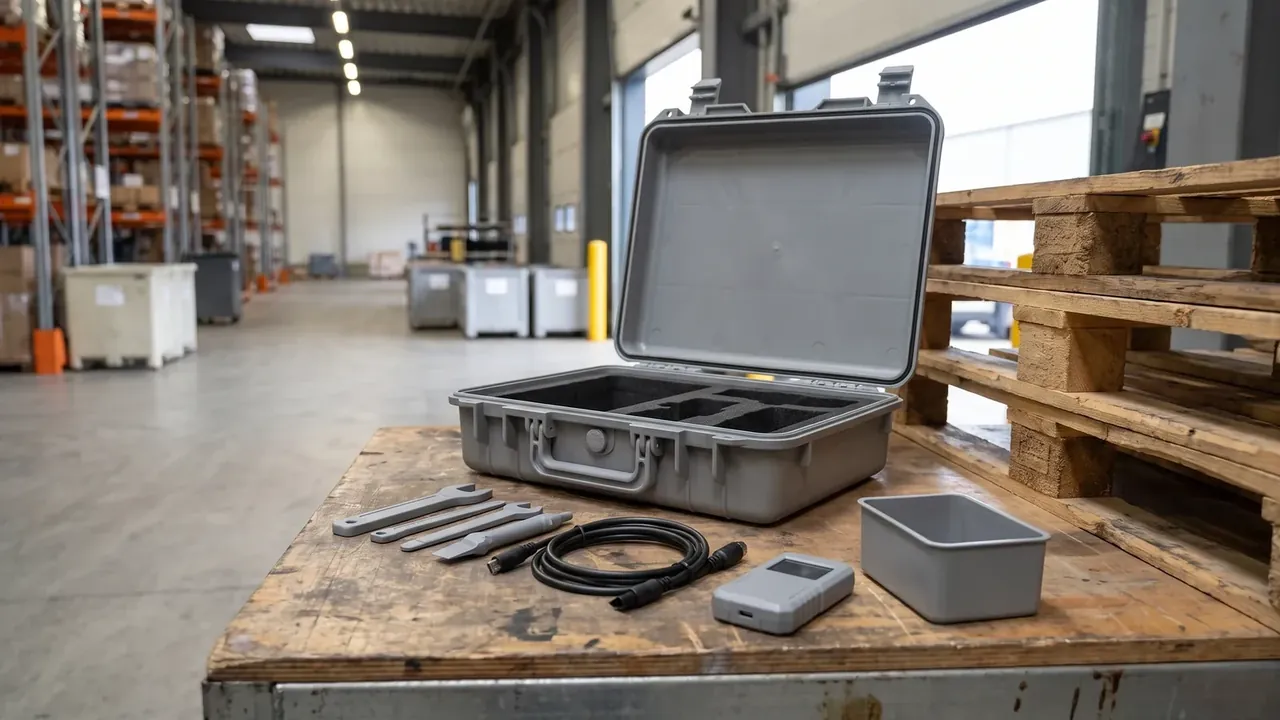
Cold hold is the second line. A 45 litre shell with four 500 g packs holds 2 to 8 °C for eight hours at 35 °C ambient, empty weight 4.2 kg. The lid needs a logger pocket no deeper than 12 mm, else the thinned wall moves a drop crack to its edge.
5. Handle Load Latch Life and Traceability
Statically, 25 kg hangs for 10 minutes and the set stays under 1 mm. Dynamically, a loaded case drops once on each of six faces from 1 metre without a latch springing.
Latches are accepted over 5,000 cycles with preload logged every 500, a fall beyond 20 percent read as short life. Hinge pins are stainless, no red rust after 48 hours of salt spray.
Traceability needs a moulded eight-digit lot code: four for year and month, four for press and shift, plus material grade. Fifty ethanol wipes must not remove it; paper labels never count.
| Class | Typical items | Sampling | Verdict |
|---|---|---|---|
| A | missing seal, cracked boss, walls under 2.2 mm | full inspection | zero tolerance |
| B | cavity oversize, uneven gasket set, loose rivets | AQL 1.0 | Ac 1 Re 2 |
| C | scratches, flow marks, flash | AQL 2.5 | Ac 3 Re 4 |
Conclusion
A Waterproof medical case standard turns field failure into bench numbers: three defect classes, a pressure drop, a paper gain, a wipe count and a cycle count. Tiering tells the inspector what cannot ship, the numbers end arguments between buyer and moulder, and pressure, gain and residual set are settled before any Waterproof medical case leaves the line.
This article discusses only the container (case body) side of specifications and design intent, and does not cover any handling, loading or use of the contents.
Related Reading
- Reading ingress ratings on hard cases
- How a medical case is laid out inside
- Specification limits for first aid cases
- Medical cases in pre-hospital use
Related Products
- 8 Series — Gun Cases; Military Equipment Cases; Camera Equipment Cases; Drone Cases; Watch Cases; Knife Cases; First Aid Cases; Electronics Equipment Cases
- WL8-2812 PP Gun Case — model WL8-2812
- All protective cases and toolboxes: 7 series, 158 models