

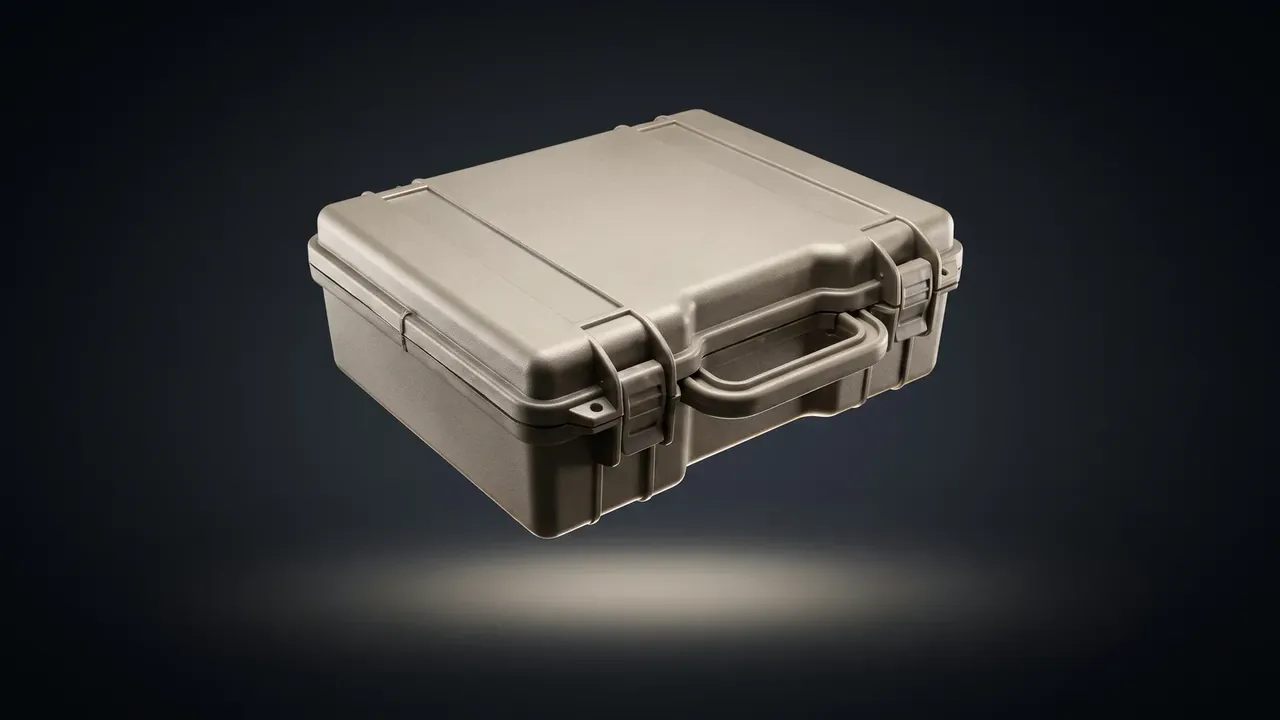
Quick answer: A plastic case with foam can be screened on site in six minutes: listen for the lid seating, pull a 60 mm paper strip around the rim, drop the loaded case from 30 cm three times.
Table of contents
- Three field checks for a plastic case with foam
- Read the imprint, not the foam thickness
- Latches and gasket lip leave one line
- A kitchen scale removes half the samples
- Three lines to put in the request
- FAQ
1. Three field checks for a plastic case with foam
Most of what separates a good plastic case with foam from a poor one shows before the lid opens.
Check one is the lid. A seated lid lands in one stroke, short and dull. A second click means a warped rim or a lip that never loaded, and softer foam will not close that gap.
Check two is the paper strip. Lay a 60 mm wide strip around the rim, latch the lid, pull it out section by section. Even resistance passes; a section that slides free is a leak path.
Check three is the drop. Lift by the handle until the base sits 30 cm up and release, three times. A dull impact means the foam works; a sharp report means a board that never compresses.
| Check | What to watch | Pass | Fail |
|---|---|---|---|
| Lid | Seating sound | One stroke, short and dull | Second click, rim rocks |
| Paper strip | Drag around the rim | Even over the full 60 mm | One section slides free |
| Drop | 30 cm free fall | Dull, no bounce | Sharp report, rebounds |
2. Read the imprint, not the foam thickness
Thickness is the easiest number to print and the worst one to read alone. Forty millimetres of foam with no matching lip above it will push sideways under load, and the depth becomes zero when it matters.

An imprint test needs one sheet of carbon paper. Cut it to the inner rim, lay it on the foam, latch the lid, wait 24 hours, then read the marks. A continuous ring means foam and lid really press on each other; scattered dots mean contact at points only.
| Item | How to measure | Passing reading |
|---|---|---|
| Gap at the foam face | Feeler gauge, foam to wall | No more than 3 mm |
| Compression on closing | Caliper before and after latching | 20% to 30% reduction |
| Imprint continuity | Carbon paper, 24 hours | One ring, at most one break |
A gap wider than 3 mm means the lip does nothing. A plastic case with foam commonly pairs a 4.5 mm wall with an 8 mm lip, which holds a 20% to 30% compression; a 3 mm lip leaves the load sliding.
3. Latches and gasket lip leave one line
Latches are the most miscounted parts on a plastic case with foam. Counting proves nothing; the mark they leave does.
- Retention: pull along the opening direction, and the latch should hold 180 N.
- Pairing: every latch needs gasket lip beneath it, 1.5 times its width.
- Base: a moulded-in base stays tough in cold; a riveted one works its holes loose at minus 20 degrees Celsius.
- Hinge side: no gap, or the lid shifts one millimetre when carried one-handed.
After latching, the lid edge should carry a shallow continuous line no wider than 2 mm. Broken means the lip never reached the foam.
4. A kitchen scale removes half the samples
Empty weight is the number almost nobody checks. Two cases in the same footprint can weigh 6.8 kg and 5.1 kg. That 1.7 kg sits in wall thickness and ribbing. Weigh the lid too: below 22% of the total the panel is thin and bows under the lip. Stack two loaded samples for 72 hours and measure the lower lid; a sag beyond 4 mm drops the quoted count by one layer. On a plastic case with foam the weak point is nearly always the lid, not the base.
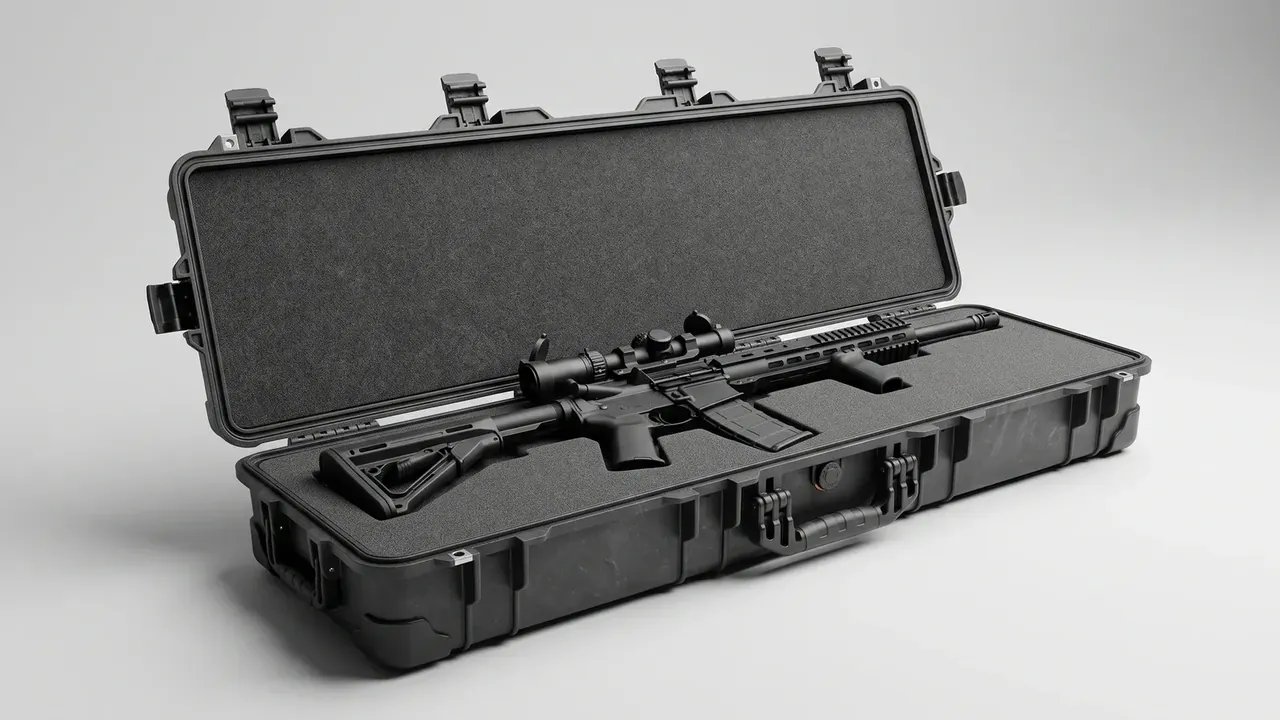
| External size | Empty weight | Lid share | Stacked when loaded |
|---|---|---|---|
| 400 x 300 x 180 mm | 3.2 kg | 24% | 4 high |
| 520 x 380 x 220 mm | 4.9 kg | 23% | 3 high |
| 600 x 400 x 230 mm | 6.8 kg | 22% | 3 high |
5. Three lines to put in the request
A criterion that lives in memory is not a criterion. Three lines on the quotation request separate the replies within a day.
- Size and mass: 600 x 400 x 230 mm, empty weight under 7.0 kg, lid at 22% or above.
- Foam and lip: gap under 3 mm, compression 20% to 30%, lip width 8 mm.
- Verification: even strip drag, three drops from 30 cm, 96 hours of salt spray without red rust.
Salt spray is the line most often softened; 96 hours is the floor for latches, hinges and valve alike. The price spread on a plastic case with foam hides in execution: a lip trimmed from 8 mm to 5 mm saves a few yuan and shows up half a year later.
Conclusion
Three checks screen, four numbers confirm, three lines hold the supplier to them. Take these criteria to the next review, and a plastic case with foam stops being judged by feel.
This article discusses only the container (case body) side of specifications and design intent, and does not cover any handling, loading or use of the contents.
Related Reading
- Tray and latch layout inside a gun case
- How to walk a case showroom and what to ask
- Cavity layout and gimbal clearance in drone cases
- Stacking and transport markings on military boxes
Related Products
- 8 Series — Gun Cases; Military Equipment Cases; Camera Equipment Cases; Drone Cases; Watch Cases; Knife Cases; First Aid Cases; Electronics Equipment Cases
- WL8-2812 PP Gun Case — model WL8-2812
- All protective cases and toolboxes: 7 series, 158 models