

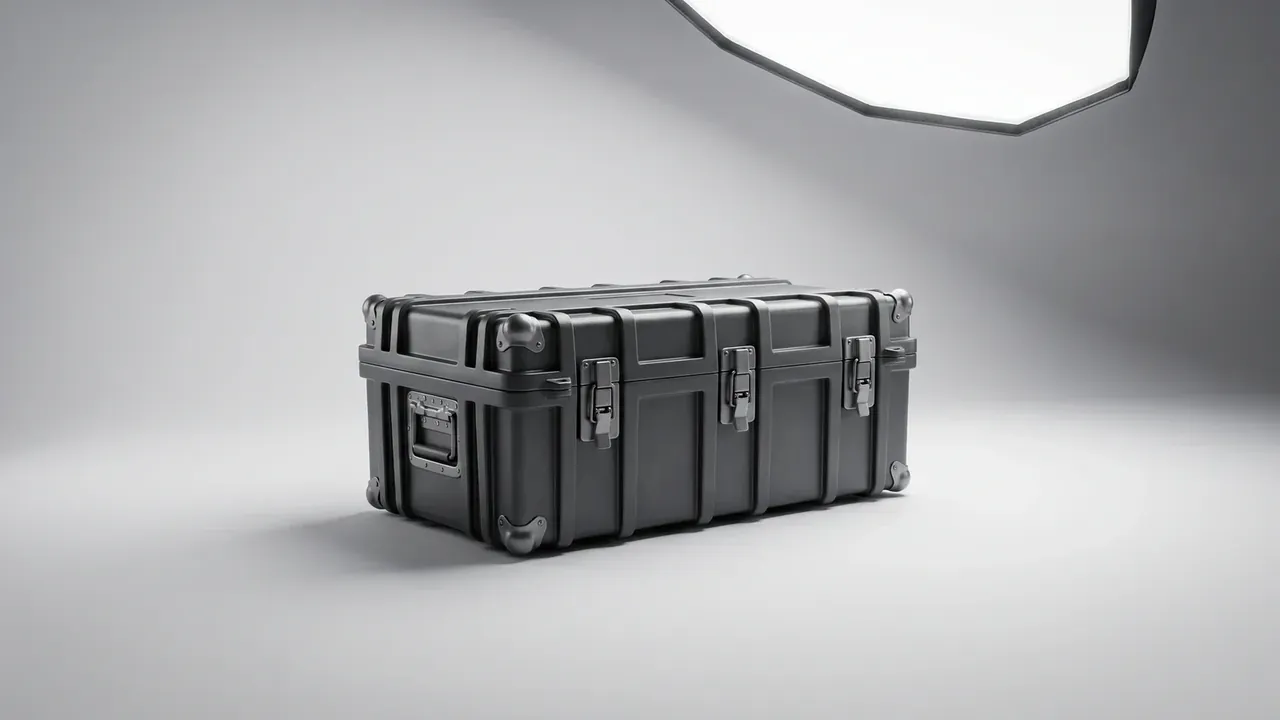
Quick answer: Five case families compared by moulding method, wall thickness, outer size and load, plus the cues in plastic case pictures that turn one photo into a specification.
Table of contents
- Reading the Five Case Types in Plastic Case Pictures
- Telling Molding Methods from Structural Cues
- Five Views and What Every Drawing Must Call Out
- Four Misreads Buyers Make from Photos
- A Selection Index by Total Weight and Shipping Mode
- FAQ
1. Reading the Five Case Types in Plastic Case Pictures
Two black cases look alike at thumbnail size yet differ threefold in wall thickness and twofold in price. Shape is the residue of a process.
| Type | Moulding | Wall | Outer size | Empty weight | Load |
|---|---|---|---|---|---|
| Hard injection case | Two-piece | 3.0–5.0 mm | 500×350×220 mm | 3.2–5.0 kg | 60–90 kg |
| Rotomoulded case | Single shell | 6.0–12 mm | 620×450×320 mm | 8–14 kg | 120–200 kg |
| Trolley case | Injection, metal handle | 2.2–3.2 mm | 560×400×250 mm | 4.5–7.0 kg | 35–50 kg |
| Stacking tote | Injection, ribbed base | 2.5–4.0 mm | 600×400×280 mm | 2.6–4.2 kg | 300 kg static |
| Wheeled body | Injection plus castors | 3.5–6.0 mm | 700×480×360 mm | 9–16 kg | 80–120 kg |
Injection tooling runs RMB 120,000 to 300,000 on a 1,200-tonne press; rotomoulding costs RMB 30,000 to 80,000 and reaches 12 mm walls.
2. Telling Molding Methods from Structural Cues
Raking light shows the parting line, the lid step shows flange width, latch spacing shows the load path. Those cues in plastic case pictures settle process without opening the box.
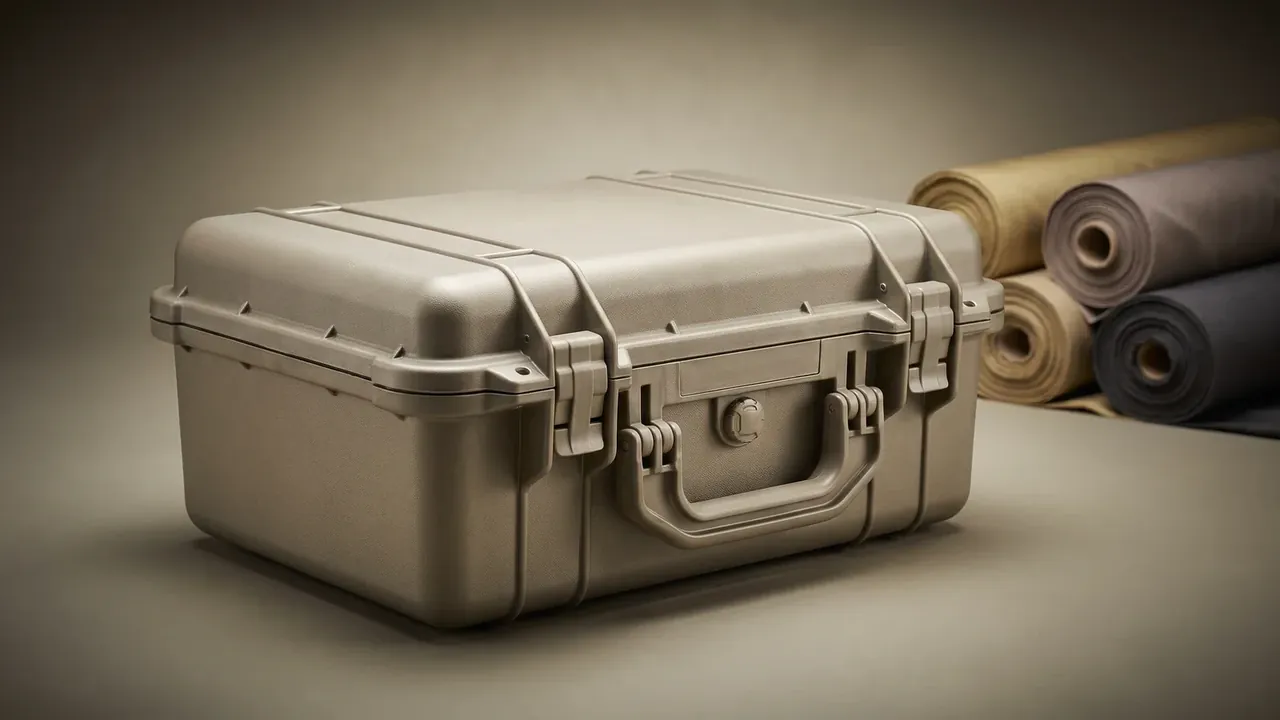
Rotomoulded shells show no parting line, only a gate witness; injection cases carry a mid-height seam and bolt-on bumpers. Flange width scales from a photo: 8 to 12 mm injection, 14 to 20 mm rotomoulded.
| Cue | Injection | Rotomoulded |
|---|---|---|
| Parting line | Seam at mid-height | Gate witness only |
| Flange width | 8–12 mm | 14–20 mm |
| Latches | 2–4 near the ends | 3–5 with a centre unit |
| Seal groove | Insert lip | Moulded double lip |
| Pressure valve | Rare, drilled later | M12 threaded, common |
| Hinge pin | 3–4 mm metal | 6–8 mm stainless |
3. Five Views and What Every Drawing Must Call Out
One frame in a set of plastic case pictures is useless for assembly planning. Handle retraction and castor overhang decide whether a case fits a rack or a van.
| View | Must state | Often omitted |
|---|---|---|
| Front | Length and height | Handle retraction 25–40 mm |
| Side | Depth and lid height | Castor overhang 60–80 mm |
| Top | Internal length and width | Corner radius 8–15 mm |
| Bottom | Foot spacing, stack lip | Landing pad 3–5 mm |
| Isometric | No dimensions | Latch and valve positions |
Retraction protrudes even when stowed. Castor overhang runs 60 to 80 mm, so two cases need 150 mm extra.
4. Four Misreads Buyers Make from Photos
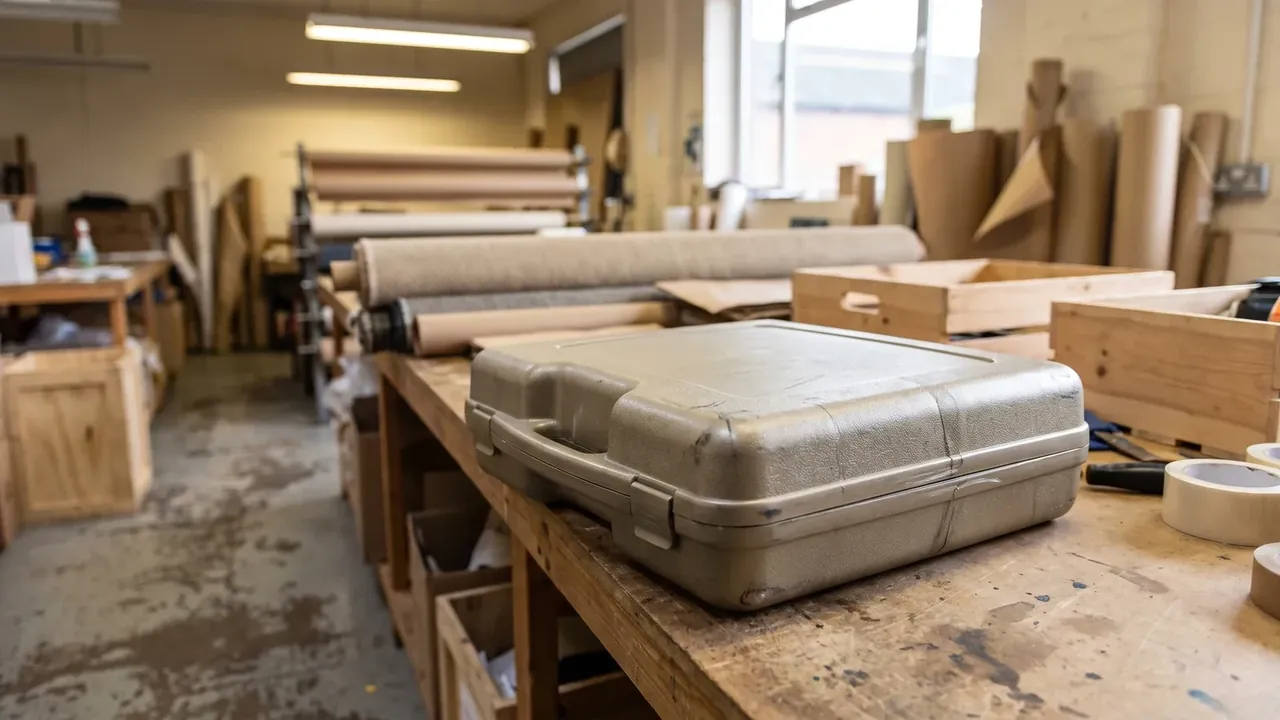
Renders passed off as photography, unmarked scale, accessories left out of net weight and internal sizes quoted as external cause most disputes over plastic case pictures.
| Misread | Real gap | Check |
|---|---|---|
| Render read as photo | 0.3 mm sink marks, flash | Unretouched raking-light file |
| Disguised scale | Looks 20 percent larger | Three views with scale bar |
| Accessories excluded | Wheels and foam add 1.5–3 kg | Weigh the complete case |
| Internal read as external | Two walls plus ribs | Ask which dimension |
Drop height is often just a claim. Checkable wording names 1.2 to 1.8 m, six faces, three edges and one corner at rated load.
5. A Selection Index by Total Weight and Shipping Mode
Packed weight is the fastest entry point in plastic case pictures: it settles type, wall thickness and handling.
Under 15 kg a hand-carried injection case with 3.0 mm walls is enough. Between 15 and 40 kg use a trolley case, handle tube at least 1.2 mm, wheels 75 mm or more. Above 40 kg add forklift pockets and 100 mm clearance under the base.
Conclusion
Line the five families up by process, wall thickness, size and load, and one frame becomes a checklist. Watch four things: parting line, flange width, latch spacing, handle retraction. Read the next set of plastic case pictures with that filter.
This article discusses only the container (case body) side of specifications and design intent, and does not cover any handling, loading or use of the contents.
Related Reading
- How rotational moulding builds a case
- Injection moulded protective case selection
- Wheeled protective case selection
- Protective case size ranges
Related Products
- 8 Series — Gun Cases; Military Equipment Cases; Camera Equipment Cases; Drone Cases; Watch Cases; Knife Cases; First Aid Cases; Electronics Equipment Cases
- WL8-2812 PP Gun Case — model WL8-2812
- All protective cases and toolboxes: 7 series, 158 models