

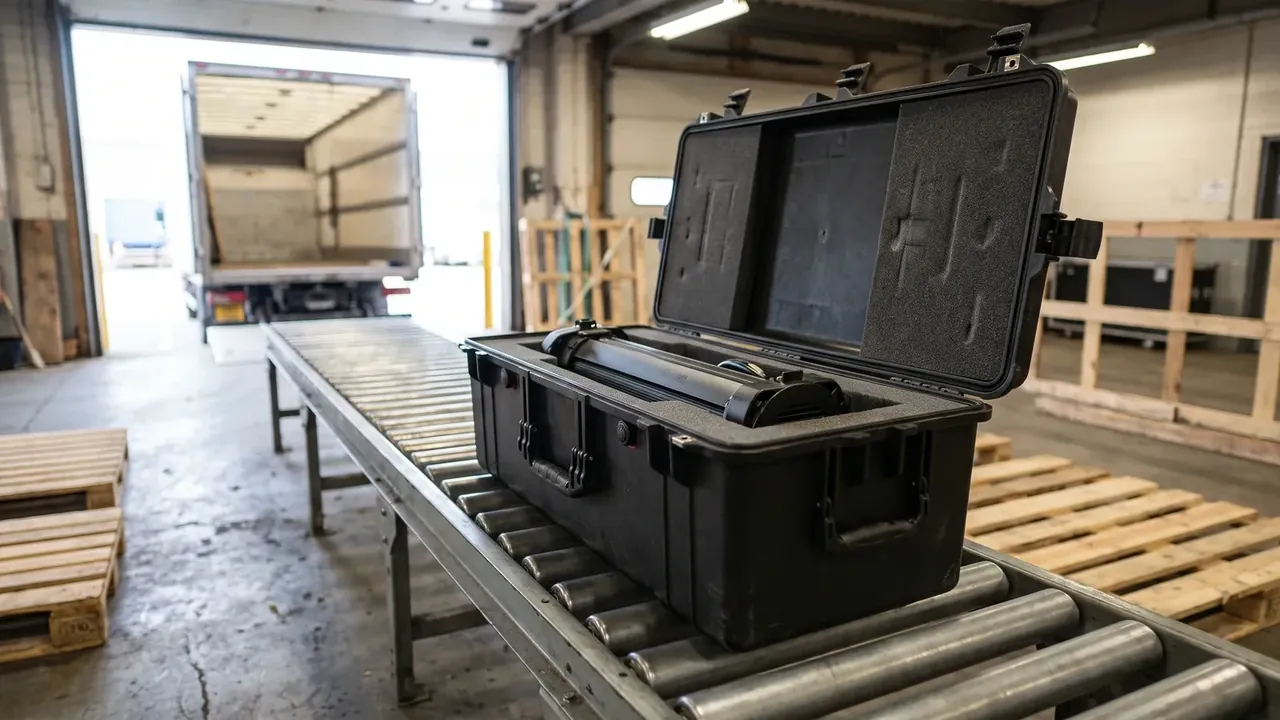
Quick answer: The Laboratory Diagnostic Equipment Case survives wipe-down when grain depth stays under 0.15 mm, Ra near 1.6 μm and the lid seam step under 0.3 mm.
Table of contents
- Surface Cleaning Requirements for the Laboratory Diagnostic Equipment Case
- Grain Depth and Residue Risk
- Material Choice for Alcohol Wipe-Down
- Liquid Trapped in the Lid Seam
- The Wipe Routine at the Clean-Area Door
- FAQ
1. Surface Cleaning Requirements for the Laboratory Diagnostic Equipment Case
A case is wiped before it crosses into a clean area, and the result depends half on the polymer and half on the grain layer above it. What the Laboratory Diagnostic Equipment Case must deliver is three measurable outcomes per pass: no liquid film, no fibre in the valleys, no white edge in the same spot twice.
Those outcomes reduce to grain depth, surface roughness and the step between two moulded faces. Together they decide how much residue one pass lifts and whether the remainder is pushed into a trough. A shell of 500×380×210 mm outside, 460×340×175 mm inside and 4.5 mm walls takes its stiffness from those dimensions; its wiping efficiency comes from the grain cut into the same tool.
A case that will not come clean is rarely failing at the cloth.
2. Grain Depth and Residue Risk
Grain is a fine relief etched into the cavity and transferred to the moulding. On the VDI 3400 scale, Ref 24 corresponds to Ra 1.6 μm, where texture depth lands between roughly 0.05 and 0.15 mm. One grade deeper, at Ref 30, Ra reaches 3.2 μm.
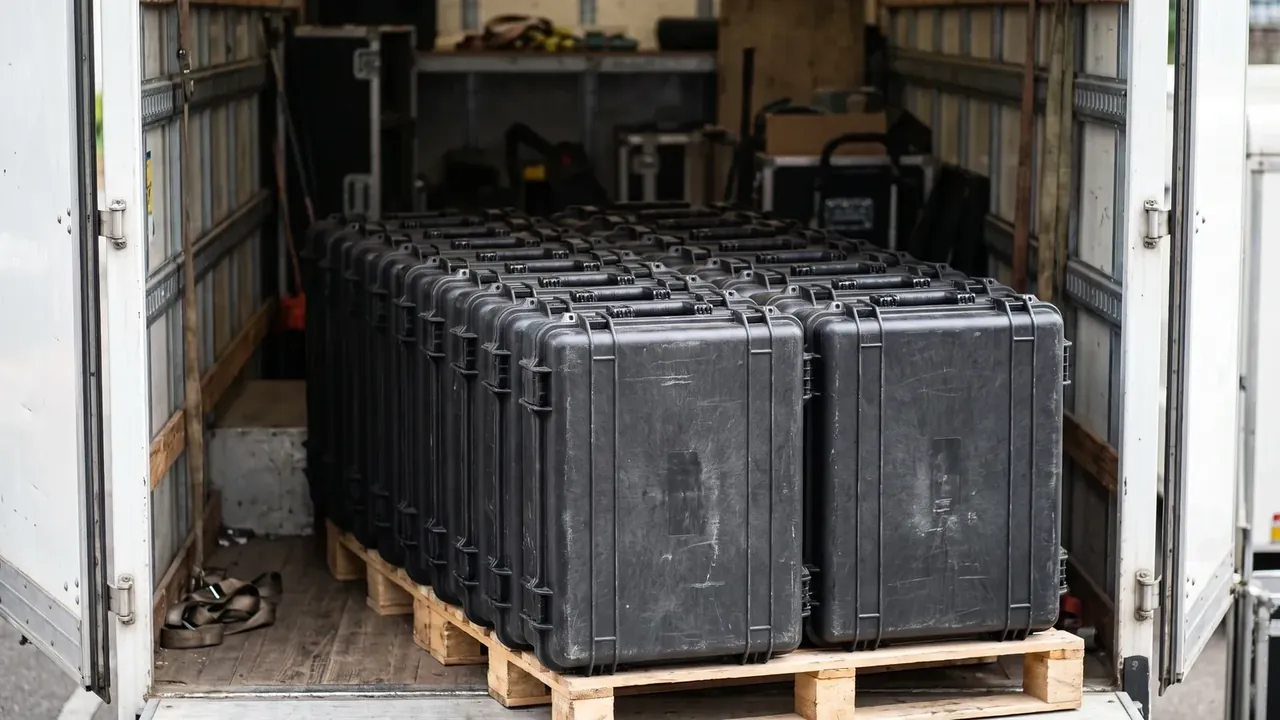
Troughs anchor residue because cloth pressure rides the peaks and skips the valleys. In one unidirectional pass a flat face gives up most of its film while a valley releases about half, and what stays behind dries into a pale edge. On the Laboratory Diagnostic Equipment Case the lid is the largest flat area, so that edge appears there first.
| Grain depth | Nearest grade | Residue after one pass |
|---|---|---|
| Under 0.05 mm | Close to Ref 18 | Shallow valleys, one pass clears |
| Around 0.10 mm | Close to Ref 21 | Thin haze in troughs, second pass needed |
| 0.15 mm | About Ref 24 | Lint in valleys, pale edge at corners |
| Over 0.20 mm | Near Ref 27 | Troughs act as grooves, brushing required |
The limit sits at 0.15 mm and Ra 1.6 μm for practical reasons. Past it, the residue grade moves up one step after 500 wipe cycles: same cloth, same motion, and the pass has to be repeated. The tool holds etch depth within ±0.005 mm, and lid and wall are textured in one etch so the two faces do not age apart.
3. Material Choice for Alcohol Wipe-Down
The wipe liquid narrows the material choice for the Laboratory Diagnostic Equipment Case more than buyers expect. Labs use 75% ethanol and 70% isopropyl alcohol, and polypropylene tolerates both at those strengths without swelling or cracking. ABS loses gloss first, then fuzzes at the valley edges. PP also takes handling knocks through its notched impact strength, and its low density keeps the case at 7.4 kg.
| Wipe cycles | Surface change | Verdict |
|---|---|---|
| 100 | Slight gloss loss, grain intact | Normal |
| 300 | Peaks rounded at the edges | Normal |
| 500 | Fine scratches in the valleys | Re-test residue grade |
| 800 | Local breakthrough, grain blurred | Replace the case |
The 500-cycle figure maps onto four wipes a day across 250 working days, five years of service. Past that, wear moves into the valleys and wipe performance slides.
4. Liquid Trapped in the Lid Seam
When lid and base close, a seam remains between two moulded faces. Its width follows parting-line accuracy, and once the step passes 0.3 mm a cloth leaves a liquid line that dries into a pale mark.
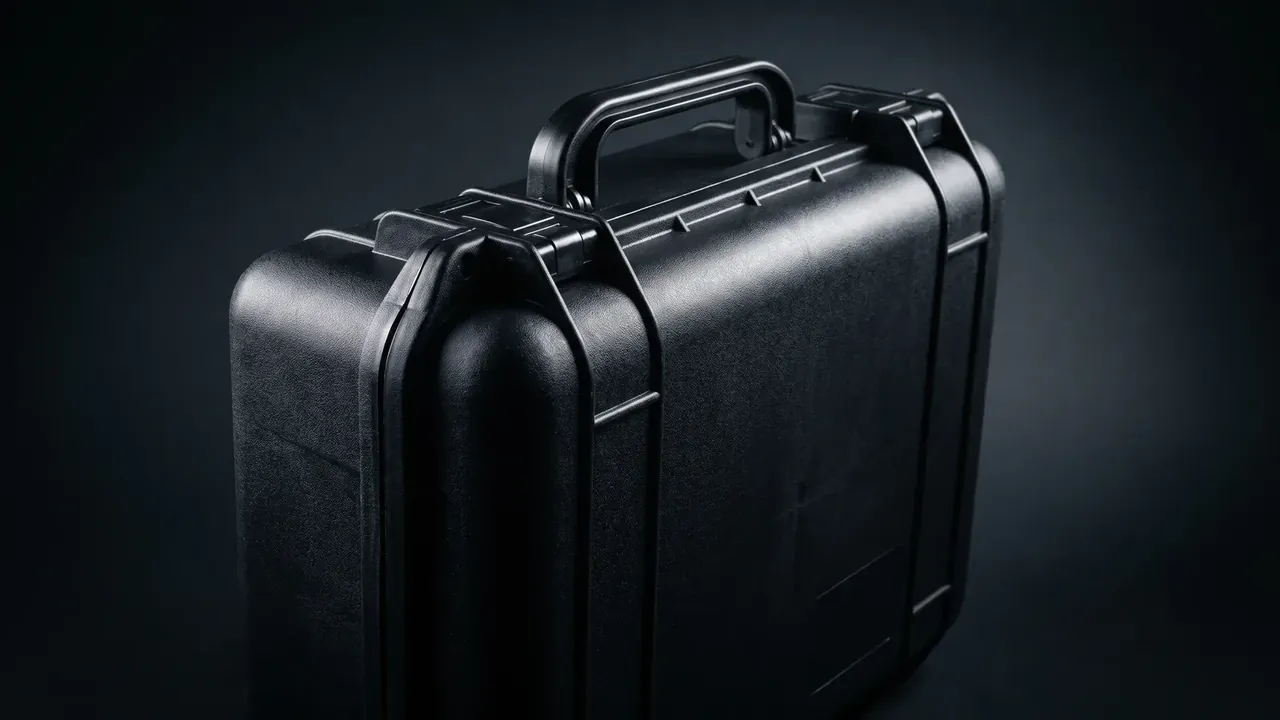
The step has two sources, parting-line mismatch and moulding warp. Mismatch is fixed by fitting the tool; warp is pressed out through cooling layout and hold pressure. The lid of the Laboratory Diagnostic Equipment Case carries a downturned lip that moves the seam to the lower side, which lets a cloth cross it without lifting an edge.
Below the seam sits the gasket in its groove, and that gasket answers the jet test behind IP65: under IEC 60529 a 6.3 mm nozzle delivers 12.5 L/min at 2.5 to 3 m for three minutes. IP65 is a benchmark here, not a claim about immersion.
A 3° drainage angle on the Laboratory Diagnostic Equipment Case lets wash liquid run to one corner rather than pool. It is moulded inside, independent of foot height, and holds at 3° on the bottom case of a four-high stack.
5. The Wipe Routine at the Clean-Area Door
Four steps on paper, three contact zones on the case: lid face, four walls, latches and handle. Passes run corner to opposite corner with no return stroke, so lifted residue is not pushed back.
Each wipe on the Laboratory Diagnostic Equipment Case is logged. A solvent-resistant label inside the lid carries the date and running total; at 500 the case goes out for re-test.
| Residue grade | Visual signature | Action |
|---|---|---|
| Grade 0 | No watermark, no pale edge, no fibre | Release |
| Grade 1 | Faint pale edge at a corner | One more pass, then release |
| Grade 2 | Continuous haze across valleys | Return for brushing |
| Grade 3 | Grain blurred, local breakthrough | Withdraw and replace |
Grading is visual but bounded: grade 0 shows even reflection within ten seconds, grade 1 breaks it at a corner, grade 2 hazes the panel, grade 3 has lost the grain.
Two latches rated 300 N each distribute lid pressure only when both are closed. A slack latch opens the seam on one side, liquid enters there, and that is the side a cloth reaches last.
Conclusion
Cleaning performance of the Laboratory Diagnostic Equipment Case rests on three numbers: grain 0.15 mm, Ra 1.6 μm, seam step 0.3 mm. Hold all three and the surface still lands within residue grade 1 after 500 cycles of 75% ethanol and 70% isopropyl alcohol. A 7.4 kg case with 4.5 mm walls, two latches at 300 N, a 3° drainage angle and an IP65 seam holds that result from a four-high stack across a −15 °C to +60 °C storage range.
Related Reading
- The Usable-Volume Calculation
- Plastic Case versus Wooden Crate
- Sealing Layers in Specimen Transit Boxes
Related Products
- 8 Series — Gun Cases; Military Equipment Cases; Camera Equipment Cases; Drone Cases; Watch Cases; Knife Cases; First Aid Cases; Electronics Equipment Cases
- WL8-2812 PP Gun Case — model WL8-2812
- All protective cases and toolboxes: 7 series, 158 models