

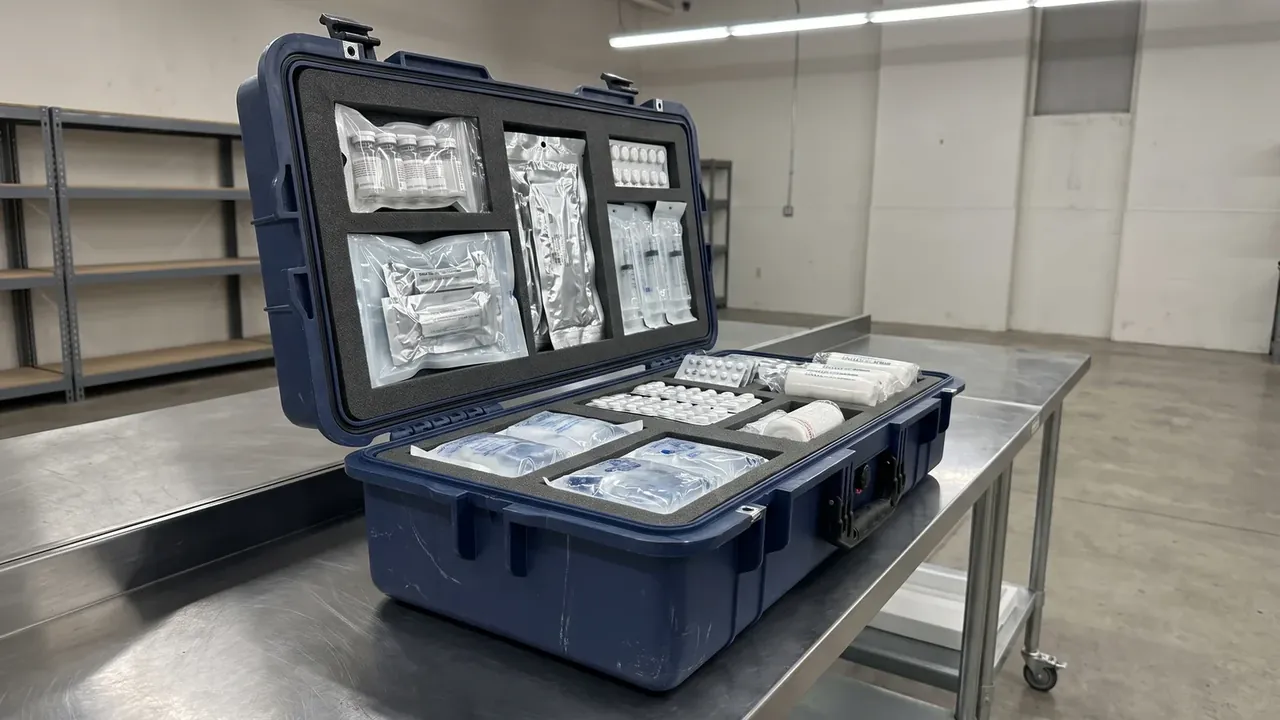
Quick answer: A logistics support box is built along five process points: frame forming, compartments and palletisation, stack load and forklift interfaces, latches and hinges, marking and manifest window. Forming fixes wall and corner, compartments fix pick speed, latches fix opening life.
Table of contents
- How a logistics support box frame is formed
- Compartments and palletisation
- Stack load and forklift interfaces
- Latches and hinges under load
- Marking and manifest windows
- FAQ
1. How a logistics support box frame is formed
Two routes dominate: rotational and injection moulding. The split is about wall distribution, corner geometry and batch economics, not machine age.
Rotational moulding fuses polyethylene powder in a mould turning on two axes at roughly 320 °C. A 6 mm wall takes about 22 minutes and holds plus or minus 0.8 mm, and corners come out as continuous radii, so impact stress never runs down one straight line.
Injection moulding fills the cavity in a single shot at a 3.5 mm wall on a 1,200 t press, near 70 seconds a cycle. Dimensions are tight, but rib roots must stay under 1.2 mm or sink marks print through.
| Process | Wall | Cycle | Corner form |
|---|---|---|---|
| Rotational | 5 to 8 mm | 18 to 25 min | Continuous radius |
| Injection | 3 to 4 mm | 60 to 90 s | Joined with ribs |
Drops favour rotational moulding, frequent opening injection.
2. Compartments and palletisation
Compartment design starts with the unit, not the foam. A common cell is 180 mm by 120 mm with 12 mm dividers, 25 mm of foam under the floor, with milling tolerance of plus or minus 1.5 mm.
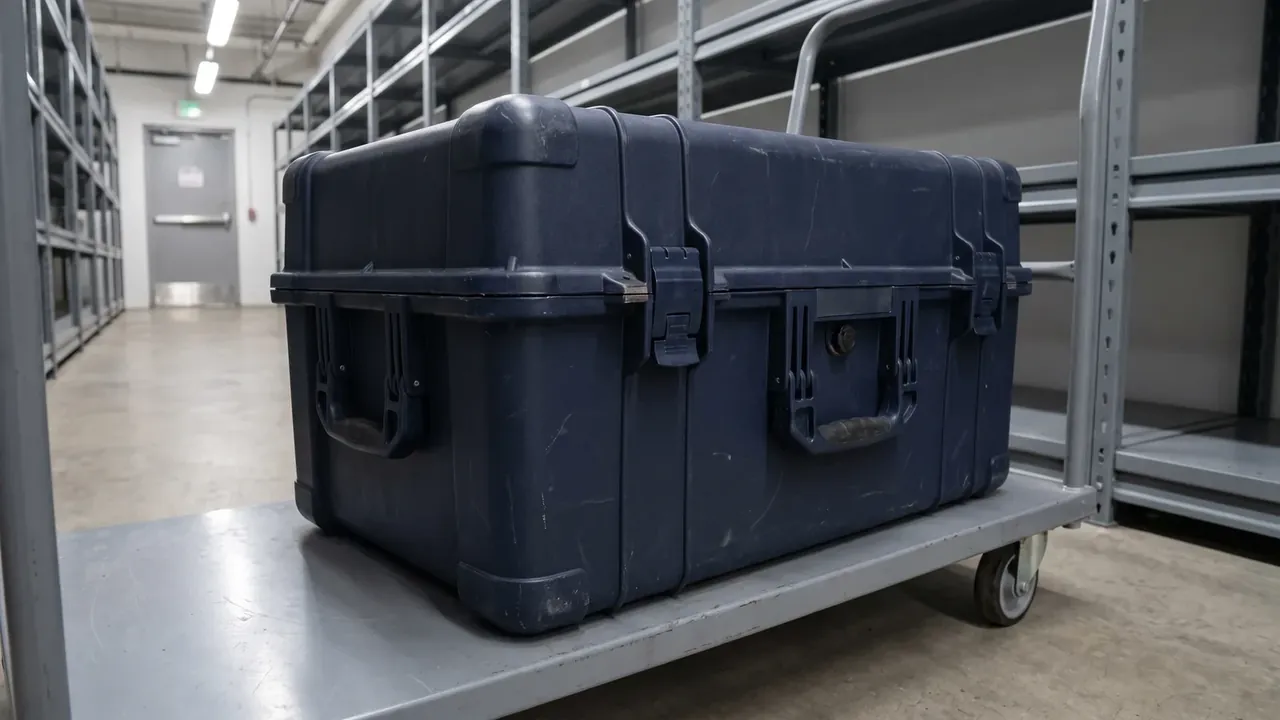
Palletisation follows. The base carries 100 mm feet so forks enter cleanly, twelve boxes fit a standard pallet, and the rated load is 600 kg.
Cell count has its own arithmetic: six cells leave about 78 per cent usable volume in a 45 litre logistics support box, nine cells 71 per cent, because dividers eat what they divide.
3. Stack load and forklift interfaces
At three layers the bottom box carries the two above. The top face takes 400 kg distributed with creep under 2 mm over 72 hours; past that the lid dishes and the gasket fails.
A lid groove and base boss locate within 3 mm, and thickened corner castings carry load down the posts, not the wall centre.
Pockets measure 130 mm by 65 mm and accept forks from four directions; the pallet truck is checked at 85 mm entry, and feet carry an 8 mm chamfer.
| Interface | Design value | Check |
|---|---|---|
| Fork pocket height by width | 130 by 65 mm | Full-load entry |
| Pallet truck entry | 85 mm | Loaded and empty |
| Stack layers | Three | Creep under 2 mm in 72 hours |
4. Latches and hinges under load
The latch is the only part a hand touches daily. An over-centre latch holds 900 N, opens between 60 N and 80 N, and works with one gloved hand; under 50 N it pops open, over 100 N it needs two hands.
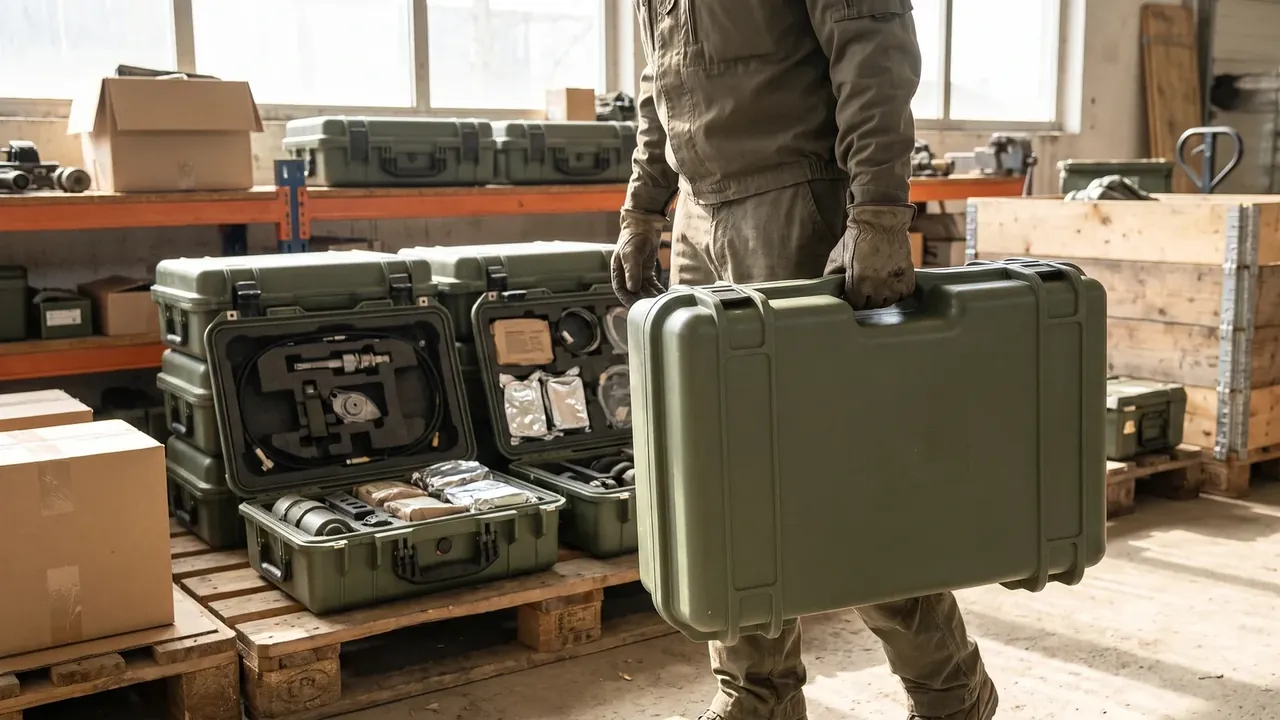
Hinges wear loose rather than tear off: a 6 mm stainless pin holds 0.5 mm clearance after 5,000 cycles, and four M5 inserts outlast self-tapping screws.
A double-lip EPDM gasket is compressed to 30 per cent, and the assembly is checked to IP65 and 96 hours salt spray.
| Part | Key dimension | Life criterion |
|---|---|---|
| Over-centre latch | 900 N holding force | No self-release |
| Hinge pin | 6 mm stainless | 0.5 mm at 5,000 cycles |
| Gasket | Double-lip, 30 per cent | 96 hours salt spray |
5. Marking and manifest windows
In-mould labelling puts the graphic inside the wall, so it lasts as long as the wall; screen printing fades where hands rub, and laser marking only reads on dark mouldings.
The manifest window is welded from 0.9 mm polycarbonate, recessed 1.5 mm, and sized to A6 at 148 mm by 105 mm so a sheet drops in unfolded. Shrink it and the picker hunts paper before the item.
A 25 mm by 25 mm code on matte film sits 120 mm above the base, so the scanner needs no angling.
Conclusion
The five points constrain one another: forming sets wall and corner, compartments set pick speed, interfaces set storage height, latches set opening life. Put the numbers on the drawing, and a logistics support box stops being a shell that only looks right.
This article discusses only the container (case body) side of specifications and design intent, and does not cover any handling, loading or use of the contents.
Related Reading
- Logistics support box applications in depots and field delivery
- Logistics support box selection: volume, load and handling
- Rotomoulded case selection: wall, mould and batch size
- Stackable case specifications and stack checks
Related Products
- 8 Series — Gun Cases; Military Equipment Cases; Camera Equipment Cases; Drone Cases; Watch Cases; Knife Cases; First Aid Cases; Electronics Equipment Cases
- WL8-2812 PP Gun Case — model WL8-2812
- All protective cases and toolboxes: 7 series, 158 models