

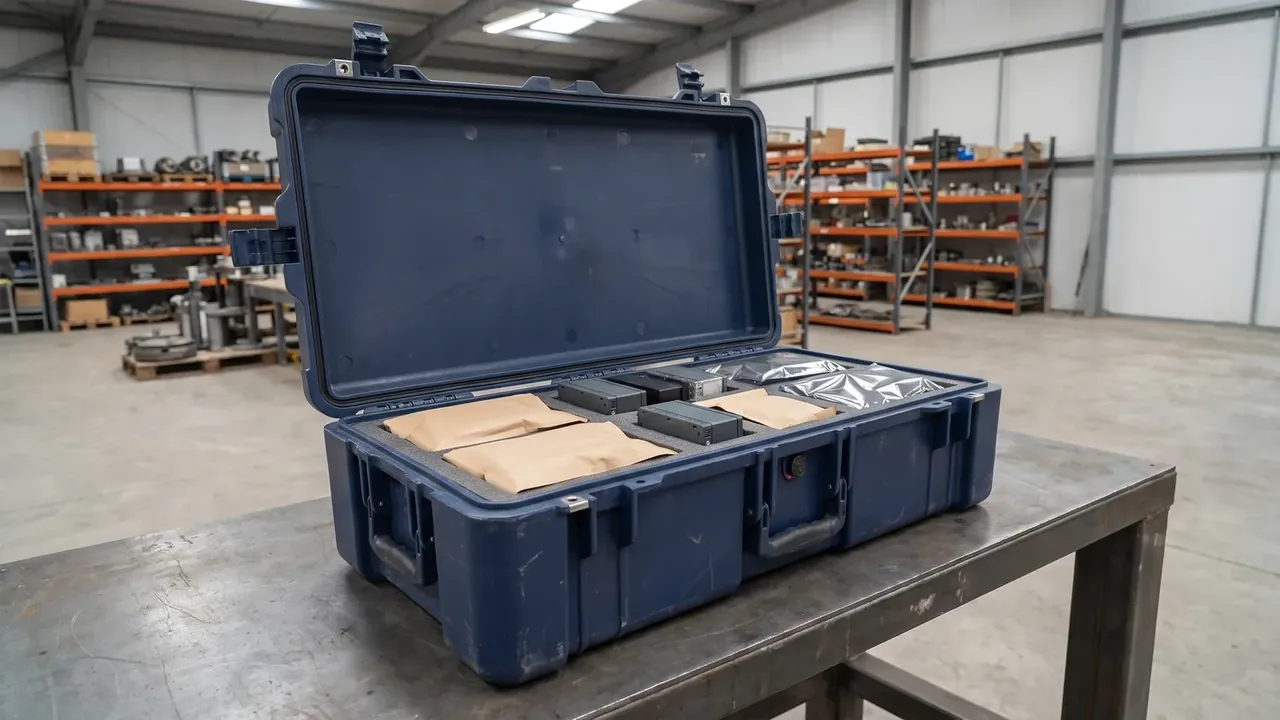
Quick answer: Case logo methods come down to screen, pad or laser, and the choice follows surface and batch: 300 mesh above 1,000 units, 20 W laser for tight curves.
Table of contents
- Where the three methods stop
- Screen: 300 mesh and two colours
- Pad: a 0.1 mm plate for curves
- Laser: 20 W and 0.05 mm
- Choosing by batch and curvature
- FAQ
1. Where the three methods stop
A flat lid is cheapest on screen, a curved corner forces a switch to pad, and a 2 mm step between faces leaves laser as the only route. The three case logo methods are split by surface geometry and batch, not ranked by appearance.
The physical difference is how ink arrives. Screen pushes ink through an open mesh for an 8–12 μm film; pad lifts ink from an etched plate on a silicone head for 5–8 μm; laser adds nothing and burns 0.05 mm deep.
| Item | Screen | Pad | Laser |
|---|---|---|---|
| Tooling | 300 mesh screen | 0.1 mm etched plate | none |
| Ink or depth | 8–12 μm | 5–8 μm | 0.05 mm |
| Minimum cap height | 1.5 mm | 1.5 mm | 1.5 mm |
| Colours | 2 by registration | 4 | one per pass |
| Curvature | above R300 | above R50 | any |
| Economic batch | above 1,000 | 100–1,000 | below 100 |
All three stop at a 1.5 mm cap height: below it, screen fills in, pad drops strokes and laser breaks up on flow lines, so small secondary text stays on a screen.
2. Screen: 300 mesh and two colours
Screen printing uses a 300 mesh polyester screen, 25 μm of emulsion and 20 N/cm of tension. The mesh sets ink thickness and minimum line width: 300 mesh holds a 0.3 mm line, while 200 mesh reaches 0.5 mm with a heavier, more opaque film.
Registration lives on location. The first colour passes 60 ℃ for 30 min before the second goes down, and the screen returns within ±0.15 mm. Leave a 0.2 mm trap, or the mismatch shows as a white hairline on a dark shell.
Cure conditions belong on the process card: a two-part ink reaches 4B at 60 ℃ for 30 min but only 3B after 24 h at 20 ℃. The 4B test is a 6×6 cross-hatch, firm 3M tape, under 5% removed.
Screen stops at R300. Tighter and the screen cannot sit flat, ink creeps under the gap and the edge feathers, which ends the method at the R30 lid corner.
Economics work above 1,000 pieces: tooling is CNY 300 per colour, or CNY 0.6 per part, plus CNY 0.35 of ink. At 200 pieces tooling alone is CNY 3 per part.
3. Pad: a 0.1 mm plate for curves
Pad printing starts from a steel plate etched 0.1 mm deep; the silicone head lifts ink out of the recess and presses it onto the case. That depth sets transfer per hit: 0.15 mm strings, 0.05 mm starves, 0.1 mm is stable at a 1.5 mm cap.
Heads come in three hardnesses: a soft Shore A 20 head wraps an R5 boss, a medium one covers flats and arcs inside R300, a hard one reaches the floor of an 8 mm recess, and three marks may need two head changes at 6 min each.
Pad lays down only 5–8 μm, so a pale mark on a dark shell needs two white passes plus one colour pass, and unit cost runs 2.6× the single-colour figure. That line is often missing from a quote priced as one colour.
Plate tooling is cheap: CNY 200 for one colour, CNY 800 for four, or CNY 2 per part at 100 pieces. By 5,000 pieces screen takes over again.
Even ink across a curve is the hard part: on an R20 corner contact pressure falls 30% from centre to edge, and splitting the mark into two passes costs 4 s per part.
4. Laser: 20 W and 0.05 mm
A 20 W fibre laser at 1064 nm marks PP and ABS to 0.05 mm. Depth comes from power and frequency together: 20 W at 40 kHz cuts 0.05 mm, while 12 W leaves 0.02 mm and a grey mark that fades after two wipes.
Laser is subtractive: changing a mark means grinding back and re-spraying, and grinding 0.05 mm flattens the texture.
Pale material needs 0.3%–0.5% of laser additive at CNY 0.8 per kg, while dark shells mark white without it, which is why dark case logo work leans on laser.
There is no tooling charge and one pattern takes 8 s, so laser wins below 50 pieces and for prototypes. What gets measured is depth, not adhesion: three profilometer readings, 0.04–0.06 mm accepted.
The limit is colour count. Two colours mean two passes with ±0.1 mm re-registration, and 0.2 mm of drift breaks a mark, so beyond two colours screen is cheaper and tighter.
5. Choosing by batch and curvature
Three variables decide it: batch size, surface shape and colour count. Fix them and one case logo method is left standing.
| Condition | Screen | Pad | Laser |
|---|---|---|---|
| Under 100 pieces | uneconomic | workable | first choice |
| 100–1,000 pieces | one colour only | first choice | workable |
| Above 1,000 pieces | first choice | workable | uneconomic |
| Curvature above R300 | suitable | suitable | suitable |
| Curvature R300–R50 | not possible | suitable | suitable |
| Step above 2 mm | not possible | marginal | first choice |
| Three colours or more | suitable | suitable | not possible |
Batch breaks at 100 and 1,000. Below 100, laser avoids tooling; between 100 and 1,000 pad plates at CNY 200 per colour pay off; above 1,000 on a flat face, screen tooling falls under CNY 0.6 per part.
Curvature breaks at R300 and R50. Above R300 the face behaves as flat, from R300 to R50 pad takes it, and below R50 the pad never bottoms out.
Colour count breaks at three. Past that, screen registration drifts to 0.45 mm unless the artwork is split across two screens, and each extra screen adds 30 min of cure.
Solvent wiping is the one requirement only laser survives: screen and pad films whiten after 20 wipes of butanone.
Conclusion
Case logo methods reduce to three tests. Batch first: below 100 pieces go laser, 100 to 1,000 go pad, above 1,000 on a flat face go screen. Surface second: R300 is the screen floor and R50 the pad floor, and past either one only laser works. Colour last: from three colours up, return to registration. Order matters as well, because picking the cheap route first ends at an R30 corner that will not print, and a new screen costs three times the saving. Artwork that fails all three tests is a design problem, fixed in the drawing stage where the mark becomes single colour and the cap clears 1.5 mm. Run the tests and marking cost settles between CNY 0.2 and CNY 3.35 per case, a tenfold gap visible line by line.
| Method | Suitable surface | Economic batch | Cost per part | Acceptance |
|---|---|---|---|---|
| Screen, 300 mesh | flat, above R300 | above 1,000 | from CNY 0.35 | 4B adhesion |
| Pad, 0.1 mm plate | curves above R50, recess floors | 100–1,000 | from CNY 0.90 | 4B adhesion |
| Laser, 20 W | any curve, dark material | below 100 | from CNY 0.20 | 0.05 mm depth |
This article discusses container-side specifications and design implications only, and does not cover any handling, loading or use of the contents.
Related Reading
- Mesh and ink control in case screen printing
- Comparing logo printing options for plastic cases
- Choosing a surface printing process for protective cases
- Specifying a plastic tool case with a custom logo
Related Products
- 8 Series — Gun Cases; Military Equipment Cases; Camera Equipment Cases; Drone Cases; Watch Cases; Knife Cases; First Aid Cases; Electronics Equipment Cases
- WL8-2812 PP Gun Case — model WL8-2812
- All protective cases and toolboxes: 7 series, 158 models