

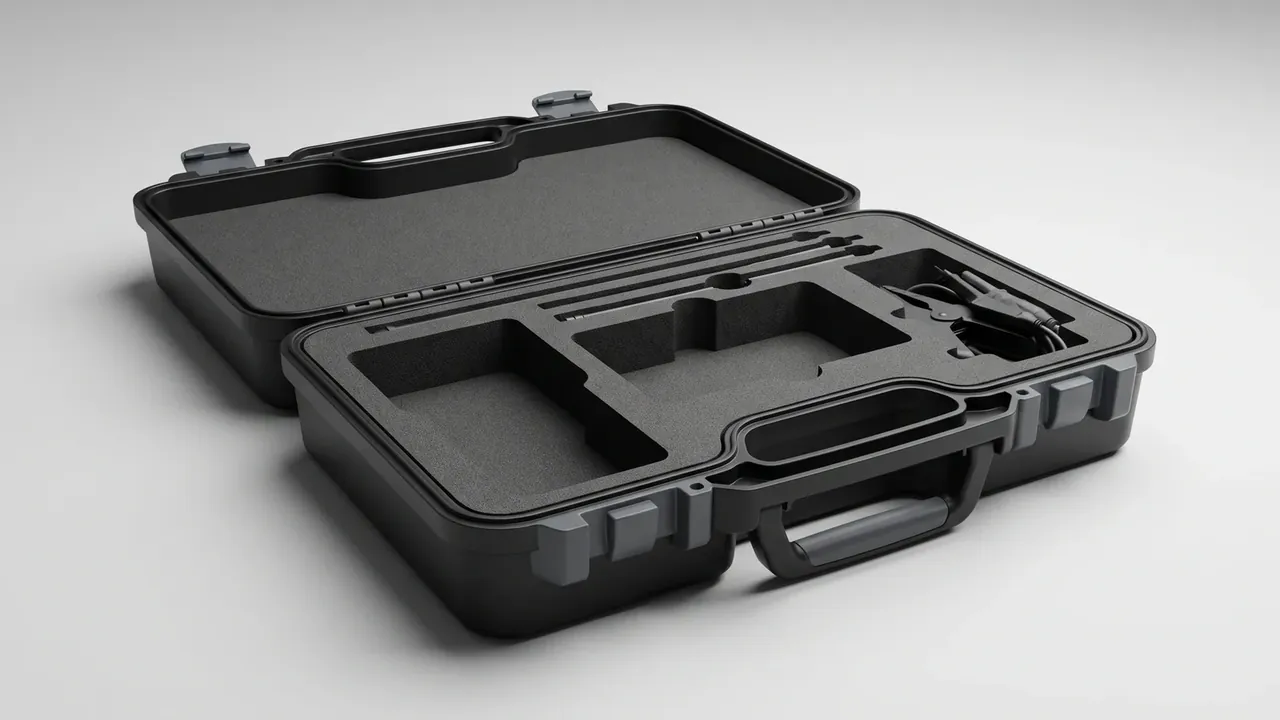
Quick answer: A Low MOQ custom plastic case does not shrink every specification at once; it splits the variables into three tiers. Cavity, color and foam move at thirty to fifty units, wall thickness and the parting line are locked the day the tool is cut, and printing or texture is billed as a plate fee. Settle those borders before anyone argues about price.
Table of contents
- Three Tiers of Change at Low Volume
- Cavity Moves Two Millimeters, Wall Thickness Moves None
- Color, Texture and Print: Three Items Billed Per Run
- Two Case Dimensions That Follow the Foam
- Batch Size Against Dimensions: Four Tiers
- FAQ
1. Three Tiers of Change at Low Volume
Most arguments start with a request for a small change. A small color change costs one barrel cleaning; the same change in wall thickness costs one new core. A Low MOQ custom plastic case quote is settled by grading each request first, and the grade follows steel, not the area touched.
| Change | Threshold | Cost shape | New tool |
|---|---|---|---|
| Color inside the standard card | 50 | 30 min purge, 2 kg scrap in price | No |
| Foam material and pockets | 30 | Cutting die, 400 CNY | No |
| Cavity plus or minus 2 mm | 200 | Two side inserts, 600 CNY | No |
| New holes, up to four | 100 | Drilled in the insert, 120 CNY each | No |
| Wall 3.2 to 4.0 mm | any | Core remade, from 1800 CNY | Yes |
| Parting line and draft | any | Whole tool recut | Yes |
Buyers underestimate the extra hole. Up to four, a fitter drills the insert; once holes crowd, the block is replaced and the price moves from 120 CNY per hole to 900 CNY per set.
Anything swapped as a part is cheap. Anything that touches steel is not.
2. Cavity Moves Two Millimeters, Wall Thickness Moves None
The cavity of a Low MOQ custom plastic case is positioned by two side inserts across length and width, and by the floor in depth. An insert is a separate steel block, so a 200 unit order can take a 420 by 320 mm cavity to 424 by 322 mm for a 600 CNY insert set and three extra days.
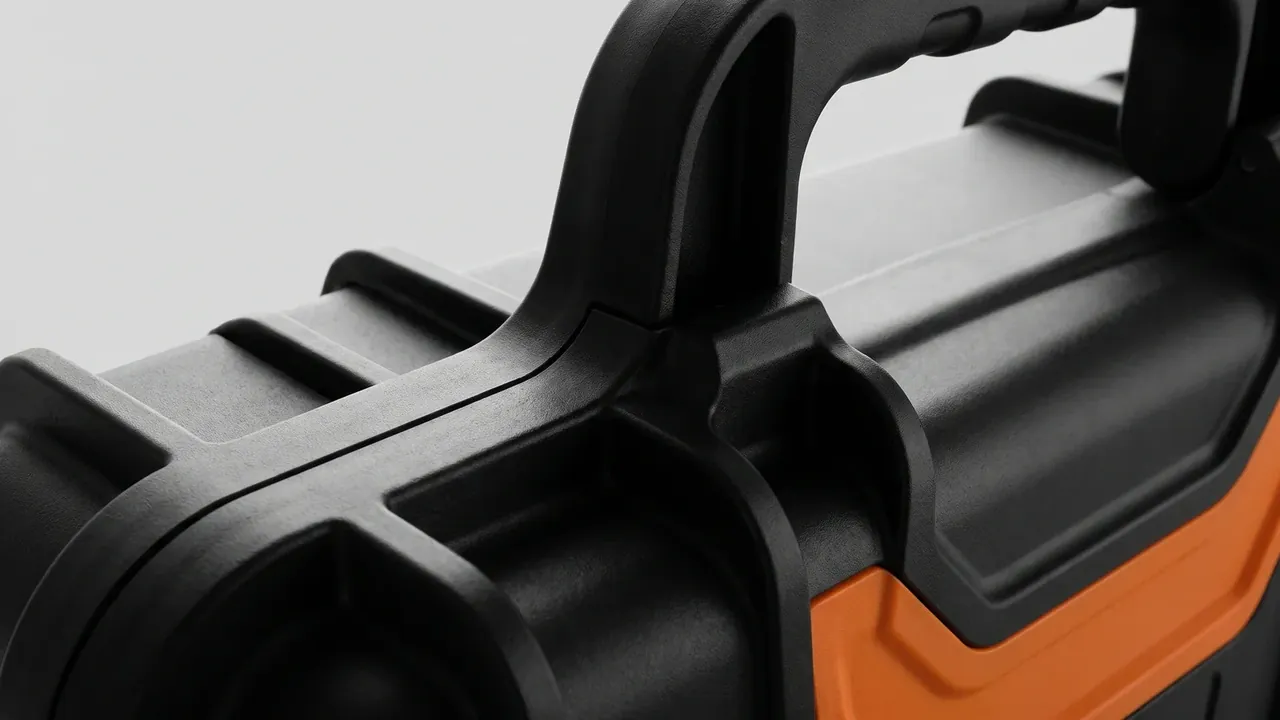
Wall thickness has no such freedom. The wall is the gap between cavity and core, milled in when the tool is built, so changing it means remaking the core; cooling lines, ejectors and insert fits all move with it, which is why the quote arrives as a whole tool. A Low MOQ custom plastic case therefore fixes its wall before the cut, and afterwards the only lever is ribbing: one lengthwise rib 3 mm high lifts the bending section modulus by about thirty percent for less material than 0.8 mm of wall. Tolerances have borders too, with plus or minus 0.8 mm normal and 0.3 mm needing trim stock, which pushes lead time from 25 days to 40. Depth sits looser at 1.2 mm because the floor keeps polishing stock.
3. Color, Texture and Print: Three Items Billed Per Run
None of the three touches the tool, but each carries a minimum.
- Color: 50 units inside the standard card, masterbatch from 25 kg, surplus not refunded.
- Texture: a 0.6 mm grain needs an 800 CNY etch plate, and a new grain means a new etch.
- Print: 320 CNY per screen per color, still billed at 50 units below that.
Color is the easiest item to win and to lose on a Low MOQ custom plastic case. A 25 kg minimum means a 50 unit order carries a whole bag of compound, and the rest waits or prices as scrap. Texture is worse: a fine grain cannot be roughened in place, since stripping it takes 0.05 mm off the cavity surface and the dimensions move. Print looks cheap until colors add up: four colors at 1280 CNY is 25 CNY per unit at 50 units, more than the shell.
4. Two Case Dimensions That Follow the Foam
Foam looks like an accessory, yet two shell dimensions follow it: lid clearance and pocket-to-wall gap.
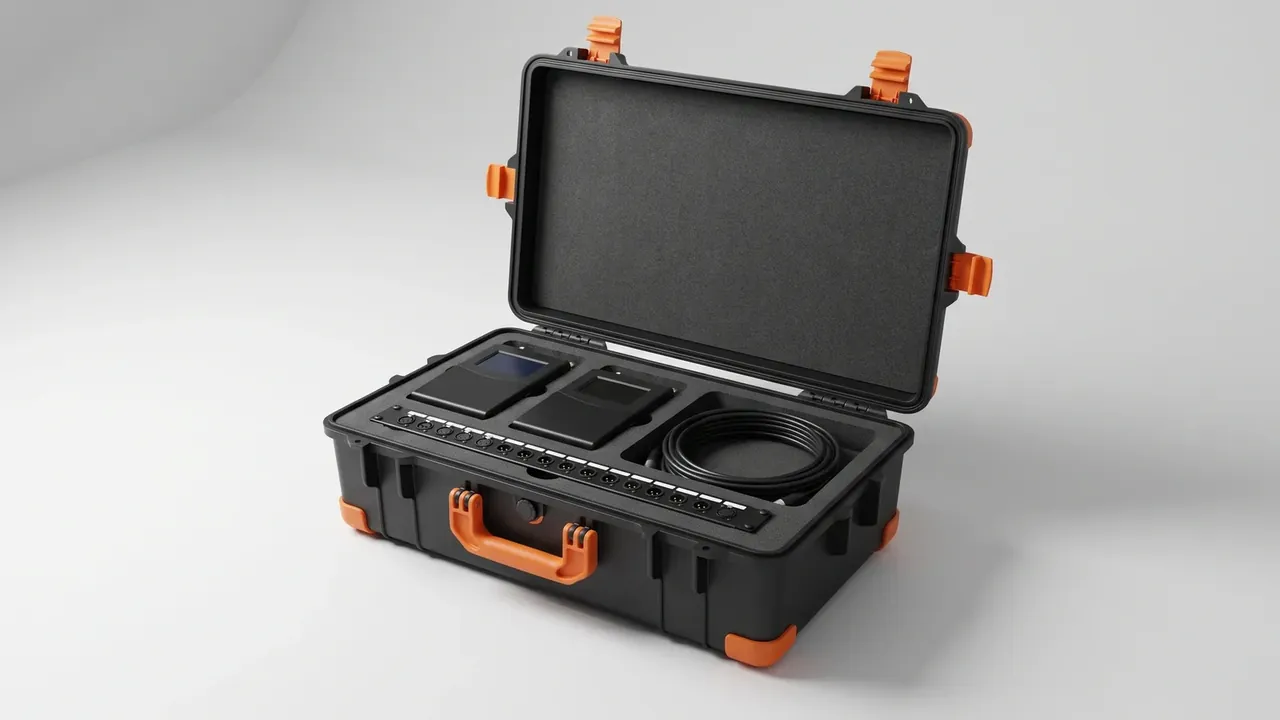
Foam from 30 mm to 40 mm asks for 10 mm more lid clearance, and clearance is set by cavity depth, which needs a new tool. So the foam in a Low MOQ custom plastic case only subtracts from existing space: thinner foam, lower density EVA, or local pockets. Dropping EVA from 45 kg/m3 to 38 kg/m3 adds about twenty percent of travel at the same thickness and slows the rebound.
The second dimension is pocket edge to wall. Under 6 mm, a tipped case presses the foam on the side wall and passes impact into the corner; at 8 to 10 mm the foam deforms first. That gap costs no tooling, only a note on the die drawing; without it the die nests to default.
5. Batch Size Against Dimensions: Four Tiers
| Batch | Dimensions that can move | Wall option | Tooling share |
|---|---|---|---|
| 30 units | Foam, labels | Existing tool, 3.2 mm | 0 |
| 50 units | Print, standard color | Existing tool, 3.2 mm | Plate from 320 CNY |
| 200 units | Cavity 2 mm, up to four holes | Existing tool or new inserts | 600 CNY inserts |
| 1000 units | Cavity and depth, latch position | New tool, 4.0 mm | 38000 CNY tool |
Fifty units is the awkward tier: plenty can change, but each item has its own minimum, so plates, masterbatch and dies often cost more than the goods. At that volume a Low MOQ custom plastic case is best used to change accessories, not the shell. Wall and structure only matter at 1000 units, where the tool amortizes to 38 CNY per case.
Conclusion
The freedom inside a Low MOQ custom plastic case is cut into steel, not drawn on paper: cavity by inserts, color by compound, foam by die, all movable at a few dozen units, while wall, parting line and height stay locked. The smaller the batch, the more of the budget belongs in accessories. Reverse that order and the quote on a Low MOQ custom plastic case runs away.
This article discusses only the container (case body) side of specifications and design intent, and does not cover any handling, loading or use of the contents.
Related Reading
- How the MOQ baseline for a custom case is calculated
- Dimension and wall thickness rules for blow molded custom cases
- How blow molding limits case structure
Related Products
- 8 Series — Gun Cases; Military Equipment Cases; Camera Equipment Cases; Drone Cases; Watch Cases; Knife Cases; First Aid Cases; Electronics Equipment Cases
- WL8-2812 PP Gun Case — model WL8-2812
- All protective cases and toolboxes: 7 series, 158 models