


Quick answer: A Marine anti-salt spray corrosion hard case pairs 28% glass fibre with a 0.25 mm pin gap to hold latch-force growth under 12% after 720 h salt spray.
Table of contents
- Glass fibre content in the Marine anti-salt spray corrosion hard case
- Fit clearance of the hinge pin bushing
- Opening-force readings across the salt spray period
- Torque decay on the salt spray retest
- Clearance reject line for marine batches
- FAQ
1. Glass fibre content in the Marine anti-salt spray corrosion hard case
Set the outside at 570×410×235 mm, the cavity at 500×345×165 mm and the wall at 4.2 mm, and the shell glass fibre content of the Marine anti-salt spray corrosion hard case settles at 28%. The fibre stiffens the shell and checks creep under damp, salt-laden air: too little lets the hinge seat close in and squeeze the bushing clearance, too much turns the material brittle at the mould knit lines.
The grade is read together with a 5.8 kg empty case and a 12.5 kg load: uneven fibre distribution costs the hinge and latch seats their coaxiality, so the mouth seals tight on one side and loose on the other.
| Glass fibre grade | Opening-force growth after 720 h | Verdict |
|---|---|---|
| 22% | 15%, crosses line | Reject |
| 28% | ≤12% | Threshold |
| 34% | 11%, but seat cracks | Reject |
2. Fit clearance of the hinge pin bushing
The 0.25 mm fit clearance of the hinge pin bushing stops salt deposits locking the bushing without letting the lid wobble. The Marine anti-salt spray corrosion hard case sets its lid torque baseline at 2.5 N·m, and that clearance is the room the pin needs: smaller, and corrosion products bind the bushing so latch force climbs; larger, and the lid goes slack at the hinge.
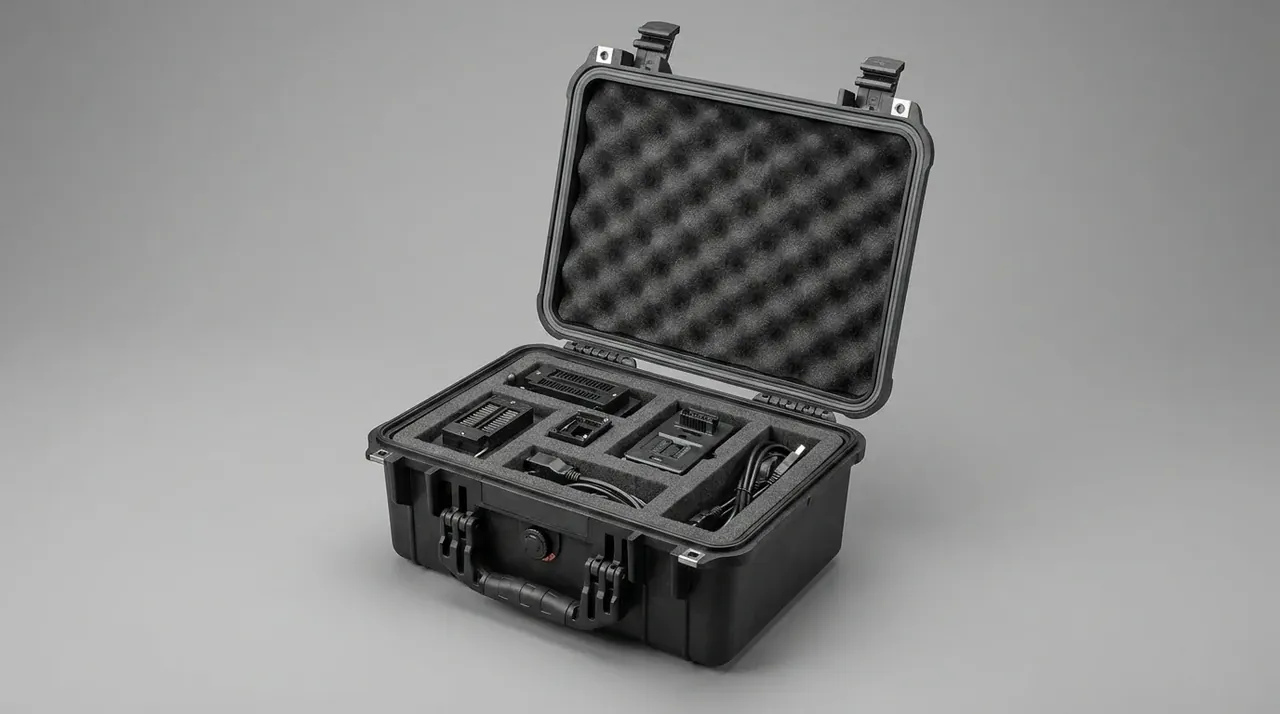
Bushing clearance and latch preload are logged apart. After 4500 open-close cycles, if the 2 latches at 370 N each give first, the lid lifts and the bushing wears oval; the single gasket at 21% compression handles moisture ingress, not the bushing fit. The Marine anti-salt spray corrosion hard case puts fibre content and bushing clearance on one sheet, and together they decide whether latch opening force climbs after 720 h of salt spray.
3. Opening-force readings across the salt spray period
The salt spray period runs 720 h, with opening force logged every 240 h rather than only at the end. Each interval the Marine anti-salt spray corrosion hard case specimen is taken out, wiped of deposits, rested, and a pull gauge reads latch force against the start to give a growth percentage; at 720 h growth must stay within ≤12%, and an early crossing stops the run.
| Salt spray interval | Opening-force growth | Hinge torque |
|---|---|---|
| 240 h | 4% | 2.45 N·m |
| 480 h | 8% | 2.38 N·m |
| 720 h | ≤12% | 2.5 N·m baseline, decay ≤8% |
Opening force read as clearance squeezed by corrosion products plus slight shell creep beats a single number. Three parallel cases per batch are sampled; a spread above 2 points means uneven clearance in the bushing lot, so the bushings are checked first. Withdrawal order at 240 h, 480 h and 720 h, specimen attitude and rest time go into the record, or the intervals have no comparison and the Marine anti-salt spray corrosion hard case retest loses its reference.
4. Torque decay on the salt spray retest
A hinge torque retest follows the 720 h salt spray, held to torque decay ≤8% against the 2.5 N·m baseline. In the Marine anti-salt spray corrosion hard case the bushing may bind with corrosion products or wear slack, the first lifting opening force and the second dropping torque.

Before the retest the gasket groove is wiped clean, since salt and condensate trapped there inflate the 21% compression figure. If the two 370 N latches give first, the fault is latch preload, not the bushing. IP66 is brought in only as a benchmark method, and the report number is measured. Read together, force growth, torque decay and gasket compression answer one thing: whether the bushing of the Marine anti-salt spray corrosion hard case still holds the lid at 2.5 N·m after 720 h.
5. Clearance reject line for marine batches
The reject line lands on the measured deviation of the 0.25 mm bushing clearance and the opening-force growth after 720 h. Every Marine anti-salt spray corrosion hard case batch is sampled for clearance first, then growth backs out fatigue in the bushing and shell; both must clear before sign-off.
| Opening-force reading | Matching clearance | Batch verdict |
|---|---|---|
| 15% | 0.18 mm | Reject |
| ≤12% | 0.25 mm | Threshold |
| 9% | 0.32 mm | Too slack |
The 15% row paired with 0.18 mm has the bushing bound by salt products and is rejected; 9% with 0.32 mm is light but lets the lid wobble and load the seal unevenly, so it is not taken either. JUNZHIJIA centres marine batches on 0.25 mm and ≤12% growth, judged case by case: bushing clearance and starting torque are read first, then the 720 h end growth placed in its row, and only a case clearing all three is logged as passed.
Conclusion
The verdict for the Marine anti-salt spray corrosion hard case is whether shell glass fibre content and hinge pin bushing clearance still hold latch-force growth within ≤12% and torque decay within ≤8% after 720 h of salt spray. The 28% fibre, 0.25 mm clearance, 2.5 N·m baseline and 4500 open-close cycles must come from one batch and be read side by side, or comparison is lost. Order matters too: judge opening force first, then torque, then gasket compression, since reversing it scores a binding bushing as fibre creep.
Related Reading
- Reading salt spray corrosion test results
- Protective case hardware after salt spray
- Marine protective case hardware in salt spray
- Stainless steel vs cast aluminium corrosion resistance
Related Products
- 8 Series — Gun Cases; Military Equipment Cases; Camera Equipment Cases; Drone Cases; Watch Cases; Knife Cases; First Aid Cases; Electronics Equipment Cases
- WL8-2812 PP Gun Case — model WL8-2812
- All protective cases and toolboxes: 7 series, 158 models