

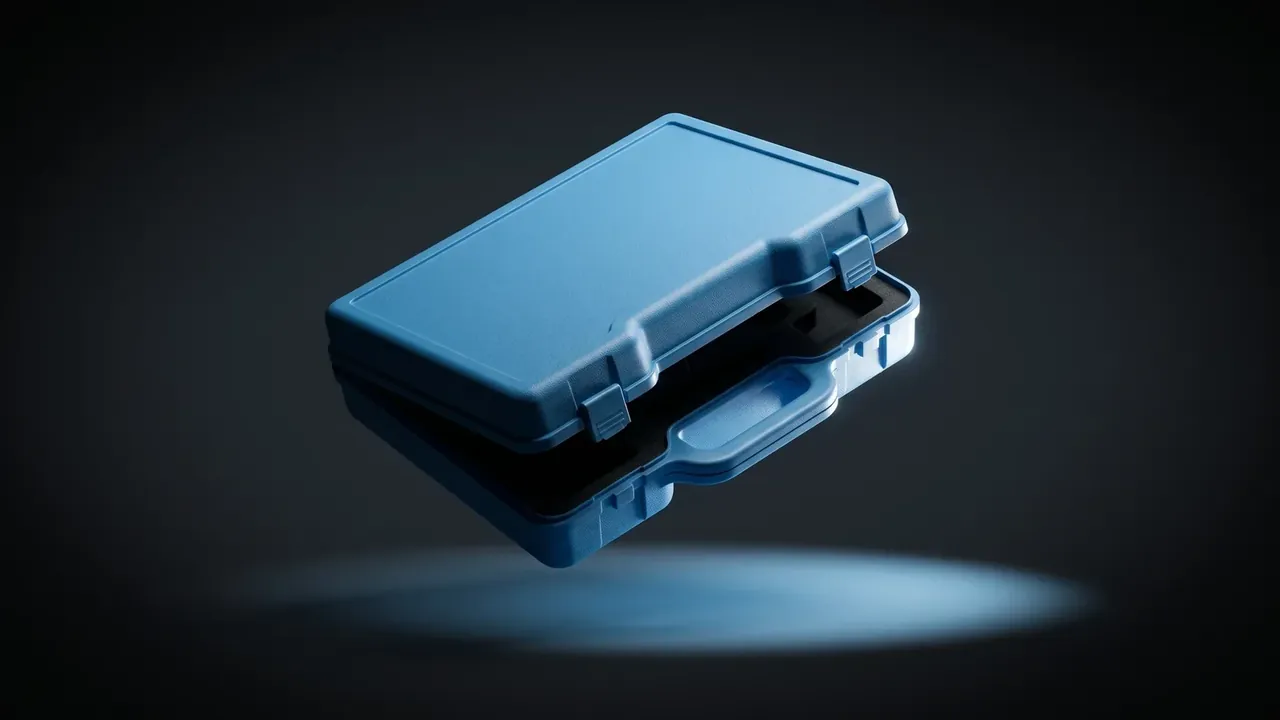
Quick answer: A Mechanic tool case that lives on an assembly station and one that lives in a mine are asked to do opposite things. Line work wants an opening that stays where you put it; site work wants a seal that keeps grit out. Volume rarely decides which one survives — a 2 mm foam difference, a 1 mm hinge pin difference and 25 percent gasket compression do.
Table of contents
- On the Line: A Mechanic Tool Case That Opens in Place
- Patrol Work: Lift, Hang, Push
- Mine and Site: Dust and Water Change the Build
- Height and Dead Circuits: One Hand Only
- Four Duties Side by Side
- Five Failures and Where They Start
- FAQ
1. On the Line: A Mechanic Tool Case That Opens in Place
An assembly station pins the case down. It sits on the same bench all shift, within arm's reach, and opens several hundred times a day without travelling a single step. Three things matter there: the lid holds its angle, the layout reads at a glance, and every tool has one home. At a 58 second takt, a pick and return has 12 seconds, so the lid cannot be allowed to drift shut while both hands are busy.
The hinge takes the whole cost of that. At 420 openings a shift and 250 shifts a year, one Mechanic tool case walks its hinge through 100,000 cycles. A 4 mm pin in a bore with 0.15 mm clearance sags about 1.2 mm over that count, and the lid starts sitting off-centre against the rim. Move to a 5 mm pin and sag drops under 0.5 mm for the same life. That single millimetre is the difference between a case that still shuts tight in year three and one that rattles by month six.
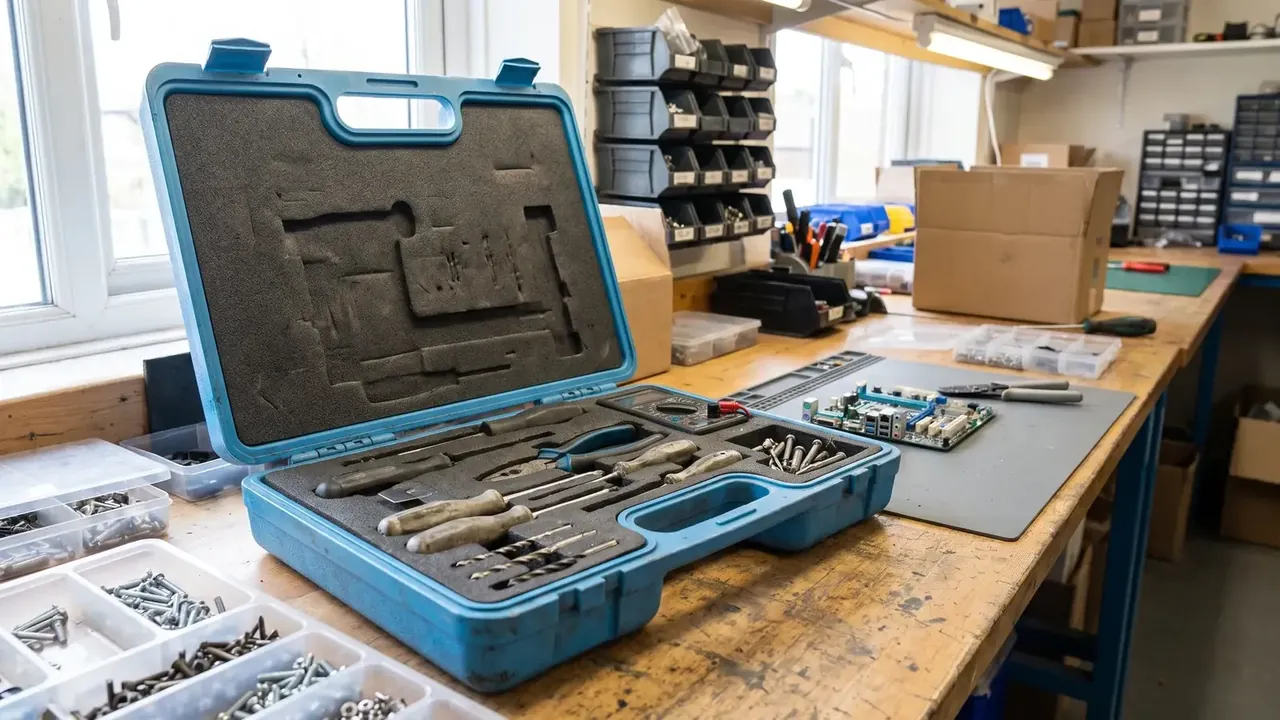
Foam is where assembly methods diverge. Line cases are usually cut both sides: a pocket in the lid and a matching pocket in the base, so a tool that was dropped in crooked still rests on the lower cut. Cut one side only and a tool sitting proud presses into the lid lining, leaving a mark you find the next morning.
Pocket depth wants to run 2 to 3 mm shallow of the tool. Flush pockets lift the tool with the lid; pockets more than 5 mm deep turn every pick into a two-finger dig.
| Parameter | Usual value | What goes wrong outside it |
|---|---|---|
| EVA density | 25 to 38 kg/m³ | Under 25 feels mushy, over 38 feels like board |
| Pocket vs tool depth | 2 to 3 mm shallow | Flush lifts with the lid, 5 mm deep resists fingers |
| Pocket wall clearance | 0.3 to 0.8 mm per side | Under 0.3 will not seat, over 0.8 rattles |
| Extraction force | 8 to 15 N | Above 20 N aches by the end of a shift |
| Lid pocket | Cut it | Skip it and tools print the lining |
Lid angle gets settled on the same bench. At 95 degrees the centre of mass is still behind the hinge and the lid falls closed when released; past 110 degrees it stays. Where shelving sits behind the operator, the usual answer is a 100 degree stop plus a damper strut.
2. Patrol Work: Lift, Hang, Push
Plant patrol takes the same Mechanic tool case off the bench, and the motion changes from opening to carrying. A 260 m round, four times a day, at 2.5 m/s, is about 40 seconds of carrying per 100 m.
The handle carries that load. A 12 kg gross in one hand for 40 seconds puts pressure on the upper edge of the grip, so the grip section runs 28 by 20 mm with an R6 round — enough width to spread the load across the palm rather than a ridge. The root is where stress concentrates, and a one-piece moulded handle needs two diagonal ribs there, 6 mm high, taking local wall from 3 mm to 5 mm.
Hanging is a back-panel problem. Two slots at 180 mm centres, 8 mm wide, with fixings driven 40 mm into a load-bearing wall. Hang a 22 kg case on plasterboard and the slots turn oval inside a week.
Pushing is a foot issue. Four feet at 5 mm keep the base off the floor; worn to 2 mm, the base grinds and the moulding furrs along the edges.
The four motions reduce to four numbers you can check on the spot:
- Lift: 15 kg gross or less, grip at least 28 by 20 mm, ribbed root
- Hang: two slots at 180 mm centres, fixings 40 mm into solid wall
- Push: 5 mm feet, all four bearing, base clear of the floor
- Set down: base flat within 1 mm, no creep on a 1 degree slope
3. Mine and Site: Dust and Water Change the Build
Open-pit dust runs 5 to 15 g/m³. Twenty minutes on the ground puts 0.5 mm of it along the lid seam, and that seam is where the gasket earns its place.
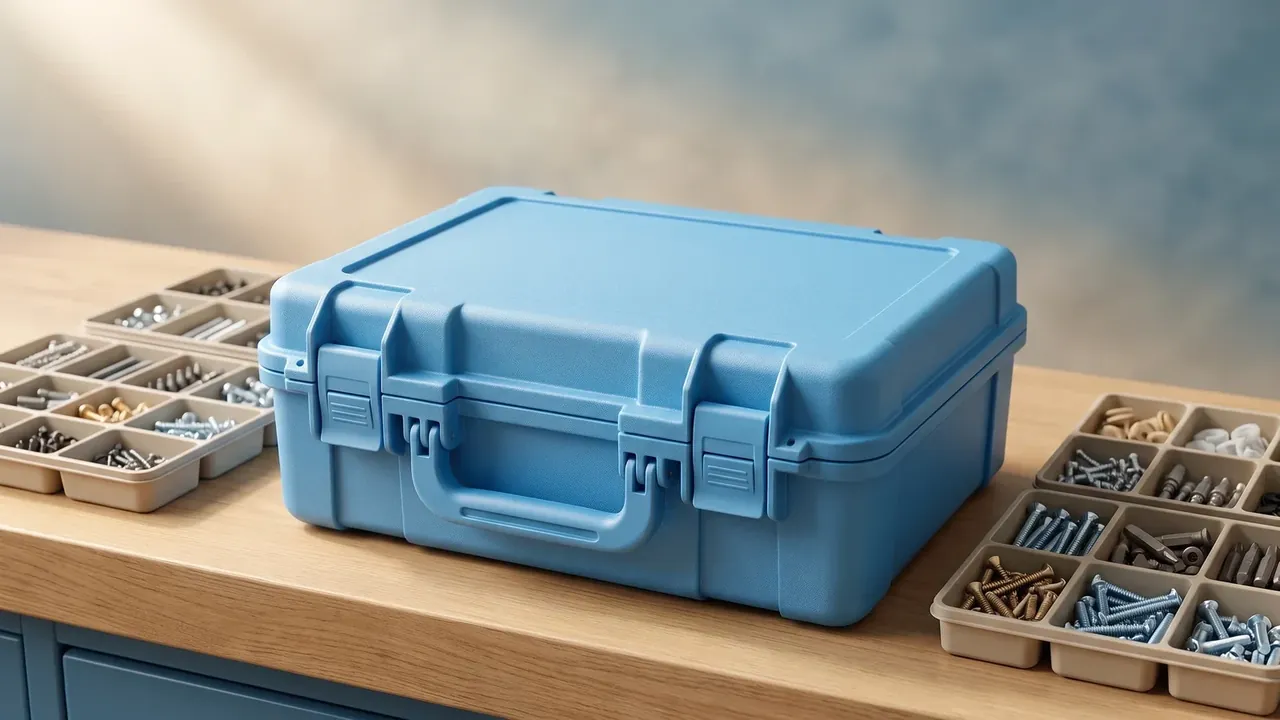
Silicone at 40 Shore A, 6 mm section, seals at 25 to 30 percent compression. Under 20 percent the cord never flattens and dust walks past; over 40 percent the latches need force, and after a few dozen closures they deform. Four latches beat two, and the classic failure of a site Mechanic tool case is a lid closed on the middle two with both ends standing open.
Foam has to change to closed cell. Open-cell EVA holds dust that shaking will not release; the grit packs into the pores, the pockets shallow out, and tools start sitting proud. Closed-cell PE wipes clean with a damp cloth in two passes.
Base material draws a line here too. HDPE keeps toughness to minus 25 °C, while PP turns brittle below minus 10 °C and can split at a corner from a single drop.
Ribs under the base start at 8 mm and are done at 3 mm. On gravel or bare concrete, a hundred metres of dragging takes about 1 mm off the rib crown.
4. Height and Dead Circuits: One Hand Only
Turbine nacelles, substations and rail possession windows share three constraints: little room, little time, one free hand. A nacelle gives 1.2 m of headroom, and a lid that swings up needs 400 mm of it, which leaves the technician standing side-on.
Here the lid must stop at 100 degrees, or come off altogether. A Mechanic tool case without a stop, set on a 15 degree surface, closes itself onto the web of the hand.
A tether point is the other non-negotiable. One 10 mm hole each side, 6 mm cord, tied to a ladder or rail, and the case cannot leave the platform.
A 180 minute possession window pushes pick-and-return under 30 seconds, which means the layout follows the order of use rather than the size of the tools.
| Duty | Room | Lid | Pick and return | Tether |
|---|---|---|---|---|
| Nacelle | 1.2 m headroom | 100 degree stop or removable | Under 30 s | One hole each side |
| Substation | 0.9 m aisle | Single-side flip | 45 s | Single point |
| Rail possession | 1.1 m underframe | Slide-out tray | 25 s | Not needed |
| Tower platform | 1.4 m square | Flat, 180 degrees | 60 s | Two points |
5. Four Duties Side by Side
Compressed into one view, the four duties differ in assembly method and failure type, not in case size. Line work fails at the pockets, patrol fails at the handle root, site work fails at the gasket and foam, height fails at the stop and the tether. Covering the first two with one Mechanic tool case usually means changing foam and handle only; adding the last two pulls in hinge, latches, gasket and shell material, which is a new mould rather than a variant.
| Duty | Build | Key motion | Usual mistake | First check |
|---|---|---|---|---|
| Assembly line | Both sides cut, 100 degree stop | 420 cycles a shift | Pocket flush with tool | 5 mm hinge pin |
| Plant patrol | One side cut, hang slots | 100 m in 40 s | Handle root cracks | 28 by 20 mm grip |
| Open-pit site | Closed-cell foam, four latches | Set down on ground | Only middle latches closed | 25 percent compression |
| Height work | Removable lid, two tethers | One-handed opening | No lid stop | Lid holds 100 degrees |
6. Five Failures and Where They Start
Returns from the field land on the same five spots, and each has a cause you can measure rather than guess.
- Hinge sag: 4 mm pin, 0.15 mm clearance, 1.2 mm of rim offset after 100,000 cycles. Check the seam quarterly; a 1 mm difference end to end means new pins.
- Handle root split: 3 mm wall with no rib, whitening within 40 seconds of carrying 12 kg. Look along the root monthly.
- Latch spring fade: 20 closures a day takes pull from 80 N to 55 N after 8,000, and the lid starts to sit loose. Test pull twice a year.
- Pocket shallowing: open-cell foam packs down 1 to 2 mm under grit, and tools stand above the rim. Lay a straight edge across the pocket each quarter.
- Corner split: PP below minus 10 °C, crack starting at the corner radius, scrap past 20 mm. Inspect all four corners after any winter drop.
Conclusion
Duty differences in a Mechanic tool case come down to millimetres: 2 mm of pocket depth keeps a tool off the lid, 1 mm of pin diameter buys years of hinge life, 25 percent gasket compression keeps grit outside. A line buys opening feel, a mine buys sealing and toughness, height work buys a stop and a tether. Fix the duty first, argue about volume later, and the case will still close squarely after the first wet season.
This article discusses only the container (case body) side of specifications and design intent, and does not cover any handling, loading or use of the contents.
Related Reading
- How tool chests are used across trades
- Mechanics tool pouch configurations
- Hardware tool box applications
- Mounting a tool case in a vehicle
Related Products
- 8 Series — Gun Cases; Military Equipment Cases; Camera Equipment Cases; Drone Cases; Watch Cases; Knife Cases; First Aid Cases; Electronics Equipment Cases
- WL8-2812 PP Gun Case — model WL8-2812
- All protective cases and toolboxes: 7 series, 158 models