

Quick answer: Against a hard case, tool roll, canvas tote and belt pouch, the mechanic's tool pouch is judged on five numbers: empty weight, usable load, seconds per pick, cost per shift, survival of a drop. None wins everywhere, so ask which number hurts at your bench.
Table of contents
- Five Dimensions Against Four Alternatives
- Weight and Capacity: Interest on Every Kilo
- Retrieval Time Measured in Six Metres
- Protection: Drop, Rain and Crush
- Amortised Cost and Fit by Workstation
- FAQ
1. Five Dimensions Against Four Alternatives
The test is fixed first: eighteen tools in every option, six open-end wrenches, eight sockets, one ratchet, three pliers, nine kilos, one mechanic, a six-metre aisle, five picks averaged.
Empty weight is the product with nothing inside; typical load is the ceiling at which it still closes; time per pick runs from standing to holding a thirteen-millimetre socket and returning; cost per shift divides price by shifts survived.
| Option | Empty weight | Typical load | Outer volume | Time per pick | Cost per shift |
|---|---|---|---|---|---|
| Mechanic's tool pouch | 0.9 kg | 18 tools / 9 kg | 7.5 L | 4 s | CNY 0.29 |
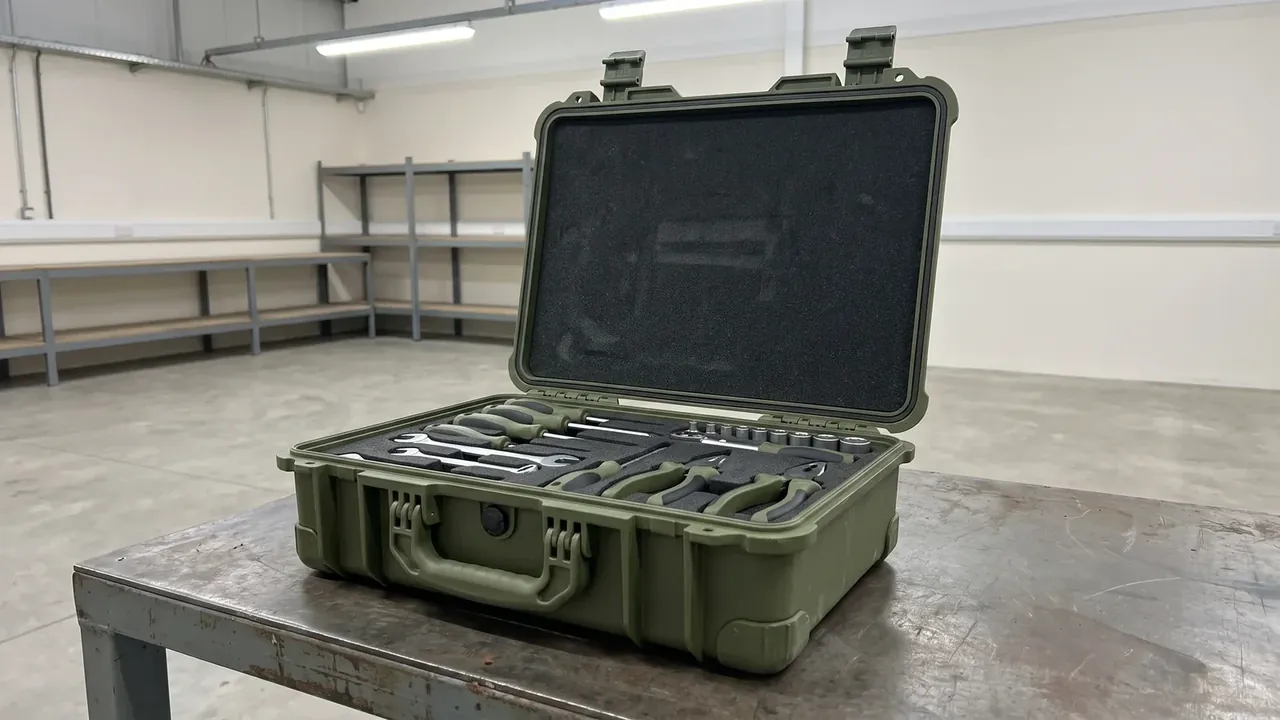
| Hard shell tool case | 4.2 kg | 40 tools / 28 kg | 26 L | 11 s | CNY 0.33 |
| Tool roll | 0.55 kg | 14 tools / 6 kg | 3.2 L | 17 s | CNY 0.30 |
| Canvas tote | 0.7 kg | 25 tools / 15 kg | 18 L | 9 s | CNY 0.37 |
| Belt pouch | 0.35 kg | 8 tools / 3.5 kg | 1.2 L | 1.5 s | CNY 0.26 |
Empty weight spans a factor of twelve; picking speed spans only four, and that part is habit.
2. Weight and Capacity: Interest on Every Kilo
Weight is rent paid every hour. At four kilometres per hour, about eight thousand steps a shift, a nine-kilo mechanic's tool pouch swings 35 mm against 12 mm for a 3.5 kg belt pouch. Capacity fails earlier than the figure suggests: at twelve kilos the mouth of a mechanic's tool pouch flares and the bag must come off the belt, while a hard case still opens at 28 kg but weighs 4.2 kg empty.
3. Retrieval Time Measured in Six Metres
Protocol decides this one: six metres from the bench, a 0.3 mm nitrile glove, a thirteen-millimetre socket as target, clock stopped on return. The hard case spends six seconds on the lid alone, the tool roll eleven unrolling, the canvas tote loses time searching.
At sixty picks a shift the pouch spends four minutes and the case eleven, a gap of 28 hours over 240 shifts, near three and a half working days. At eight picks a day the gap is 56 seconds. A lid also needs two hands, which on a ladder means climbing down.
4. Protection: Drop, Rain and Crush
Protection is judged per hazard. Dropped 1.2 m onto concrete, the hard case arrives intact, the mechanic's tool pouch keeps a scuff and spills nothing, the open tool roll sheds its tools, the canvas tote risks a corner punching through, and the belt pouch pops its buckle.
| Test | Tool pouch | Hard case | Tool roll | Canvas tote | Belt pouch |
|---|---|---|---|---|---|
| 1.2 m drop | scuff, tools stay in | intact | tools spill | punch-through risk | buckle opens |
| 30 min steady rain | inner layer wets | dry inside | soaked | soaked | soaked |
| 200 kg static load | deforms, recovers | no deflection | not applicable | permanent crease | not applicable |
| 50 oil wipes | no seep | no seep | seeps after 30 | seeps after 20 | no seep |
The case wins. The question is whether the margin pays for 3.3 kg more weight and seven seconds per opening; where things fall from above or the floor floods it does, and in a dry aisle it goes unused.
5. Amortised Cost and Fit by Workstation
At CNY 320 over 1,100 shifts the mechanic's tool pouch lands at 0.29 per shift, the hard case at 0.33, the roll 0.30, the tote 0.37 and the belt pouch 0.26. The ranking inverts the price list, since the cheapest tote fails first near 260 shifts. Fit follows the same logic: fixed bench, case; breakdown calls, pouch; height work, belt pouch; long job, roll.
Conclusion
The decision is a trade, not a ranking: the case takes protection and capacity, the pouch weight and speed, the roll volume, the tote price, the belt pouch closeness to the body. A mechanic's tool pouch earns its place by riding on the body and opening with one hand, an advantage that ends at twelve kilos.
This article discusses only the container (case body) side of specifications and design intent, and does not cover any handling, loading or use of the contents.
Related Reading
- How a tool pouch is packed across three workstations
- Tool roll versus the alternatives
- How to specify a hardware tool box
- Choosing a tool pouch by belt load
Related Products
- 8 Series — Gun Cases; Military Equipment Cases; Camera Equipment Cases; Drone Cases; Watch Cases; Knife Cases; First Aid Cases; Electronics Equipment Cases
- WL8-2812 PP Gun Case — model WL8-2812
- All protective cases and toolboxes: 7 series, 158 models