

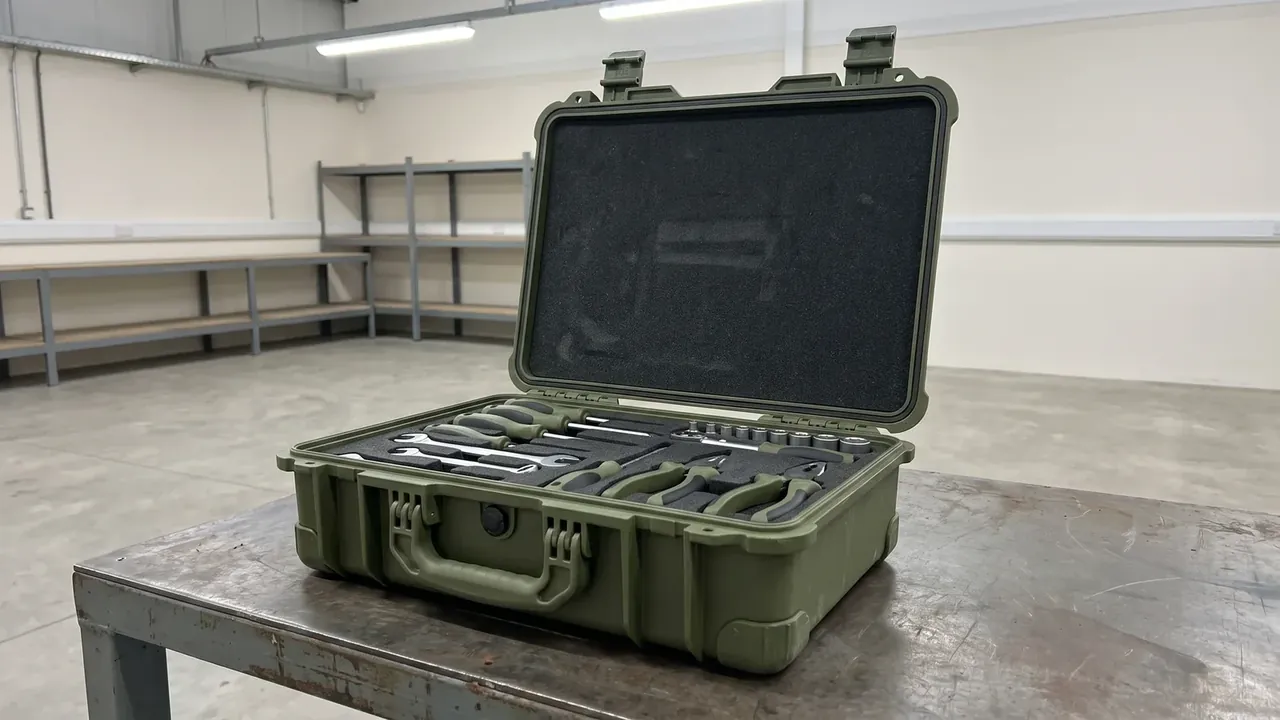
Quick answer: A mechanic's tool pouch reads in five layers: fabric and coating set the abrasion baseline, stitching decides whether seams fail first, pocket layout decides where weight travels, belt loop and handle set the load paths, and oil treatment decides service life.
Table of contents
- Fabric and Coating on a Mechanic's Tool Pouch
- Stitching and Reinforcement: Double Rows, Bar Tacks, Rivets
- Pocket Layout and Load Distribution
- Belt Loop and Handle Interfaces
- Abrasion and Oil Resistance
- FAQ
1. Fabric and Coating on a Mechanic's Tool Pouch
Fabric on a mechanic's tool pouch is graded by denier, the weight of 9,000 metres of yarn. A larger number means a coarser, denser weave and better puncture resistance.
| Panel | Spec | Coating | Purpose |
|---|---|---|---|
| Main body face | 1680D polyester | PVC 0.45 mm | Resists wrench corners |
| Side and slip pockets | 600D polyester | PVC 0.35 mm | Cuts weight, folds easily |
| Base and corner patches | 1680D, two layers | Heavy PVC | Secondary reinforcement |
| Belt backing | 1000D with stiffener | none | Resists curling |
| Lining | 210D oxford | PU | Protects plated tools |
Thicker coating is not better. Around 500 g/m² of PVC, peel strength and suppleness balance out. Finished mechanic's tool pouches usually run 480 to 620 g/m² of fabric; below that the bag will not stand empty and slumps to one side when loaded.
2. Stitching and Reinforcement: Double Rows, Bar Tacks, Rivets
Stitching decides whether the pouch comes apart at a seam. Load seams run two rows of 301 lockstitch at 3.0 mm, about eight stitches per 25 mm; tighter spacing perforates the coating into a line of holes.
| Seam | Stitch | Reinforcement | Parameter |
|---|---|---|---|
| Main pocket mouth | Double 301 | Backstitch | 30 mm |
| Handle root | Double 301 | Bar tack | 12 mm, 28 stitches |
| Belt loop | Double 301 | Tack and rivet | 8 mm brass |
| Base corner | Single plus binding | Rivet | 8 mm, washers |
| Side pocket mouth | Single | Short bar tack | 8 mm |
A bar tack is a dense zigzag that concentrates force into a small patch so a tear cannot run along the seam. Rivets back it up, and every shank needs washers on both faces or the coating cracks. Use 210D/3 nylon thread, which stretches further than polyester.
3. Pocket Layout and Load Distribution
Pocket layout decides where weight sits. The waist carries only so much hanging load, so a full mechanic's tool pouch keeps its centre of gravity near the midline: heavy parts in the main pocket, frequent parts in front.
| Zone | Design load | Typical content | Response |
|---|---|---|---|
| Main pocket | 6 kg | Wrenches, pliers | Double base, stiff back |
| Front slip pocket | 2 kg | Drivers, tape | Angled mouth, elastic |
| Side pocket | 1 kg | Bits, small parts | Flap, single seam |
| Rear pocket | 0.5 kg | Notes, marker | Light lining |
More than 3 kg hung on one side pulls the belt over and leaves a pressure point after a long walk. Depth matters too: below a 0.6 ratio of mouth width to depth, long tools stand half out; above 0.9 they are awkward to reach.
4. Belt Loop and Handle Interfaces
The belt loop on a mechanic's tool pouch transfers load to the body. A 50 mm opening accepts both 38 mm and 50 mm belts, with a bar tack above and below so the webbing cannot stretch out of shape. A two-point press buckle opens one-handed and resists accidental release.
The handle is the second path. Fold 50 mm webbing double, backstitch 30 mm at the root and cap it with a bar tack; static capacity is rated at 15 kg, twice the design load. Offset the D-ring from the handle so both paths never stack on one point.
5. Abrasion and Oil Resistance
Wear starts at the base and corners: two layers of 1680D plus a PU corner patch reaching 20 mm above the side seam. A Taber test at 500 g load and 500 cycles checks whether the ground fabric shows through.
Oil separates a mechanic's tool pouch from an ordinary bag. Engine oil softens PVC until the surface turns tacky and cracks, so specify oil-modified PVC or PU and verify with a 24-hour immersion. Never wipe it with strong solvent, which strips plasticiser.
Conclusion
Put material where the force arrives: fabric graded by panel, seams reinforced where they carry load, pockets balanced on the body, loop and handle given margin, base and coating treated for abrasion and oil. That is how a mechanic's tool pouch earns its service life.
This article discusses only the container (case body) side of specifications and design intent, and does not cover any handling, loading or use of the contents.
Related Reading
- How to choose a mechanic's tool pouch
- Tool bag fabric comparison
- How a tool roll is built and used
- Where mechanics use a tool pouch on site
Related Products
- 8 Series — Gun Cases; Military Equipment Cases; Camera Equipment Cases; Drone Cases; Watch Cases; Knife Cases; First Aid Cases; Electronics Equipment Cases
- WL8-2812 PP Gun Case — model WL8-2812
- All protective cases and toolboxes: 7 series, 158 models