

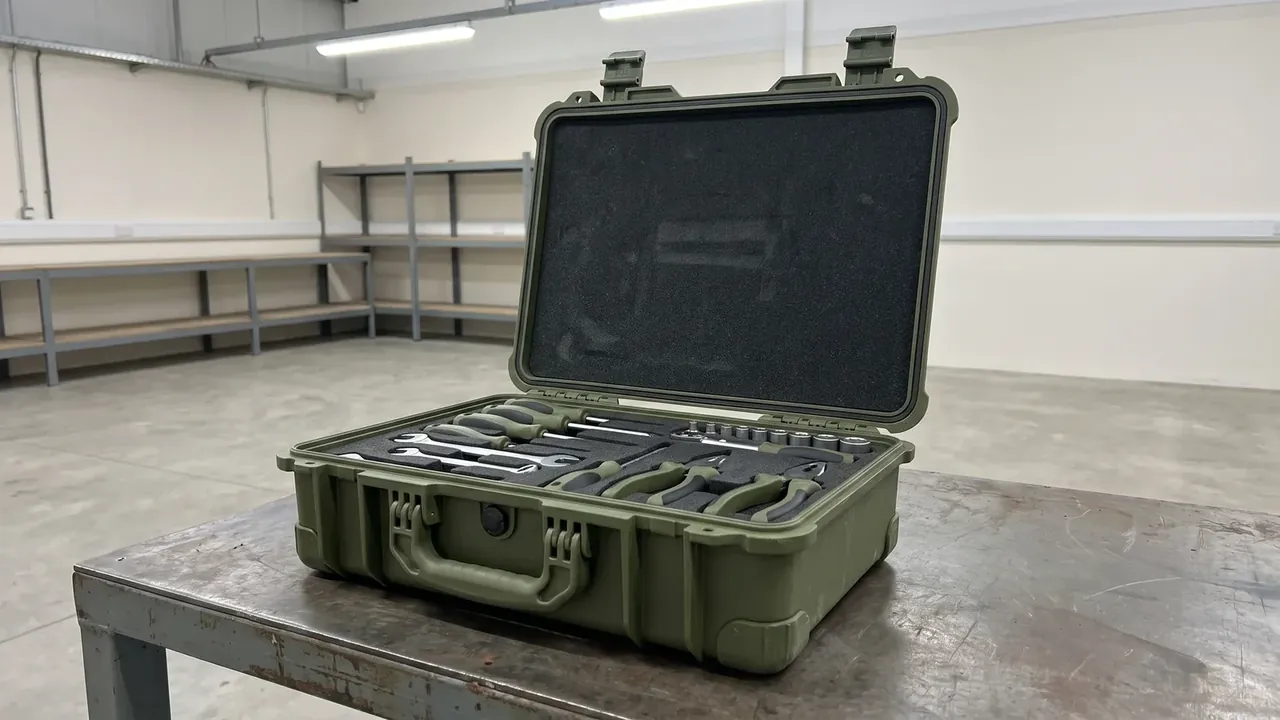
Quick answer: A mechanic's tool pouch specification is four sets of numbers that must agree: layout sets capacity, fabric and coating set wear life, stitch length sets seam strength, load and hardware set the safety margin. Write all four and nothing is left to interpret.
Table of contents
- How to Specify Mechanic's Tool Pouch Outline and Pocket Layout
- Fabric and Coating Lines That Can Be Measured
- Stitch Length, Stitch Density and Seam Allowance
- Rated Load and Attachment Points
- Hardware Specs and the Tolerance Table
- FAQ
1. How to Specify Mechanic's Tool Pouch Outline and Pocket Layout
Start from a datum, not a picture. A mechanic's tool pouch drawing needs three layers: outline with side pockets, cavity without seam allowance, and pocket layout of width and depth.
The datum is the outer face of the bottom panel. Keep the 10 mm seam allowance out of the cavity and list empty and loaded heights separately; the bottom sags 8 to 15 mm at rated load.
| Line item | Example | Tolerance |
|---|---|---|
| Outline, 420 by 260 by 180 mm | Body with pockets | plus or minus 4 mm |
| Main cavity, 300 by 150 by 165 mm | Clear space | plus or minus 3 mm |
Pockets follow a 25 mm module at 25, 50 and 75 mm net width, since most handles measure 20 to 45 mm. Twelve pockets cover a normal set. A 170 mm main pocket is the ceiling; under 120 mm, long shanks ride above the mouth.
2. Fabric and Coating Lines That Can Be Measured
Heavy-duty oxford cloth cannot be tested, so five lines replace it: mass per unit area, density, tensile strength, tear strength and hydrostatic head.
| Property | Main body | Slots |
|---|---|---|
| Mass per unit area | 380 g/m² | 280 g/m² |
| Density per inch | 32 by 26 | 28 by 24 |
| Tensile strength | 1400 N warp | 900 N warp |
| Tear strength | 45 N | 30 N |
| Hydrostatic head | 1500 mm | 800 mm |
Weigh three samples per roll; above eight percent spread means mixed lots. 380 g/m² suits the body and 280 g/m² the slots, saving over two hundred grams. Plain weave wears evenly; twill snags on corners. For polyurethane coating, ask for peel adhesion above 3 N/cm, 30,000 flex cycles, and 180 degree folding at minus 20 degrees Celsius.
3. Stitch Length, Stitch Density and Seam Allowance
Stitch length and density describe one property, so pick one. Main seams run at 4.0 mm, six or seven stitches per 25 mm, tightening to 3.2 mm at the mouth and corners. Needles are size 110, thread is 20/3 polyester core-spun, and speed is capped at 2800 stitches per minute.
Denser is not stronger. Holes in a row pre-cut a tear line, so the seam opens along the perforation. Allowance is 10 mm, binding 12 mm, backstitch 25 mm, raw edges enclosed.
4. Rated Load and Attachment Points
Load needs two numbers. A mechanic's tool pouch is rated 12 kg at a safety factor of four, so 48 kg held for one hour with no seam opening is the pass line.
Attachments sit at the left hip, right hip and back, two eyelets each, 60 mm between centres, 10 mm bore, 8 kg per point and deflection under 5 mm, placed at two thirds of pouch height to limit swing.
Twelve kilograms is roughly thirty common tools: eight combination wrenches near 2.6 kg, a 250 mm adjustable wrench at 0.45 kg. Past that, move up a size and state three-point even loading.
5. Hardware Specs and the Tolerance Table
List hardware part by part: 25 mm polyacetal buckles, 25 mm ladder locks, brass eyelets with a 10 mm bore, a size 8 nylon zip. Plating is 8 microns; thinner shows rust within two months.
Size 8 teeth measure 6.4 mm and need a size 8 slider; a mouth radius under 60 mm calls for a two-way slider. Zip length is mouth width minus 20 mm.
| Item | Nominal | Tolerance |
|---|---|---|
| Outline | 420 by 260 by 180 mm | plus or minus 4 mm |
| Pocket position | 40 mm below mouth | plus or minus 2 mm |
| Stitch length | 4.0 mm | plus or minus 0.4 mm |
| Pouch weight | 1.35 kg | plus or minus 3% |
Tolerances on a mechanic's tool pouch are not shared evenly: pocket position tightens to 2 mm because a shifted pocket is felt at every draw, and weight past three percent means the stiffener changed. Close with two sealed samples.
Conclusion
Mechanic's tool pouch specifications translate durability into numbers: dimensions tied to a datum, fabric to four strength properties, sewing to stitch length, load to a rating, closed by a tolerance table. Then sampling and mass production stop drifting apart. Attach the table to the enquiry, and the mechanic's tool pouch brief does its job.
This article discusses only the container (case body) side of specifications and design intent, and does not cover any handling, loading or use of the contents.
Related Reading
- How to choose a mechanic's tool pouch
- Tool bag fabric comparison
- Specification lines for a consolidated tool kit
- Socket wrench set case specifications
Related Products
- 8 Series — Gun Cases; Military Equipment Cases; Camera Equipment Cases; Drone Cases; Watch Cases; Knife Cases; First Aid Cases; Electronics Equipment Cases
- WL8-2812 PP Gun Case — model WL8-2812
- All protective cases and toolboxes: 7 series, 158 models