

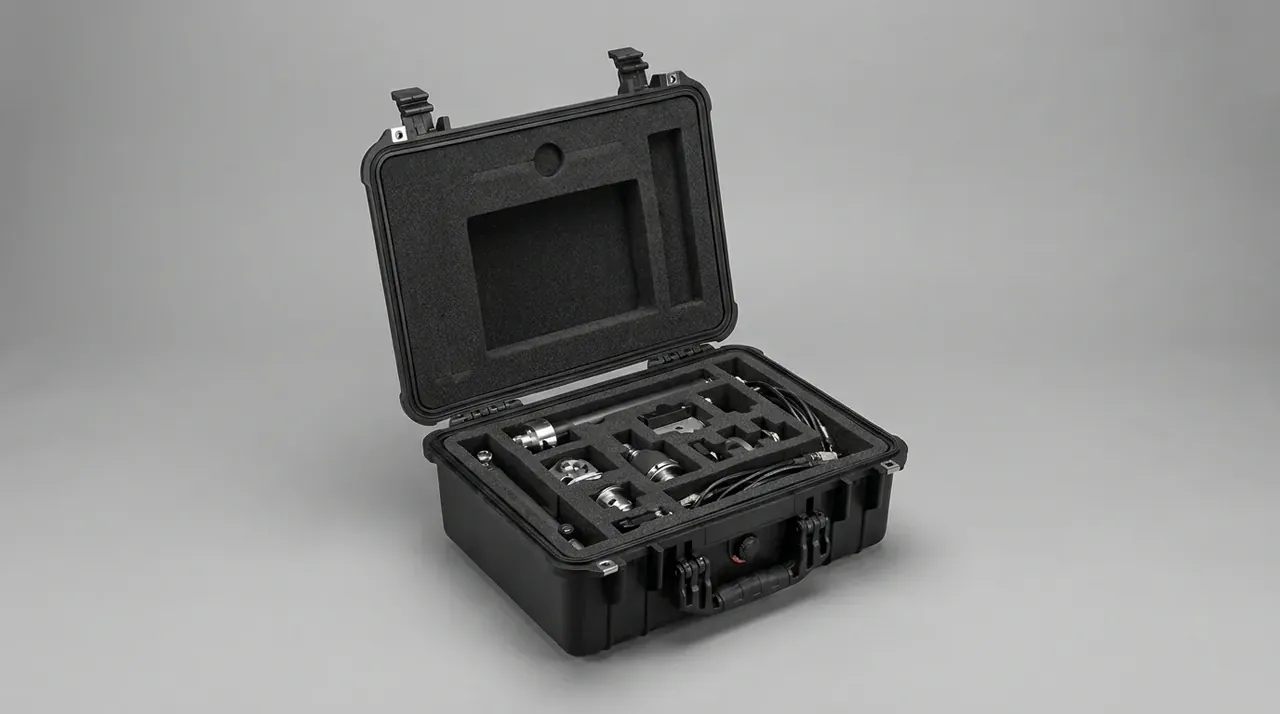
Quick answer: Medical blood pressure monitor shockproof case meets 10–55 Hz for 2 h and a 1.0 m corner drop, on a 320 by 240 by 90 mm cavity and 45 kg/m³ foam.
Table of contents
- Where vibration enters a medical blood pressure monitor shockproof case
- A 120 by 90 by 60 mm cuff bay and the 25 mm bend radius
- What 45 kg per cubic metre buys and costs
- Corner landing order in a 1.0 m drop
- Holding the air connector still in transit
- FAQ
1. Where vibration enters a medical blood pressure monitor shockproof case
An ambulance crosses a speed bump and a muffled knock comes out of the box. The monitor has not moved, but the cuff has slid two fingers wide and the tube carries a crease. Nothing was dropped; the case took a dose of vibration.
Road resonance sits at 3–7 Hz, truck structure at 10–30 Hz, and relative motion between case and insert above 30 Hz. The design band is 10–55 Hz because that is what the shell amplifies: the wall flexes at 10–30 Hz and foam only turns motion into heat above 30 Hz.
| Link in the path | Dominant band | Case-side measure |
|---|---|---|
| Base wall | 10–30 Hz | 2.8 mm wall, two longitudinal ribs |
| Foam layer | 30–55 Hz | 45 kg/m³ bead foam, 25 mm pads |
| Pocket face | above 55 Hz | 0.5 mm clearance, flocked surface |
Two hours is the time budget: a drop lasts tens of milliseconds, while two hours of shaking walks screws back and furs a tube at an edge. ISTA 3A spans 2–200 Hz at 0.46 to 0.53 Grms, so the Medical blood pressure monitor shockproof case takes the 10–55 Hz slice.
2. A 120 by 90 by 60 mm cuff bay and the 25 mm bend radius
An adult cuff fits a 22–32 cm arm, bladder 22–26 cm by 13–15 cm, and rolls to 55–60 mm thick. The bay is 120 by 90 by 60 mm with 5 mm clearance each way, so the lid pad holds the roll still.
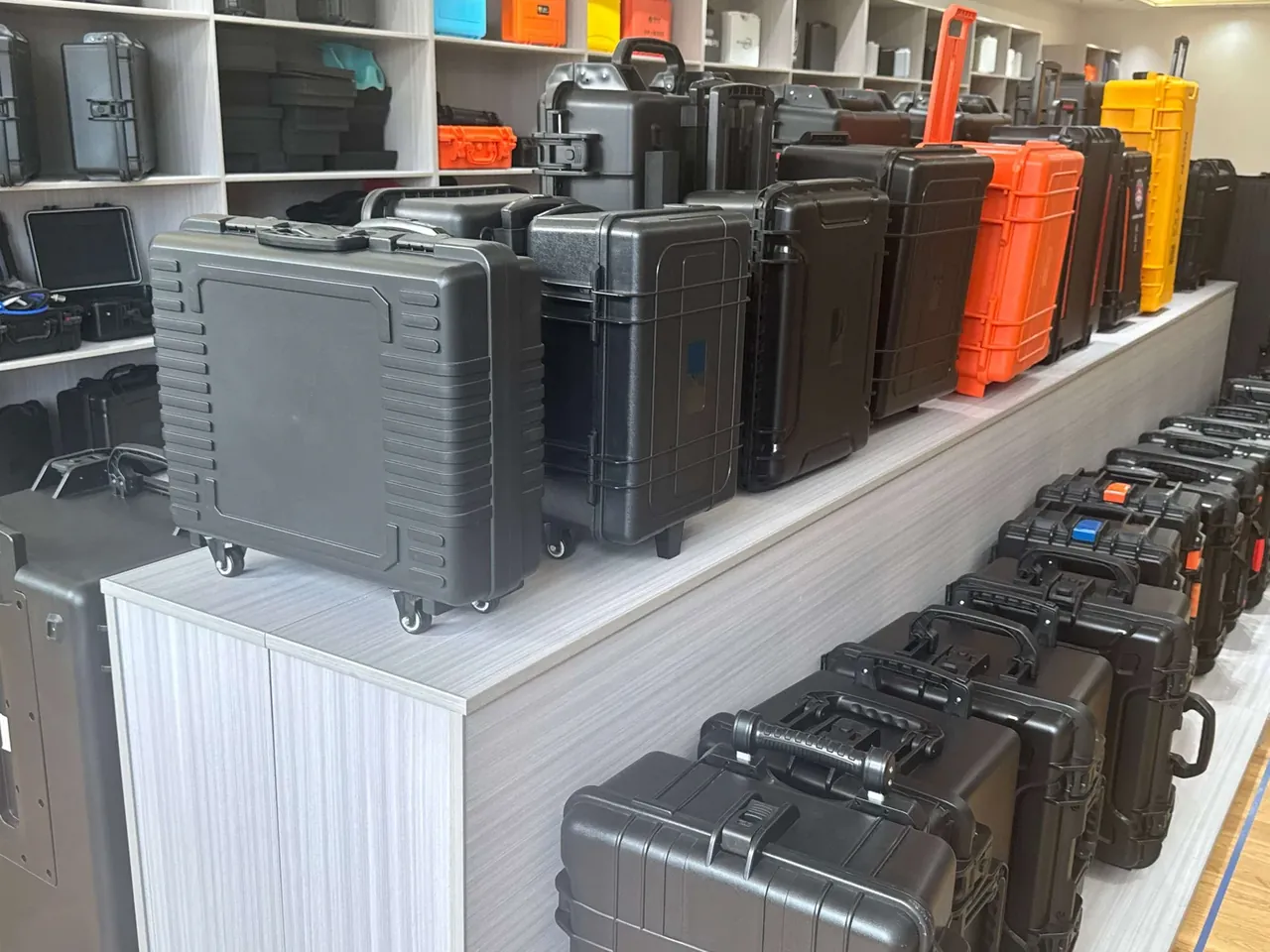
A single-tube cuff carries 45–50 cm of hose at 4–6 mm outside diameter, with 4.0 to 6.0 mm connectors. Below a 25 mm bend radius the tube flattens and stays flat, so damping changes and readings drift. The Medical blood pressure monitor shockproof case coils it 2.5 turns at a 30 mm radius, wound the way the factory wound it.
| Item | Value | Note |
|---|---|---|
| Outer size | 360 by 280 by 130 mm | with corner guards and latch bosses |
| Cavity | 320 by 240 by 90 mm | three pockets combined |
| Wall | 2.8 mm | base, sides and lid |
| Empty mass | 1.8 kg | foam and hardware included |
| Payload | 3.2 kg | monitor, cuff, hose, connectors |
| Loaded mass | 5.0 kg | near the one-hand ceiling |
3. What 45 kg per cubic metre buys and costs
Density is not a safety dial. Bead EPE at 45 kg/m³ carries 142.7 kPa at 25% compression and 231.0 kPa at 50%, with 4% set after 22 h at 25% strain. At 30 kg/m³ that figure is 88.3 kPa; at 67 kg/m³ it reaches 246.1 kPa.
| Density | Stress at 25% compression | Set after 25% strain |
|---|---|---|
| 30 kg/m³ | 88.3 kPa | 4% |
| 45 kg/m³ | 142.7 kPa | 4% |
| 67 kg/m³ | 246.1 kPa | 7% |
Static stress explains the choice. A 3.2 kg payload on a 200 by 150 mm footprint spreads 31.4 N over 0.03 m², about 1.0 kPa, where foam barely compresses. Four 20 mm pads cut bearing area to 0.012 m² and lift stress to 2.6 kPa, near the trough for 45 kg/m³.
Mass follows density: 0.006 m³ of solid foam is 0.27 kg at 45 kg/m³, 0.40 kg at 67 and 0.18 kg at 30. EPE loses a fifth of its cushioning at −10 °C, so a 0.8 factor applies before stress is checked; 50 °C sits far below the 80 °C limit.
4. Corner landing order in a 1.0 m drop
The first contact at 1.0 m is a corner, not a face. A 5.0 kg case lands at about 4.4 m/s with 49 J to absorb in tens of milliseconds. Ten drops follow one corner, three edges and six faces, corner first.
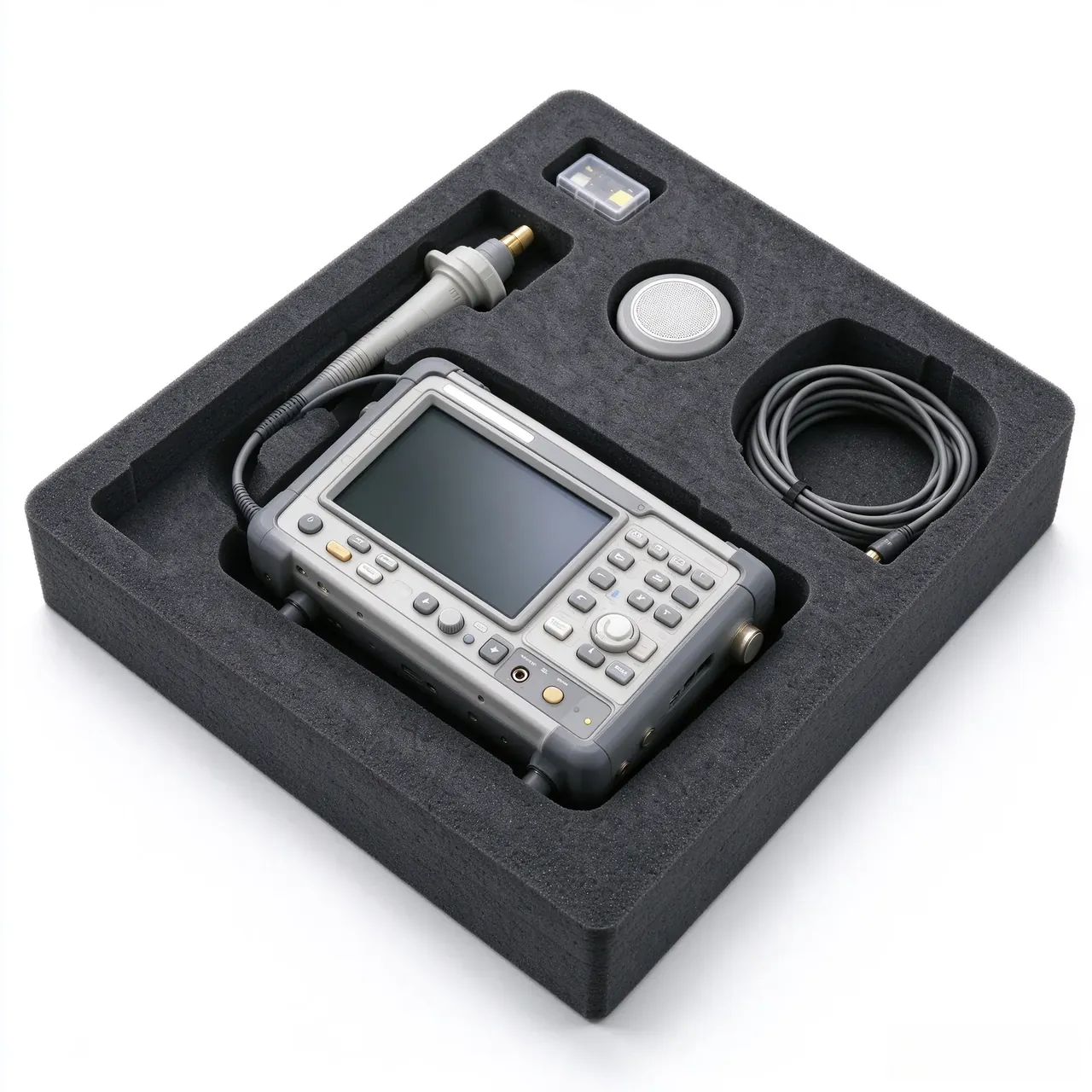
R6 outside and R3 inside carry that load, with the wall climbing from 2.8 mm to 3.2 mm through the corner. R6 spreads impact along an arc; R3 keeps melt moving so no weld line forms for a drop to open.
The 1.0 m figure is stricter than two common references: ASTM D4169 Level II asks for 361 mm at 0 to 9.1 kg and ISTA 3A uses 460 mm up to 32 kg. Pass means no shell crack and no sprung lid.
5. Holding the air connector still in transit
A 4.0–6.0 mm connector weighs under 3 g, and once free it rolls into a corner and stays missing. Each gets a Ø14 mm, 20 mm deep well with a 1 mm elastic lip, plus a 2 mm vent so suction does not grip it.
Where hose meets connector sits a 15 mm straight channel, 1 mm wider than the tube, to keep side load off the joint. A coil wants to spring back, and a connector riding the coil walks off its nipple. The Medical blood pressure monitor shockproof case moulds that channel into the rib between the two bays, clear of the hand reaching for the cuff.
The handle sits over the centre of gravity, 110 mm wide in an 18 by 12 mm section, so 5.0 kg arrives as about 12 N per finger. Supply runs 300 pieces in standard colour, 1000 custom, 7–10 days for a sample and 25–35 days for a repeat order.
Conclusion
Vibration is the real opponent; the drop is only its loudest moment. The Medical blood pressure monitor shockproof case splits 10–55 Hz over two hours between wall, foam and pocket face, then checks corners with ten landings from 1.0 m against a 5.0 kg loaded mass.
This article covers the case side only, meaning shell, foam and pocket dimensions. It does not describe any handling, filling or use of what goes inside.
Related Reading
- Latch and mass budgets for transport cases
- Foam inserts for small centrifuge cases
- Where a plastic case stops and a wooden crate starts
- Case-side specifications for emergency equipment boxes
Related Products
- 8 Series — Gun Cases; Military Equipment Cases; Camera Equipment Cases; Drone Cases; Watch Cases; Knife Cases; First Aid Cases; Electronics Equipment Cases
- WL8-2812 PP Gun Case — model WL8-2812
- All protective cases and toolboxes: 7 series, 158 models