

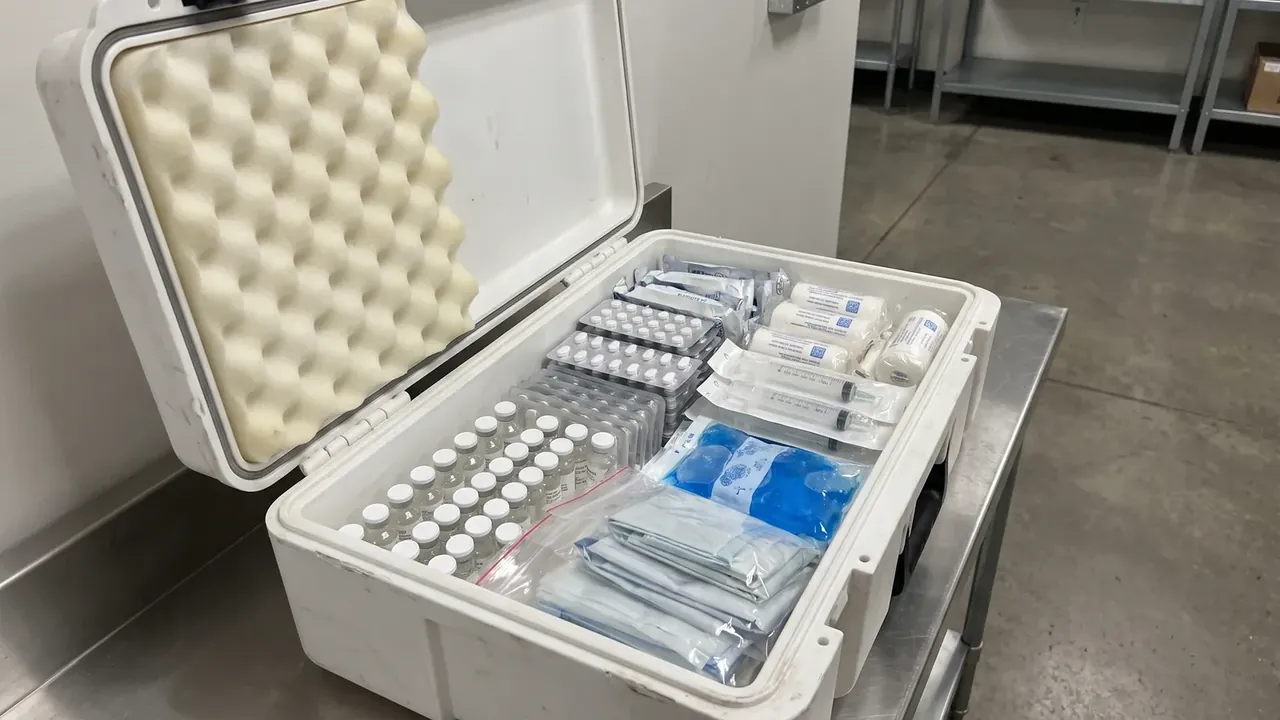
Quick answer: A portable medical emergency equipment safety box takes 500 wipes of 75% alcohol but only 200 of 500 ppm hypochlorite; its gasket hits 15% set first.
Table of contents
- Shell: how many wipes PP+GF20 takes
- Two disinfectants: 500 cycles and 200
- The gasket goes first: 70 Shore A and 15%
- A 100° lid, −20 ℃ and UV 300 h
- FAQ
1. Shell: how many wipes PP+GF20 takes
Boxes in medical use are rarely broken by a drop. Most are worn out by wiping. A portable medical emergency equipment safety box shell is moulded in PP+GF20, polypropylene with 20% glass fibre. The fibre is not there to make the shell harder; it keeps the wall from going soft and the lid edge straight between −20 ℃ and 60 ℃.
The resin layer on the surface is only tens of microns thick, and each wipe takes some of it away. Once fibres stand proud the surface turns pale, so the limit is chalking, not wear-through.
Gloss hides nothing: a polished shell shows the first loss at once, which is why 500 passes is cautious on a glossy face. A textured face buries chalking in the grain, yet its valleys wear faster and the peaks pale late.
Chalking needs no instrument. Rub a black cloth ten times across the lid; a white trace means it has begun.
2. Two disinfectants: 500 cycles and 200
75% alcohol is mild on the PP+GF20 of a portable medical emergency equipment safety box. Run the cycle at 90 s of wiping and 15 min of drying, and after 500 passes the surface still holds gloss inside ΔE 0.4. Both times are test conditions rather than a site procedure; they exist so each exposure is comparable.
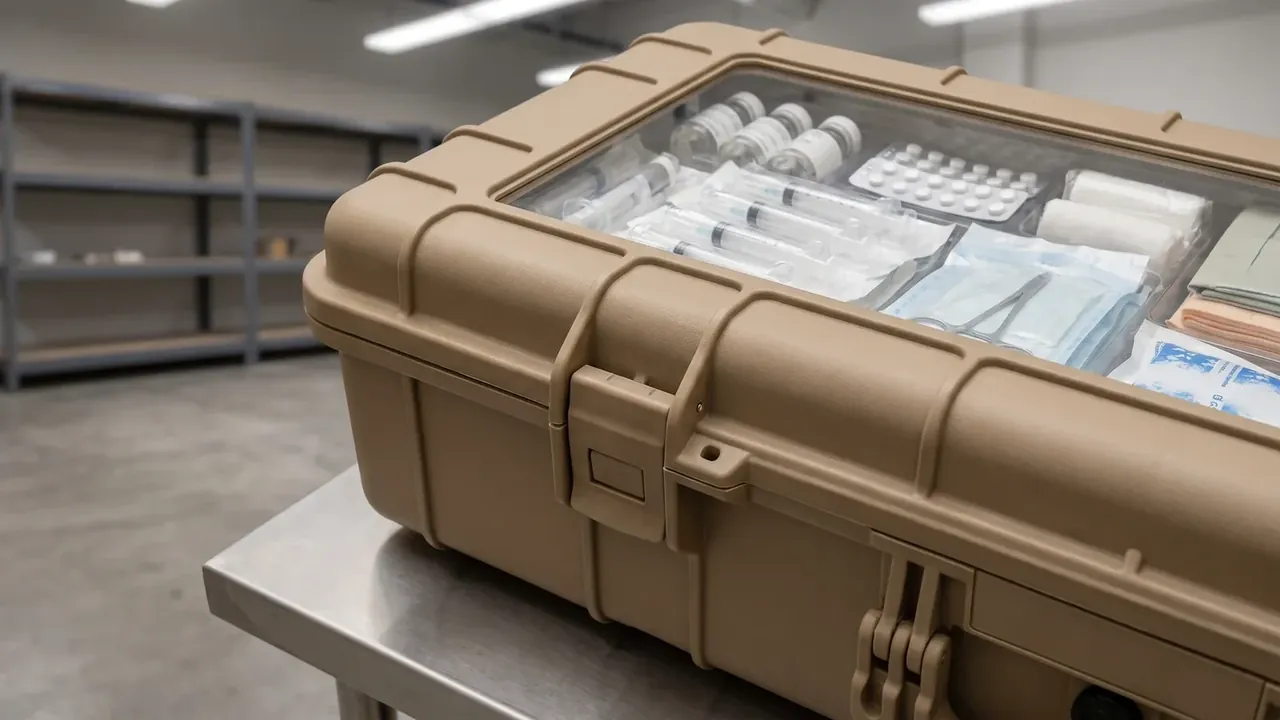
Sodium hypochlorite is an oxidiser and attacks the polymer chain. On a portable medical emergency equipment safety box at 500 ppm it reaches ΔE 1.0 after 200 passes. Close the lid wet and the residue stays longer, which makes 200 optimistic.
Concentration and cycle count are not linear. Double 500 ppm to 1000 ppm and the limit falls from 200 passes to 80, four tenths of the original. Oxidation speeds up, the surface resin goes an order of magnitude faster, and the passes shrink with it.
A neutral soap solution only lifts soil; it does not disinfect, it costs the surface almost nothing, and it belongs before the alcohol.
| Disinfectant | Active agent | Compatibility | Role |
|---|---|---|---|
| 75% alcohol | Ethanol | Gloss held past 500 passes | Routine |
| 500 ppm hypochlorite | Hypochlorite ion | ΔE 1.0 at 200 passes | Restricted |
| Neutral soap | Surfactant | Almost no loss | Pre-clean |
| Concentration | Wipe limit | Gloss loss | Note |
|---|---|---|---|
| 75% alcohol | 500 passes | ΔE 0.4 | Baseline |
| 500 ppm hypochlorite | 200 passes | ΔE 1.0 | Four tenths |
| 1000 ppm hypochlorite | 80 passes | ΔE 1.6 | Halved again |
3. The gasket goes first: 70 Shore A and 15%
The gasket on a portable medical emergency equipment safety box is EPDM at 70 Shore A. Hardness sets closing force: too soft and the lid edge never seals, too hard and two latches cannot pull it down.
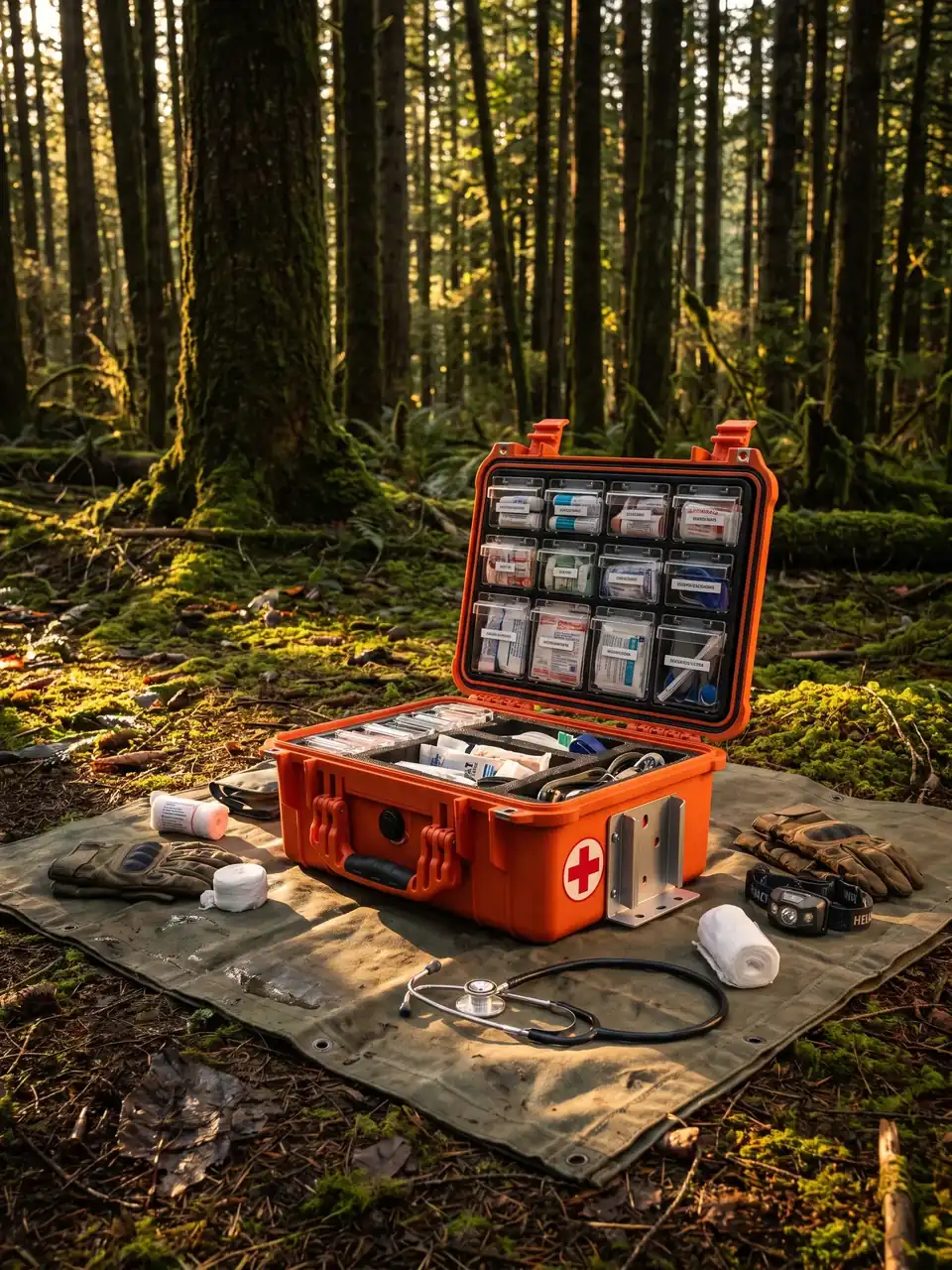
The gasket on a portable medical emergency equipment safety box ages faster than the shell. It flattens from about 200 passes, going from round to oval while the rebound slows. At 15% compression set it is a replacement line, because the lid edge no longer sits down and immersion fails first.
Set can be measured without a lab: pull the gasket, measure section height, compare with a new one. 8% is serviceable, 15% is finished. Keep clear of the joint.
The test behind the figure is fixed: compress to 75% of height, hold 24 h at 70 ℃, release 30 min, measure. Change the method and the same compound reads 2 points apart, so 15% means nothing without it.
Two φ4 mm seal holes and a 1.2 mm security wire belong together. The wire passes through and is knotted, the closed lid traps it, and opening always breaks it. Those holes are not screw holes: a screw splits the wall and proves nothing.
| Wipe limit | Gasket hardness | Compression set, % | Verdict |
|---|---|---|---|
| 100 passes | Unchanged | 8 | Normal |
| 200 passes | Up 2 points | 11 | Watch |
| 500 passes | Up 5 points | 15 | Replace |
4. A 100° lid, −20 ℃ and UV 300 h
The lid opens to 100°, the angle that keeps the edge clear of a bench. At 750 mm bench height the arc stays outside the front edge; five degrees less and the edge scrapes and loads the latch side.
The −20 ℃ to 60 ℃ rating of a portable medical emergency equipment safety box belongs to the shell, not the gasket. At −20 ℃ the EPDM stiffens and set rises temporarily, so the latch feels tight. It recovers indoors and does not count as permanent set.
UV 300 h leaves a shift of ΔE 1.0, roughly one year of a white shell beside a window. White hides yellowing least: ΔE 1.0 is just visible, and past it lid and body stop matching when two boxes stand side by side.
Two latches at 300 N each hold the lid, pressing 600 N onto one EPDM gasket. Whether that is enough depends on how far the section compresses, not on how hard the latch closes. A latch shut with the gasket still proud means the section is thin or the lid edge is not flat.
The latch body is PA66 on an interference fit: too much and the lid needs two hands, too little and it pops open in transit. The 300 N is holding force, not failure force, which runs over twice that.
Conclusion
The life of a portable medical emergency equipment safety box sits half in the shell resin and half in the gasket rebound. PP+GF20 gives 500 wipes with 75% alcohol and 200 with 500 ppm hypochlorite; doubling the concentration cuts the limit to four tenths. The 15% set arrives before any pale patch. Ask for those numbers, not a material name.
Related Reading
- Medical case checks and replacement lines
- Where disinfection stops for medical cases
- Silicone, EPDM and PVC gasket materials
- How IP67 is actually judged
Related Products
- 8 Series — Gun Cases; Military Equipment Cases; Camera Equipment Cases; Drone Cases; Watch Cases; Knife Cases; First Aid Cases; Electronics Equipment Cases
- WL8-2812 PP Gun Case — model WL8-2812
- All protective cases and toolboxes: 7 series, 158 models