

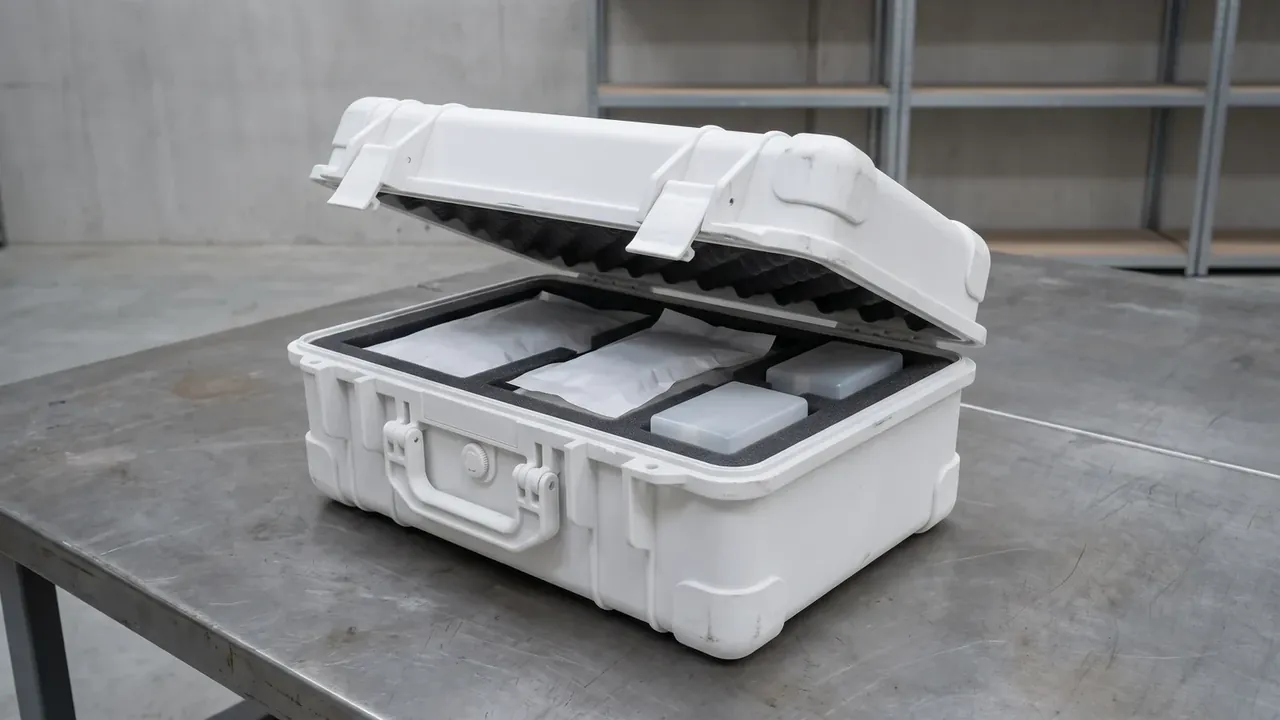
Quick answer: Judge a medical case by interior space, wall stiffness, clamp points, tray interchange and handle reserve, in that order. The five checks take half an hour and need no instruments.
Table of contents
- Measure the Interior, Not the Outside
- Stiffness: Press the Wall With Both Hands
- Sealing Is Set by Clamp Points
- Dividers Only Matter If the Tray Swaps
- Handle, Stacking and Transport Interfaces
- FAQ
1. Measure the Interior, Not the Outside
A medical case is sold on its outside length. Take a body of 470 x 350 x 185 mm with a 3.5 mm wall, 12 mm corner radii and floor ribs: the opening measures 420 x 300 x 160 mm, and usable volume lands under 62 percent.
Measure usable height separately, because lid foam eats it. A 20 mm layer of convoluted foam leaves about 140 mm from rib tops to foam face. A 150 mm bottle upright fouls the lid, the latches stop short and the gasket never seats.
| Figure | How to measure | Example | What it decides |
|---|---|---|---|
| Outside | Widest point, latches included | 470 x 350 x 185 mm | Shelf depth |
| Interior | Opening edge | 420 x 300 x 160 mm | What fits |
| Usable height | Rib top to foam face | 140 mm | Upright bottles |
Work backwards: list the longest item, then derive the opening. A 300 mm tray needs 10 mm of foam per side, so the opening must reach 320 mm.
2. Stiffness: Press the Wall With Both Hands
Thickness is half of stiffness; geometry is the rest. A 3.0 mm polypropylene wall with 8 mm ribs resists bending better than a 3.5 mm flat wall, so read the figure with the rib layout: pitch under 80 mm.
No equipment is needed. Press both side walls inward and release. A crisp return with no white stress marks means wall and ribs are matched. If the rim bows and the lid gap is uneven, the gasket leaks there.
Then load it. A filled medical case weighs about 11 kg, carried between the handle mounts, where bulging appears. Substitute two 5 litre bottles and a 1 kg weight, walk 20 m, and check the bottom corners for blush.
3. Sealing Is Set by Clamp Points
The gasket is made by even compression, not loop count. A 6 mm cord section needs 25 to 30 percent compression for a continuous contact band. Less leaves a gap; more takes a permanent set and the second closure leaks.
Long cases are where clamping goes wrong. A 470 mm body with two end latches leaves 300 mm in the middle relying on wall stiffness, and it does not hold; vapour enters along that seam.
| Case length | End latches | Clamp points | Note |
|---|---|---|---|
| 400 mm | 2 | 3 | Centre catch |
| 470 mm | 2 | 4 | Two per side |
| 550 mm | 2 | 4 plus seam rib | Long body |
Two field checks settle it. Trap a paper strip across the rim, latch the lid, then pull: if it slides out, that section is unclamped. Or lift one end; a gap over 2 mm marks the leak.
4. Dividers Only Matter If the Tray Swaps
More compartments is not the goal; replaceable ones are. A medical case earns its life from a foam tray that lifts out in one piece and trays that interchange between bodies. A moulded-in grid is scrap the first time the list changes.
Slot pitch is commonly 25 mm. Specify closed-cell foam at 30 kg per cubic metre or denser; lighter material compresses at the pockets in a season. Leave a 15 mm finger notch for gloved hands.
5. Handle, Stacking and Transport Interfaces
The handle is the most neglected load path. At 11 kg loaded, one-handed carrying peaks above twice the static load, so a 30 kg rating is the sensible floor. Lift, hold ten seconds, and check the roots for blush.
The base should carry stacking grooves so five units stack without sliding, and the sides need strap channels for 25 mm webbing. Without them, a loaded medical case is located only by neighbouring cargo.
Conclusion
Run the tests in this order: interior, walls, clamps, tray interchange, handle and interfaces. Interior comes first because the wrong size ends the conversation, tray interchange decides service life, and the handle decides whether the case ever leaves the store. A medical case is judged by what it does under load.
This article discusses only the container (case body) side of specifications and design intent, and does not cover any handling, loading or use of the contents.
Related Reading
- How a medical case is structured and divided
- Medical case layouts for aid posts and field teams
- First aid kit case layout and quick access
- How to specify an emergency supply case
Related Products
- 8 Series — Gun Cases; Military Equipment Cases; Camera Equipment Cases; Drone Cases; Watch Cases; Knife Cases; First Aid Cases; Electronics Equipment Cases
- WL8-2812 PP Gun Case — model WL8-2812
- All protective cases and toolboxes: 7 series, 158 models