

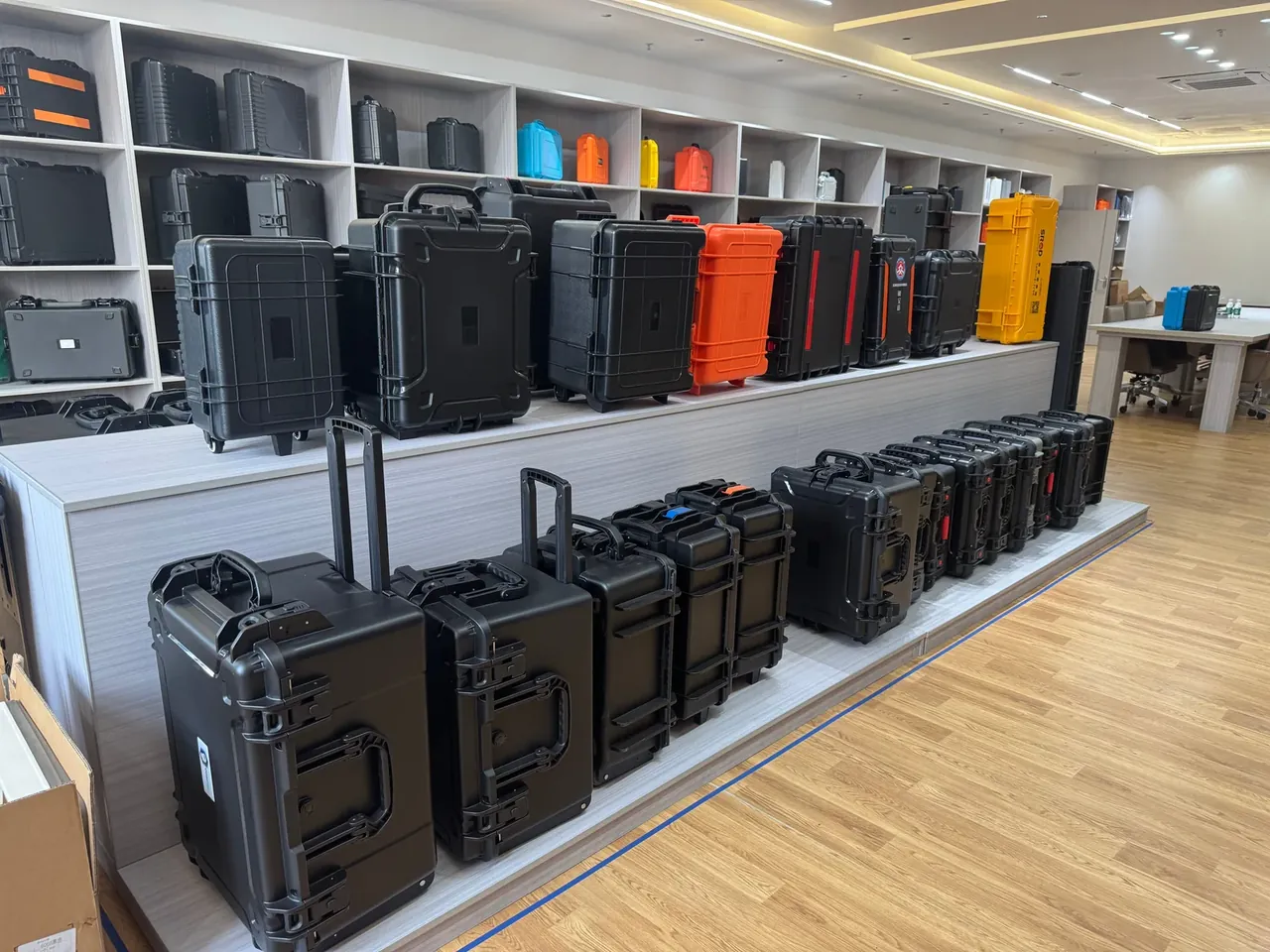
Quick answer: Medical EEG machine protective trolley box layout puts 4.5 kg of headbox over the axle and the 21-lead cap in its own tray.
Table of contents
- Why the headbox and the electrode cap ride in separate layers
- Three handle stages and where the centre of gravity lands
- Latch count against lid stiffness
- Castors on outpatient flooring
- Coil radius and connector protection for the lead bundle
- FAQ
1. Why the headbox and the electrode cap ride in separate layers
Inside a Medical EEG machine protective trolley box the first casualty is rarely the amplifier; it is the cap. The headbox is a sealed aluminium shell that shrugs off a knock, while the cap is a fabric dome holding twenty-one soft electrodes trailing hair-thin leads. Let 4.5 kg rest on that dome overnight and electrode heights go uneven, which appears next morning as impedance climbing across the montage.
So whatever crushes easily goes on top, the mass goes to the floor, and the two never share a layer. The cavity splits into three tiers for that reason, headbox on the base, a lift-out foam tray for the cap in the middle, the lid hollow left for leads. Handling follows the tiers: leads out first, headbox last, reverse at pack-down.
| Tier | What sits there | Mass in this build | Why that tier |
|---|---|---|---|
| Base cradle | Headbox and mains adapter | 4.5 kg | Mass over the axle, so the shell does not sway |
| Lift-out tray | 21-lead electrode cap | One cap, lifted as a unit | Soft dome lies flat, no sideways squeeze |
| Lid recess | Leads, junction block, gel | One bundle, two small items | Reached first on opening |
2. Three handle stages and where the centre of gravity lands
On a Medical EEG machine protective trolley box the handle does not pull a person along; it joins grip height to the mass behind it. Here the three stages add to 340 mm. The further the grip travels, the longer the lever on the axle, so the centre of gravity must stay ahead of it.
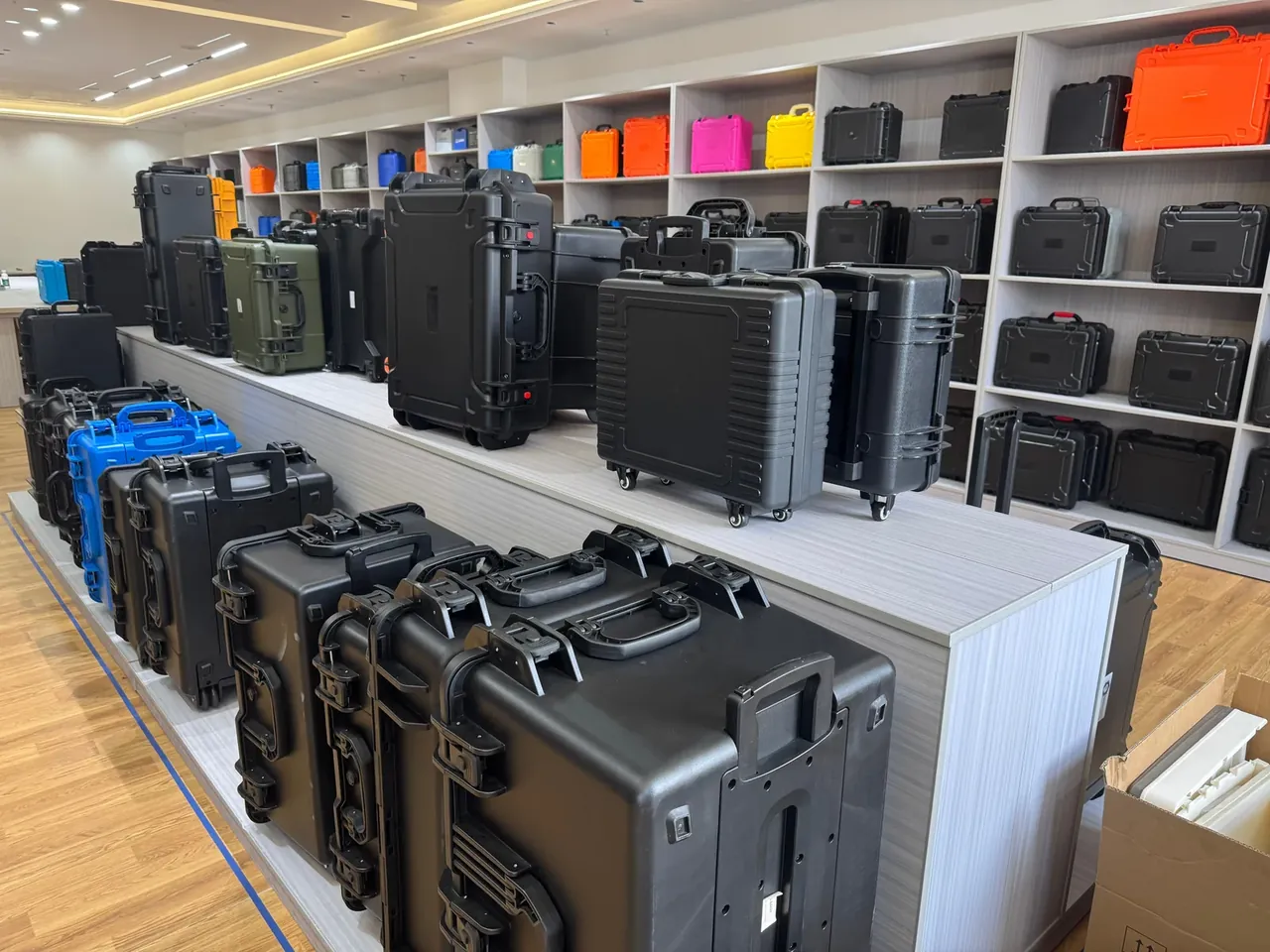
Load 4.5 kg on the base toward the axle and the projection falls about 30 mm ahead of it. It measures 560 x 420 x 260 mm, low enough in height-to-width ratio to keep roll margin on a slope. The verdict is measurable: handle fully extended, a shell leaning back past 15 degrees, or wheels wandering more than 5 mm under push, fails. A Medical EEG machine protective trolley box whose tubes soften at the stage joint fails the same check.
| Stage | Extension | Typical posture | Gravity projection |
|---|---|---|---|
| One | Shortest, grip near the lid | Two-handed carry, stairs | Over the axle |
| Two | Middle | Pushing an outpatient corridor | About 20 mm ahead of the axle |
| Three | Full, 340 mm total | Towing level ground or a gentle ramp | Must not pass the axle |
3. Latch count against lid stiffness
More latches do not make a better lid; each has to compress something. The body is 560 mm long with two draw latches at the ends, leaving roughly 380 mm of span between them, and that middle stretch carries load only through lid stiffness. Ribs that stop at the rim let the centre arch on closing, the gasket never seats, dust enters along the seam.
Read the latch figure in parts. One latch holds 300 N, so two give 600 N; spread that around the rim and only a share reaches the gasket, the rest absorbed by rim elasticity. At 2.0 to 3.5 mm wall section, every extra 0.5 mm stiffens the rim noticeably, and a step on the inner rim keeps a Medical EEG machine protective trolley box closing evenly at both ends.
Dropped 1.2 m onto a corner, the same latch sees shock rather than holding force. Corner bumpers route energy into the radius and the latch only has to stay shut; once it pops, the lid flies open and the cap goes with it. Hinge life counts here too at 20000 cycles, so latches belong near the corners of a Medical EEG machine protective trolley box.
4. Castors on outpatient flooring
Outpatient floors look flat and are not. Three things catch a wheel: tile joints, threshold strips, the lift entrance plate. A 75 mm wheel is the common choice, since a 15 mm threshold lifts the axle through a shallow angle and a toe under the frame gets it across; anything smaller drops into tile joints.
Of 4 castors, 2 swivel and 2 run fixed. Swivels go on the handle end, where a small turning circle lets the case hug a wall through an L-shaped corner; fixed castors keep a straight push straight. This Medical EEG machine protective trolley box uses 4 separate axle housings, so a worn wheel is swapped out. At 8 degrees along a link corridor one person tows 340 mm of handle without strain, and hard tread passes jolts into the cavity above.
| Floor | Usual obstacle | Wheel requirement | What to do |
|---|---|---|---|
| Polished tile | Height step at the joint | 75 mm diameter or more | Cross at an angle |
| Corridor threshold | 15 mm upstand | Front wheel leads, rear follows | Lift the handle |
| Link ramp | 8 degree slope | Two people or a pull strap | Stay uphill of the case |
| Lift entrance plate | 5 mm metal strip | Slightly soft tread | Straight through, no turning |
5. Coil radius and connector protection for the lead bundle
Leads are the part most often stuffed in without thought. On a Medical EEG machine protective trolley box one end is a 21-pin connector, the other fans into 21 fine wires; wound too tight, copper work-hardens inside the jacket and the break appears just behind the connector. Coil along the bundle's natural curve, one loop at a time, never around the headbox.
Protecting the connector takes two moves: a fixed seat with pins facing up or sideways, and a thin foam pad between connector and base so a drop does not load the pins directly. The lid recess serves as that seat, set two or three millimetres below the connector body inside a Medical EEG machine protective trolley box. Moisture is the quieter route: a damp cap builds its own microclimate and silver/silver chloride surfaces darken. IP67 at 1 m immersion keeps water out yet says nothing about vapour inside, so add a desiccant sachet in a lid corner.
Related Reading
- Choosing a monitor transit case with latches
- Foam layout and fixing inside an infusion pump case
- Custom foam layouts for diagnostic devices
- Volume, cavity and corner usable ratio in a case
Related Products
- 8 Series — Gun Cases; Military Equipment Cases; Camera Equipment Cases; Drone Cases; Watch Cases; Knife Cases; First Aid Cases; Electronics Equipment Cases
- WL8-2812 PP Gun Case — model WL8-2812
- All protective cases and toolboxes: 7 series, 158 models