

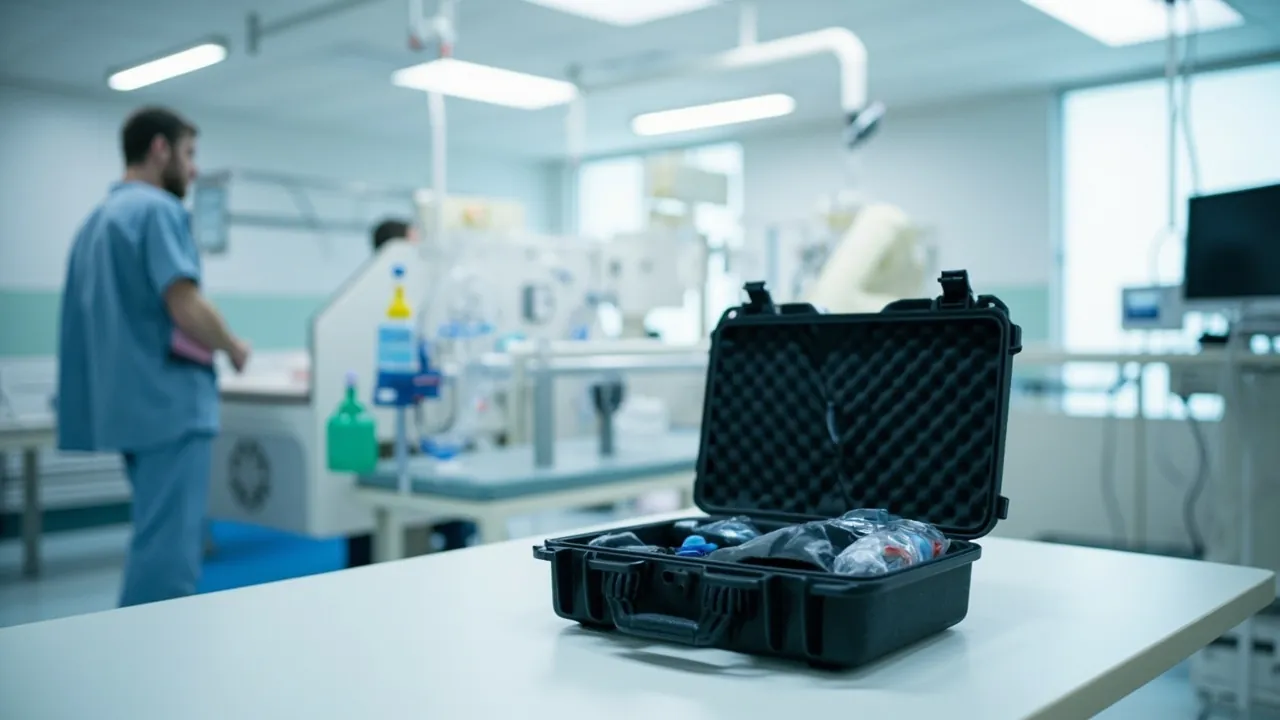
Transport protection for infusion and syringe pumps is not about compression resistance. It is about preserving accuracy. These devices are the final execution link in clinical drug delivery: an infusion pump meters volume by peristaltically occluding a pump segment, while a syringe pump delivers a micro-volume by driving a syringe plunger along a lead screw. What they share is that output accuracy is expressed as a percentage, failure appears as an alarm, and damage accumulates as displacement. A single axial shock can change lead screw backlash. A sustained squeeze can give a pump segment a permanent set. Cumulative vibration can shift a pressure sensor zero. None of this is visible in an arrival inspection, yet after installation it appears as flow deviation, occlusion alarms that do not match reality, frequent air-in-line alarms and unstable delivery rate. At that point it is a clinical risk, not merely an equipment fault.
Why does infusion pump protection differ so much from general medical equipment? Three compounding characteristics. First, accuracy is the core functional specification: typical stated volumetric accuracy is in the order of plus or minus 5 percent, subject to the product standard and the manufacturer's declaration, and the mechanical geometry changes introduced in transit are easily large enough to consume that margin. Second, the critical components are small-displacement sensitive: lead screw backlash, gear meshing clearance, sensor diaphragm position and the geometry of optical detection windows all operate at micron to millimetre scale, and changes caused by shock cannot be seen in the assembled state. Third, these are mobile devices: infusion pumps move constantly between wards, operating theatres, emergency departments and transport, so they are packed, carried and redeployed frequently. Protection must therefore withstand high-cycle circulation, not a single journey, which is entirely different from large fixed equipment.
This article is written for packaging and supply-chain staff at infusion and syringe pump manufacturers and distributors, hospital biomedical engineering departments, third-party medical equipment service providers, and export trading firms and after-sales parts operations. It covers infusion pumps, syringe pumps, enteral feeding pumps, patient-controlled analgesia pumps and related consumables, including pump body and drive mechanism restraint, sensor and detection window protection, lithium battery transport compliance, sterile barrier protection for consumables, standards references, a selection matrix, a packing SOP and arrival flow verification methods. All figures are typical industry values or empirical ranges; the governing inputs are the equipment drawing, the manufacturer's technical manual, the product registration conditions and destination regulations. JUNZHJIA supplies model-specific custom inserts, axial restraint and dust-control structures, sealing and moisture-control configurations, multi-colour infection-control track schemes, OEM and ODM programmes, and supporting test documentation for infusion and syringe pump cases.
Table of Contents
- 1. Why Infusion Pumps Fear Vibration Rather Than Compression: The Physical Origin of Flow Accuracy
- 2. Infusion, Syringe, Enteral and PCA Pumps: Categories and Failure Modes Compared
- 3. Peristaltic Pump Bodies and Occlusion Mechanisms: Segment Clearance and Calibration Preservation
- 4. Syringe Pump Drive Mechanisms and Lead Screws: Axial Shock and Backlash Control
- 5. Pressure Sensors, Air Detection and Alarm Systems: Protecting Sensitive Elements
- 6. Batteries and Power Modules: Lithium Battery Transport Compliance and Safety Boundaries
- 7. Pump Segments, Syringes and Consumables: Compression Set and Sterile Barrier Protection
- 8. Electrical Safety and the GB 9706 Series: Boundary of Transport Validation
- 9. Sealing, Moisture Control and IP Ratings: IEC 60529 and GB/T 4208
- 10. Transport Test Basis: ISTA, GB/T 4857, ASTM D4169 and MIL-STD-810H
- 11. Packing SOP, Arrival Flow Verification and Calibration Boundaries
- 12. Sea Export, High-Cycle In-Hospital Re-Use and Infection-Control Tracks
- 13. Supplier Evaluation Dimensions and the OEM/ODM Customisation Path
- Frequently Asked Questions
- Conclusion and Further Reading
1. Why Infusion Pumps Fear Vibration Rather Than Compression: The Physical Origin of Flow Accuracy
Understanding how accuracy is produced is the prerequisite for understanding how to protect it.
Where peristaltic infusion pump accuracy comes from. An infusion pump meters by having a set of rollers or fingers cyclically occlude a pump segment, pushing the fluid ahead. The volume per revolution depends on three quantities: the pump segment internal diameter, set by the segment specification; the effective volume of the segment after occlusion; and the clearance between the occlusion mechanism and the segment backing plate. The first two are set by the segment; the third is set by the mechanical precision of the pump head. Shock in transit changes exactly that third quantity. Once the occlusion mechanism or backing plate shifts slightly, clearance changes, volume per revolution changes, and the result is delivery rate deviation.
Where syringe pump accuracy comes from. A syringe pump drives the plunger along a lead screw or rack, expelling fluid from the syringe. Delivered volume depends on lead screw pitch, motor step resolution and the contact condition between the drive head and the plunger. Shock in transit produces two classes of change. Lead screw and nut backlash increases, because impact dents the ball or thread surfaces, which increases lost motion and appears as start-up delay and flow fluctuation. And the drive head position shifts or the clamp deforms, so contact between drive head and plunger becomes poor, producing uneven delivery and alarms.
The third and fourth accuracy risks. The third is the force and pressure sensing link. Infusion pumps normally infer occlusion and infiltration by measuring line pressure, and syringe pumps infer blockage by measuring drive resistance. These sensors, mostly strain gauge or optical, depend heavily on assembly position, and a position change caused by shock directly shifts the alarm threshold, producing either a failure to alarm when required or frequent nuisance alarms. The fourth is detection window contamination. Air detection is normally ultrasonic or optical, and once the window is contaminated by dust, fibre or grease, sensitivity falls and the result is either missed detection or false alarms.
Why compression resistance is not the priority. An infusion pump weighs only a few kilograms, so stacking loads on the case are limited. What actually causes damage is small, fast shock and prolonged low-amplitude vibration. That determines the strategy: the priority is not thicker walls but restraint and surface-contact support that eliminate the path by which shock reaches the pump body and drive mechanism. For the underlying principle, see shock and vibration case design and cushion liner and case base interaction.
A field observation: in arrival complaints for infusion pumps, the proportion of "looks fine but flow is inaccurate" cases is normally clearly higher than "visibly damaged" cases. Packaging validation for infusion pumps must therefore include flow verification, with acceptance criteria led by functional indicators and supported by appearance. An appearance-only acceptance step simply defers the risk to the first clinical infusion.
2. Infusion, Syringe, Enteral and PCA Pumps: Categories and Failure Modes Compared
| Category | Main structure | Fragile points | Primary failure mode | Priority countermeasure |
|---|---|---|---|---|
| --- | --- | --- | --- | --- |
| Volumetric infusion pump, peristaltic | Occlusion mechanism, backing plate, pressure sensor | Occlusion clearance, sensor position, detection window | Flow deviation, inaccurate occlusion alarm | Axial and radial restraint, dust control, separate compartment |
| Syringe pump | Lead screw or rack, drive head, clamp | Lead screw backlash, drive head position, clamp deformation | Increased lost motion, uneven delivery | Drive mechanism locking, axial restraint, separate compartment |
| Enteral feeding pump | Peristaltic body, warming module, line port | Pump body, heater, port | Flow deviation, temperature control error | Separate compartment, heater protection, port caps |
| PCA pump | Pump body, cassette port, keys and display | Cassette port, keys, display panel | Port leakage, unresponsive keys | Cassette port protection, panel protection |
| Portable infusion pump | Pump body, battery, wearing structure | Battery, pump body, keys | Battery damage, body deformation | Battery compliance handling, separate compartment |
| Pump segment and giving set | Wall, drip chamber, connectors | Compression set, puncture, moisture | Inaccurate flow, sterile barrier failure | Flat separate packing, no sharp edges, moisture control |
| Syringes and cassettes | Plunger, barrel, port | Squeeze deformation, plunger contamination | Abnormal drive resistance, drug contamination | Separate compartments, end protection, clean packaging |
| Power adapter and cables | Plug, cable, adapter body | Plug deformation, cable fatigue | Poor contact, supply faults | Separate coiling, capped connectors, numbering |
| Display and control panel | LCD, keys, knobs | Point-contact pressure, squeeze | Bright spots, dead lines, unresponsive keys | Rigid screen protector, surface-contact support |
All these modes share concealment, delay and clinical relevance: damage forms in transit, self-test after installation may pass completely, and the problem appears during infusion as flow deviation or abnormal alarms. Failure priority depends strongly on transport mode. High-cycle in-hospital circulation is dominated by handling shock and squeeze; sea export is dominated by humidity, salt fog and cumulative vibration; airfreight is dominated by repeated transhipment and abrupt temperature and humidity change. A design must therefore be configured for the worst credible route and must include flow verification in the acceptance criteria.
3. Peristaltic Pump Bodies and Occlusion Mechanisms: Segment Clearance and Calibration Preservation
The peristaltic pump body is the core of a volumetric infusion pump and the part most in need of micro-displacement protection.
Three damage pathways.
- Axial shock transmitted into the pump head: when the device is dropped or struck, shock travels along the pump head axis and can shift the relative position of the occlusion mechanism and backing plate, directly changing occlusion clearance. The change cannot be seen in the assembled state and can only be identified by flow testing.
- Pump segment left occluded: this is the most overlooked and most directly consequential. If the segment is left in the pump head when packing, and the device is squeezed or left clamped in the case, the segment takes a permanent set, its cross-section changing from round to oval or flat. After installation the result is insufficient elastic recovery, a changed volume per revolution, flow deviation and frequent alarms. The correct practice is to remove the pump segment from the pump head before packing, or to ensure the head is fully released, and pack the segment flat and separately.
- Backing plate and door deformation: on some models the pump door opens and closes, and if the door is pressed or propped by another component in transit, the hinge and latch can deform, so the plate no longer seats correctly when closed, producing unstable flow and door alarms.
Design points.
- Axial restraint: fit limit blocks at the pump head axis, not pressing directly on the pump body but transmitting load through structural members, so shock is not carried axially.
- Radial constraint: form a flexible constraint around the pump head so the device cannot shift inside the case.
- Door locking: confirm with the manufacturer whether the door should be closed and locked or open for transport. If closed, confirm no external pressure acts on it. If open, confirm it cannot be struck by vibration.
- Separate compartment: no accessories or tools in the pump body zone, to avoid local point-contact pressure.
- Dust control: the pump head and detection window are precision areas, so the case interior should avoid shedding materials and the case should provide basic dust protection.
The boundary of flow calibration. Infusion pump flow calibration is normally performed by the manufacturer before dispatch, or rechecked by a qualified clinical engineering department on a defined cycle. The task of transport packaging is to preserve the calibrated state, not to re-establish calibration. Arrival verification therefore asks whether calibration is still valid, meaning whether the observed value deviates from the stated value within the permitted range, rather than re-calibrating. If verification shows an out-of-tolerance result, the device should be returned for service or recalibrated as the manufacturer requires, not adjusted on site. This boundary matters because it defines responsibility: the packaging supplier is responsible for not introducing deviation in transit, while the manufacturer or service organisation is responsible for determining and correcting deviation.
Practical arrival flow verification. Quick checks that can be performed on site normally include: a no-load running check, observing for abnormal noise, speed stability and binding; a quantitative check, delivering a known volume over a defined time and comparing actual with stated, with the specific method governed by the manufacturer's technical manual; and an alarm function check, using standard test items to trigger occlusion and air alarms and confirming threshold and message behaviour. All three can be completed before installation, at low cost and with clear results.
4. Syringe Pump Drive Mechanisms and Lead Screws: Axial Shock and Backlash Control
The core of a syringe pump is delivery accuracy, and delivery accuracy is more easily affected by transport because the mechanical relationships it depends on are more precise.
The backlash problem. The backlash between lead screw and nut is a designed allowable clearance, normally small. Axial shock in transit dents the ball or thread surfaces, so backlash increases. The direct consequence of increased backlash is greater lost motion: after the motor starts turning, the drive head must first traverse the lost motion before actual delivery begins. In high-precision micro-volume delivery, that lost motion appears as start-up delay, a missing leading edge on the flow curve, and significantly amplified deviation at low delivery rates, because at low flow the lost motion represents a larger proportion of each delivery increment.
Drive head and clamp. The contact condition between the drive head, or pusher block, and the syringe plunger determines how efficiently drive force is transmitted. Shock in transit can cause the drive head to shift, producing eccentric contact and uneven drive force; the clamp to deform, so the syringe is not held securely and slips during delivery; and the guide rail to deform, so the drive head binds somewhere along its travel.
Three damage pathways.
- Drop shock: when the device is dropped, the drive mechanism takes axial shock, which is the primary cause of increased backlash.
- Free movement of the drive mechanism within its travel: if the drive head is not locked for transport, vibration makes it oscillate on the lead screw, and cumulative thread wear increases backlash over time.
- External squeeze: other components or the case wall pressing on the drive mechanism, deforming the rail or drive head.
Design points.
- Drive mechanism locking: use the manufacturer's dedicated transport lock where provided, or place a support block between drive head and pump body so the mechanism cannot move freely in transit. If the manufacturer provides a transport lock, it must be used; if not, provide equivalent restraint through the insert.
- Axial support: support the drive mechanism at both axial ends so shock is not carried axially.
- Syringe slot protection: the syringe mounting slot is an open structure, so confirm it contains no foreign matter and that the slot opening is not squeezed in transit.
- Separate compartment and dust control: the drive mechanism and rail are precision kinematic pairs, so the case interior must be free of metal swarf, grit and shedding materials. A relatively clean packaging structure for the kinematic pair area, such as a separate non-woven bag plus a dedicated cavity, is advisable so that particles cannot reach the rail.
- Display and panel protection: syringe pump displays, which are prone to bright spots and dead lines, are point-contact sensitive, so provide a rigid screen protector or dedicated relief and never place a hard object against the screen.
5. Pressure Sensors, Air Detection and Alarm Systems: Protecting Sensitive Elements
A large part of an infusion pump's safety value lies in its alarm system. Alarm reliability depends on the original condition of the sensors and detection windows, which are precisely the parts most easily and invisibly altered in transit.
Pressure sensor zero and threshold. Infusion pumps infer occlusion, infiltration and free flow by measuring line pressure, and syringe pumps infer blockage by measuring drive resistance. Sensors are mostly strain gauge, based on diaphragm deflection, or optical, based on displacement detection. Shock in transit produces three classes of change: diaphragm deformation causing zero drift; assembly position change causing threshold shift; and pressure channel blockage by debris causing response lag. The common result is either a failure to alarm when required or frequent nuisance alarms. The first is a safety risk and the second a usability risk.
Air detection window contamination. Air detection normally uses ultrasonic, through a transmit-receive pair, or optical principles, and the geometry and transmission performance of the window directly determine sensitivity. Three contaminants change detection performance: dust and fibre from shedding case materials, grease and plasticiser migration from certain packaging materials or flexible plastics, and condensation films from high humidity or temperature change. The first two are material selection issues; the third is a sealing and desiccant configuration issue.
Other alarm system components. Beyond sensors, the alarm system includes buzzers, indicator lights and keys. Buzzers are electromechanical and generally not sensitive, but keys, especially membrane keys, and knobs can change feel and develop poor contact after compression, so any local pressure should be avoided.
Design points.
- Relief around sensing areas: leave space around sensors and detection windows with no material in direct contact.
- Avoid migratable contamination: confirm low migration in insert materials and avoid flexible plasticiser-containing materials in direct contact with detection window areas. For material evaluation dimensions, see case foam material comparison.
- Control internal humidity: fit desiccant and a humidity indicator card to prevent condensation films from affecting optical windows and electrical performance.
- Electrostatic considerations: where packaging contains removed boards or sensor assemblies, an ESD protection approach is advisable; see ESD shielding case.
- Arrival checks: visual inspection for window contamination and visible diaphragm deformation; a no-load self-test using the built-in routine to confirm the alarm circuit; and a functional trigger using standard test items to trigger occlusion and air alarms and confirm threshold and message behaviour. Where the device keeps a self-test log, export it for the record.
Why "self-test passed" is not sufficient. Device self-test normally confirms only that circuits and firmware are functioning. It cannot detect a shift in detection threshold, because a threshold shift does not cause a self-test failure; it only causes the alarm to fire at the wrong point. Arrival acceptance should therefore include at least one threshold trigger check, using known conditions to fire the alarm and observing whether the trigger point matches expectation. This is the single most commonly omitted and most valuable step in infusion pump acceptance.
6. Batteries and Power Modules: Lithium Battery Transport Compliance and Safety Boundaries
Modern infusion and syringe pumps commonly contain lithium batteries, with some models using hot-swappable packs, alongside large numbers of external power adapters. This brings the packaging problem into the scope of lithium battery transport compliance as well.
Why lithium batteries need specific treatment. The transport risks of lithium batteries come from three sources: external short circuit, where metal parts or a damp environment bridge the terminals and can trigger thermal runaway; mechanical damage, where squeeze, puncture or drop damages the internal separator; and high temperature, where elevated temperature inside the case accelerates ageing or precipitates failure. Lithium battery transport requirements therefore normally cover state of charge limits, packaging insulation and short-circuit prevention, structural protection of cells and packs, and the corresponding marking and declaration.
Common compliance routes and boundaries. Lithium battery transport normally builds on the transport safety testing in Section 38.3 of the United Nations Manual of Tests and Criteria, known as UN 38.3, and is managed under the International Air Transport Association Dangerous Goods Regulations or the applicable road and sea rules. Core requirements generally include: the battery has passed UN 38.3; packaging prevents short circuit, for example by packing cells individually, insulating connectors and capping terminals; air transport carries explicit state of charge limits; and marking and declaration follow the rules. The specific packing requirements, state of charge limits, net quantity limits, declaration and marking rules differ by mode, carrier and routing, and must be confirmed by qualified personnel against the current edition of the applicable rules. This article is not a compliance determination. General design thinking is set out in hazmat transport packaging requirements.
Packaging practice.
- Power down and confirm shutdown: confirm the device is fully shut down, not in standby, so accidental power-on in transit cannot cause heating.
- Battery restraint: the battery must be securely fixed inside the device; removable batteries should preferably be taken out, bagged separately and have their terminals insulated.
- Short-circuit prevention: cap or tape battery terminals, and never place a battery in the same cavity as metal items such as screws, tools or clips.
- Temperature control: avoid prolonged high-temperature exposure. Where a route crosses hot regions or open-air storage is likely, assess internal temperature and apply shading and insulation; see case design for extreme temperature environments.
- Marking: apply lithium battery marking per the applicable rules, and declare for air transport as required.
- Arrival checks: appearance for swelling, deformation, odour and leakage; structure for terminal deformation and protector integrity; function for power-up self-test and charging. If swelling, deformation, odour or leakage is found, isolate the battery immediately and follow the lithium battery emergency procedure; do not energise or charge it.
An important boundary: compliance decisions regarding batteries, meaning whether an item is a dangerous good, which category applies, state of charge limits and packing requirements, fall within the scope of regulations and carrier rules and must be confirmed by qualified personnel against the current edition. The supplier's role is to provide a case and insert that meet structural, insulation and marking-coordination requirements, together with the necessary supporting documentation.
7. Pump Segments, Syringes and Consumables: Compression Set and Sterile Barrier Protection
Infusion and syringe pump consumables, including pump segments, giving sets, syringes, cassettes, extension lines and filters, share a common characteristic: low unit price, high quantity, and direct impact on delivery safety if they fail. Consumable protection therefore cannot be downgraded because the items are inexpensive.
Three risks for pump segments and giving sets.
- Compression set: the pump segment pressed by a heavy object or tightened under a strap takes a permanent set, and flow accuracy falls after installation. This is the same problem described in section 3, occurring on the consumable side. Note that even if the segment has been removed from the device, segments in a consumables case still must not carry sustained compression.
- Puncture: sharp corners, nail heads, splinters or metal swarf inside the case puncture the sterile barrier packaging. Giving set walls are extremely thin, and a single puncture fails the barrier.
- Moisture and contamination: high internal humidity moistens packaging, or a case previously used for contaminated items introduces cross-contamination.
Syringes and cassettes. Syringe barrels are thin-walled, and the fit between plunger and barrel determines drive resistance. Squeeze in transit can ovalise the barrel, producing abnormal drive resistance and poor sealing, while a contaminated plunger can contaminate the drug. Cassettes used with PCA pumps normally contain a fluid chamber and ports, and the ports and seals are sensitive to squeeze. Design points: separate compartments; protection at end faces and ports; no stacking; and confirmation of sealing and labelling for liquid-filled cassettes so leakage cannot contaminate other components.
Design points.
- Handle consumables on a one-set-one-bag basis, keeping the original sterile barrier intact;
- Provide dedicated cavities with no sharp edges and no hard protrusions;
- Pack pump segments flat, never coiled into small loops, with a coil radius no less than the manufacturer's stated minimum, and never over-tightened under a strap;
- Cap connectors and needle guards, each with its own relief;
- Never place heavy objects on consumables and never use consumables as internal void fill;
- Fit desiccant with a humidity indicator card, and check the indicator before deciding to open the case;
- Strictly segregate or separately case liquids such as drug solutions and disinfectants.
Managing consumables and small parts. Infusion pump shipments carry many small items, including power leads, mounting clamps, brackets, spare part kits, manuals and calibration tools, in diverse specifications and large quantities. Use a lidded compartment box, zoned by purpose and labelled by number, with the packing list ordered by compartment number so the site can verify compartment by compartment. Where a removable divider system is used, the compartment count can be adjusted between load configurations; see case removable divider system and custom foam insert design guide.
Sterilisation state and barrier protection. Giving sets and syringes are normally sterilised before dispatch and packed in a sterile barrier system, with product standards such as the dedicated infusion set series covering performance and packaging. The transport case is tertiary packaging and its duty is to protect the sterile barrier. The interior must be free of sharp corners, nail heads, splinters, metal swarf and shedding materials, and any significant crush deformation or sign of moisture should likewise be treated as a barrier risk. The international framework for terminally sterilised medical device packaging, such as the ISO 11607 series covering sterile barrier systems, packaging materials and packaging processes, is a useful reference for understanding the division of packaging responsibility. Applicability is governed by the manufacturer's technical documentation and registration requirements; this article does not cover regulatory determination for sterile barrier systems.
8. Electrical Safety and the GB 9706 Series: Boundary of Transport Validation
Infusion and syringe pumps are medical electrical equipment, and their basic safety and essential performance normally have to satisfy the general requirements of the GB 9706 series, together with the relevant particular standard, such as the requirements specific to infusion pumps and controllers corresponding to IEC 60601-2-24, published in China within the GB 9706.224 series. The purpose of this section is not to discuss conformity with those standards, but to clarify the boundary between transport packaging validation and electrical safety validation.
Three boundaries that must be kept distinct.
First, transport testing does not replace electrical safety validation. Vibration, shock, drop, stacking and water ingress testing of transport packaging, and the electrical safety and electromagnetic compatibility validation required by the GB 9706 series, are two independent evaluation systems. Passing a transport test does not mean the GB 9706 requirements are met, and passing a GB 9706 type test does not mean the equipment can survive transport shock.
Second, transport does not change type test conclusions, but it can change the delivered safety state. Type testing addresses the equipment in its design condition. Shock, moisture and battery damage in transit can introduce new risks into the actual delivered unit: altered insulation distances, loosened earth connections, failed seals, released mechanical fixings and structurally damaged batteries. On arrival, installation inspection and pre-energisation safety confirmation must still follow the manufacturer's instructions, and any electrical safety item must be performed by qualified personnel.
Third, accuracy and alarm reliability fall under safety in use but not under electrical safety metrics. Flow deviation and alarm threshold shift do not appear in electrical safety test results, yet they directly affect drug delivery safety. Arrival acceptance should therefore place flow verification and alarm trigger verification alongside electrical checks rather than performing electrical checks alone.
On free-flow protection. Most infusion pumps incorporate an anti-free-flow mechanism preventing gravity free flow into the patient when the pump door is open. This is a mechanical safety component, normally built from a clamp structure and a spring element. Squeeze and shock in transit can deform the clamp or displace the spring, so arrival functional checks should include whether door opening and closing and the anti-free-flow mechanism operate correctly. The check is inexpensive and is a safety-related mandatory item.
9. Sealing, Moisture Control and IP Ratings: IEC 60529 and GB/T 4208
What an IP code means. The IP code defined in IEC 60529 has two digits: the first covers protection against solid foreign objects, 0 to 6, and the second covers water, 0 to 9K. China's equivalent standard is GB/T 4208. Typical infusion pump choices:
- IP54: limited dust protection and splash resistance, suitable for covered in-hospital circulation and indoor storage;
- IP65: dust-tight and resistant to water jets, suitable for most domestic and near-sea shipments and for short-term storage in ward environments;
- IP67: dust-tight and protected against short immersion, typically 1 metre for 30 minutes, suitable for sea freight, open-air transhipment, rainy regions and storage near wash-down areas;
- IP68: continuous immersion, needed only in extreme duty.
For the trade-off logic, see IP67 protective case design points and the practical meaning of IP ratings.
What infusion pumps actually need is dust protection and humidity control, not maximum waterproofing. Three reasons. First, precision kinematic pairs are most vulnerable to particles: once dust enters a lead screw, rail, gear or occlusion mechanism, it accelerates wear and changes clearance. Second, detection windows are most vulnerable to contamination: an optical or ultrasonic window contaminated by dust or a grease film loses air detection sensitivity. Third, electrical parts are most vulnerable to humidity, which causes insulation loss and connector oxidation. Treat sealing, desiccant and humidity indicator as a standard combination, not an upgraded option.
Desiccant quantity cannot be decided by tossing in a few packets. It should be calculated from internal free volume, the hygroscopicity of packaging materials, transit days and target humidity. A 30 to 45 day sea shipment requires substantially more than domestic short haul, and paper manuals, the open-cell structure of foam inserts and paper consumable packaging all absorb moisture and consume desiccant capacity, so they must be included. Checking the humidity indicator colour before deciding to open the case is an extremely low-cost, high-value practice.
A frequently overlooked detail: a well-sealed case cannot easily expel internal moisture across a day-night temperature cycle, so condensation can form. For infusion pumps containing precision kinematic pairs and optical detection windows, the resulting window films and rail corrosion are often harder to diagnose than external water ingress. Where the route involves large temperature swings, fitting a pressure equalisation valve that passes gas but not liquid is more effective than pushing the IP rating higher; see case pressure equalisation valve.
Flammability performance of case materials. Where the customer or the facility imposes requirements on the flammability performance of case materials, for example hospital requirements for plastic articles, the UL94 test methods for flammability of plastic materials are a common reference. Note that UL94 characterises the flammability classification of the material itself; it is not equivalent to a fire certification of the finished case, and it does not replace the fire safety requirements of the facility. The applicable classification should follow the customer specification and procurement documents.
Gasket selection and low temperature. Common gasket materials are silicone, EPDM and TPE foam. Silicone offers the best temperature and weather resistance plus good low-temperature elasticity; EPDM is balanced and suits outdoor duty; TPE foam has low compression set and suits frequent opening and closing. That last property matters especially for high-cycle infusion pump cases, because frequent opening and closing accelerates gasket fatigue. The gasket profile must match the case groove and the compression ratio should be confirmed by design; see case hinge, latch and seal selection and case seal materials and selection. Gaskets are consumables and belong on the spare parts list with a defined replacement criterion.
Disinfectant tolerance. Infusion pump cases are cleaned and disinfected periodically during in-hospital circulation, so case and insert materials must resist common disinfectants such as 75 percent ethanol, quaternary ammonium compounds, chlorine-based agents and hydrogen peroxide products without rapid ageing. A specific warning: chlorine-based disinfectants carry corrosion risk for stainless steel and some metal parts and stress-crazing risk for certain plastics, and prolonged contact with oxidising disinfectants accelerates gasket ageing. Regulatory references for disinfection methods in healthcare settings include the relevant technical standards; the specific agent and concentration should follow the device manufacturer's instructions and the institution's infection-control policy. Everyday care guidance is in how to clean and maintain a protective case.
Locks and circulation management. Cases used in high-cycle in-hospital circulation should be fitted with numbered single-use seals or numbered locks so that handover can confirm the case has not been opened since packing, and so that traceability is possible. See case lock customisation options and case wheels and trolley handle.
10. Transport Test Basis: ISTA, GB/T 4857, ASTM D4169 and MIL-STD-810H
"Our case is very strong" is not an acceptable qualification statement. An acceptable statement is "it passed this test sequence under this standard, judged against this set of criteria."
ISTA programmes. The International Safe Transit Association defines test procedures graded by package format and weight. Portable infusion and syringe pumps are mostly small-package items, so ISTA 3A for parcel transport or ISTA 2A and 2B apply, with bulk dispatch referencing ISTA 3E for unitised loads and 3B for less-than-truckload. The value of ISTA lies in sequencing: preconditioning, shock and drop, vibration, temperature and humidity, then re-inspection as a complete chain. See ISTA transport testing procedure explained.
GB/T 4857 series. China's basic test methods for transport packages cover vibration, shock, stacking, drop and compression as separate items, and this family has the highest citation rate in domestic tender and acceptance documents. Application guidance is in GB/T 4857 transport packaging application.
ASTM D4169. This standard assigns test intensity by distribution cycle and is frequently used for packaging validation for North American export markets. See ASTM D4169 distribution cycle testing.
MIL-STD-810H. Its vibration, shock, temperature and humidity, and low-temperature methods are often cited for environmental test design. It must be stated clearly: citing MIL-STD-810H is a reference to environmental test methods only and does not mean the product has obtained any military certification. See MIL-STD-810H environmental test compliance.
| Test type | Common standard | Example parameters | Significance for infusion and syringe pumps |
|---|---|---|---|
| --- | --- | --- | --- |
| Random vibration | ISTA 3A/3B/3E, ASTM D4169 | Power spectral density, duration | Checks lead screw backlash, sensors and cables |
| Shock and drop | GB/T 4857, ISTA | Drop height, peak acceleration | Checks pump head, drive head and display panel |
| Stacking | GB/T 4857.3 | Load, duration, temperature and humidity | Checks pump door, panel and case compression |
| Temperature and humidity cycling | MIL-STD-810H method 507 | Temperature range, cycle count | Checks condensation, detection windows and insulation |
| Low-temperature test | MIL-STD-810H method 502 | Low temperature value, duration | Checks pump segment stiffening and gasket elasticity |
| Salt fog | ISO 9227 / ASTM B117 | Concentration, duration | Checks metal fasteners and connectors |
| Water ingress | IEC 60529 / GB/T 4208 | IPX5 / IPX7 | Checks open-air transhipment and wash-down areas |
| Battery-specific | UN 38.3 transport safety testing | Altitude simulation, thermal cycling, vibration, shock | Prerequisite for lithium battery transport compliance |
On functional checks. Transport validation for infusion and syringe pumps must include functional items, which is what distinguishes them from general medical equipment. After vibration and temperature and humidity testing, check: flow verification, delivering a known volume over a defined time and comparing deviation, with the method governed by the manufacturer's manual; alarm trigger verification, using standard test items to trigger occlusion and air alarms and confirming threshold and message behaviour; drive mechanism verification, running the syringe pump unloaded to observe abnormal noise, binding and unusual lost motion; anti-free-flow mechanism operation; detection window contamination; battery appearance and charge-discharge function; and panel and display inspection for bright spots, dead lines and unresponsive keys. Acceptance criteria must be led by functional indicators and supported by appearance.
On test documentation. The contract technical annex should specify test items, standard numbers, sample quantities, load condition, acceptance criteria, the report issuer, and responsibilities for corrective action and retest. For export customers, also specify whether the report must come from a third-party laboratory with an English version. Where lithium batteries are involved, also specify responsibility for providing the UN 38.3 test summary, since this is frequently a prerequisite document in airfreight and export.
11. Packing SOP, Arrival Flow Verification and Calibration Boundaries
- Confirm the plan: check model, configuration list including battery and adapter, packing format, transport mode and destination; confirm the correct case type and insert drawing number; confirm the battery compliance route, meaning whether the battery must be removed, state of charge requirements and marking requirements.
- Pre-treat the device: shut down fully, not standby; remove the pump segment from the pump head or confirm the head is fully released; lock the drive mechanism as required, using the manufacturer's transport lock or equivalent insert restraint; empty residual fluid from the lines; clean surfaces using permitted methods with particular attention to the detection window area; inspect appearance and photograph for the record.
- Handle the battery: determine per the compliance route whether the battery travels in the device or is removed and packed separately; cap or insulate terminals; confirm no shared cavity with metal items; apply marking as required.
- Pre-fit the insert: place limit blocks, compartments and pads according to drawing, and confirm no misalignment or omission. Run a first-article trial fit and record it.
- Seat the device: load in the design attitude; never drag and never lift from a single point; confirm the display, detection window and pump door areas carry no contact pressure; confirm no direct contact with rigid surfaces.
- Restrain and limit: fit the top clamp and axial stops; straps are for assistance only and must use corner guards, never tightening directly on the pump door, display or cables; confirm that hand pressure produces no significant movement, with an empirical criterion of no more than 2 millimetres of displacement.
- Accessories and consumables: place power adapter, cables, brackets and clamps in separate numbered compartments; pack pump segments and giving sets flat without over-coiling and without load; give syringes and cassettes separate compartments with protectors; strictly segregate or separately case liquids from new consumables.
- Seal and dry: add desiccant calculated from volume and days, plus a humidity indicator card; confirm the gasket is intact with no trapped foreign matter; close latches evenly; where a numbered seal is used, record the seal number.
- Mark and record: apply centre-of-gravity, rain protection, this way up, do not invert, precision equipment and battery markings as required; photograph the packed case for the record; on handover, record the time, seal number and case condition.
Arrival inspection checklist, to be signed item by item.
- Case exterior: cracks, deformation, signs of moisture; latches and hinges intact; seal number matches;
- Humidity indicator: colour within the permitted range, checked before opening;
- Display and control panel: bright spots, dead lines, scoring; key feel normal;
- Detection window: dust, grease film, water film and scoring on the optical or ultrasonic window;
- Peristaltic pump body: occlusion mechanism movement smooth on manual check; door opening and closing normal; anti-free-flow mechanism operating normally;
- Drive mechanism, syringe pump: unloaded running with no abnormal noise or binding; lost motion not abnormal;
- Lines and consumables: pump segment free of permanent deformation; sterile barrier packaging free of puncture, crush and moisture;
- Sensors and alarms: self-test passed; occlusion and air alarms triggered with standard test items, with threshold and message behaviour confirmed;
- Flow verification: known volume delivered over a defined time and compared with stated value, with the method governed by the manufacturer's manual;
- Battery: appearance free of swelling, deformation, odour and leakage; terminals and protectors intact; power-up and charging normal;
- Accessories: compartment box verified compartment by compartment against the list.
A field practice: use three-point comparison. Record key functional baseline values before packing, meaning unloaded running condition, self-test results and flow verification values; photograph the packed case; then re-measure the same set of indicators on arrival. The three data sets form a complete chain of responsibility and cleanly separate incoming issues, packaging issues and transport issues. Flow verification data carries particular value because it is the only indicator that directly reflects whether accuracy was changed in transit.
Pre-installation preparation and the calibration boundary. After arrival and before installation: remove all packaging materials and clear the installation area; remove every transport lock, since leaving one in place causes drive mechanism or pump door faults; check that lines and connectors are clean with no foreign matter; confirm the device exterior and panel are intact; complete installation and power-up self-test per the manufacturer's instructions; complete flow and alarm verification; and have electrical safety items performed by qualified personnel. On calibration: if verification shows flow beyond the permitted deviation, return the device for service or have it recalibrated by a qualified department as the manufacturer requires. Adjusting calibration parameters on the clinical site is not advisable, nor is involving the packaging supplier in calibration decisions, because that lies within the responsibility boundary of the manufacturer and clinical engineering.
12. Sea Export, High-Cycle In-Hospital Re-Use and Infection-Control Tracks
Five key variables in sea export. First, route duration of 30 to 45 days means desiccant must be calculated from internal free volume and days, counting the hygroscopicity of paper manuals, the open-cell structure of foam inserts and paper consumable packaging. Second, day-night temperature differences inside the container cause condensation, so a pressure equalisation valve is recommended, and condensation affects detection windows and precision kinematic pairs particularly strongly. Third, deck carriage and open-air storage bring salt fog exposure, so the corrosion protection class of metal fasteners, connectors and hinges must be raised, and galvanic corrosion where stainless and carbon steel touch must be addressed. Fourth, sea freight usually stacks higher, so compression strength must be calculated for the worst stacking case; infusion pump cases are typically small packages and are the easiest to end up at the bottom of a stack, so apply clear "do not stack heavy items on top" marking and prioritise them for upper layers in the loading plan. Fifth, wooden export packaging must meet ISPM 15 heat treatment or fumigation; plastic cases avoid this issue but raise questions about destination-country requirements for packaging materials and recyclability. In addition, where lithium batteries are present, confirm any additional carrier and destination-country requirements.
The particular nature of high-cycle in-hospital circulation. An infusion pump is a highly mobile device. The same unit may be packed, carried and redeployed several times in a single day, and the personnel and equipment involved in that circulation are often not specialised. An in-hospital solution should therefore emphasise ease of use, mistake-proofing and durability:
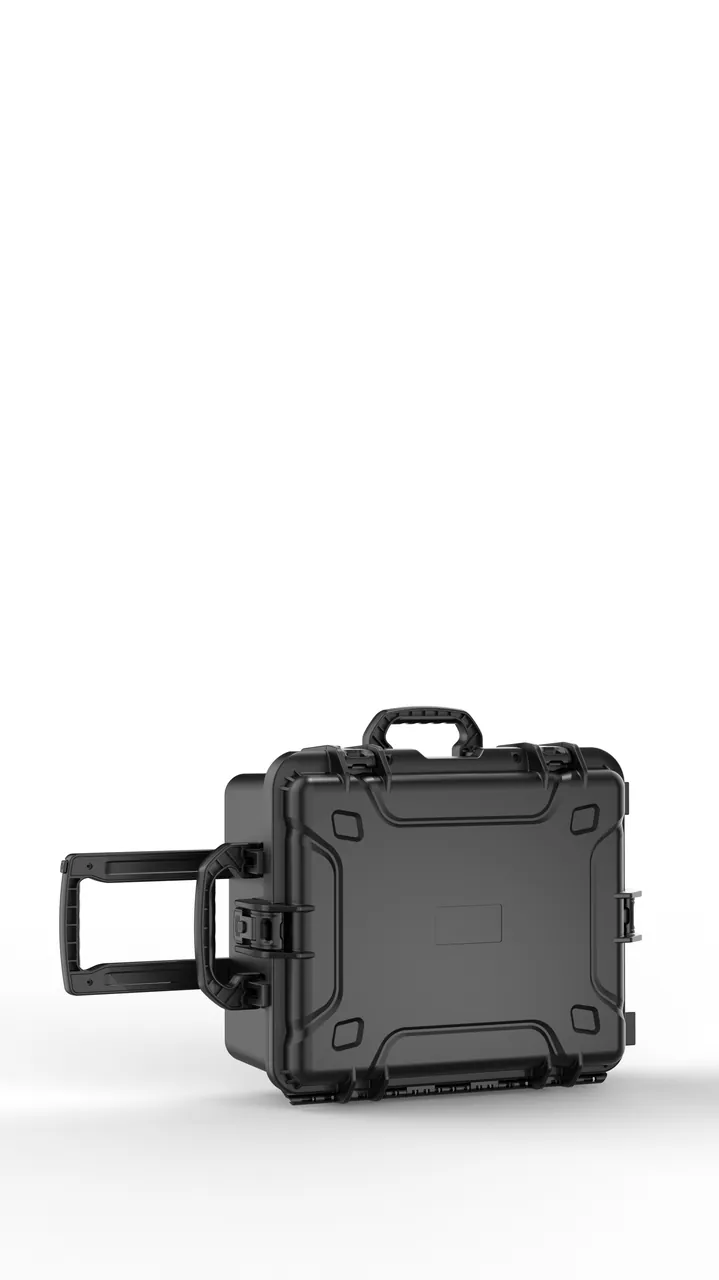
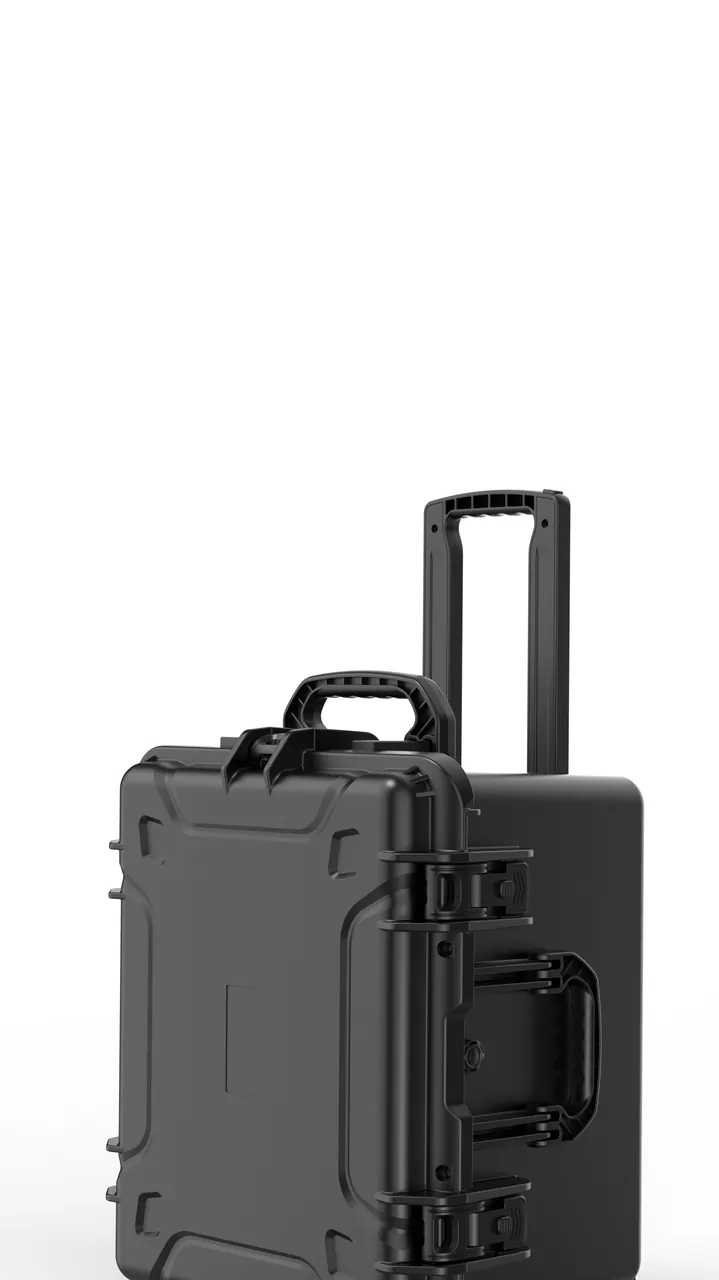
- Ease of use: castors and a trolley handle to improve handling efficiency; a mistake-proofed insert so the device only fits in the correct attitude; a brief handling diagram printed on the case.
- Mistake-proofing: place a prompt label or a physical keying feature to indicate that the pump segment has been removed; list "remove the drive mechanism transport lock" on the unpacking checklist printed inside the lid; use colour to distinguish departments or equipment models.
- Durability: frequent opening and closing accelerates gasket and latch fatigue, so choose low compression-set gasket materials and high-life latches, such as replaceable cores or reinforced hinges, and bring gaskets and latches into a preventive replacement plan.
Returnable re-use and criteria. Six checks before reissue: cracks, deformation and delamination, with particular attention to corners, base and castor mounting areas; gasket hardening, cracking, debonding or permanent compression set; latches and hinges that close reliably with even perimeter load distribution; insert collapse, fracture, contamination or shedding; compartment box damage or missing compartments; and castor and handle wear, load capacity and locking function. Any failed item means replacement before reissue, with criteria along the lines of protective case service life assessment.
Infection-control track management. Infusion and syringe pumps contact patients frequently and move between wards, so case infection control is especially important. Operate separate tracks:
| Track | Purpose | Permitted contents | Prohibited contents | Identification |
|---|---|---|---|---|
| --- | --- | --- | --- | --- |
| Clean track | New equipment and consumables dispatch and receipt | New equipment, intact sterile barrier consumables | Any used device, contaminated item, liquid | White or blue case |
| Circulation track | Daily movement of devices between wards | Infusion and syringe pumps already cleaned and disinfected | Uncleaned contaminated devices, new sterile consumables | Green case |
| Contaminated track | Contaminated devices, used consumables and waste disposal | Devices awaiting cleaning, and waste | Anything intended for a patient or new consumables | Red case |
Cases, inserts and gaskets are not shared between tracks. A specific warning: a case previously used for contaminated devices, used giving sets, waste fluid or chemical disinfectant must have all inserts and gaskets replaced and complete cleaning and residue assessment before being used for new equipment or sterile consumables, with infection-control or quality sign-off. The most effective control is a register recording case serial number, cycle count, each use, cleaning and disinfection records and inspection results, with colour-coded tracks as the first line of defence. Insert materials should be non-shedding, non-absorbent and resistant to microbial growth, because fragments both affect precision kinematic pairs and can contaminate sterile barriers.
Consumable shelf life and batch management. Giving sets and syringes carry defined shelf lives and batch requirements. Where consumables are stored in returnable cases, operate a first-in-first-out rule with an expiry alert, and include batch number and expiry date fields in the packing list so a quality event can be traced quickly.
13. Supplier Evaluation Dimensions and the OEM/ODM Customisation Path
Infusion pump cases form a small-item, high-frequency, accuracy-sensitive and compliance-heavy category, so procurement emphasis belongs on solution capability, especially restraint and dust-control design, and on documentation completeness.
Seven dimensions for evaluating a supplier.
- Tooling and restraint design capability: can they produce a zoned insert proposal from 3D data or physical patterns, and specifically can they solve the three concrete problems of no pressure on the pump door, no point contact on the display, and axial restraint of the drive mechanism?
- Dust and cleanliness control: control of insert shedding and migratable constituents, foam density and batch consistency, and a clean packaging approach for precision kinematic pair areas, such as separate non-woven bags.
- Materials and durability: gasket profile and compression set, latch and hinge fatigue life, which is critical for high-cycle duty, insert resistance to compression collapse, and disinfectant tolerance.
- Moisture configuration capability: can they calculate desiccant quantity from internal free volume and transit days and supply a humidity indicator card, and can they integrate a pressure equalisation valve?
- Compliance support: can they support the packaging insulation and marking coordination required for lithium battery transport, supply material declarations, and provide English-language test documentation?
- Capacity and delivery flexibility: infusion pump procurement is usually high-volume with concentrated model ranges, so peak-season elasticity and schedule reliability are real risk points.
- Quality system and sampling rules: defined sampling rules and nonconforming product handling, along the lines of the sampling logic in custom case acceptance and AQL sampling.
The combination strategy of standardised cases with customised inserts. Infusion pump case specification diversity is moderate, since complete units, pump segments and consumables, accessories and spare parts differ in size. Use standardised cases with customised inserts: cover most situations with two or three standard case sizes and adapt specific models with custom inserts, spreading tooling cost. For tooling cost structure, see custom case mould cost analysis.
A mandatory separation rule for liquids and clean items. This belongs in the procurement technical agreement: drug solutions, disinfectants and waste fluid must not travel in the same case as new equipment, pump segments, giving sets or syringes. The reason is direct: the cost of a single leak, meaning a whole case of sterile consumables scrapped, equipment corrosion and cleaning labour, far exceeds the cost of separate packaging. If a customer requires shared transport, they should state it in the technical agreement and carry the corresponding risk, and the supplier should provide a separate leak-contained cavity design.
Enquiry checklist. A practical enquiry should include: equipment model and configuration list with battery type and count, power adapter, brackets and other accessories; quantity per case and total weight; packing format, meaning single-unit case or bulk circulation case; transport mode and route including transhipment; re-use cycles and circulation scenario, export or in-hospital; whether lithium batteries are present and the applicable compliance requirements; storage environment and target IP rating; infection-control and disinfection requirements; whether liquid zoning is required; test and documentation requirements including whether a UN 38.3 test summary is needed; marking and seal requirements; annual volume and delivery cadence. The more complete the input, the closer the proposal comes to being ready for production. For supplier selection method, see how to choose a protective case OEM factory. For general case format selection, see portable transport box selection.
JUNZHJIA's standard approach for infusion and syringe pump cases is: accept 3D data or physical tooling patterns; produce a zoned insert proposal with drive mechanism locking and axial restraint configurations, desiccant quantity calculations and a multi-colour infection-control track scheme; confirm with a first-article trial assembly; move to volume production with sampling inspection; and supply material declarations and test documentation alongside. For customers with recurring demand, a model file can be established so that repeat orders for the same model re-use the approved configuration directly. For hospital customers with high-cycle circulation, a preventive replacement plan for gaskets and latches can be provided alongside.
Frequently Asked Questions
Q: What is the most common cause of inaccurate infusion pump flow after transport?
A: Two causes dominate, and both point to the pump segment and the occlusion clearance. The first is permanent deformation of the pump segment from prolonged occlusion. Many packing procedures skip the step of removing the segment from the pump head, and if the head remains clamped while the device sits in the case, the segment is squeezed continuously for days or weeks until its cross-section changes from round to oval or flat, taking a permanent set. After installation the symptoms are insufficient elastic recovery, a changed volume per revolution, flow deviation and frequent alarms, while operators suspect the segment batch or a device fault first and rarely trace it back to transport. The second is a small shift in the relative position of the occlusion mechanism and backing plate. When the device is dropped or struck, shock travels along the pump head axis and can change occlusion clearance, and the change cannot be seen in the assembled state, only identified by flow verification. A third, less common cause exists: a detection window contaminated by dust or a grease film, which shifts alarm timing and is misdiagnosed as a flow problem. Preventive measures are: remove the segment before packing or confirm the head is fully released; apply axial restraint to the pump head; keep accessories out of the pump body zone; avoid shedding materials inside the case; and fit desiccant with a humidity indicator card. On arrival, perform an unloaded running check and a quantitative flow verification.
Q: How does lead screw backlash in a syringe pump affect delivery accuracy, and how is it protected?
A: Backlash between lead screw and nut is a designed allowable clearance, and it determines the lost motion when the drive head reverses direction. Axial shock in transit dents the ball or thread surfaces, so backlash increases. The direct consequence is greater lost motion: after the motor begins turning, the drive head must first traverse the lost motion before actual delivery starts. In high-precision micro-volume delivery this appears as start-up delay, a missing leading edge on the flow curve, and significantly amplified deviation at low delivery rates, because at low flow the lost motion is a larger proportion of each delivery increment. Four protections apply. First, lock the drive mechanism: if the manufacturer provides a transport lock it must be used, and if not, provide equivalent restraint through the insert so the drive head cannot oscillate freely on the lead screw. Second, provide axial support at both ends of the drive mechanism so shock is not carried axially. Third, use a separate compartment and control dust, because the lead screw and rail are precision kinematic pairs and the case interior must be free of metal swarf, grit and shedding materials; a relatively clean packaging structure such as a separate non-woven bag plus dedicated cavity is advisable. Fourth, protect the display and panel by never placing a hard object against the screen. On arrival, run the pump unloaded and observe abnormal noise, binding and unusual lost motion.
Q: Should the battery be left in the infusion or syringe pump for transport, or removed?
A: It depends on battery type, transport mode and carrier rules, so there is no single answer, but several general principles apply. First, confirm the device is fully shut down rather than in standby, so accidental power-on cannot cause heating. Second, where the battery is removable, packing it separately usually makes it easier to meet insulation and short-circuit prevention requirements: cap or tape the terminals, never place the battery in the same cavity as screws, tools or clips, and prevent it from moving freely in the same cavity as the device. Third, where the battery is not removable, confirm the device is shut down, the battery is securely fixed inside, and lithium battery marking is applied to the packaging as required. Fourth, lithium battery transport normally presupposes UN 38.3 transport safety testing, and air transport carries explicit state of charge limits; the specific packing requirements, state of charge limits, net quantity limits and declaration method differ by mode, carrier and routing, so the current edition of the applicable rules governs and must be confirmed by qualified personnel. This article is not a compliance determination. Fifth, temperature control matters too: avoid prolonged high-temperature exposure, and where the route crosses hot regions or open-air storage is likely, assess internal temperature and apply shading and insulation. On arrival, check for swelling, deformation, odour and leakage, and isolate immediately without energising or charging if any is found.
Q: Why does the alarm system of an infusion pump also need transport protection?
A: Because alarm reliability depends on the original condition of the sensors and detection windows, and those are exactly the parts most easily and invisibly altered in transit. Three pathways apply. First, pressure sensor zero and threshold shift: infusion pumps infer occlusion, infiltration and free flow from line pressure, using strain gauge or optical sensors, and shock in transit can deform the diaphragm causing zero drift, shift the assembly position causing threshold shift, or block the pressure channel with debris causing response lag. The common result is either failure to alarm when required, which is a safety risk, or frequent nuisance alarms, which is a usability risk. Second, detection window contamination: air detection uses ultrasonic or optical principles, and sensitivity falls once the window is contaminated by dust, fibre, grease or a condensation film. Third, deformation of mechanical safety components: the anti-free-flow mechanism consists of a clamp structure and a spring element, and squeeze in transit can deform the clamp or displace the spring. Arrival checks should therefore cover three items: visual inspection for window contamination and visible diaphragm deformation; a no-load self-test using the built-in routine to confirm the alarm circuit; and the threshold trigger check that is most often omitted yet most valuable, using standard test items to fire occlusion and air alarms and confirm the trigger point and message against expectation. "Self-test passed" cannot on its own constitute acceptance, because a threshold shift does not cause a self-test failure.
Q: Why can infusion pump packaging validation not rely on drop testing alone, but must also include vibration?
A: Because the failure mechanism in infusion pumps is dominated by cumulative micro-displacement rather than single-impact destruction. A drop test verifies whether the case and device can survive one significant impact without structural failure, answering the question of whether it will break. But accuracy damage in infusion pumps comes more from prolonged low-amplitude cumulative vibration: lead screw and nut oscillate continuously, abrasive wear and micro-denting accumulate, and backlash grows; an unrestrained drive head oscillates back and forth; fasteners and connectors loosen; and cables fatigue. None of this breaks the device, yet each element progressively widens flow deviation. Packaging validation should therefore treat random vibration as a core item, with test intensity and duration set to the actual transport mode: high-cycle in-hospital circulation should address the cumulative effect of repeated short-haul handling, and sea export should address the cumulative effect of prolonged vibration. Validation should also include temperature and humidity cycling, because condensation affects detection windows and insulation; a low-temperature test, because pump segments and gaskets stiffen in the cold; stacking, because the pump door and panel are compression-sensitive; and salt fog testing where relevant, for metal connectors and fasteners. Acceptance criteria must be led by functional indicators such as flow verification and alarm trigger verification, supported by appearance. State test items, standard numbers, test intensity, acceptance criteria and the report issuer in the contract technical annex.
Q: How does protection for pump segments and giving sets differ from protection for the device itself?
A: The logic differs: the device body fears geometric change caused by shock, while consumables fear permanent deformation from squeeze, sterile barrier failure from puncture, and barrier degradation from moisture. Three specific requirements. First, pump segments must not carry sustained compression. Even if the segment has been removed from the device, segments in the consumables case must not be pressed by heavy objects, tightened under straps, or coiled below the manufacturer's minimum radius. Once a segment takes a compression set, flow accuracy falls after installation just as it would inside the device. Second, sterile barrier protection. Giving set walls are extremely thin, and a single puncture fails the barrier, so inserts must be free of sharp corners, nail heads, splinters, metal swarf and shedding materials; consumables should be handled one set per bag with the original packaging intact; connectors and needle guards should be capped and given their own relief; and consumables must never be used as internal void fill. Third, moisture control and segregation. Fit desiccant with a humidity indicator card and check the indicator before deciding to open the case; strictly segregate or separately case liquids such as drug solutions and disinfectants, because a single leak contaminates an entire case of sterile consumables. Consumables are numerous and varied in specification, so use a lidded compartment box with numbering and a packing list ordered by compartment number, verified compartment by compartment on site to prevent shortages and mis-loading.
Q: How should the IP rating be chosen for an infusion pump case, and is higher always better?
A: No, choose by actual exposure and understand what the pump actually needs. For in-hospital circulation and covered domestic transport, IP54 to IP65 is usually sufficient. For sea freight, open-air transhipment, rainy regions or storage near wash-down areas, IP67 is recommended. Four points to note. First, what an infusion pump genuinely needs is dust protection and humidity control rather than maximum waterproofing: precision kinematic pairs such as lead screws, rails, gears and occlusion mechanisms are most vulnerable to particles; detection windows are most vulnerable to dust and grease films; and electrical parts are most vulnerable to humidity causing insulation loss. An IP rating addresses external particle and water ingress but cannot prevent internal condensation, so the combination of sealing, desiccant and humidity indicator is more effective than raising the IP rating alone. Second, a higher sealing class means a larger differential pressure as temperature changes, making the case harder to open and potentially drawing the gasket inward and deforming it; a pressure equalisation valve is more practical than a higher IP rating. Third, desiccant quantity must be calculated from internal free volume, the hygroscopicity of packaging materials, transit days and target humidity, counting paper manuals, the open-cell structure of foam inserts and paper consumable packaging. Fourth, in high-cycle circulation gasket fatigue is far faster than in low-cycle duty, so choose low compression-set materials and place gaskets on a preventive replacement plan. If a tender document specifies an IP rating, follow the document and require the corresponding test record.
Q: What is the most overlooked failure in infusion pump cases used in high-cycle in-hospital circulation?
A: The most overlooked failures are two management-related ones, hidden leakage and lost prompt labelling. First, hidden leakage. Frequent opening and closing accelerates gasket fatigue, and gasket failure does not normally present as visible water ingress; it presents as faster desiccant consumption and an abnormal humidity indicator colour. This is a gradual process, and staff rarely connect it to the gasket until a shipment arrives with moisture damage or corrosion. The countermeasures are to place gaskets on a preventive replacement plan and to make "check the humidity indicator colour before opening" part of the standard procedure. Second, lost prompt labelling. Packing an infusion pump involves several critical actions, including removing the pump segment, locking the drive mechanism, shutting down rather than leaving standby, and removing the battery or insulating its terminals, and omitting any one produces accuracy damage or a compliance exposure. A common practice is to print the workflow diagram and checklist inside the case lid and to build in physical mistake-proofing. Third, lock and seal management failure. In high-cycle duty, damaged locks and lost seals are common, so handover cannot confirm whether the case was opened. Use numbered seals and record the number on the handover form, and keep locks and seals on the spare parts list. What these three have in common is that they do not surface immediately but accumulate risk, which means they must be managed by procedure rather than by experience.
Q: We buy complete unit cases, consumable cases and spare part cases, and our devices contain lithium batteries. How can packaging and compliance costs be controlled?
A: The core approach is standardised cases, customised inserts, track management, numbering traceability and front-loaded compliance documentation. First, standardise cases into two or three volume classes covering most situations for complete units, consumables and spare parts, spreading tooling cost across many SKUs. Second, customise inserts by model and category while keeping the internal cavity common so inserts are interchangeable, reducing inventory and switching cost; complete units, pump segments and consumables, and accessories can each have a dedicated insert ordered by drawing number. Third, operate separate clean, circulation and contaminated tracks so cases and inserts are not shared, with colour coding as the most direct control. Fourth, build a packaging file for each model containing 3D data, insert drawing number, packing photographs, test records and functional baseline values, so repeat orders reuse it without re-tooling. Fifth, front-load compliance documentation: lithium battery transport normally presupposes UN 38.3 transport safety testing, so at the procurement stage require the supplier to confirm who provides the test summary and in what form, and write the packaging insulation and marking coordination requirements into the technical agreement. This avoids delays caused by last-minute document requests before dispatch. Sixth, include re-use cycles in cost accounting: single-trip packaging is costed per unit, while returnable packaging is costed as unit price divided by cycle count plus maintenance, including consumables such as gaskets, desiccant, inserts, compartment boxes and seals. Seventh, enforce mandatory separation of liquids to avoid a single leak scrapping an entire case of sterile consumables.
Conclusion and Further Reading
Infusion and syringe pump transport protection is fundamentally about protecting precision that cannot be seen: the elastic recovery of the pump segment, occlusion mechanism clearance, lead screw backlash, sensor zero, and the cleanliness of detection windows. None of these shows up in an arrival appearance inspection, yet all appear at the first clinical infusion as flow deviation, inaccurate alarms and unstable delivery. An infusion pump packaging plan must therefore be designed along three parallel chains: use restraint and surface-contact support first to cut the path by which shock reaches the pump body, drive mechanism and sensors; then use dust-control structures and clean packaging to protect precision kinematic pairs and detection windows; then use sealing, desiccant, pressure equalisation and infection-control tracks to address circulation and compliance.
The implementation path compresses into five steps: define the model and fragile points; remove the pump segment and lock the drive mechanism; design the case, insert and restraint structure by zone; close the loop with transport testing plus flow and alarm verification; and manage high-cycle circulation with separate tracks, numbering and preventive replacement. Follow these five steps and the risk of "arrives intact, fails during infusion" is reduced to a minimum.
If you need a zoned insert proposal, drive mechanism locking and axial restraint configurations, desiccant quantity calculations, or a compliant packaging package for devices with lithium batteries, provide the equipment 3D data, model configuration, transport mode and circulation scenario to JUNZHJIA, and we will produce a model-specific drawing package and arrange a first-article trial assembly so that the packaging plan can go directly into production.
Further Reading