

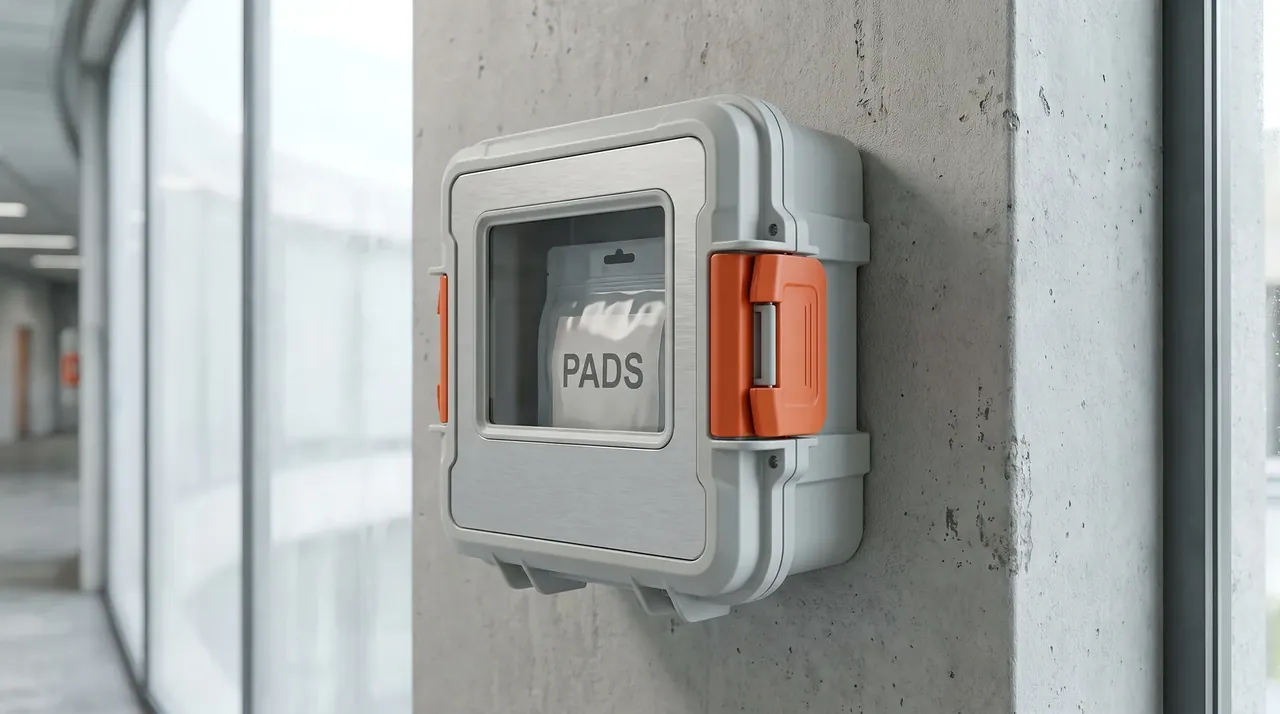
Quick answer: Medical diagnostic device case with custom foam ships with two inserts, full wrap and windowed, in one 520×400×260 mm shell swapped within 90 s.
Table of contents
- Why a medical diagnostic device case with custom foam ships with two inserts
- 40 kg/m3 foam, a 20 mm egg-crate lid and a 15 mm base pad
- What the full-wrap and the windowed inserts each hold
- A 90 s swap set by datums, not by recutting
- Wall, latches and wipe-down acceptance
- FAQ
1. Why a medical diagnostic device case with custom foam ships with two inserts
Two inserts for one shell are forced by two duties. In transit a 1.2 m drop demands a six-face wrap, since one open face passes the shock to the 3.8 mm wall; at the bedside an open lid demands a window while the other faces still hold the envelope. Medical diagnostic device case with custom foam keeps the difference in the insert and the sameness in the shell: one 520×400×260 mm body with a 465×345×215 mm cavity, sharing wall, four latches and one gasket.
Sharing needs one locating datum. Medical diagnostic device case with custom foam moulds a stop into the base and a frame into the lid, both cut to one outline; move it and the window drifts, so the clearance stops being even.
2. 40 kg/m3 foam, a 20 mm egg-crate lid and a 15 mm base pad
The 40 kg/m3 figure is density, not hardness; the 20 mm egg-crate sits in the lid and the 15 mm pad on the floor. Medical diagnostic device case with custom foam uses the pair because density sets absorbed energy and thickness sets the travel before the envelope meets the wall: too low and a 1.2 m drop bottoms the foam onto the 3.8 mm wall.
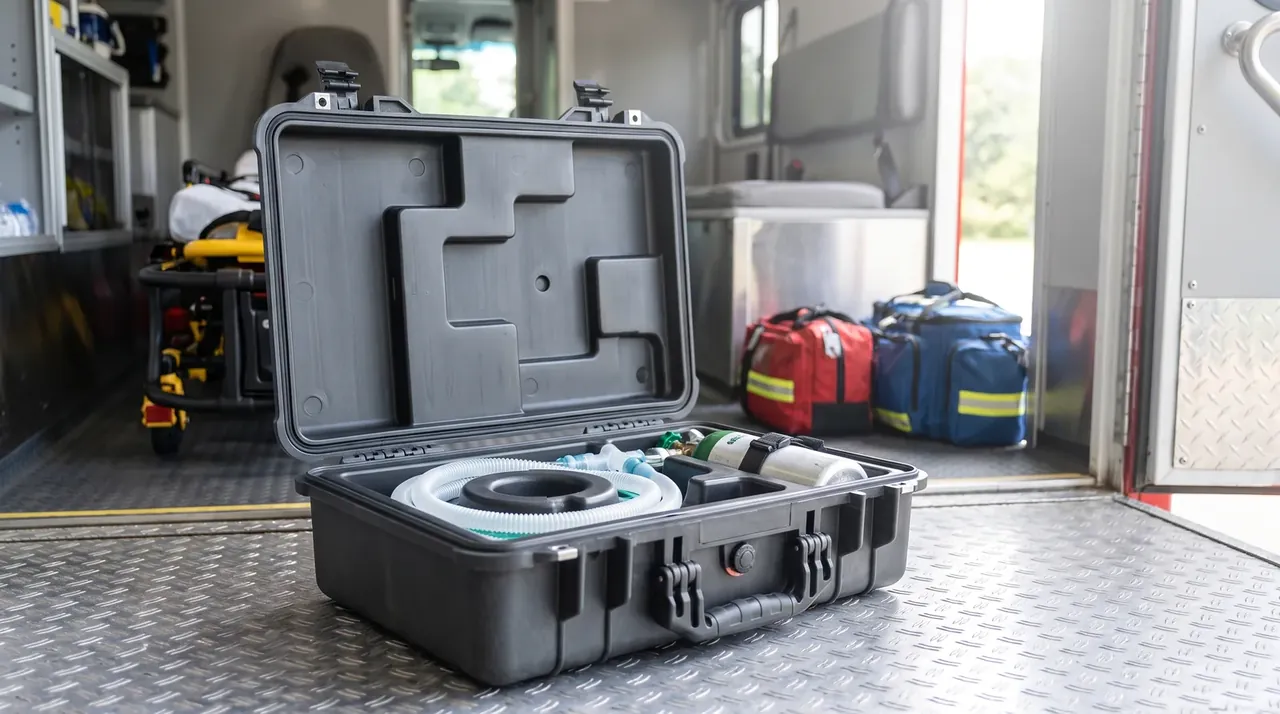
The peaks face down and the cut takes the valley between them, so a windowed insert keeps a 20 mm toothed ring. The edge steps inward, and the criterion is that no point of the envelope touches the wall after the cut.
| Insert version | Lid foam | Floor pad | Envelope margin |
|---|---|---|---|
| Transit, full wrap | 20 mm egg-crate, full | 15 mm pad | Six faces in 40 kg/m3 |
| Bedside, windowed | Rectangular window | 15 mm pad | Edge stepped in |
| Shared datum | Base stop | One outline | Swap within 90 s |
A 1.2 m drop check looks for contact marks; IP67 is benchmarked against immersion and belongs to wall and gasket, not density.
3. What the full-wrap and the windowed inserts each hold
The full-wrap insert holds six faces. Medical diagnostic device case with custom foam presses 20 mm egg-crate toward the lid and a 15 mm pad toward the floor, with a ring against the inner 3.8 mm wall, so the envelope hangs at the centre. Four latches at 380 N each clamp the gasket rather than carry weight, and stay below a higher force since over-tightening relaxes the wall at -20 °C.
The windowed insert holds the ring around the opening: with lid foam gone, centring falls to the ring and the 15 mm pad. Medical diagnostic device case with custom foam limits the opening to lid foam, so the wall and gasket stay complete and IP67 still applies.
| Foam window | Face cut | Layers kept | What it holds |
|---|---|---|---|
| None, full wrap | None | 20 mm egg-crate plus 15 mm pad | Six-face gap |
| Top window | Lid insert | 15 mm pad plus ring | Window step-in |
| Shared datum | Four base stops | One outline | Window position |
Both versions are checked against the same datum; neither yields size to the other.
4. A 90 s swap set by datums, not by recutting
The 90 s is a swap time, not a cutting time. Both inserts share one outline and differ only in the window, so the change is four moves: release the frame, lift the old insert, seat the new one, refit frame and four latches. Medical diagnostic device case with custom foam locates on the base stop, so the new insert centres itself without a knife.
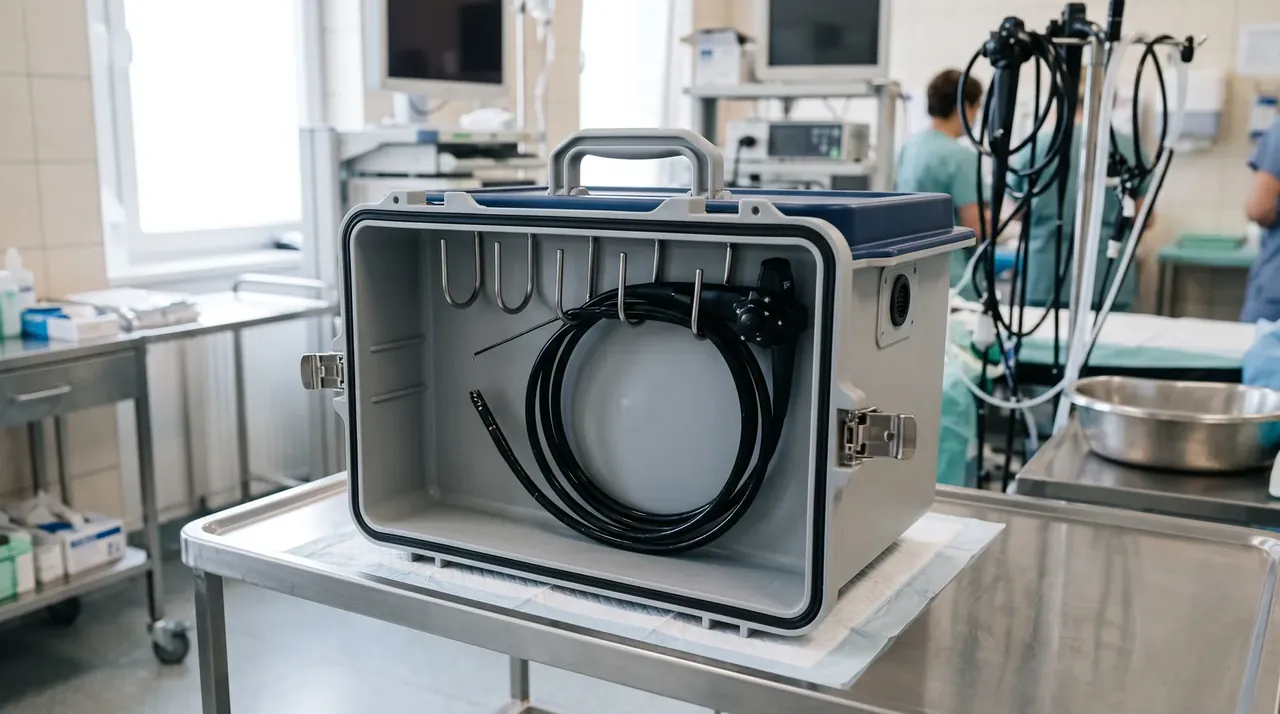
Alignment is what the limit caps, hence a lead-in chamfer and rounded corners; a square stop would need several tries to seat. From -20 °C to 60 °C foam and shell expand differently, and the gap at the stop is sized for that difference, with the insert left unglued so a swap does not tear it.
| Swap step | Part handled | Time account |
|---|---|---|
| Release hold-down frame | Frame and four latches | Inside 90 s |
| Lift the transit insert | Whole foam piece | Inside 90 s |
| Seat the bedside insert | Base-stop alignment | Inside 90 s |
| Refit frame and latches | 380 N each | Inside 90 s |
Nothing in the shell changes, so the acceptance figures stand.
5. Wall, latches and wipe-down acceptance
Medical diagnostic device case with custom foam has plain boundaries: a 520×400×260 mm outside, a 465×345×215 mm cavity, a 3.8 mm wall, a 5.4 kg empty shell and 10.5 kg of rated load. Four latches at 380 N are sized from gasket reaction and, against the IP67 immersion benchmark, must survive the spring-back of a 1.2 m drop. The -20 °C to 60 °C band covers cold transport and warm use, with the mismatch taken up at the stop.
500 wipes with 70% ethanol check shell, latches and gasket, not foam: no blushing, no dragging, no swelling. Medical diagnostic device case with custom foam treats that as a wipe method, and runs the 1.2 m drop on six faces to see whether the 20 mm egg-crate and 15 mm pad have bottomed out.
Conclusion
Medical diagnostic device case with custom foam concentrates the problem: one shell, two inserts, a 90 s swap, and 40 kg/m3 foam with a 20 mm lid and 15 mm pad that keep the envelope off the wall. Check three things first: one shared datum, a window that steps in far enough, and foam that does not bottom out after a 1.2 m drop. The 3.8 mm wall, four 380 N latches and IP67 benchmark only underpin those three.
Related Reading
- Cleanliness and transit structure of medical device transport cases
- Factors in choosing a custom foam insert
- Specification terms for plastic cases with foam inserts
- Cut-out specification terms for pre-cut foam liners
Related Products
- 8 Series — Gun Cases; Military Equipment Cases; Camera Equipment Cases; Drone Cases; Watch Cases; Knife Cases; First Aid Cases; Electronics Equipment Cases
- WL8-2812 PP Gun Case — model WL8-2812
- All protective cases and toolboxes: 7 series, 158 models