

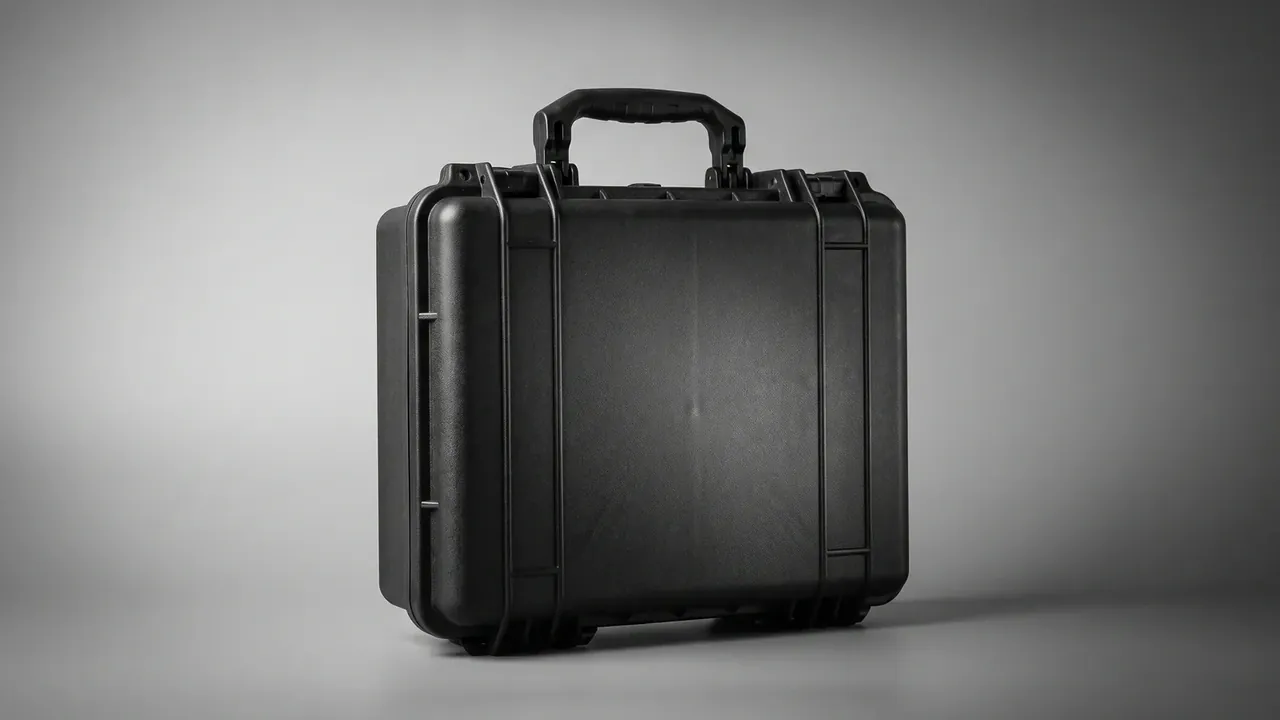
Quick answer: In a plastic case with custom foam insert, thickness is not a free choice. It is inner depth minus base layer, lid layer and lid compression. Measure the true depth, clear the ribs, cut to 2-3 mm side clearance, then check handle load against the centre of gravity.
Table of contents
- Why Thicker Foam Fails
- Case Depth Sets the Thickness Ceiling
- Clearing Ribs and Bosses
- Side Clearance and Pick-Out Notches
- Centre of Gravity and Lid Compression
- FAQ
1. Why Thicker Foam Fails
Most buyers of a plastic case with custom foam insert follow one rule: fill the void. A 120 mm case gets a 120 mm block. It looks airtight at hand-over and fails in the first week.
The lid hits first. The rim carries a seal groove, the foam stops at the groove, and every latch needs a slap. Then the handle side hangs heavy and no finger fits beside the unit.
Thickness is not independent. It is inner depth minus base layer, lid layer and compression allowance, and the inner depth has already lost its ribs, bosses and draft.
2. Case Depth Sets the Thickness Ceiling
On a plastic case with custom foam insert, inner depth is the clear distance from floor to lid face, excluding groove and bosses. A case sold as 120 mm gives 110 mm once a 4 mm floor rib and a 6 mm boss come off.
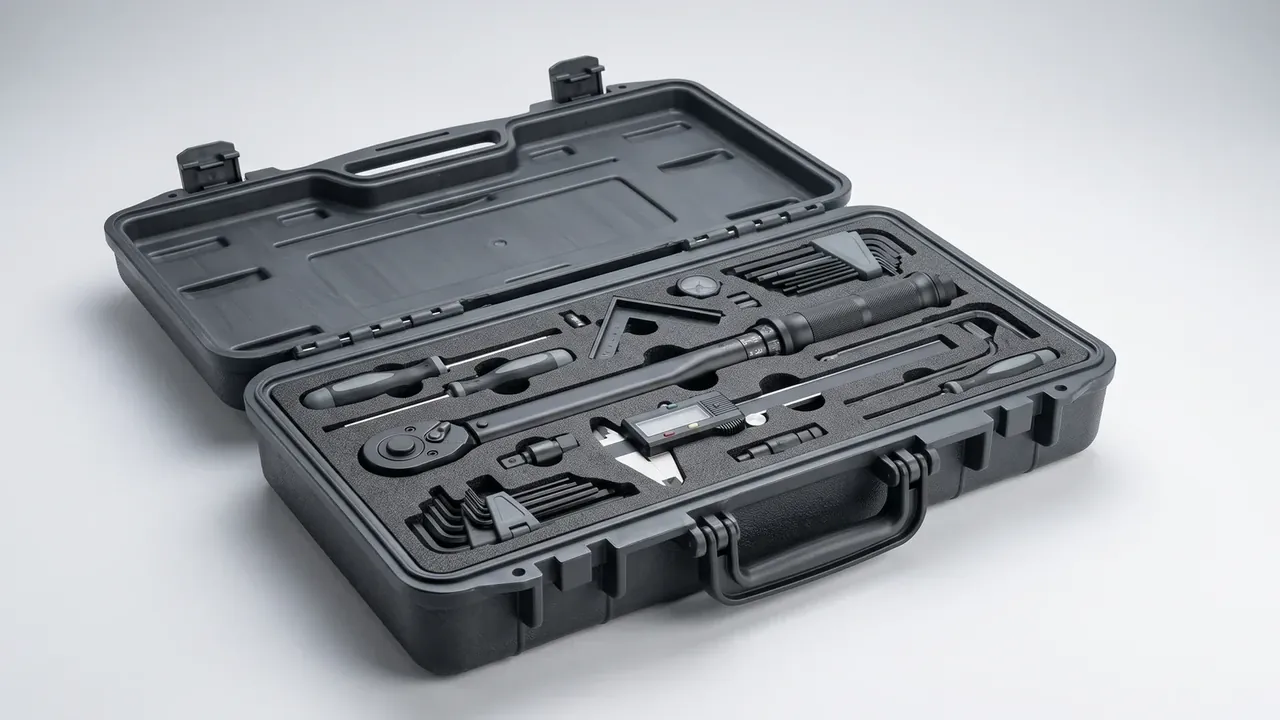
Table 1 splits four depths. Edge land is the foam between a pocket wall and the insert edge; below it the wall bulges.
| Inner depth (mm) | Insert thickness (mm) | Pocket edge land (mm) | Usable pocket depth (mm) |
|---|---|---|---|
| 90 | 62 | 12 | 32 |
| 120 | 88 | 15 | 50 |
| 160 | 118 | 18 | 70 |
| 200 | 148 | 20 | 92 |
When the unit stands proud, take material off the base layer rather than the lid layer, which does the clamping. With 15 mm spare, add it to the base so the centre of gravity drops.
The lid boss is the most forgotten item. Latch seats often carry 5-8 mm of it, and ignoring that height holds the lid 3 mm open.
3. Clearing Ribs and Bosses
The inside of a plastic case with custom foam insert is not a flat box. Vertical ribs, a floor grid, hinge and latch seats all project into the cavity, so an insert cut to smooth-face size rides on them and bulges 2-3 mm.
- Vertical ribs: 3 mm relief groove, 2 mm wider than the rib
- Floor grid: 5 mm flat plate before the pocket layer
- Hinge seat: no foam within 15 mm of the axis
- Latch seat: 10 mm gap inside the latch
- Draft angle: about 1.5 degrees, roughly 5 mm over 200 mm
- Seal groove: insert no closer than 6 mm
Draft is the one skipped: measure only the top opening and the insert comes out a ring oversize.
4. Side Clearance and Pick-Out Notches
Side clearance is 2-3 mm per side, an allowance for mould shrinkage and foam growth. A moulded case keeps shrinking for 48 h, 1.0-1.6 mm over a 200 mm span, and foam carried into a humid shop swells 0.5 mm per side.
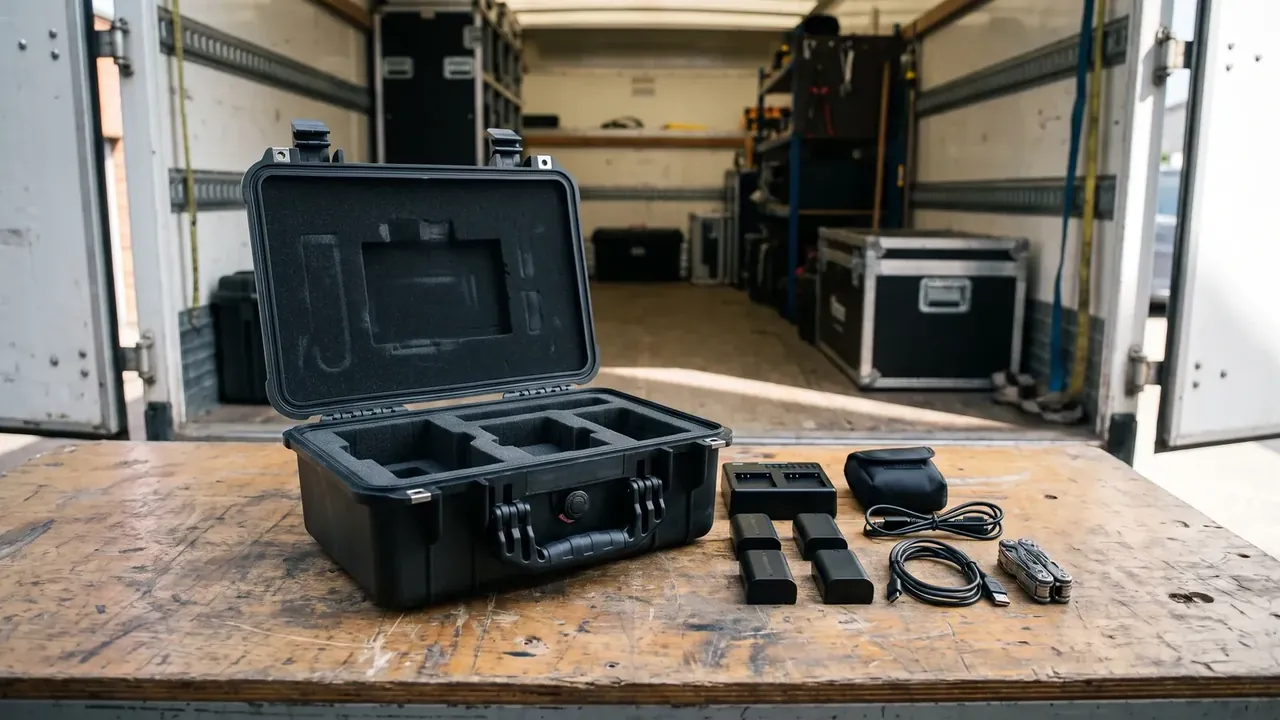
Three millimetres is the ceiling for a plastic case with custom foam insert. Past it the insert slides as a block and the wall takes the drop before the foam does. Notches run 15-25 mm, sit mid short edge and cut to the pocket floor. Under 15 mm no finger enters; over 25 mm the wall loses section. Radius the edge at 2 mm.
5. Centre of Gravity and Lid Compression
Pocket layout sets the centre of gravity, and that sets the handle load. Four equal pockets look tidy, but two heavy items put the mass in one corner and double the handle side.
| Load layout | CoG offset (share of width) | Extra force at handle (N) | Insert change |
|---|---|---|---|
| Heavy item centred | 0 | 0 | Equal pockets |
| Heavy item at handle side | 1/4 | 18 | Base 8 mm thicker there |
| Heavy item at hinge side | 1/3 | 9 | Thicker lid layer |
| Two items diagonal | 1/5 | 5 | Divider rib |
Past a third of the width the bending moment keeps the wall in tension, and polypropylene creeps above 40 °C, so a permanent set appears within a year.
Lid compression is 2.5 mm: the lid layer stands proud of the clear height and compresses 8-12% into a preload ring. Under 1.5 mm it rattles, over 4 mm the latch tongue fatigues. The gasket takes about 2 mm of the groove, so the foam bears only on the flat inside it.
Conclusion
A plastic case with custom foam insert is a subtraction problem: inner depth minus base layer, lid layer, boss and compression leaves the usable pocket depth. Relieve the ribs, hold 2-3 mm of clearance, keep notches at 15-25 mm, and keep the centre of gravity inside a third of the width. Get those numbers right and a plastic case with custom foam insert fits better with thin foam than with thick.
This article discusses only the container (case body) side of specifications and design intent, and does not cover any handling, loading or use of the contents.
Related Reading
- Foam insert specifications: thickness, compression ratio and tolerance
- Fitting an insert into a case and checking the bond line
- Foam cutting processes and cut edge quality
- Insert layouts for different case applications
Related Products
- 8 Series — Gun Cases; Military Equipment Cases; Camera Equipment Cases; Drone Cases; Watch Cases; Knife Cases; First Aid Cases; Electronics Equipment Cases
- WL8-2812 PP Gun Case — model WL8-2812
- All protective cases and toolboxes: 7 series, 158 models