

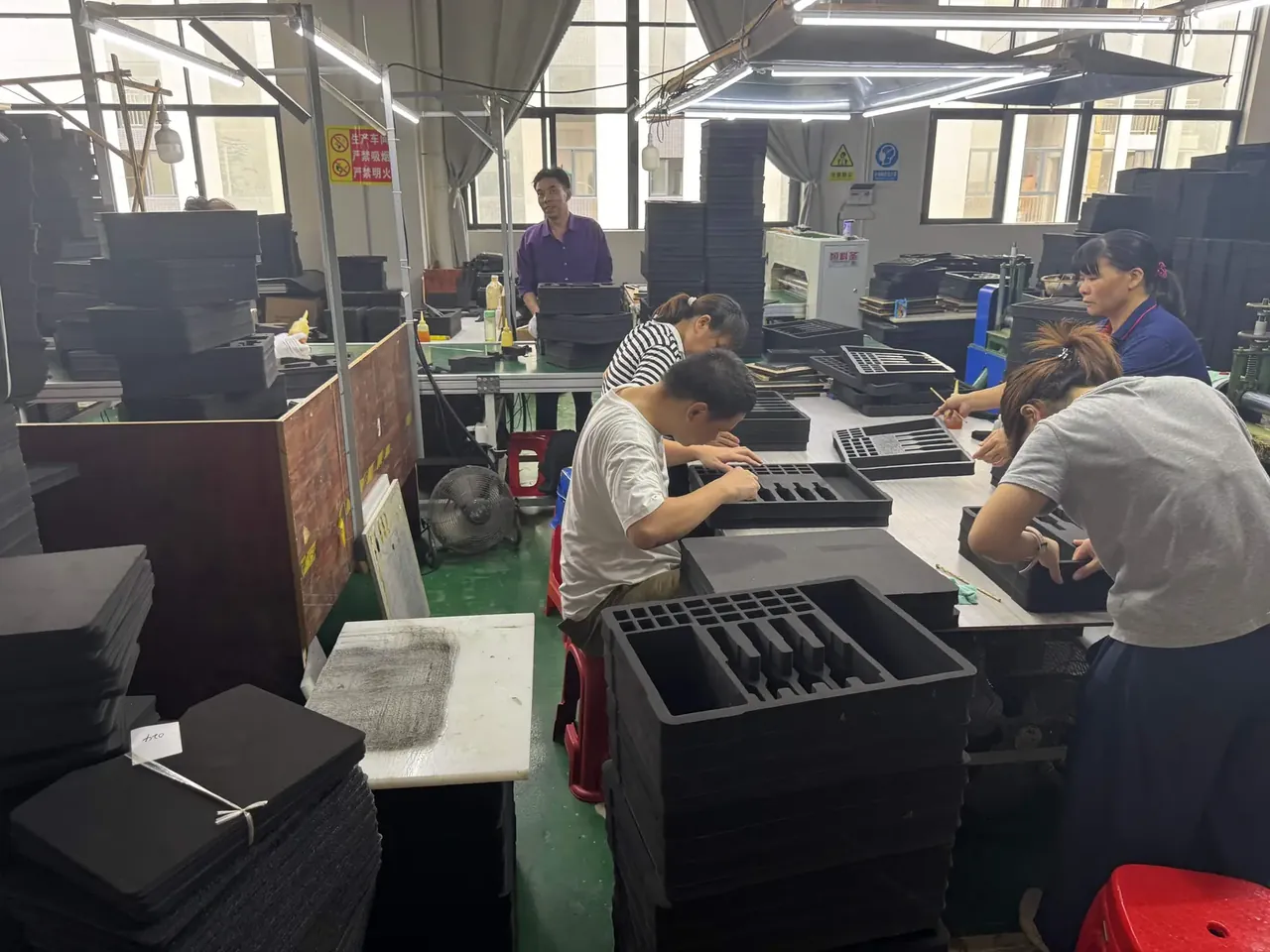
Quick answer: Three faults dominate foam insert installation: curled edges from cut-face absorption, fixed by sealing and 25 g/m² coating; debonding from release residue or the wrong adhesive, judged at 0.3 N/mm peel; loose fit from corner build-up or thickness spread beyond ±0.4 mm.
Table of contents
- Sorting foam insert installation faults before touching the case
- Curling: edge sealing and coating weight
- Debonding: substrate cleaning and adhesive choice
- Loose fit: corner build-up and thickness tolerance
- Rework flow and the 24 hour recheck
- FAQ
1. Sorting foam insert installation faults before touching the case
Three symptoms reach the bench: a lifted edge, a panel that comes away whole, and a lid that closes without resistance. Each belongs to a different part of the process, and sorting them removes half the wasted rework.
Check adhesive first, substrate second, geometry last: a continuous bead within 10 mm of the edge, a water film that stays put, and a warp under 2 mm on a flat plate.
| Fault | Likely cause | First action |
|---|---|---|
| Curling | Open cells drink adhesive | Seal the cut face, coat at 25 g/m² |
| Debonding | Release agent, wrong family | Two-stage clean, primer, peel 0.3 N/mm |
| Loose fit | Corner build-up, thickness spread | V-groove or split layers, hold ±0.4 mm |
2. Curling: edge sealing and coating weight
Curling is usually a loss of adhesive rather than a shortage. A die-cut face is open-cell, so the first pass disappears into the cell walls and under half of what was applied reaches the joint. Heat-laminating a thin slice of the same foam, or brushing a thinned coat into the cut face, closes it.
Coating is set by area, not by eye: about 25 g/m², with a second pass over the outer 15 mm band where peel load concentrates. Below 15 g/m² the edge lifts as a matter of course. Sealed edges then flash off until touch-dry.
3. Debonding: substrate cleaning and adhesive choice
A panel that comes away whole points at the substrate. Silicone and wax release agents left from moulding are invisible and can pull bond strength close to zero. Wipe twice with isopropyl alcohol, change cloths for the second pass, and allow 90 seconds; a continuous water film means the surface wets.
Family mismatch debonds just as reliably. Polypropylene and polyethylene shells are low-energy surfaces, so standard hot melt will not hold; a modified grade or a primer is needed. Release at 0.3 N/mm minimum, pulled at 50 mm/min over three specimens. Hold the press 40 seconds; a longer squeeze thins the layer.
4. Loose fit: corner build-up and thickness tolerance
A loose fit shows as a lid that rocks, or corners that accept a 1 mm feeler blade. Measure five points per sheet: a spread above 0.4 mm means uneven density or a dull blade.
Corner build-up is more common: square-cut ends meeting at an internal corner compress against each other and the joint grows about 30% through the thickness. A 90° V-groove with a 0.35 mm web closes the fold with one wall added; above 40 mm, laminate two 20 mm layers, staggered 10 mm.
| Incoming check | Method | Limit |
|---|---|---|
| Thickness | Micrometer, five points | ±0.4 mm of nominal |
| Compression set | 25% deflection, 70 °C for 22 h | ≤8% |
| Surface energy | Dyne pens | ≥38 dyn/cm |
5. Rework flow and the 24 hour recheck
Rework starts with heat, not force. Warm the old adhesive, peel at 30°, keep the scraper on flat faces, and hold residue under 0.05 mm before recoating.
Tagged units rest 24 hours, then face three checks: 0.3 N/mm peel, 1 mm maximum curl, a lid without rattle. A failure is downgraded, never shipped the same shift.
| Stage | Action | Release |
|---|---|---|
| Strip | Warm, peel at 30° | Residue ≤0.05 mm |
| Re-bond | 25 g/m², 40 s press | Edge sits flat |
| Recheck | 24 h dwell, then test | Peel 0.3 N/mm, curl ≤1 mm |
Conclusion
Nearly every field complaint about foam insert installation reduces to three values: coating weight, surface energy and thickness spread. Curling points to open cells, debonding to a contaminated surface, loose fit to corners and tolerance. Judge by peel strength, curl height and closing feel, and foam insert installation repairs begin to converge.
This article discusses only the container (case body) side of specifications and design intent, and does not cover any handling, loading or use of the contents.
Related Reading
- The full custom foam lining workflow
- Dividers or foam lining: how to choose
- Foam structures used inside protective cases
- A custom foam insert project walkthrough
Related Products
- 8 Series — Gun Cases; Military Equipment Cases; Camera Equipment Cases; Drone Cases; Watch Cases; Knife Cases; First Aid Cases; Electronics Equipment Cases
- WL8-2812 PP Gun Case — model WL8-2812
- All protective cases and toolboxes: 7 series, 158 models