

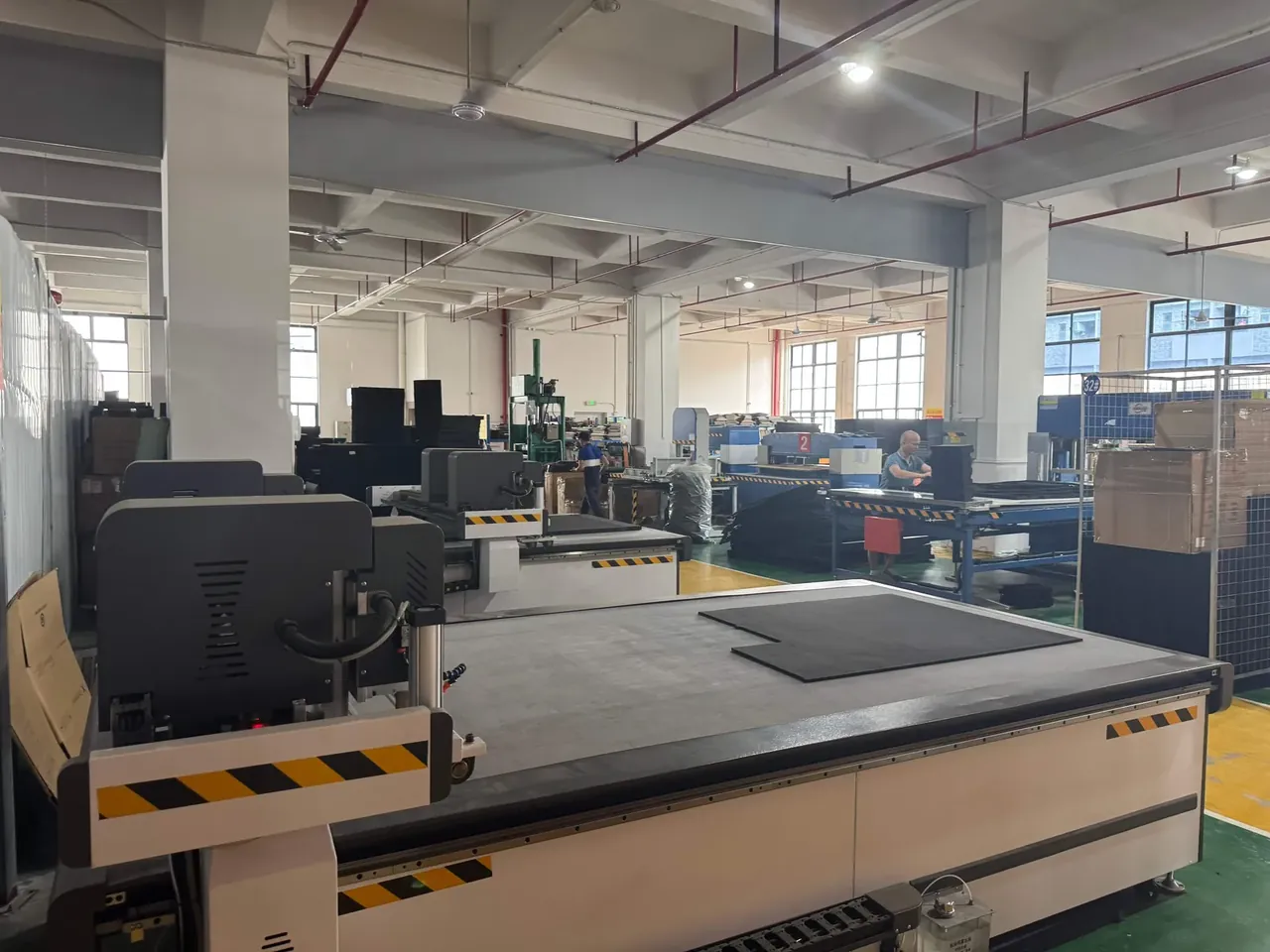
Quick answer: Foam cutting runs on three machines: a die that drives one closed rule through the sheet, a CNC head that walks a path, and a hot wire that melts its way through. Each stops at a different shape, so draw the part before choosing.
Table of contents
- Three Routes for Foam Cutting
- Die Cutting: Outline for Volume
- CNC: Freedom Bought with Machine Time
- Hot Wire: Straight Lines and Sealed Edges
- Four Shapes and Where Each Process Stops
- FAQ
1. Three Routes for Foam Cutting
A workshop cutting foam inserts owns three machines: a flatbed press with a steel die, a CNC table on a vacuum bed, and a wire bench. Capital cost runs 20,000 to 600,000 yuan.
The difference is how the edge meets material. A die drives one closed rule through the sheet in one stroke; a CNC knife is a point travelling a path; a hot wire melts a kerf and seals the walls behind it. Shape range, tolerance and cost all follow.
| Process | Shapes it can hold | Tolerance | Minimum run |
|---|---|---|---|
| Die cutting | 2D outline, through holes, straight walls | ±0.5 mm | 500 pcs |
| CNC routing | 2D outline plus pockets, tapers, steps | ±0.2 mm | 1 pc |
| Hot wire | Straight runs, single taper, constant arcs | ±1.0 mm | 1 pc |
2. Die Cutting: Outline for Volume
A die is an 18 mm plywood board with a 23.8 mm steel rule bent along the outline and set into laser-cut slots. A 30 to 60 tonne press cuts in one stroke.
Thickness runs 10 to 100 mm. Below 10 mm the rule drags the sheet back on the upstroke; above 100 mm the edge leans and the two outlines differ by 1.5 mm. A die costs 300 to 800 yuan, and suppliers quote from 500 pieces.
The limit is depth: a die cuts through, so a 20 mm pocket becomes two bonded layers, and a three-layer stack drifts to ±1.2 mm.
3. CNC: Freedom Bought with Machine Time
An oscillating knife strokes 12,000 to 18,000 times a minute for EPE and EVA; a router spins at 18,000 to 24,000 rpm for dense stock. The ±0.2 mm tolerance rests on a 6 kPa vacuum bed and 0.05 mm servo repeatability.
Feed is quoted per outline length. A knife runs 2,000 to 4,000 mm per minute at 30 to 50 mm per pass; a router takes 10 to 15 mm per layer, so a 40 mm board needs three or four passes.
Pockets and tapers come from layering. A 60 mm pocket with 15 degree walls needs a tilting head; three axes leave a visible stair.
4. Hot Wire: Straight Lines and Sealed Edges
A 0.3 to 0.6 mm nichrome wire reaches 200 to 400 °C, and the workpiece is pushed past at 20 to 60 mm per second. A straight wire cuts straight or at one taper; curves need a template or a pre-bent wire.
Kerf runs 0.5 to 1.5 mm. Too hot and the edge yellows, too cold and foam builds on the wire. The melted face closes the cells, so EPS leaves no dust; EPE shrinks 0.3 to 0.8 mm and needs compensation.
5. Four Shapes and Where Each Process Stops
Small radii. A rule will not turn below R3 leaving a corner to trim. CNC holds R0.5, and a wire follows R5 with a template.
Blind pockets. Neither a die nor a wire can stop inside the sheet, which is why inserts are built in layers.
Angled walls. A rule sits square to the bed, so a die always yields a vertical wall. A wire gives one taper; two tapers need a tilting head.
Through holes. All three can make them, but below 2 mm the wire closes the hole, and a die needs a bridge left inside to be snipped.
| Feature | Die | CNC | Hot wire | Reason |
|---|---|---|---|---|
| R3 outside corner | no | yes | template | rule will not turn |
| 20 mm blind pocket | no | yes | no | cannot stop inside |
| 15 degree wall | no | yes | single taper | rule stays vertical |
| 1.5 mm through hole | bridge | yes | no | kerf closes the hole |
Conclusion
None of the three is better; each has an edge it cannot cross. A die trades tooling for unit price, CNC trades time for shape, and a wire trades shape for speed and a sealed face. Draw the outline honestly and the choice narrows on its own, which is how foam cutting should be specified.
This article discusses only the container (case body) side of specifications and design intent, and does not cover any handling, loading or use of the contents.
Related Reading
Related Products
- 8 Series — Gun Cases; Military Equipment Cases; Camera Equipment Cases; Drone Cases; Watch Cases; Knife Cases; First Aid Cases; Electronics Equipment Cases
- WL8-2812 PP Gun Case — model WL8-2812
- All protective cases and toolboxes: 7 series, 158 models