

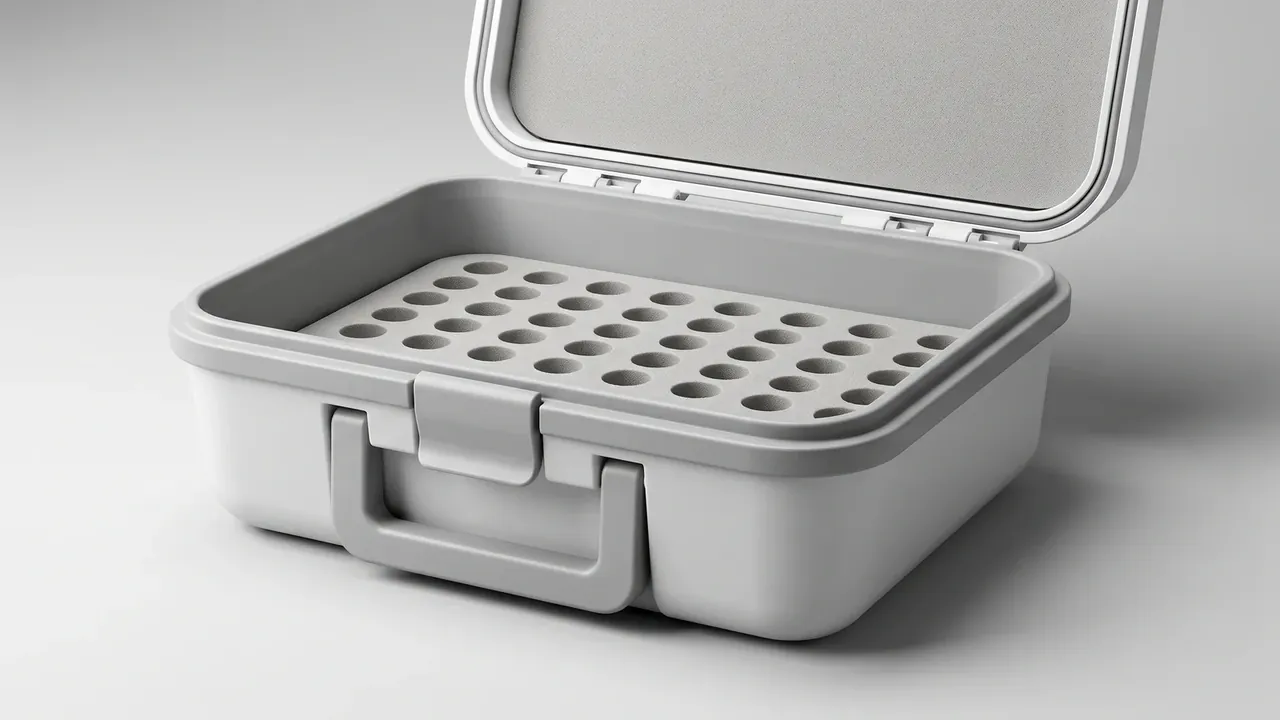
Quick answer: Work backwards from the cavity: measure the largest outline, add three millimetres of clearance per axis and a finger gap, then add wall thickness.
Table of contents
- Plastic Case with Custom Foam Cutout Specs Start from the Interior
- Wall Thickness and Load Capacity
- Foam Density, Hardness and Kerf
- Tolerances, Clearance and Pick Feel
- Hardware, Sealing and Factory Tests
- FAQ
1. Plastic Case with Custom Foam Cutout Specs Start from the Interior
The cavity comes first. Measure the part at its longest, widest and tallest points, add three millimetres to length and width and fifteen for fingers, then add the walls.
Foam is quoted in two layers: a 20 to 30 mm base pad carrying the load and a 30 to 50 mm cut layer wrapping the outline. Deep pockets are bonded rather than routed through, or the floor collapses.
| Cavity, length by width | Cut layer | Base pad | Wall |
|---|---|---|---|
| 300 by 200 mm | 30 mm | 20 mm | 3.5 mm |
| 400 by 300 mm | 40 mm | 25 mm | 4.0 mm |
| 550 by 400 mm | 50 mm | 30 mm | 4.5 mm |
An 850-tonne press holds a 4.0 mm wall on a 400 by 300 mm plastic case with custom foam cutout and keeps the rim square; under-powered machines leave it oval, and an oval rim never compresses foam evenly.
2. Wall Thickness and Load Capacity
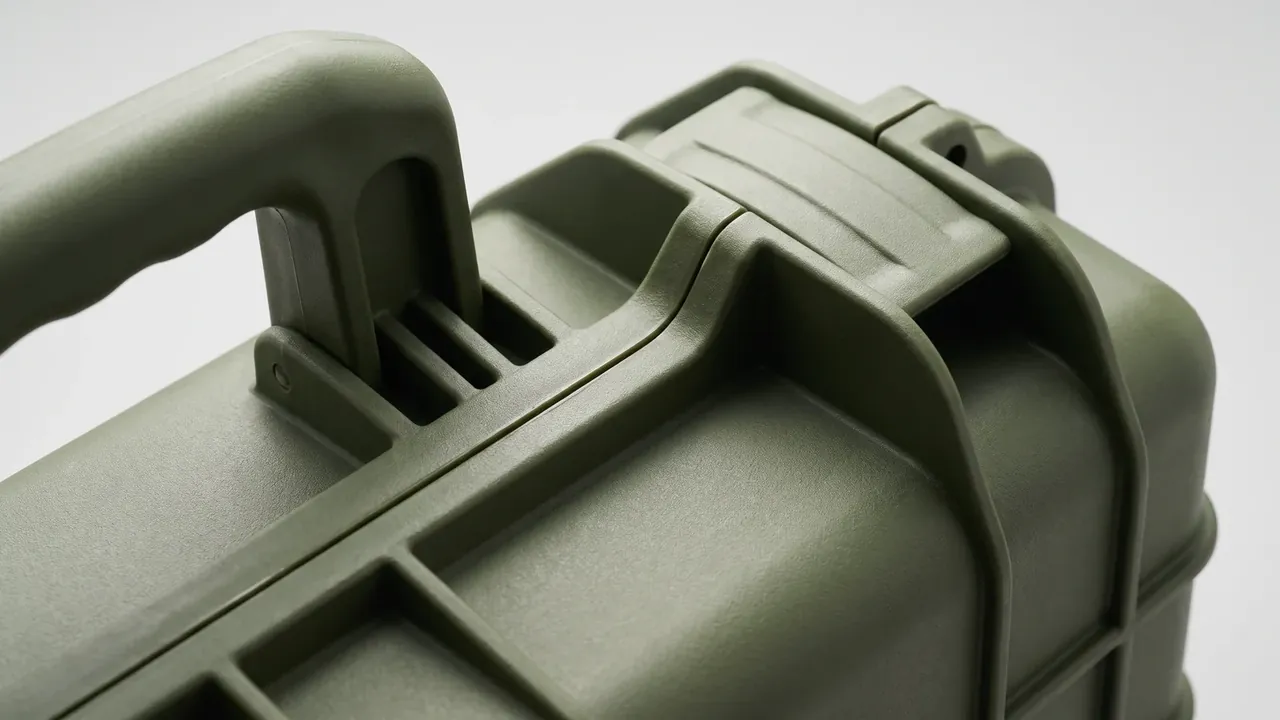
A 4.0 mm wall is the working value on a plastic case with custom foam cutout. Dropping to 3.2 mm saves thirty per cent of weight but the side panels give under a thumb; 4.5 mm adds weight a one-handed carry notices.
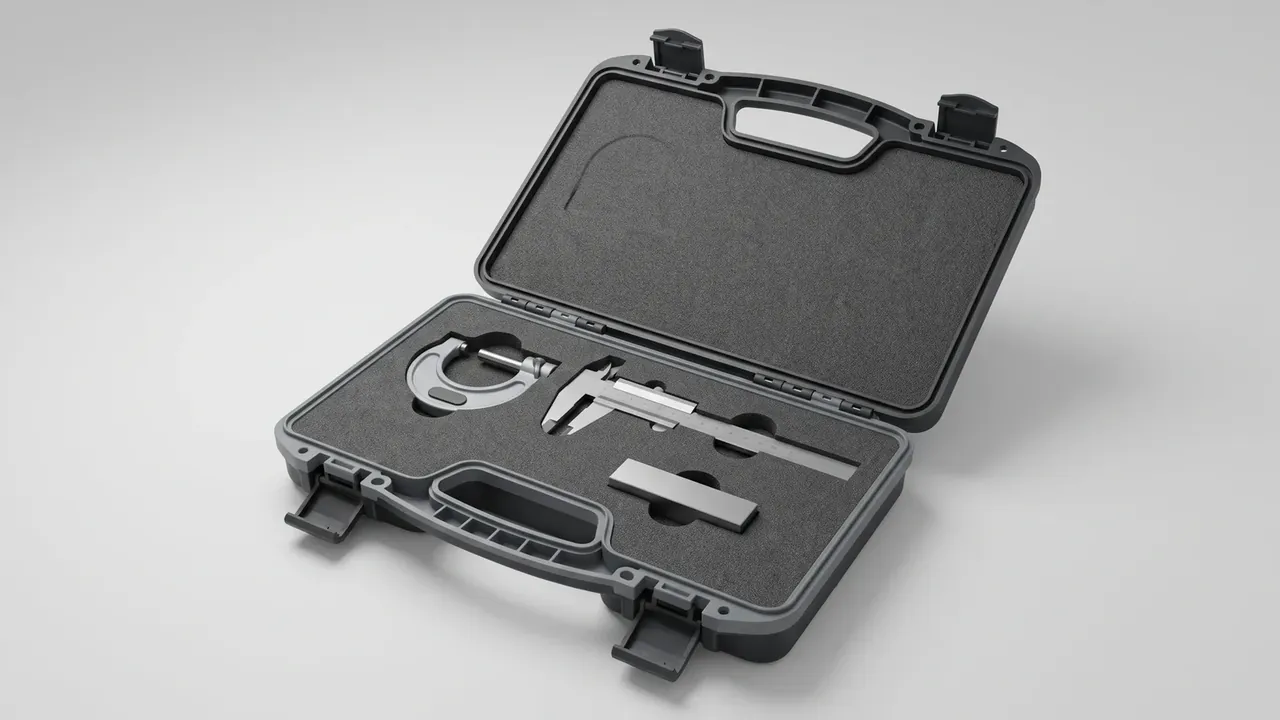
A rating assumes an even spread. At two handles and four corners the momentary force reaches three times the distributed figure, so a 10 mm radius where base meets wall buys more than 0.3 mm of extra wall. The lid shares that load through a seating rib that compresses the foam 5 mm.
3. Foam Density, Hardness and Kerf
Density follows weight: at 45 kg per cubic metre the foam balances rebound and support, 38 slumps within three months, 55 marks thin walls. Hardness sits at 35 to 45 on the Shore C scale.
Kerf sets how tight a plastic case with custom foam cutout feels. A vibrating blade removes about 1.2 mm and leaves a 1.5 mm web between close paths; laser gives a narrower slot but a burnt crust that sheds grit, so polished parts are usually routed.
Adhesive belongs in the tolerance stack: spray glue at 40 grams per square metre bonds evenly, while a heavier coat hardens the foam and lifts pocket edges.
4. Tolerances, Clearance and Pick Feel
Routing depth holds to plus or minus 0.5 mm; too shallow and the part rides high, too deep and it rattles. Precision pockets tighten to 0.3 mm.
| Item | Standard | Tightened |
|---|---|---|
| Cavity | 1 mm | 0.5 mm |
| Routing depth | 0.5 mm | 0.3 mm |
| Pocket position | 1.5 mm | 1 mm |
| Case flatness | 1.5 mm | 1 mm |
Clearance runs 0.5 to 1.0 mm per side: below 0.5 the part will not seat, above 1.5 it shifts in transit; metal parts take the tight end.
Two finger pulls of 25 mm diameter and 20 mm depth, set opposite, balance the load; a single pull tears the pocket lip.
5. Hardware, Sealing and Factory Tests
Three first articles for a plastic case with custom foam cutout cover the risks: one sectioned for wall thickness, one built up with foam, one dropped loaded. Production samples one in five hundred.
| Test | Pass line |
|---|---|
| Cavity | Within 1 mm at three points |
| Foam density | 45 plus or minus 3 kg per cubic metre |
| Kerf | 1.2 mm maximum in every pocket |
| Hardware | No red rust at 96 hours |
| Load | Sag of 2 mm or less at 80 kg |
Salt spray scales with the route: 96 hours inland, 240 for coastal freight. Two cycles from minus thirty to seventy degrees Celsius should leave the foam bonded.
Conclusion
The order is cavity, foam, wall, load; skip a step and the job goes back for rework. Put the cavity tolerance, routing depth, kerf and load on the drawing, then ask for first articles. A plastic case with custom foam cutout lives or dies on that half-millimetre clearance.
This article discusses only the container (case body) side of specifications and design intent, and does not cover any handling, loading or use of the contents.
Related Reading
- Custom foam insert specifications: density, layers and tolerance
- How custom foam inserts are actually made
- Foam cutting methods compared: die, blade and laser
- Choosing internal dividers: compartments, location and access
Related Products
- 8 Series — Gun Cases; Military Equipment Cases; Camera Equipment Cases; Drone Cases; Watch Cases; Knife Cases; First Aid Cases; Electronics Equipment Cases
- WL8-2812 PP Gun Case — model WL8-2812
- All protective cases and toolboxes: 7 series, 158 models