

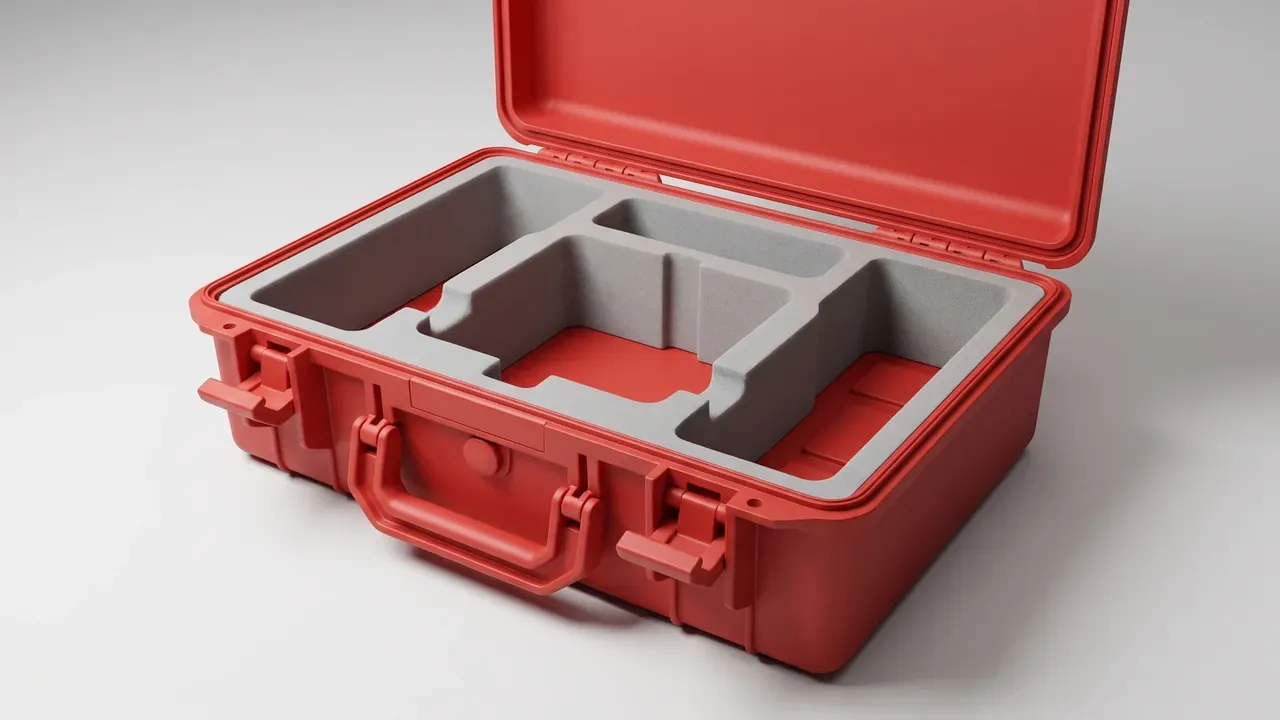
Quick answer: A medical equipment plastic case in a hospital is not shipped once; it is opened, wiped and carried up stairs several times a day. This article splits the configuration by four contact surfaces: disinfectant resistance decides material and surface finish, dust decides which way the gasket groove faces, device geometry decides the foam cavity, and staircases decide where the trolley hooks sit.
Table of contents
- Medical equipment plastic case: four contact surfaces
- Disinfectant resistance: after 300 wipes
- Sealing and dust: the gap ratings miss
- Foam locating: devices should not be squeezed
- Stairs, trolleys and package validation
- FAQ
1. Medical equipment plastic case: four contact surfaces
An ambulance bay sits near ten degrees Celsius, a theatre corridor near twenty-three, and the service lift in between has no air handling at all. A medical equipment plastic case shuttles between those three zones in a single morning, so what it sees is repeated temperature swing rather than one long journey.
| Contact surface | Typical action | What the case needs | Common mistake |
|---|---|---|---|
| Vehicle floor | Braking, vibration, stacking | Ribbed base, stack strength | Judging by looks, not by base ribs |
| Trolley | Hooks, straps, kerbs | Side hook holes, low centre of gravity | Hooks placed too high, case tips |
| Hands | Handle, carry, lid opening | Handle rated at twice the load | Handle root left thin |
| Disinfectant | Daily wiping | Chemical resistance, stable colour | Wiping ABS like polypropylene |
The first three surfaces are structural questions. The fourth is a material question, and it is the one that ends most service lives: cases come back scuffed, crazed, or with a gasket gone hard.
2. Disinfectant resistance: after 300 wipes
Hospital disinfection runs stronger and more often than industrial cleaning. Chlorine at 500 mg per litre, ethanol at 75 percent, hydrogen peroxide at 0.5 percent, two or three times a day: over a year the same wall is wiped more than 300 times.
| Agent | On polypropylene | On ABS | On the gasket |
|---|---|---|---|
| Chlorine, 500 mg per litre | Stable | Yellows with long wiping | Nitrile fine, natural rubber not |
| Ethanol, 75 percent | Stable | Gradually loses gloss | Fine |
| Hydrogen peroxide, 0.5 percent | Stable | Fine | Fine |
Two criteria are enough: colour shift below 2 after 300 wipes, and tensile strength retaining more than 80 percent. A case that fails usually carries too much filler, or has been painted, and paint starts showing through around the fiftieth wipe.
3. Sealing and dust: the gap ratings miss
An IP rating measures whether water and dust get in, not whether dust collects in the groove. Corridors carry floor-scrubber mist and lint, and that lint settles in the overlap between lid and body, ready to drop inside at the next opening.
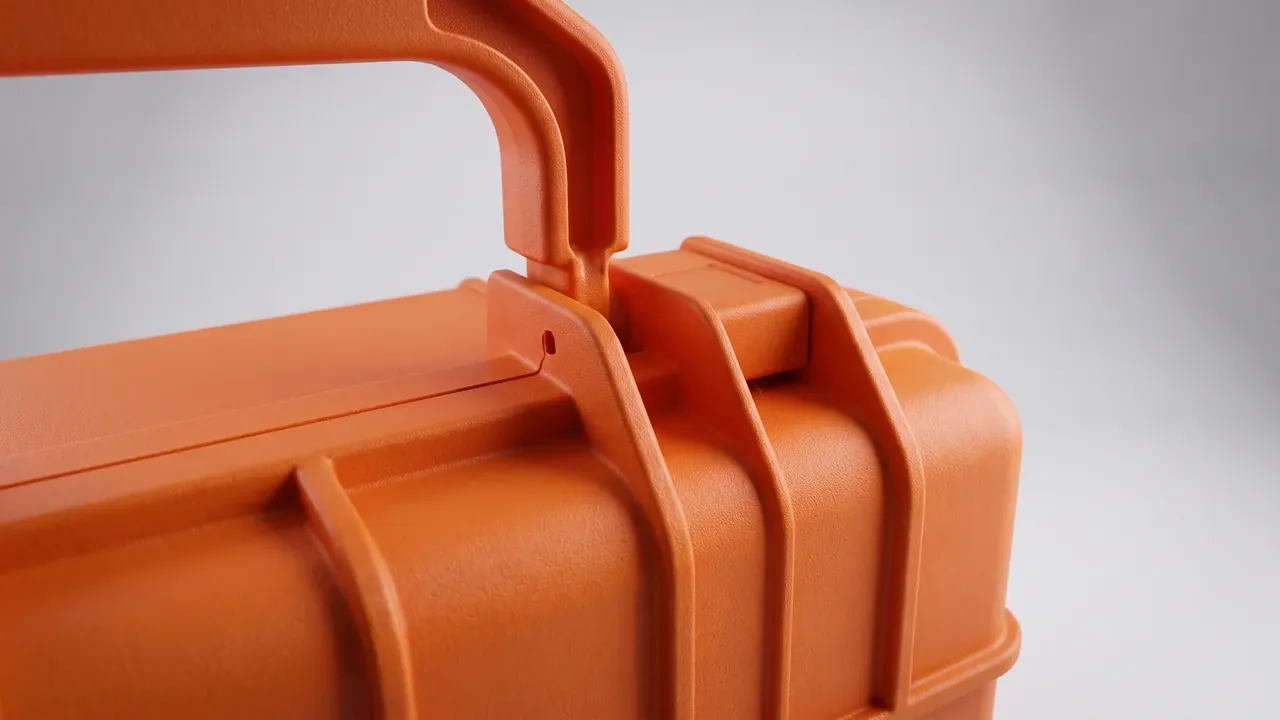
Three structural moves help. Make the gasket groove a single continuous, replaceable loop. Leave half a millimetre of interference on the mating face, with compression held between 25 and 30 percent. Add an inner lip on the lid so dust stops outside the sealing line.
Wiping technique matters too. An exposed U-shaped groove lets a cloth push dirty water straight into the channel; a groove that faces inward is easier to clean.
IP54 and IP67 differ on immersion, not on dust. Most hospital transfers need splash protection only, where IP65 is enough; full washdown or open-air loading in rain is where IP67 earns its tighter latches.
4. Foam locating: devices should not be squeezed
Movement inside the case should stay under two millimetres. That figure comes from a cavity cut to the outline of the device, not from foam pressed hard against it.
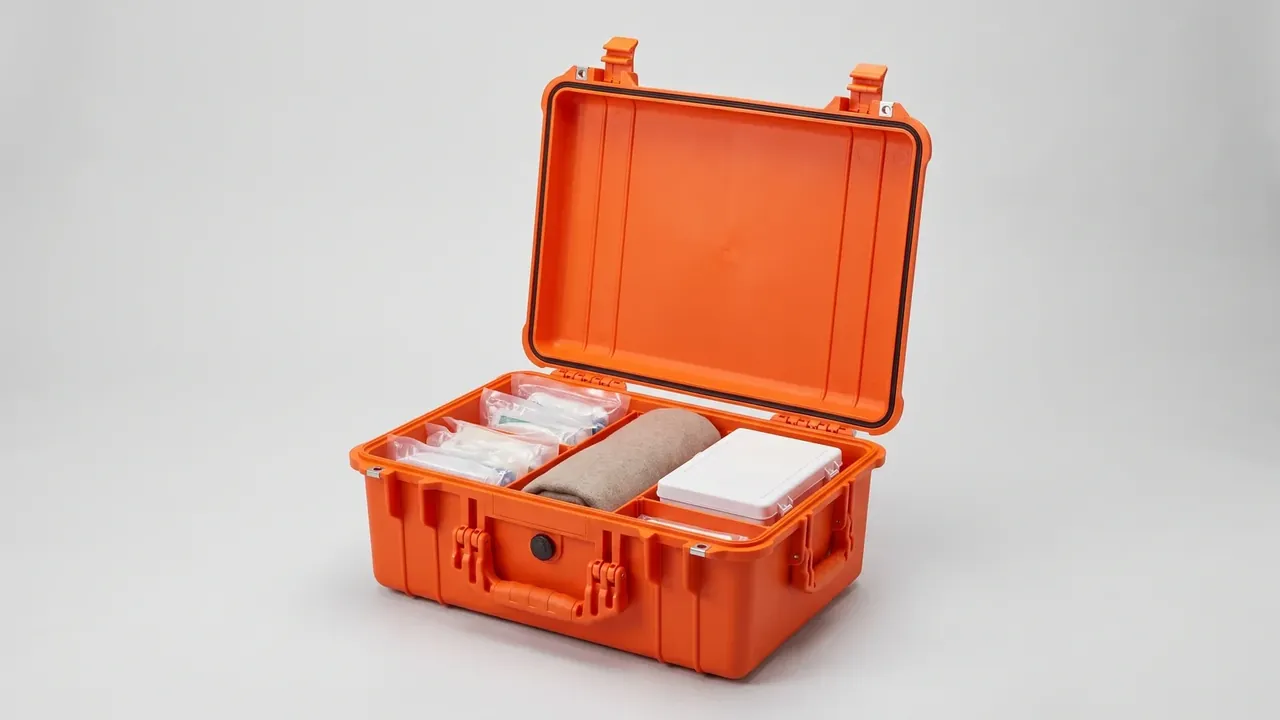
Choose density by weight: polyurethane at 35 kg per cubic metre suits devices above 5 kg, 25 kg suits small light items. Compression set should stay under 5 percent, otherwise the cavity loosens within three months.
Locating points go on rigid features: frame, handle root, the four corners of the base, never on a screen, probe or connector. Leave three millimetres beside a display and stop lateral movement with a side block rather than by pressing the front. A cavity two millimetres deeper than the device height makes removal easy. Add a finger notch, or the next person will pull the case out by its cable. One cavity holding two different devices saves a cutting die and ruins the fit for both.
5. Stairs, trolleys and package validation
On a 45-degree staircase the centre of gravity drifts and takes the trolley with it, and hook holes in the upper third of the case multiply the tipping moment. A medical equipment plastic case usually fails here on two dimensions, not on wall thickness.
- Move hook holes below 40 percent of case height, which roughly halves the tipping moment.
- Add two transverse ribs on the base so the case grips the trolley bar instead of sliding.
- Keep the loaded weight under 25 kg, so one person can carry it up two flights.
Package validation is best written against an ISTA 3A type criterion, cited here as a criterion only and not as a claim that this site has run the test: drop from 76 cm below 18 kg and from 46 cm between 18 and 27 kg, once each on edge, corner and face, then random vibration at 1.05 Grms for an hour. The point of a criterion is to turn the phrase built to survive into a number somebody can repeat.
Three records belong on the acceptance sheet afterwards: seal test before and after the drop, measured movement inside the cavity, and whether the latches still open with one hand.
Conclusion
The configuration of a medical equipment plastic case is derived backwards from four contact surfaces: disinfectant sets the material and finish, dust sets the gasket groove direction, device geometry sets the cavity and locating points, and staircases set hook height and loaded weight. The two items most often skipped are wipe corrosion and hook height, and both only show up in the third month. Put those criteria on the acceptance sheet and a medical equipment plastic case is genuinely configured rather than merely bought.
This article discusses only the container (case body) side of specifications and design intent, and does not cover any handling, loading or use of the contents.
Related Reading
- Protective case setups for medical devices
- Test criteria for ABS waterproof equipment cases
- Emergency equipment cases inside the hospital
Related Products
- 8 Series — Gun Cases; Military Equipment Cases; Camera Equipment Cases; Drone Cases; Watch Cases; Knife Cases; First Aid Cases; Electronics Equipment Cases
- WL8-2812 PP Gun Case — model WL8-2812
- All protective cases and toolboxes: 7 series, 158 models