

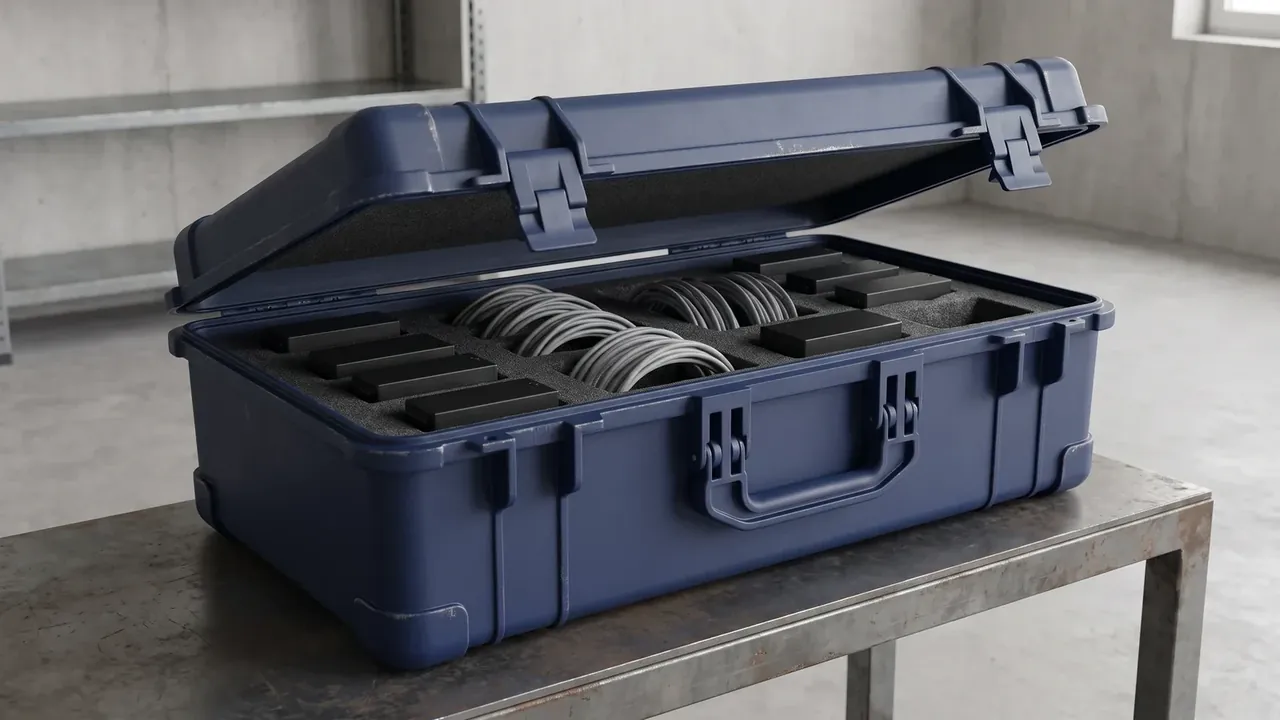
Quick answer: A medical equipment protective case works in four settings: hospital transfer, pre-hospital response, sample delivery and outreach clinics. All four share frequent handovers and cleaning; they differ on temperature, cushioning and labelling, so the surface follows the cleaning agent, the latch follows handover count, the cold chain follows trip length.
Table of contents
- Four Clinical Settings and Their Configurations
- Intra-Hospital Transfer: Surfaces and Latches
- Pre-Hospital Response: Temperature and Cold Chain
- Sample and Scanner Delivery: Cushioning and Labelling
- Outreach Clinics and Disaster Teams: Stacking and Counting
- FAQ
1. Four Clinical Settings and Their Configurations
The difference between settings shows up in cleaning before impact resistance. A case lent between departments may be wiped three times a day; one back from an ambulance run is disinfected before restocking. The cleaning agent decides how long the shell and gasket of a medical equipment protective case last.
| Setting | Cleaning | Temperature | Handover |
|---|---|---|---|
| Intra-hospital transfer | Chlorinated wipe, daily | Ambient, away from heat | Department sign-off |
| Pre-hospital response | Full disinfection after each run | 2 to 8 degrees Celsius | Handover at the vehicle |
| Sample delivery | Surface wipe plus UV | 2 to 8 degrees Celsius | Laboratory check |
| Outreach clinic | Wipe at end of day | Ambient, shaded | Team leader count |
The common mistake is sizing from the most expensive device: a monitor insert plus cold chain and stacking reaches 11 kg, which no nurse lifts one-handed. Configure a medical equipment protective case around the person carrying it.
2. Intra-Hospital Transfer: Surfaces and Latches
Transfer inside a hospital means daily chlorinated wipes at 1000 mg per litre. Plain ABS crazes within three months; a PP and PC blend is still intact after a year. The gasket should be silicone, since EPDM hardens under the same exposure.
Count latch cycles, not years: twelve openings a day is 4400 a year and over 20,000 in five, and an all-plastic hinge pin loosens after 5000 cycles.
Identification matters more than protection: an 80 by 50 mm recessed label area survives wiping, a paper label does not.
3. Pre-Hospital Response: Temperature and Cold Chain
On an ambulance a medical equipment protective case meets 55 degrees Celsius in the cabin in summer and minus 20 in a northern winter. Holding 2 to 8 degrees takes 25 mm of polyurethane plus two 400 g packs, about 8 hours at 25 degrees ambient.
Cold leaves through the lid: a 30-second opening lifts the interior by roughly 1.5 degrees, and six openings in eight hours is the limit.
Under braking an 8 kg case lunges at several times its weight, so a medical equipment protective case needs a non-slip base and a two-point strap.
4. Sample and Scanner Delivery: Cushioning and Labelling
Delivery starts at a 1.2 m drop, the line most hospitals apply. Sample racks and probes are different loads: a rack tips, a probe takes corner impact.
| Load | Internal size | Insert | Pass criterion |
|---|---|---|---|
| Sample rack | 400 x 300 x 180 mm | Upright cells, 16 mm each | No tip after six-face drop |
| Portable probe | 320 x 260 x 150 mm | EVA cut-out, 38 Shore A | 50 mm foam at corners |
| Portable scanner | 520 x 400 x 230 mm | Layered tray plus straps | No movement inside |
Probe cut-outs run 1.5 mm under the outline so compression grips the body, with a 10 mm soft layer below for corner impact. Racks stand upright.
Labelling carries half the function of a medical equipment protective case: a biohazard mark in a fixed position, arrows up, and a window over the data logger so the receiver reads the trace without opening.
5. Outreach Clinics and Disaster Teams: Stacking and Counting
Outreach work needs stackable cases: stacked four high, a medical equipment protective case takes 60 kg on the bottom, so the lid needs corner recesses and anything beyond four needs a pallet.
| Stage | Counting method | Label position | Record |
|---|---|---|---|
| Departure | Cell by cell | Checklist card inside lid | Paper signature |
| Resupply | Colour codes | Colour ring by the handle | Phone photo |
| Return to store | Full count | Checklist card inside lid | System entry |
Counting speed decides use. A cell-by-cell count of a full medical equipment protective case takes about 3 minutes; colour zones bring it under 1 minute in a dim tent.
Weight decides whether it arrives: 6.8 kg lets one responder carry two for 500 m; above 9 kg it takes two people, slower through rubble.
Conclusion
Four priorities: hospitals need surface and latches, ambulances need temperature and opening count, delivery needs cushioning and labels, outreach needs stacking and fast counts. Where one case serves all four, meet cleaning and temperature first. Start with the carrier, and a medical equipment protective case leaves the store room.
This article discusses only the container (case body) side of specifications and design intent, and does not cover any handling, loading or use of the contents.
Related Reading
- Medical case applications by department
- First aid kit case specifications
- Shockproof case cushioning figures
- Moisture-proof case selection
Related Products
- 8 Series — Gun Cases; Military Equipment Cases; Camera Equipment Cases; Drone Cases; Watch Cases; Knife Cases; First Aid Cases; Electronics Equipment Cases
- WL8-2812 PP Gun Case — model WL8-2812
- All protective cases and toolboxes: 7 series, 158 models