

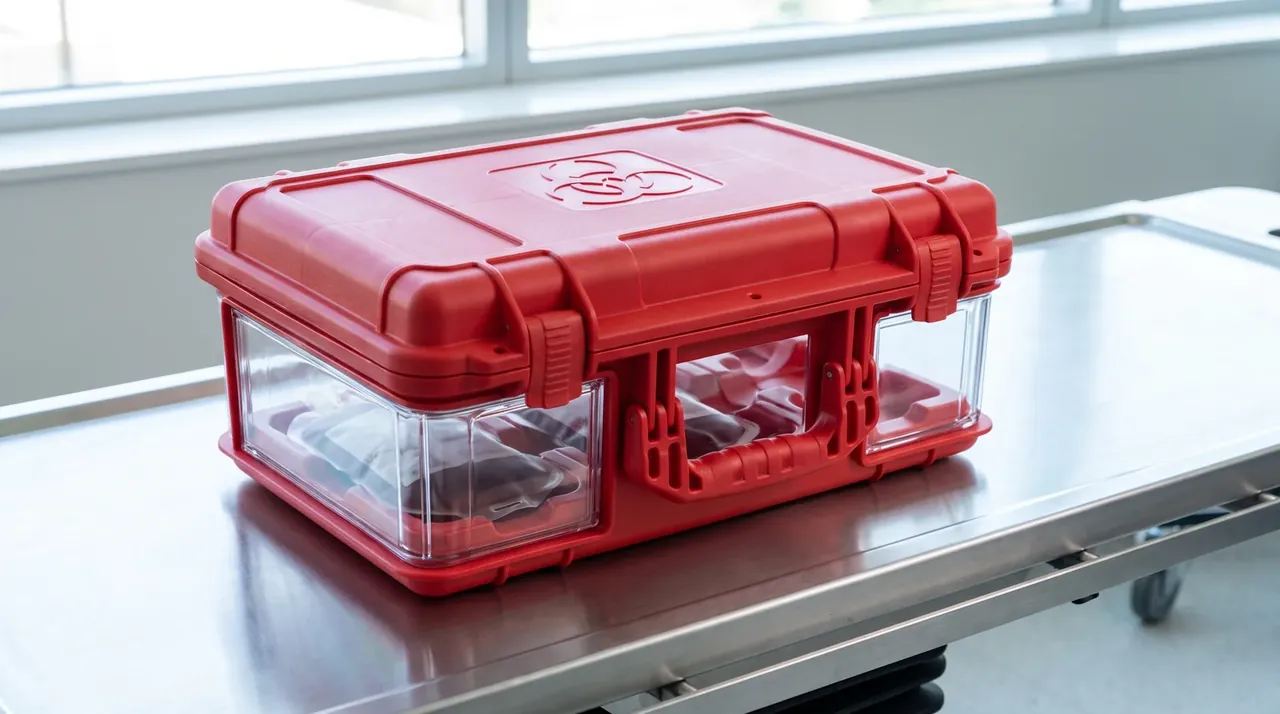
Quick answer: Medical field rescue emergency kit box limits retrieval, not volume: 9.4 kg loaded, a 100° lid stop and 8 slots hold a one-hand pick to 8 s.
Table of contents
- What the medical field rescue emergency kit box must finish in eight seconds
- A 100° lid stop and two latches that release in one motion
- Eight slots and a blind-reach path
- Carrying 9.4 kg for 200 m: handle load and shell bosses
- Drop at 1.2 m, IP67 and the −20 °C to 55 °C band
- FAQ
1. What the medical field rescue emergency kit box must finish in eight seconds
Three things here can be measured: time to an open lid, the angle at which a one-handed lid stays put, and whether the case stays upright. On the medical field rescue emergency kit box, eight seconds covers both latches, the lid to its stop and one slot cleared.
Volume is not the variable: a 355 × 255 × 140 mm cavity holds a set with 10 mm spare.
The carry is the first leg: 9.4 kg is 2.6 kg empty plus 6.8 kg of load, and a 200 m walk adds a 1.2 dynamic factor to the 92 N static pull. The set-down is the second: a 400 × 300 mm footprint holds on a slope, while anything under 260 mm tips.
| Retrieval step | Where it happens | Time limit and check |
|---|---|---|
| 200 m carry | Handle and bosses | 9.4 kg plus 1.2 factor, handle 300 N |
| Latch release | Front edge, both sides | Two latches in one motion, under 2 s |
| Lid to stop | Rear hinges | Holds at 100°, no fall-back |
| Blind pick | Eight slots | Fingertip location under 3 s |
| Lid close | Gasket channel | One pull to full compression |
The last step is often under-designed: a lid needing a second push hands back the seconds saved earlier.
2. A 100° lid stop and two latches that release in one motion
On the medical field rescue emergency kit box a 100° opening angle marks where the lid's centre of mass crosses the hinge axis. At 90° the lid falls back; past 100° the mass sits on the far side and the lid holds itself, freeing the second hand.
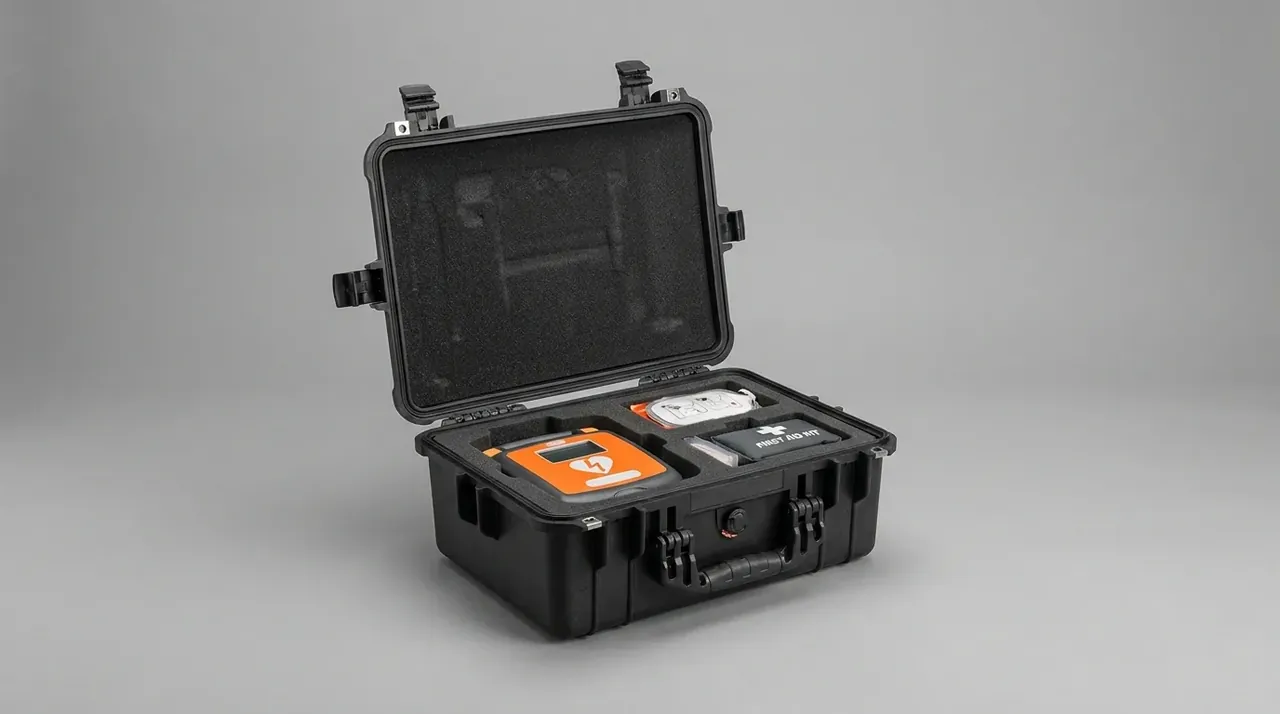
Two latches rated at 300 N each are about direction as much as force. With both triggers on one edge, thumb and forefinger open them together; split front to back, the job takes two motions the budget cannot carry. Wear sits where the trigger pivot meets the catch seat; the 3000-cycle life is set there.
| Time and posture constraint | Field condition | Value on the case |
|---|---|---|
| One-hand release | Other hand steadying or holding | Both latches on one edge |
| Lid resting position | Calm to force 3 wind | Hinge stop at 100° |
| Cycle rate | 8 open-close per day | 3000 cycles, about 375 days |
| Cold operation | −20 °C ambient | Latch trigger tested cold |
At eight cycles a day that is 375 days, so a worn latch should be replaceable alone.
3. Eight slots and a blind-reach path
On the medical field rescue emergency kit box, blind reach means finding a slot by fingertip. Each of the eight compartments needs a boundary told apart by touch: a 12 mm notch on the handle side, an open channel on the hinge side.
With 15 mm foam on four walls the cavity narrows to 325 × 225 mm. The slots run two columns of four, 55 mm to 160 mm wide; the tray above eats 20 mm, leaving 105 mm of clear height.
More slots is not better: each added compartment widens the search area and narrows the slot, so parts press together. Eight is the compromise; two more and clear width drops under 50 mm.
4. Carrying 9.4 kg for 200 m: handle load and shell bosses
On the medical field rescue emergency kit box the 300 N rating is not derived from the 9.4 kg static weight. 92 N is the static pull and 300 N leaves a 3.2× margin for the swing of walking and the set-down drop. Both ends of the handle sit in bosses spreading the load across 60 mm of 3.0 mm wall.
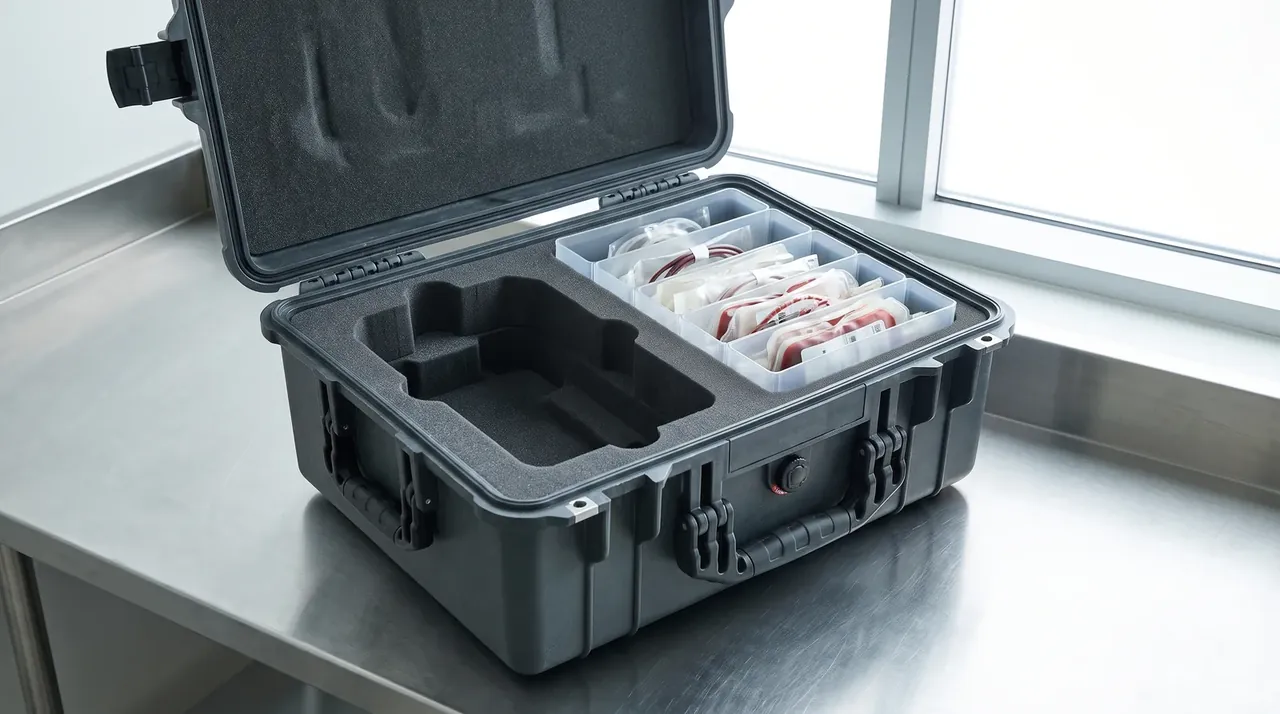
A 200 m carry raises posture: the handle sits mid-way along the long edge, so the case swings across the body, and a lower centre of mass shortens that swing; loading the base drops it about 25 mm.
At 3.0 mm the wall is at the lower bound; at 2.5 mm the boss root cracks in a 1.2 m drop.
| Case value | Number | Why it is set there |
|---|---|---|
| Outside | 400 × 300 × 180 mm | One-arm carry and tailgate rest |
| Cavity | 355 × 255 × 140 mm | Eight slots plus one tray |
| Empty / load / all-up | 2.6 / 6.8 / 9.4 kg | One-hand carry ceiling |
| Handle rating | 300 N | 3.2× static margin |
| Opening angle | 100° | Lid holds on its own weight |
5. Drop at 1.2 m, IP67 and the −20 °C to 55 °C band
On the medical field rescue emergency kit box the 1.2 m figure matches the handle height of a one-hand carry. A bottom corner is worst: impact runs into the four corner ribs, and a radius under 8 mm concentrates strain.
IP67 at 1 m for 30 min holds only with the lid clamped. Closed, the gasket sits at about 70% of free thickness; less leaves a gap, more takes a set. Points over 240 mm apart let the lid bow at mid-span.
At −20 °C the shell keeps about 60% of room-temperature impact strength; at 55 °C foam takes set faster.
Conclusion
The medical field rescue emergency kit box puts time before volume: an eight-second ceiling sets the 100° lid stop and two same-edge latches, and a 9.4 kg one-hand ceiling sets the 3.0 mm wall and the boss area. Compare all-up weight, opening angle and one slot's width first.
Related Reading
- Compartment layout inside an emergency kit case
- Shell requirements for medical emergency equipment cases
- Field medical case and battlefield first-aid case conventions
- Handle and opening behaviour of portable medical safety boxes
Related Products
- 8 Series — Gun Cases; Military Equipment Cases; Camera Equipment Cases; Drone Cases; Watch Cases; Knife Cases; First Aid Cases; Electronics Equipment Cases
- WL8-2812 PP Gun Case — model WL8-2812
- All protective cases and toolboxes: 7 series, 158 models