

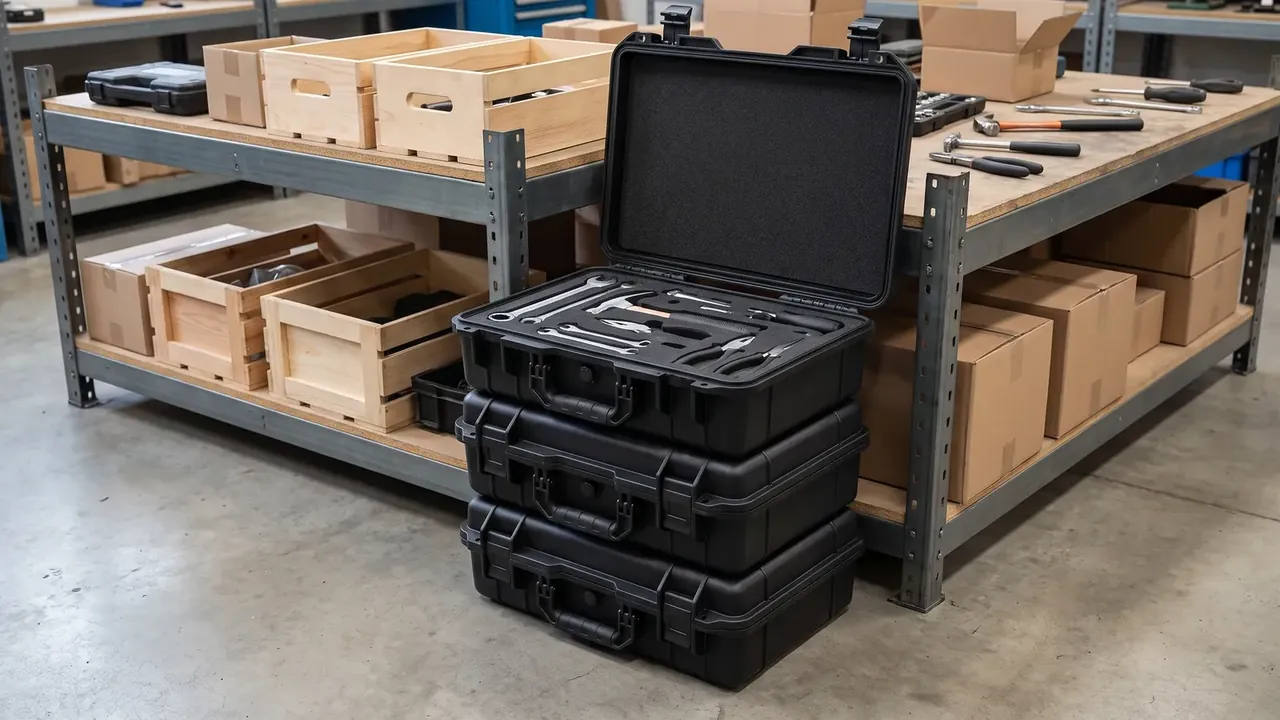
Quick answer: A metal tool chest comparison fails when it stops at the purchase price. At 52 L, a steel chest weighs 9.5 kg, carries 25 kg per drawer and costs 470 yuan over ten years, a quarter below a timber crate and half of stainless. Rotomoulded plastic never rusts but chalks within three years.
Table of contents
- Why a Metal Tool Chest Comparison Needs Fixed Criteria
- Weight and Load: What Each Litre Weighs
- Corrosion and Service Life: Turning Salt Spray Hours into Years
- Cost and Repair: The Ten-Year Ownership Sum
- When a Different Box Is the Better Choice
- FAQ
1. Why a Metal Tool Chest Comparison Needs Fixed Criteria
Four box types side by side invite a price-only reading, which tells you nothing: each fails differently. A metal tool chest rusts once the coating is cut, plastic fails on ultraviolet light, timber on moisture, stainless on weld quality and cost.
Fix six criteria first: dead weight, drawer static load, salt spray hours, unit price, repair time, service life. The first four come off a quotation; the last two need three years of records.
| Criterion | Metal tool chest | Rotomoulded plastic | Timber crate | Stainless cabinet |
|---|---|---|---|---|
| Dead weight at 52 L | 9.5 kg | 7.2 kg | 11.0 kg | 21.5 kg |
| Drawer static load | 25 kg | 12 kg | none | 40 kg |
| Neutral salt spray | rust at 240 h | chalks | mould at 72 h | clean at 720 h |
| Unit price | 320 yuan | 480 yuan | 150 yuan | 980 yuan |
Plastic costing more than steel is no typo: rotomould tooling costs more per unit than stamped sheet. All figures use one 560 by 330 by 290 mm envelope.
2. Weight and Load: What Each Litre Weighs
Per litre: steel 0.18 kg, plastic 0.14, timber 0.21, stainless 0.41. Carried eight times a day, the 2.3 kg gap becomes fatigue by mid-shift. Slides are rated 25 kg static and 15 kg dynamic; stacked four high, mid-panel deflection must stay under 1.5 mm before the coating cracks. Plastic deflects more because LLDPE sits far below steel in modulus, so it needs ribs or fewer tiers.
3. Corrosion and Service Life: Turning Salt Spray Hours into Years
Salt spray hours convert, they are not service life: 240 hours maps to eight to twelve years indoors, 480 to sixteen, but only while the film is intact. Timber's 72 hours is mould: above 18 percent moisture the nails loosen, so a humid-site crate lasts four years. Plastic never rusts, but 1000 hours of xenon-arc ageing equals three years outdoors, after which it chalks and loses 30 percent impact strength.
4. Cost and Repair: The Ten-Year Ownership Sum
Replacement count is the term usually left out: a 150 yuan crate looks cheapest until it is swapped 2.5 times and patched each season. Steel is bought once and repaired at the hinge, latch and paint.
| Item | Metal tool chest | Rotomoulded plastic | Timber crate | Stainless cabinet |
|---|---|---|---|---|
| Unit price | 320 yuan | 480 yuan | 150 yuan | 980 yuan |
| Replacements in 10 years | 1 | 1 | 2.5 | 1 |
| Ten-year total | 470 yuan | 520 yuan | 625 yuan | 1040 yuan |
| Annualised | 47 yuan | 52 yuan | 62 yuan | 104 yuan |
Steel runs a quarter cheaper a year than timber and less than half of stainless, while plastic costs 5 yuan a year more.
5. When a Different Box Is the Better Choice
Coastal sites are the exception: 240 hours of protection will not survive two rainy seasons, so plastic or stainless is safer. For air freight, 2.3 kg less per chest takes 92 kg off a 40-unit pallet. For one-way export, timber wins on price, but ISPM 15 needs 56 °C for 30 minutes and an unmarked crate is refused at the border.
Conclusion
The four box types differ less in price than in how they fail and how they are repaired. A metal tool chest trades 9.5 kg of dead weight for a 25 kg drawer rating and hinge-level repairs, landing at 47 yuan a year, which makes it the default for an indoor bay. Writing the service environment into the specification saves more than squeezing the unit price, and that is why the metal tool chest outnumbers the rest on most shop floors.
This article discusses only the container (case body) side of specifications and design intent, and does not cover any handling, loading or use of the contents.
Related Reading
- Trade-offs between a metal tool chest and alternatives
- A rust and maintenance schedule for steel chests
- How to state tool cabinet specifications
- Comparison criteria for rotomoulded cases
Related Products
- 8 Series — Gun Cases; Military Equipment Cases; Camera Equipment Cases; Drone Cases; Watch Cases; Knife Cases; First Aid Cases; Electronics Equipment Cases
- WL8-2812 PP Gun Case — model WL8-2812
- All protective cases and toolboxes: 7 series, 158 models