

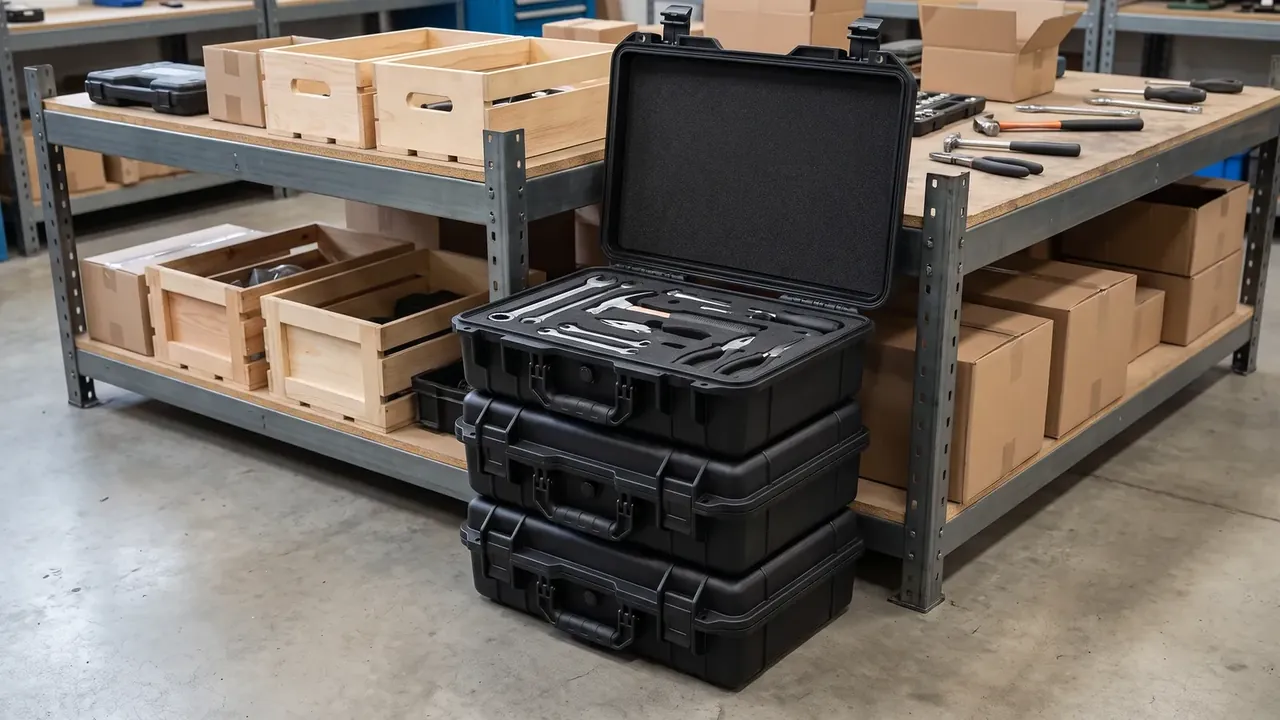
Quick answer: A Metal Tool Chest lives or dies on five parameters: sheet thickness and flange design set stiffness, weld pitch decides whether seams open, film build decides when rust returns, hinge and catch structure set the load path, and drain holes decide where moisture goes.
Table of contents
- Why the Body of a Metal Tool Chest Is Cold Rolled Steel
- Sheet Thickness, Flanges and Ribs: Where Stiffness Comes From
- Spot Welding, Riveting and Folded Seams
- Phosphating and Powder Coating: Film Build Against Salt Spray
- Hinges, Catches and Drainage: Opening and Sealing Details
- FAQ
1. Why the Body of a Metal Tool Chest Is Cold Rolled Steel
Most Metal Tool Chest bodies use 0.8 to 1.2 mm cold rolled SPCC. The reason is not a high strength ceiling but process fit: bending, spot welding and coating all run on the same tooling, and cost scales with thickness. Cold rolled sheet is flat, stable and predictable in springback.
The value sits in the flange. On the same 1.0 mm sheet, a 12 mm flange on four sides beats an 8 mm flange by over 30% in bending stiffness, because it turns a free edge into a restrained one.
| Thickness | Position | Drawer load | Weight |
|---|---|---|---|
| 0.8 mm | Sides, rear | Up to 15 kg | Lightest |
| 1.0 mm | Lid, drawer fronts | 25 kg | General purpose |
| 1.2 mm | Base, top | 40 kg | Heavy duty |
2. Sheet Thickness, Flanges and Ribs: Where Stiffness Comes From
Inside bend radius runs 1.5 times thickness, so 1.8 mm for 1.2 mm stock. Tighter, and the outer fibre stretches past its limit until a hairline crack opens along the bend. Each corner also needs a relief notch equal to thickness plus 0.2 mm, or the two legs push together and thin the corner.
Ribs are the second layer of compensation. A Metal Tool Chest lid carries one 6 mm deep, 40 mm wide rib across the middle, turning a large panel into two short spans; drawer bases take two ribs 120 mm apart.
3. Spot Welding, Riveting and Folded Seams
Spot welding is the cheapest joint on a Metal Tool Chest: an 8 mm overlap, nuggets 4 to 5 mm across, pitch 25 to 40 mm, electrode force 2.5 kN, current 8 to 9 kA, eight cycles. Past 40 mm the strip between nuggets still passes water after coating, and that is where salt spray rusts first.
Riveting suits parts that cannot be welded, such as hinge seats. Folded seams look clean but always leave a capillary gap that needs mastic.
4. Phosphating and Powder Coating: Film Build Against Salt Spray
Pretreatment decides coating life. After degreasing, parts enter zinc phosphating at 40 to 45 C for 3 to 5 minutes, coating weight held at 1.5 to 3 grams per square meter; too thin and powder will not key, too thick and the layer flakes on impact.
| Stage | Parameter | Range |
|---|---|---|
| Degreasing | Temperature, time | 50–55 C, 5 min |
| Phosphating | Coating weight | 1.5–3 g/m² |
| Powder | Film build | 60–90 µm |
| Curing | Temperature, time | 180 C, 15 min |
Epoxy polyester powder goes on at 60 to 90 micrometres and cures at 180 C for 15 minutes. Below 60, scribe creep passes 2 mm at 240 hours of salt spray; above 90, powder builds in bend corners and blisters.
5. Hinges, Catches and Drainage: Opening and Sealing Details
The usual hinge is a piano hinge, 1.5 mm leaf with a 3 mm pin, running the full lid length so load spreads along the whole edge; the price is that removal means driving out the entire pin. Butt hinges at each end are easier to service, but the lid edge between them lifts.
Catches are die-cast zinc, failing near 1,800 N, paired with a five-pin lock core. An EPDM gasket is compressed to 30%: looser leaks, tighter takes a set and flattens. Drainage is forgotten most often: four 6 mm holes at the base corners and a 5 mm lip on the lid edge.
| Feature | Parameter | Failure mode |
|---|---|---|
| Flange | 12 mm | Distorts under 8 mm |
| Weld pitch | 25–40 mm | Seam rust past 40 mm |
| Piano hinge | 1.5 mm leaf, 3 mm pin | Lid wobble |
| Catch | 1,800 N failure | Bent tongue |
| Drains | 4 × 6 mm | Water pools inside |
Conclusion
The durability of a Metal Tool Chest is the match between five things: flanges supply stiffness, welds hold seams, coating holds appearance, hinges and catches hold the cycle, drains keep the interior dry. Raise one alone and the weakest absorbs the gain. Fix those five number sets on one drawing, and a Metal Tool Chest is genuinely specified.
This article discusses only the container (case body) side of specifications and design intent, and does not cover any handling, loading or use of the contents.
Related Reading
- Metal Tool Chest Maintenance and Inspection Points
- Metal Tool Chest vs Alternatives: Where the Difference Sits
- How to Set Tool Chest Specifications
- Where Tool Chests Are Used: Scenarios and Configurations
Related Products
- 8 Series — Gun Cases; Military Equipment Cases; Camera Equipment Cases; Drone Cases; Watch Cases; Knife Cases; First Aid Cases; Electronics Equipment Cases
- WL8-2812 PP Gun Case — model WL8-2812
- All protective cases and toolboxes: 7 series, 158 models