

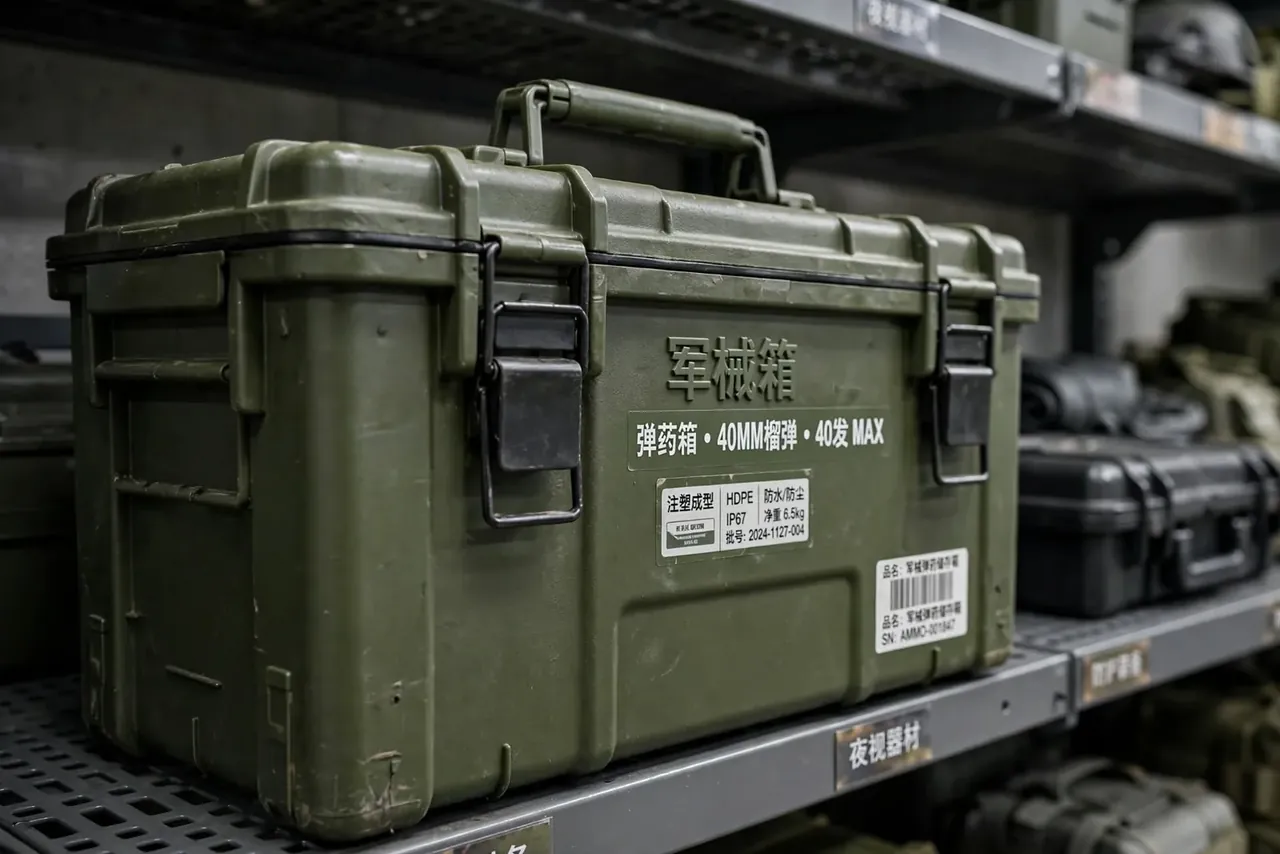
Quick answer: On a MIL-STD certified heavy duty military plastic case the thickening sits at 7.0 mm edges, not the 5.0 mm flats, and is sized to 26 drops at 1.2 m.
Table of contents
- Where the Wall Thickness Actually Goes
- Edges at 7.0 mm: Where Impact Lands First
- Flats at 5.0 mm: Why They Stop There
- Local Pads at Hinges and Latch Seats
- The Thickness Table Worked Back From Four Tests
- FAQ
1. Where the Wall Thickness Actually Goes
A MIL-STD certified heavy duty military plastic case measures 540×400×220 mm outside and 480×340×175 mm inside, and the two figures already say the wall is not uniform. Edges and base corners run 7.0 mm, the lid and base flats run 5.0 mm, and the hinge and latch seats get a third, local value. Three numbers, three load paths.
| Test item | Condition | Pass line |
|---|---|---|
| Drop | 1.2 m, 26 drops | No crack at the latch seats, lid still closes |
| Vibration | 5–500 Hz, 1 h per axis | Latches stay shut, hinge pin does not walk |
| Salt spray | Neutral, 96 h | No red rust, hinges still turn |
| Thermal shock | −40 °C to 71 °C, 3 cycles | No cracks, seal still compressed 25% |
| Static stacking | 6 tiers, 48 h | Lid set no more than 2 mm |
Empty weight is 5.8 kg and nominal net weight is 6.5 kg. The 0.7 kg is lining, webbing and the data plate, none of it wall. To judge whether a MIL-STD certified heavy duty military plastic case is thick enough, ask where the caliper sat: 7.0 mm on an edge and 5.0 mm on a flat are both true.
2. Edges at 7.0 mm: Where Impact Lands First
Energy from a 1.2 m drop lands on edges and corner wraps. Bending stiffness follows the cube of thickness, so 7.0 mm against 5.0 mm is 2.7 times, not 1.4 times, which is why the extra 2 mm sits on the edges only. Thickness is local; stiffness is cubic.
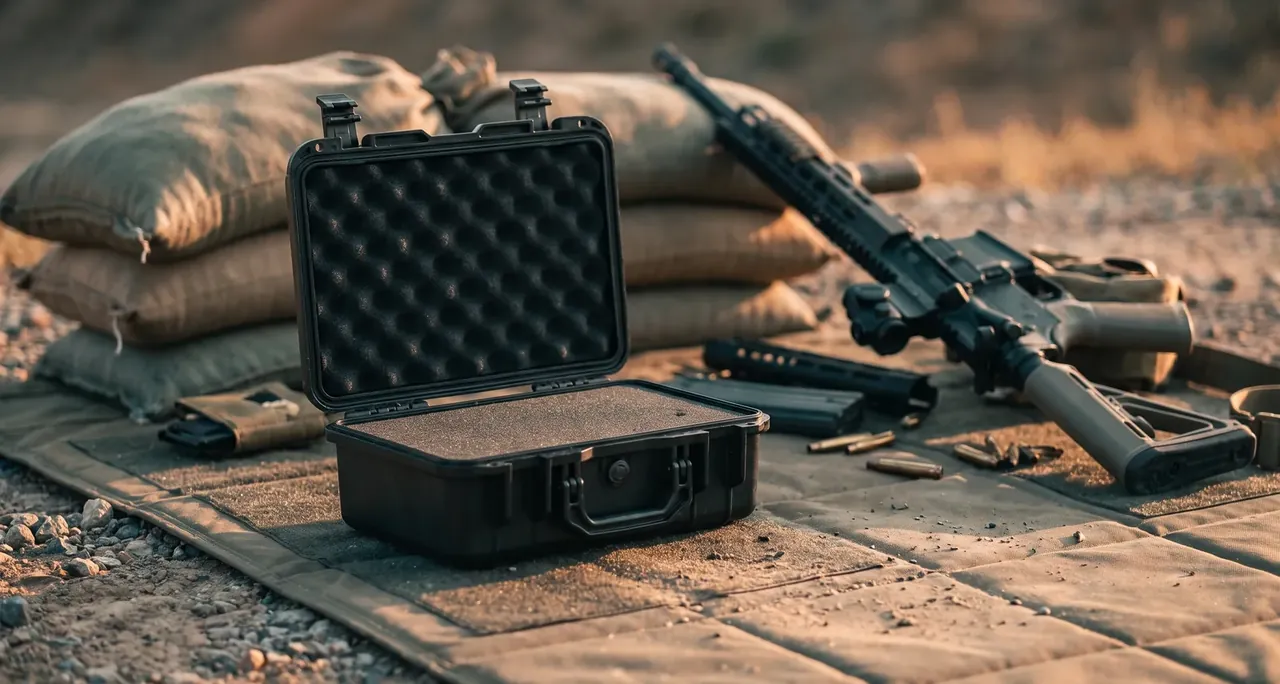
On a MIL-STD certified heavy duty military plastic case a thickened edge cannot step straight down to the flat: it runs from 7.0 mm to 5.0 mm over an R8 radius and about 12 mm of length. A square step lifts the stress concentration factor past 2 and gives the thickening back; with the radius, the first damage over 26 drops moves to the latch seat, the order the design wants.
3. Flats at 5.0 mm: Why They Stop There
The flats carry distributed pressure and long-term creep, not impact. At 6 tiers the bottom lid holds five cases, 32.5 kg at 6.5 kg nominal, over a 540×400 mm face at under 1.5 kPa. That pressure is harmless to a 5.0 mm flat; 48 h at 71 °C and the set that follows are not.
| Condition | Wall response | Location |
|---|---|---|
| Edge-first impact | 7.0 mm absorbs it | Four edges and base corners |
| Long static load | 5.0 mm plus ribs | Lid and base flats |
| Repeated hinging | Local 9 mm pad | Two hinge seats |
| Latch pull | Local 8 mm pad | Two latch seats |
| −40 °C cold | R8 transition | Every edge line |
On a MIL-STD certified heavy duty military plastic case, taking a flat from 5.0 mm to 7.0 mm adds about 1.2 kg and buys little stiffness. Under 6 tiers that mass multiplies by six onto the bottom lid. On the move it lands on the handles, so the flat stays at 5.0 mm. Creep resistance comes from ribs inside the lid: 12 mm tall at 90 mm pitch. Measure the set one way every time: close the lid, load 50 N at the centre, wait 48 h, unload, rest 2 h, read the centre. A MIL-STD certified heavy duty military plastic case checked by different methods between batches makes the 2 mm line meaningless.
4. Local Pads at Hinges and Latch Seats
What fails first on a MIL-STD certified heavy duty military plastic case is usually a seat, not a wall. The hinge pin is only φ6 mm, so both seats run 9 mm with a 1.5 mm bush between pin and plastic; each latch seat is checked at 500 N and padded to 8 mm, ribs extended 15 mm along the pull. Two latches make 1 000 N, carried by those two small patches.
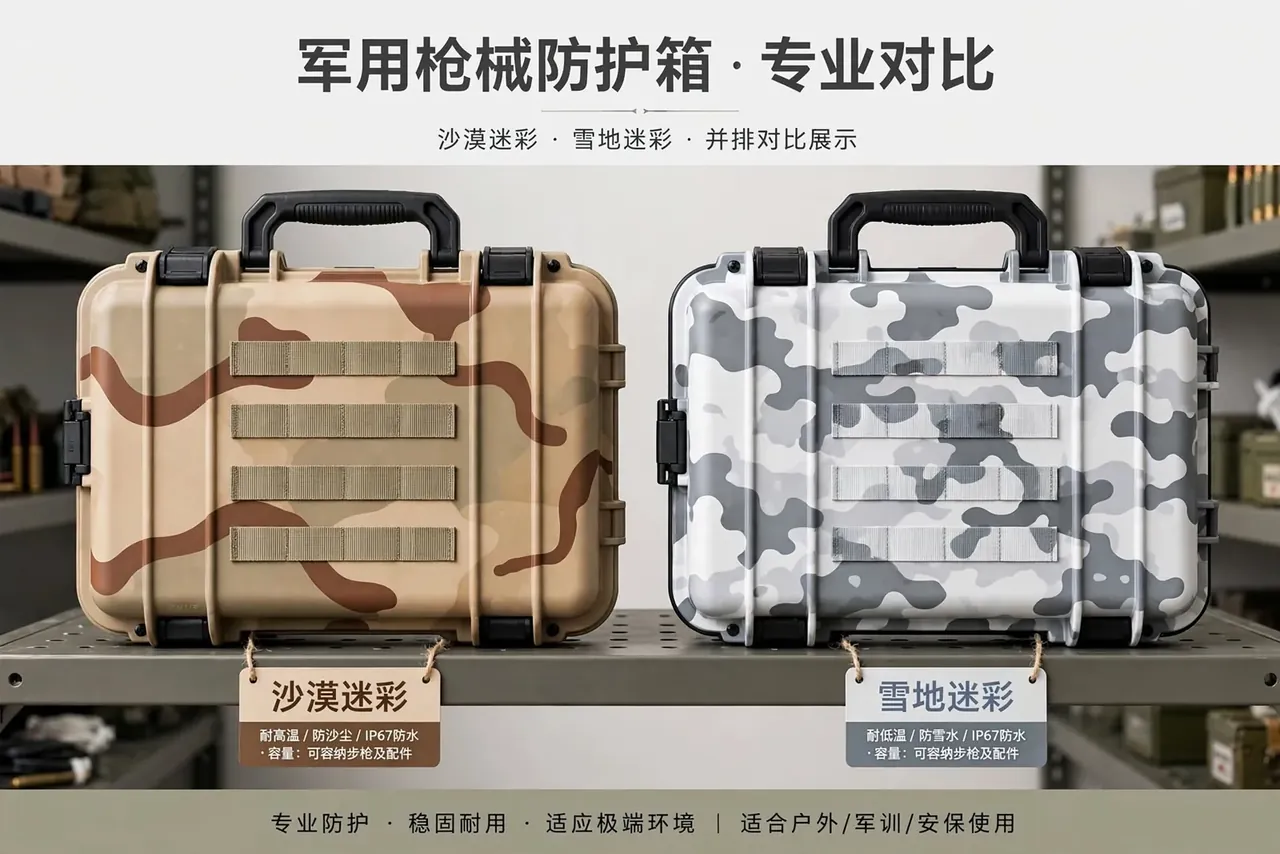
The pad is not symmetric: 8 mm on the loaded side, 6 mm behind, so the plastic deforms in a known direction. The pass line is no crack at the seat after 26 drops at 1.2 m. A cracked wall can be patched; a cracked seat means a dead latch and no IP67 at 1 m for 30 min.
5. The Thickness Table Worked Back From Four Tests
Vibration at 5 to 500 Hz for 1 h per axis tests hinge pin walk and latch loosening, not wall thickness; 96 h of salt spray tests hardware, since the shell only has to stay crack-free; thermal shock from −40 °C to 71 °C for 3 cycles tests the joint where a 7.0 mm edge meets a 5.0 mm flat, which is where 0.2 mm stress cracks appear.
| Pass line | Location | What happens past it |
|---|---|---|
| No crack at latch seat | 8 mm seat | Dead latch, lid will not close |
| Lid set 2 mm or less | 5.0 mm flat | Six tiers sink tier by tier |
| Seal compressed 25% | Rim groove | Under-compressed leaks, over-compressed loses rebound |
| Hinge pin does not walk | φ6 mm pin, 9 mm seat | Lid skews, one side crushed |
| No red rust | Hinges and latches | Turning effort climbs after 96 h |
These are verification figures under the methods, not a statement about anyone's certification status; 6 tiers and 26 drops together leave one allocation.
Conclusion
Thickening on a MIL-STD certified heavy duty military plastic case is an allocation problem, not a total: 7.0 mm edges answer 26 drops at 1.2 m, a 5.0 mm flat answers creep under 6 tiers, 9 mm hinge seats and 8 mm latch seats answer 500 N of pull. Together they weigh 5.8 kg; levelling any to 7.0 mm breaks the weight first.
Related Reading
- How the 26-drop sequence is read
- Method 512 against method 516
- Compliance paths under the national military standard
- Hardware and coating options for cases
Related Products
- 8 Series — Gun Cases; Military Equipment Cases; Camera Equipment Cases; Drone Cases; Watch Cases; Knife Cases; First Aid Cases; Electronics Equipment Cases
- WL8-2812 PP Gun Case — model WL8-2812
- All protective cases and toolboxes: 7 series, 158 models