

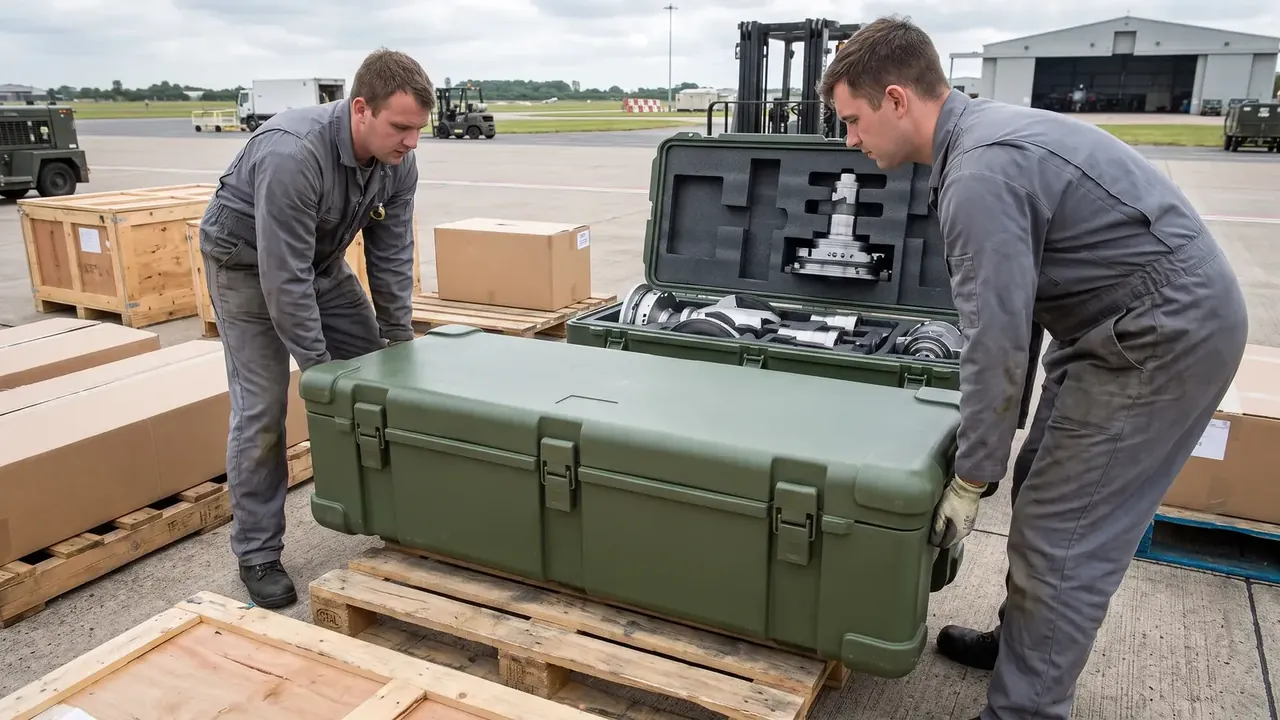
Quick answer: Five numbers settle it: weight, peak acceleration in a 1.2 m corner drop, reuse count, cost per trip, repair hours. A Military Air Transport Case weighs 14.2 kg, peaks at 62 g, lasts 120 rotations and costs 23.6 per trip; a plywood crate lands at 121.7.
Table of contents
- How Five Numbers Are Measured for a Military Air Transport Case
- What 11 kg of Weight Difference Buys
- Peak Acceleration in a Corner Drop
- Reuse Count Sets the Amortised Cost
- When to Go Back to an Ordinary Case
- FAQ
1. How Five Numbers Are Measured for a Military Air Transport Case
Five options, one table, and the argument starts: aluminium is light, plywood is cheap, a soft bag swallows odd shapes. Fix the test first: 1100×560×380 mm outer, 8 kg ballast, three corner drops from 1.2 m, accelerometer at 1 kHz.
| Option | Empty weight | Price | Design rotations |
|---|---|---|---|
| Military Air Transport Case | 14.2 kg | 2180 | 120 |
| Aluminium case | 9.8 kg | 1650 | 45 |
| Plywood crate | 21.5 kg | 320 | 3 |
| Plastic case | 6.4 kg | 480 | 28 |
| Soft bag | 3.2 kg | 260 | 12 |
Rotations follow the failure point: seal face, rivets, hinge seats, zip, strap marks. Weight decides whether two people lift it; the rest fold into one ranking.
2. What 11 kg of Weight Difference Buys
Freight barely notices eleven kilos: volumetric weight at 1:6000 is about 39 kg, more than any case here travels gross, so the airline bills volume. Manpower notices: loaded with 8 kg, a Military Air Transport Case is 22.2 kg, 11.1 kg per hand and inside the 12 kg single-lift limit; the plywood crate is 29.5 kg, 14.8 kg per hand, so most sites call for a trolley.
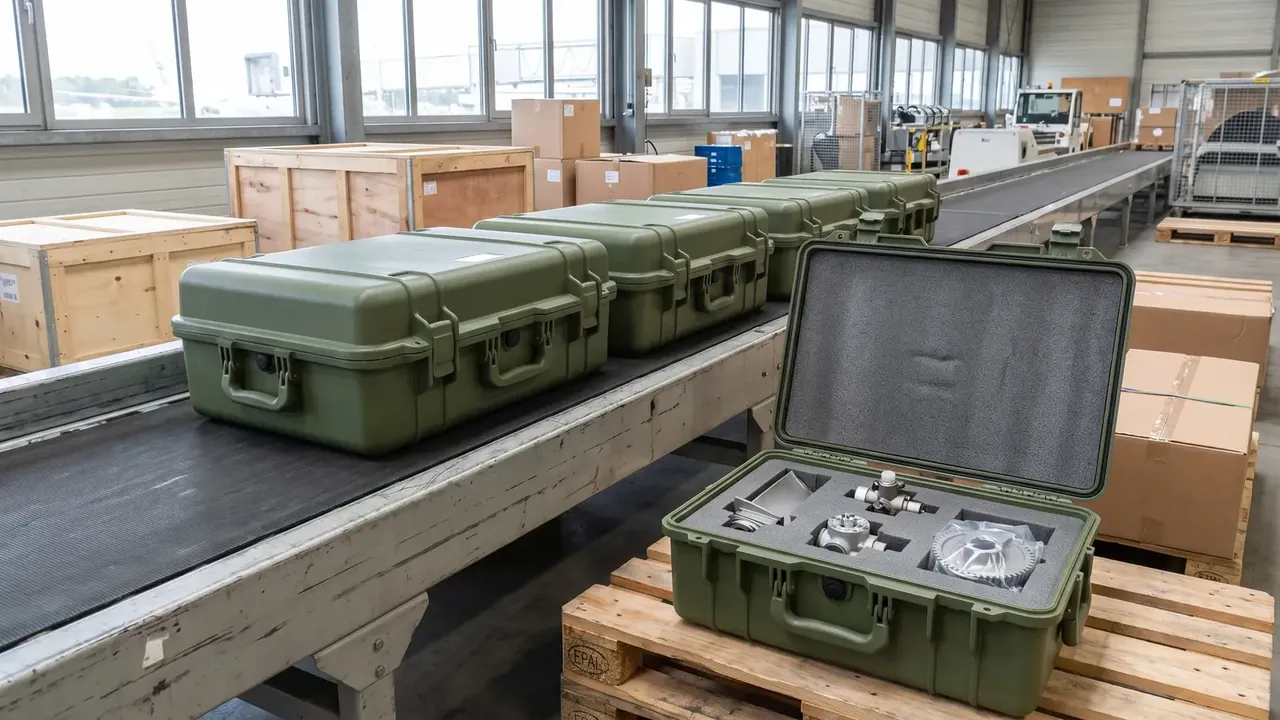
Light is not easy, heavy is not stiff: the soft bag weighs 3.2 kg on a 5 mm EVA panel, and crate panels soften with moisture.
3. Peak Acceleration in a Corner Drop
Peak and displacement must be read together.
- Military Air Transport Case: 62 g, 9 ms, 4 mm, seal still holding 4.5 kPa.
- Aluminium: 88 g, 0.3 mm rivet shift, 1.2 mm by the second drop.
- Plywood crate: 74 g, cracking at the strap mark on the third drop.
- Plastic case: 121 g, an 18 mm corner crack on the first drop.
- Soft bag: 46 g, but 22 mm into the inner panel.
| Option | Peak | Displacement |
|---|---|---|
| Military Air Transport Case | 62 g | 4 mm |
| Aluminium | 88 g | 7 mm |
| Plywood crate | 74 g | 9 mm |
| Plastic case | 121 g | 12 mm |
| Soft bag | 46 g | 22 mm |
The bag reaches 46 g by stretching travel and pays in displacement; the rotomoulded shell pairs a low peak with small movement. Foam matters: 30 mm EVA cut to 20 mm lifts the peak to 79 g while displacement falls to 2.5 mm.
4. Reuse Count Sets the Amortised Cost
A Military Air Transport Case is designed for five years at 24 rotations a year, or 120. Aluminium gives out at 45 when rivets loosen, plastic cases at 28, soft bags at 12, plywood at three.
Repairs run back to serviceable: six at 1.2 hours, nine at 1.6, twelve at 0.9, seven at 0.7. At 90 per hour, cost per trip is price plus repairs over rotations.
| Option | Repairs | Hours | Cost per trip |
|---|---|---|---|
| Military Air Transport Case | 6 | 7.2 | 23.6 |
| Aluminium | 9 | 14.4 | 65.5 |
| Plywood crate | 1 | 0.5 | 121.7 |
| Plastic case | 12 | 10.8 | 51.9 |
| Soft bag | 7 | 4.9 | 58.4 |
The dearest case per unit is cheapest per trip: a 320 crate over three rotations is 106.7 before downtime.
5. When to Go Back to an Ordinary Case
When all four hold, an ordinary case wins:
- Six rotations a year or fewer, inspected after each;
- No stacking, no tie-down, moved by hand or trolley;
- Road legs under 300 km, no transshipment;
- Cargo with its own suspension.
One exception reverses the arithmetic: tie-down rails, over 8 hours of open storage, three-high stacking, −20 °C to 55 °C, or five years of turnover. Open storage is underestimated most: UV and temperature age a shell and the bill appears in year three.
Conclusion
The spread is measurable: 11 kg of weight, 59 g of peak, forty times the rotations, a fifth of the cost per trip. Unit price is a small part of the numerator; the denominator decides, which is why a Military Air Transport Case is hard to displace.
This article discusses only the container (case body) side of specifications and design intent, and does not cover any handling, loading or use of the contents.
Related Reading
- Air freight compliance and pressure balance
- Structural differences from an ordinary flight case
- How a rotomoulded case differs from alternatives
- Material comparison for military packing boxes
Related Products
- 8 Series — Gun Cases; Military Equipment Cases; Camera Equipment Cases; Drone Cases; Watch Cases; Knife Cases; First Aid Cases; Electronics Equipment Cases
- WL8-2812 PP Gun Case — model WL8-2812
- All protective cases and toolboxes: 7 series, 158 models