

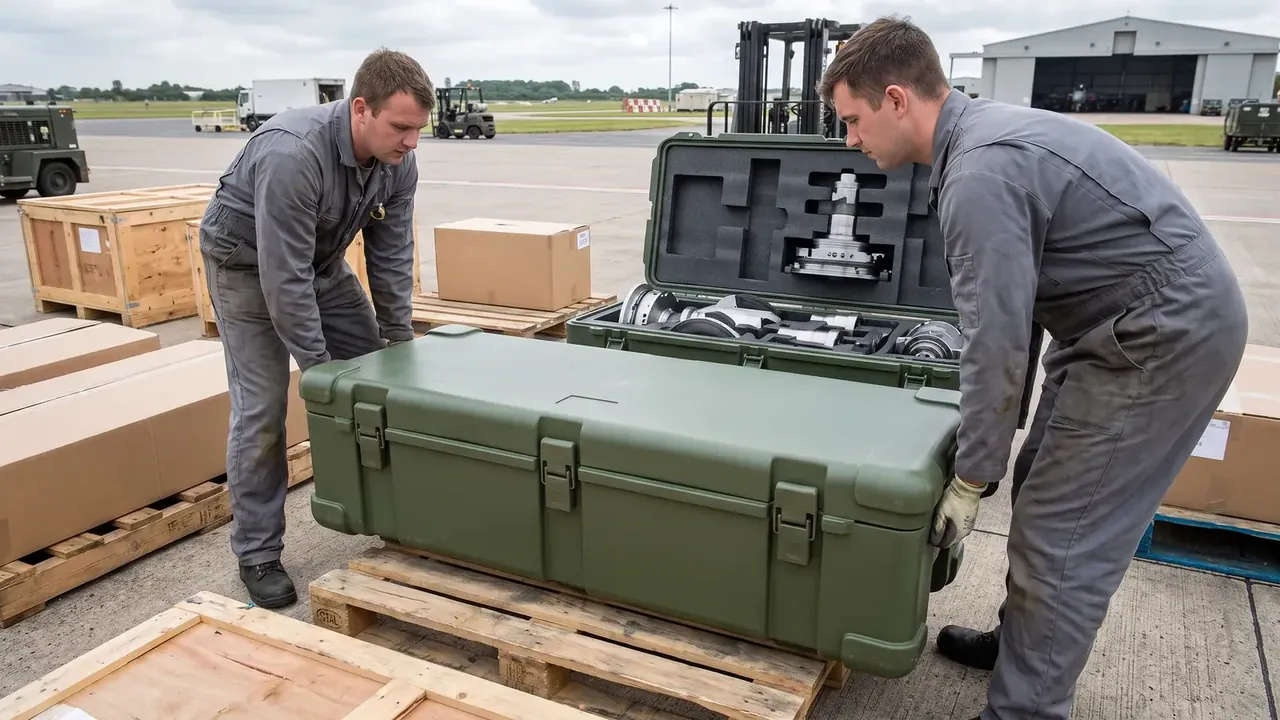
Quick answer: Four intervals cover it: a 3-minute pre-flight look, a 22-minute weekly check, a 55-minute monthly check and a 2.5-hour annual one. Three lines force replacement: seal compression under 1.8 mm, a catch base crack over 6 mm, wall thickness under 2.24 mm.
Table of contents
- Four Inspection Intervals for a Military Air Transport Case
- Seal Compression and Ageing
- Torque and Gaps at Catches and Hinges
- Valve Test and Shell Hold Test
- Repair and Retirement Limits
- FAQ
1. Four Inspection Intervals for a Military Air Transport Case
Two triggers set the schedule: rotations and calendar time. The seal ages by pressure cycles, catches wear by openings, the shell takes impacts, the valve degrades with dirt.
| Tier | Trigger | Time |
|---|---|---|
| Pre-flight, 9 items | Every flight | 3 min |
| Weekly, 16 items | 7 days or 5 rotations | 22 min |
| Monthly, 24 items | 30 days | 55 min |
| Annual, full set | 60 rotations or 12 months | 2.5 h |
Pre-flight stays tool-free: debris on the seal, catches engaged, cracks at the handles. Weekly adds a closing-force gauge; monthly brings instruments for valve pressure and shell hold; the annual check runs everything.
Take whichever comes first: a Military Air Transport Case stored outdoors still earns the annual check; a busy one hits 60 rotations first.
2. Seal Compression and Ageing
The seal on a Military Air Transport Case ages first and is the only part judged with numbers. Close the lid, engage every catch, measure exposed height per side and subtract it from free height.
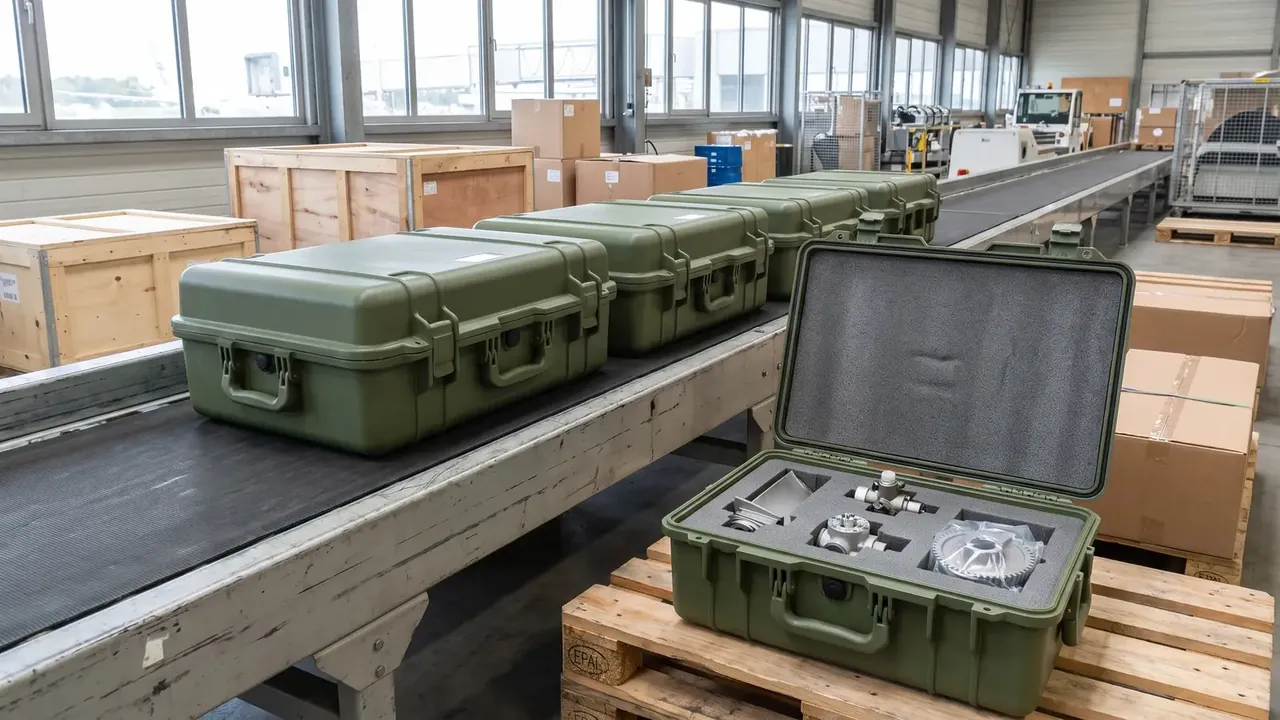
A new cord is 9×9 mm at 9.0 mm free height, closing to 6.6 mm at 27% compression. Under 20% it never seats; over 32% the groove or cord is wrong.
| Item | Pass | Replace |
|---|---|---|
| Compression | 1.8 to 2.9 mm | Under 1.8 mm |
| Permanent set | Up to 0.8 mm | Over 1.2 mm |
| Hardness, rebound | 62 Shore, 1.5 s | 70 Shore, 2.5 s |
Hardness and rebound warn earlier than appearance: UV and ozone stiffen the skin while it looks intact. Fold a 20 mm section and release; recovery inside 1.5 s passes, past 2.5 s the plasticiser has migrated.
3. Torque and Gaps at Catches and Hinges
Catches on a Military Air Transport Case fail from the base outward. Work in order: feel when closing, closing force, bolt torque, then base and pin.
Closing force is read at the hook. Under 70 N the lid pops open in vibration; over 150 N crews need a tool, use one catch and load the seal unevenly. M6 adjusters take 4.2 N·m, M5 hinge screws 3.0 N·m, four per side.
Re-torque quarterly: plastic bases creep, and repeated tightening crushes material around the stud.
4. Valve Test and Shell Hold Test
The valve on a Military Air Transport Case bleeds pressure as it builds. Its failure shows at the worst moment: the lid opens and vacuum pulls the seal into the cavity.
Draw the valve to −4.0 kPa: it should open within 30 seconds with an audible rush. Release and the disc reseats, holding under 0.5 kPa over 60 seconds. Late opening means clean, retest, replace; a disc warped past 0.3 mm shifts the cracking point.
Plug the port and test the shell: −4.5 kPa for 10 minutes, no more than 0.8 kPa of decay, chasing leaks at groove corners, hinge seats and repaired areas.
5. Repair and Retirement Limits
A Military Air Transport Case can be repaired inside a boundary: a crack up to 40 mm, 15 mm clear of the seal, may be welded with same-material rod at 210 °C, then hold-tested within two hours.
| Defect | Repair | Retire |
|---|---|---|
| Crack length | Up to 40 mm, away from seal | Over 40 mm or across seal |
| Patches per face | Up to 3 | More than 3 |
| Remaining wall | 70% of original or more | Under 2.24 mm |
| Corner fitting | Up to 2 mm, straighten | Over 2 mm or cracked |
Eight wall readings on the Military Air Transport Case decide the rest: under 2.24 mm it retires, because the wall bulges past the insert face and no repair holds.
Retirement is not disposal: catches, hinges, valves and handles become spares, the shell goes to plastic recovery, and the log records the reason.
Conclusion
Maintenance is arithmetic, not diligence: compression, torque, cracking pressure, wall thickness, each with a line that ends the argument. Two triggers keep the schedule honest, and a log turns those lines into a service life anyone can check, which keeps a Military Air Transport Case in service.
This article discusses only the container (case body) side of specifications and design intent, and does not cover any handling, loading or use of the contents.
Related Reading
- Air freight compliance and pressure balance
- Structural differences from an ordinary flight case
- Maintenance points for a rotomoulded case
- How a military supply case is inspected
Related Products
- 8 Series — Gun Cases; Military Equipment Cases; Camera Equipment Cases; Drone Cases; Watch Cases; Knife Cases; First Aid Cases; Electronics Equipment Cases
- WL8-2812 PP Gun Case — model WL8-2812
- All protective cases and toolboxes: 7 series, 158 models