

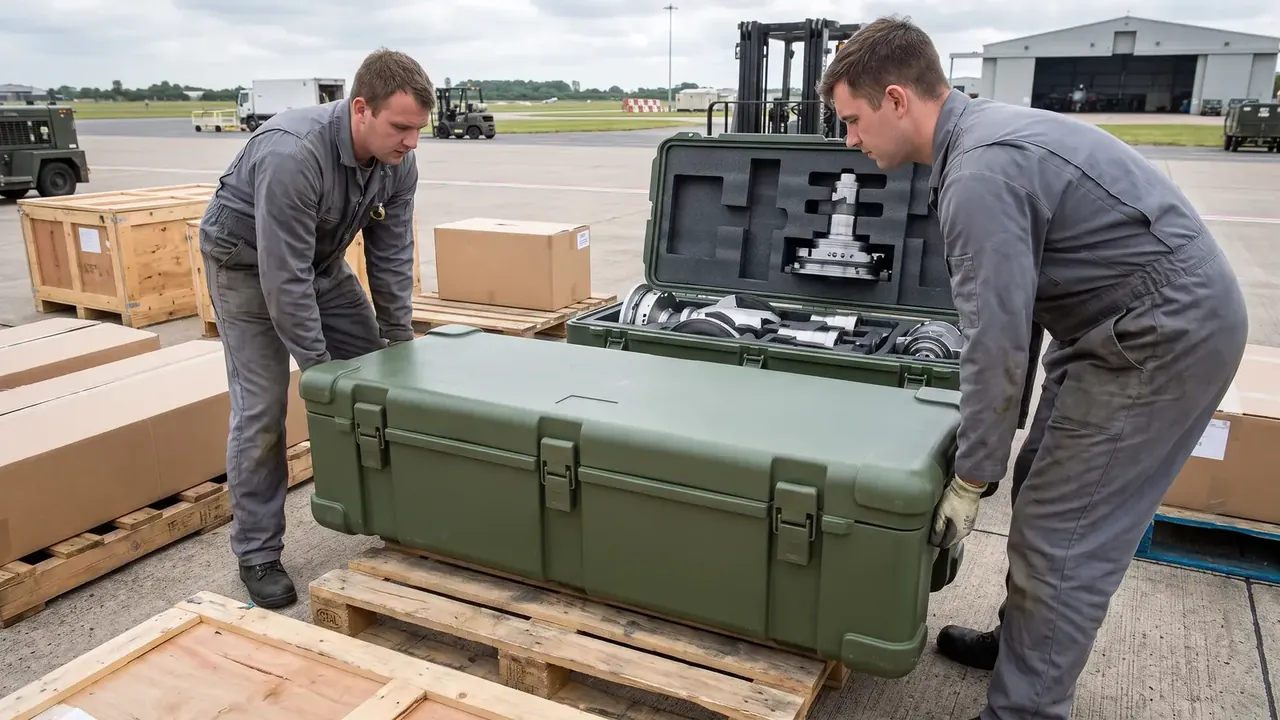
Quick answer: Choose a Military Air Transport Case in five passes: clearance, route and aircraft, tie-downs and stacking, sealing versus relief, documents and marking. In that order, quotations become comparable.
Table of contents
- Start From the Internal Clearance
- Work Back From Route and Aircraft
- Check Tie-Down Points and Stacking
- Weigh Sealing Against Pressure Relief
- Documents and Marking to Hand Over
- FAQ
1. Start From the Internal Clearance
The first decision is the cavity, not the shell. Measure the load envelope to the millimetre, then add foam, finger clearance and lid ribs. A 10 mm to 12 mm margin suits most loads: foam cut at 15 mm compresses to 12 mm, a 12% to 18% ratio.
Gloved clearance is separate: 20 mm per side and a 35 mm notch, or a 12 kg module needs two people to pry out. Tolerances run 2 mm on length, 1.5 mm on depth, 3 mm between diagonals.
| Item | Value | Failure |
|---|---|---|
| Side foam | Cut 15 mm, set 12 mm | Load shifts, corners rub |
| Finger clearance | 20 mm per side, 35 mm notch | Bare hands cannot lift |
| Cavity tolerance | 2 mm, 1.5 mm depth | Lid offsets, seal pinched |
| Top and lid | 25 mm foam, 14 mm rib | Lid sits high, latches slack |
Keep the heaviest module near the handles: 40 mm of offset doubles the load on one latch.
2. Work Back From Route and Aircraft
The route sets the shape. A narrow-body belly door clears about 1.2 m by 0.9 m, so a 1.0 m case goes in at an angle; an LD3 container of 1534 mm by 1562 mm by 1626 mm caps a body at 1400 mm; a 463L pallet takes 2200 mm.
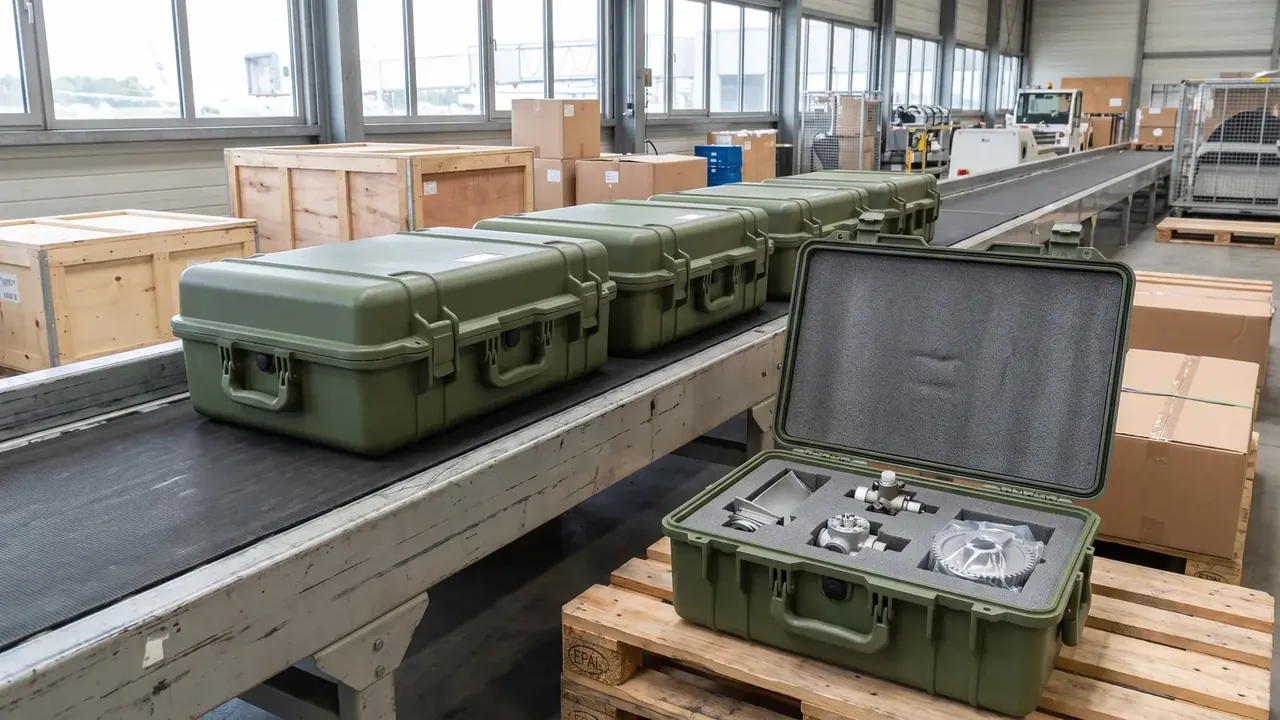
One person carries 25 kg, two carry 50 kg. Past that a Military Air Transport Case needs forklift pockets and 100 mm of ground clearance, and corners at R25 keep a loaded case from catching on a door frame.
| Carrier | Case limit | Unit weight |
|---|---|---|
| Narrow-body belly | 900 by 700 by 600 mm | 32 kg |
| Wide-body LD3 | 1400 by 1500 by 1500 mm | 750 kg |
| Freighter 463L | 2200 by 2700 by 1600 mm | 1100 kg |
3. Check Tie-Down Points and Stacking
Tie-downs on a Military Air Transport Case scale with weight: two points under 40 kg, four to 120 kg, six above, each on a corner casting. Rate every point at 1500 N for 30 seconds and keep corner movement under 0.8 mm; past 0.15 mm of residual movement the insert has yielded.
Strap angle matters more than count. At 30 to 45 degrees the pull turns into restraint; below 15 degrees it dents the lid and lifts the latches. Points sit a fifth of the body length from each end.
Stacking is checked at four high: 120 kg on the lid, sink inside 1.5 mm, held 24 hours and re-checked after 48 hours at 40 °C. An 8 mm plywood pad spreads the load.
4. Weigh Sealing Against Pressure Relief
Three routes exist and the wrong one costs more than the dear one. A full seal suits optics; a breather valve suits high-altitude sectors; a seal plus molecular sieve suits cavities under 30 L held below 40% RH.
Silicone cord at Shore A40 runs at 20% to 25% compression in a 7 mm groove 5 mm deep. A valve opens at 12 kPa and passes 200 mL per minute; the case takes a 30 minute IP67 immersion. At minus 30 °C for four hours, compression set must stay under 20%.
Sieve dose runs 30 g per 10 L. Skipping the valve is the quiet error: on a sealed Military Air Transport Case the vacuum at opening pulls the cord from its groove, so cycle the latches three times at acceptance.
5. Documents and Marking to Hand Over
Four documents travel with a reusable air package: packing list, tie-down drawing, material statement, reusable class declaration. The list carries net weight, gross weight and three dimensions.
Marking goes on four sides, and a Military Air Transport Case is no exception: an 80 mm by 80 mm low-temperature label flat at minus 40 °C, and a 30 mm QR code resolving to the packing list number. Past 50 trips use in-mould labels, which cannot wear off; under 20, adhesive is enough, but never over a latch or seal groove.
Conclusion
Clearance decides whether the load fits, route and aircraft whether it passes a door, tie-downs whether it flies steady, sealing whether it opens on arrival, documents whether it clears. Written as one checklist, those five points make quotations comparable, which is the whole point of choosing a Military Air Transport Case.
This article discusses only the container (case body) side of specifications and design intent, and does not cover any handling, loading or use of the contents.
Related Reading
- Standards a military air transport case must meet
- Comparing a military air transport case with alternatives
- How to choose a rotomoulded case
- Choosing a military supply transport case
Related Products
- 8 Series — Gun Cases; Military Equipment Cases; Camera Equipment Cases; Drone Cases; Watch Cases; Knife Cases; First Aid Cases; Electronics Equipment Cases
- WL8-2812 PP Gun Case — model WL8-2812
- All protective cases and toolboxes: 7 series, 158 models