

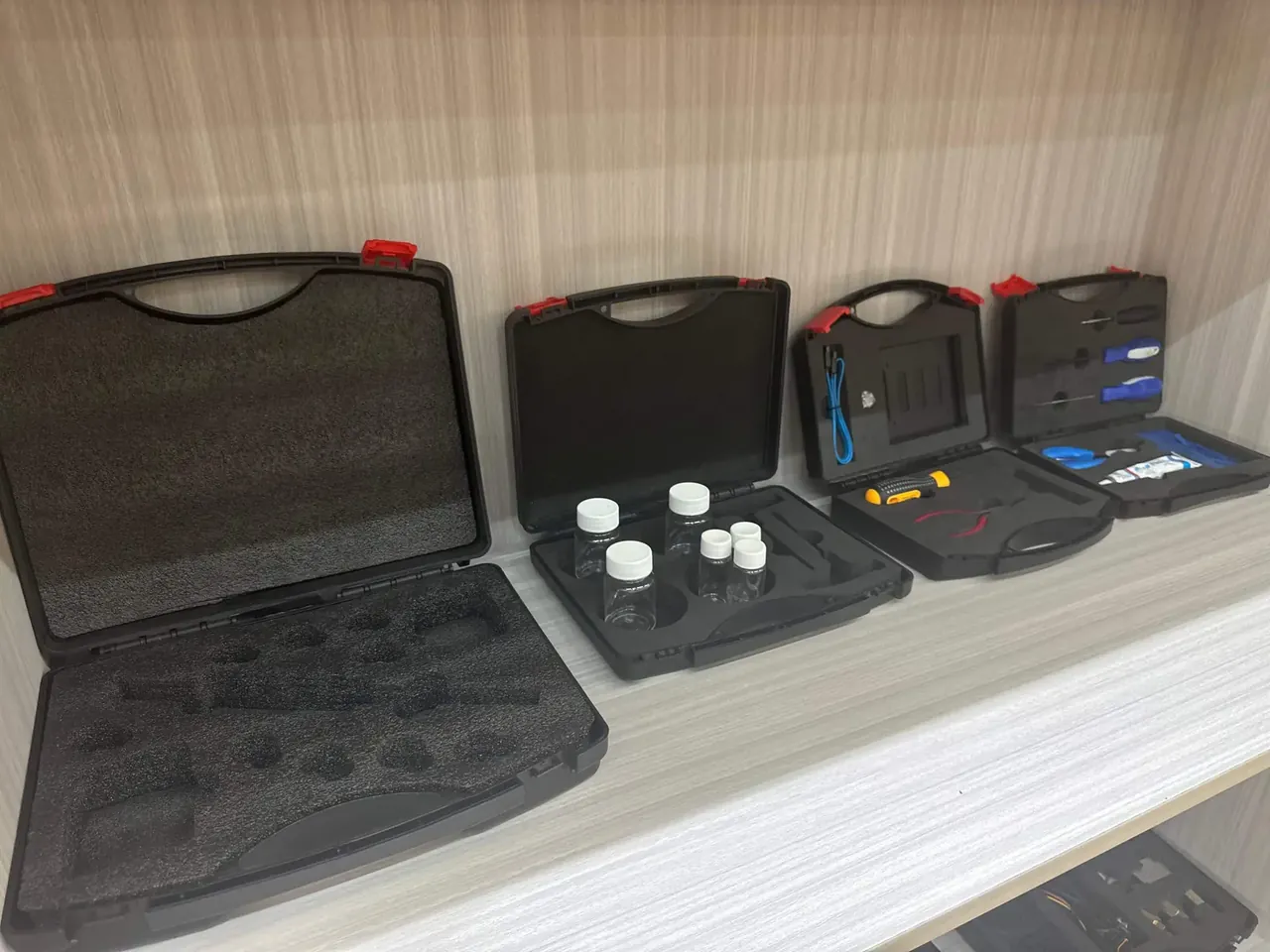
Quick answer: A military box specification is a chain, not a thickness number. Fix the interior cavity first, distribute wall thickness along the load path, recover stiffness with ribs and radii, then verify with static load and stacking data a lab can repeat.
Table of contents
- Start From the Interior Cavity
- Wall Thickness Follows the Load Path
- Ribs and Radii Carry the Stiffness
- Static Load and Stacking Are Two Tests
- Write Specifications an Inspector Can Check
- FAQ
1. Start From the Interior Cavity
The first number on a military box drawing belongs to what goes inside; the outside envelope is only cavity plus walls, ribs and feet.
Leave 8 to 12 mm on length, 6 to 10 mm on width and 10 to 15 mm on height. The gap absorbs foam compression, finger clearance and item tolerance, and 30 kg/m³ foam needs only about 5 percent compression to hold a shape. A 600 × 400 × 220 mm cavity with a 3.5 mm wall plus 10 mm ribs lands near 615 × 415 × 245 mm overall.
| Dimension | Definition | Typical value | Tolerance |
|---|---|---|---|
| Interior cavity | Usable space for the item | 600 × 400 × 220 mm | ±1.5 mm |
| Outside envelope | Walls, ribs and feet included | 615 × 415 × 245 mm | ±2.0 mm |
| Main wall | Thickness of the large panels | 3.0–4.0 mm | ±0.15 mm |
2. Wall Thickness Follows the Load Path
Wall thickness on a military box is where molding cost meets stiffness. Moving a main wall from 3.0 to 4.5 mm stretches cooling with the square of thickness, so a 55 second cycle becomes roughly 95 seconds, and sink marks arrive with warpage.
Distribute rather than inflate: main wall 3.0–4.0 mm, bottom corners 6.5–7.0 mm for drop and stacking pressure, rim 5.0 mm against gasket load, latch seats 6.0 mm. Rotomolded bodies run 4.5–6.0 mm. A 600 × 400 mm cavity projects about 0.26 m², which at 40 MPa needs over 600 tonnes of clamp force, so production sits on an 800 tonne press.
3. Ribs and Radii Carry the Stiffness
Ribs on a military box run 0.6 to 0.7 times the wall, stand 8 to 12 mm tall and repeat every 80 to 120 mm. Root radii of R2–R3 are not cosmetic: sharp corners multiply stress, thick ribs print sink marks, thin ribs snap at ejection.
Body radii run R8–R12, which spreads a landing impact instead of concentrating it. Draft is 1.5° on shallow walls and 2° in deep pockets. The lid tongue gets its own line: 6 to 8 mm deep with 0.3–0.5 mm clearance per side, since a shallow tongue shifts under side load and a tight one will not open cold.
4. Static Load and Stacking Are Two Tests
A line reading “load capacity 100 kg” cannot be inspected: static, transport and stacking loads differ. Static spreads over the lid, stacking measures creep, dynamic load looks at peak impact.
Take a 9.5 kg military box that reaches 32 kg loaded. In a three-high stack the bottom lid carries 64 kg; in a four-high warehouse layout that becomes 96 kg. Held at 40 °C for 30 days, settlement under 2 mm is a limit worth writing down. At minus 20 °C the material embrittles, so drop height derates to 0.9 m. A 100 × 100 mm pad at 120 kg then finds a thin lid immediately.
| Case | How it is applied | Reference value | Pass condition |
|---|---|---|---|
| Static | Uniform load on the lid | 500 kg for 30 min | Residual set ≤3 mm after 24 h |
| Stacking | Four high at 40 °C | 96 kg on the bottom lid | Settlement ≤2 mm in 30 days |
| Point load | 100 × 100 mm pad | 120 kg | Indentation ≤1 mm |
5. Write Specifications an Inspector Can Check
A military box specification becomes testable when it splits into four blocks: dimensions and tolerances, material and thickness, performance, and marking and packing.
Keep tolerances by feature: cavity ±1.5 mm, holes ±0.5 mm, flatness 1.0 mm per metre. Then write method and pass condition, never adjectives: “uniform 500 kg on the lid for 30 minutes, residual set no more than 3 mm after 24 hours” can be repeated by any lab, while “high strength” cannot. Marking follows the same rule, with mold number, grade and lot at fixed positions and 12 cases per pallet.
Conclusion
Order creates certainty: fix the cavity, distribute wall thickness, recover stiffness with ribs, then verify with static and stacking data. With numbers on the drawing and methods in the performance block, the military box specification stops being a list of adjectives.
This article discusses only the container (case body) side of specifications and design intent, and does not cover any handling, loading or use of the contents.
Related Reading
- What a military box is: classes, structure and specifications
- Choosing a military box by handling method and load band
- Reading a protective case size range: cavity to envelope
- Heavy duty protective case specifications: load versus wall
Related Products
- 8 Series — Gun Cases; Military Equipment Cases; Camera Equipment Cases; Drone Cases; Watch Cases; Knife Cases; First Aid Cases; Electronics Equipment Cases
- WL8-2812 PP Gun Case — model WL8-2812
- All protective cases and toolboxes: 7 series, 158 models