

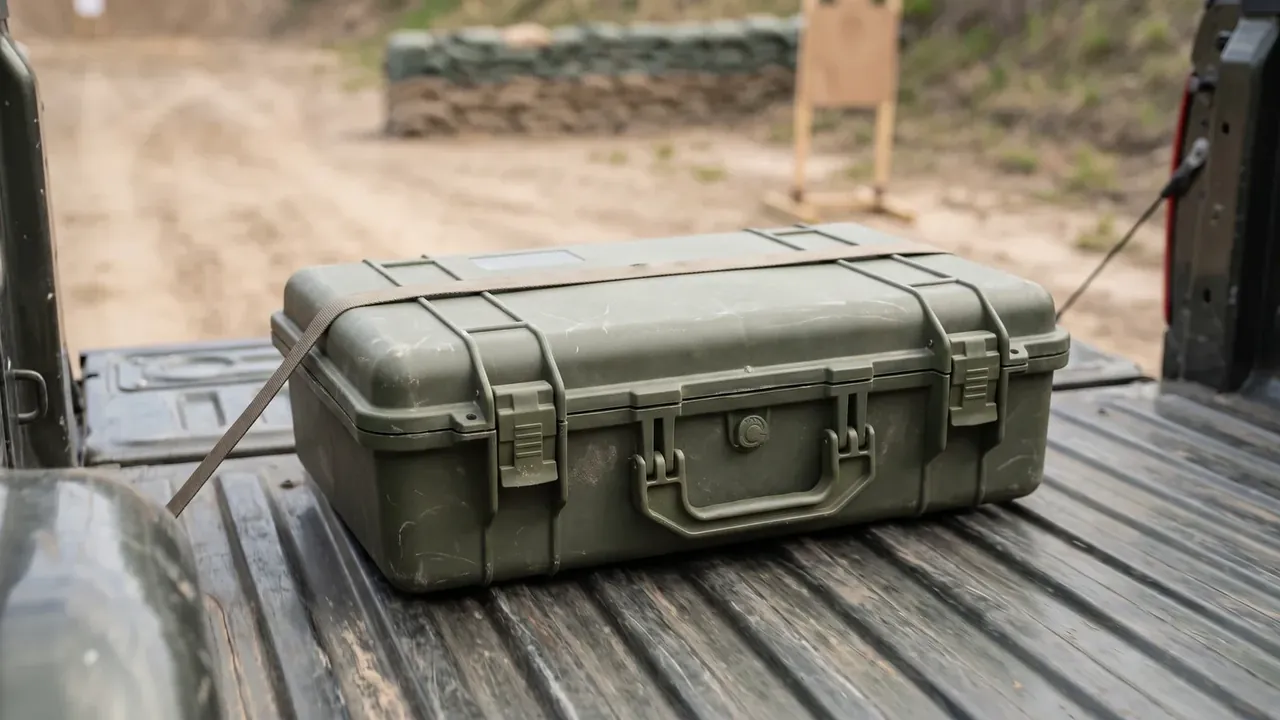
Quick answer: Five move sets run on a Military Chemical Agent Container in a night washdown: unload, tie down, wash and dry, reset the liner, hand over sealed. Each carries a checkable number and the mistake that repeats.
Table of contents
- Four moves before a Military Chemical Agent Container leaves the truck
- Tie-down routing and chock blocks
- Draining and drying after a washdown
- Resetting the foam cavities
- Handover, seal numbers and six checks
- FAQ
1. Four moves before a Military Chemical Agent Container leaves the truck
The tailgate drops at 4 a.m., air at 3 °C, and nobody lifts yet. First the seal: 12 digits matched to the handover sheet, and a mismatch quarantines the case, lid shut.
Lift comes second, two people on opposite corners: the empty case weighs 11.5 kg, a loaded one 38 kg, and anything past 25 kg belongs on a lift frame. Drag it and the damage lands on the base ribs, 0.6 mm gone, salt mist into the wall in two weeks.
| Move | Crew action | Mistake | Cost |
|---|---|---|---|
| Seal | 12 digits vs the sheet | Checking a seal exists | Unrecorded opening |
| Lift | Opposite corners, handle and base lip | One hand, dragged | Ribs worn through |
| Set down | Base flat, 100 mm clear | Leaned on a rail | Point load on the wall |
| Open | Bleed, then flip latches | Prying with a bar | Seal lip rolled out |
Setting down is the move crews skip: on a rail, a 5 mm wall takes a point load it was never built for, and 3 months leaves a curved dent.
Bleed pressure first. At -8 kPa the pull on each latch rises from 90 N past 150 N, so a hard yank bends the hook tongue rather than the seal.
2. Tie-down routing and chock blocks
The ribbed bed offers four anchor points, so the load rides on 2 polyester straps 25 mm wide. At 1,200 kg breaking strength, working load is 400 kg per strap, three times a 38 kg case.
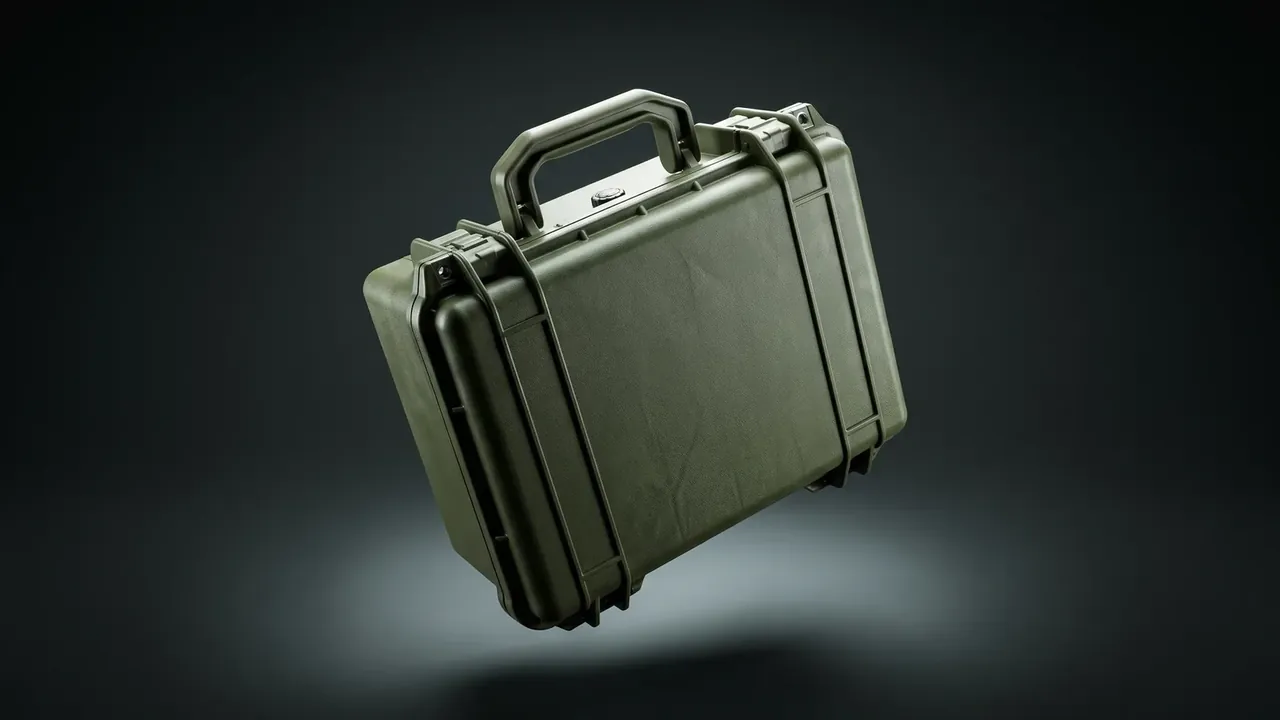
The strap crosses the lid ribs and stays off the latches. A latch is the softest part of the body, 90 N opens it, so a strap over one leaves the Military Chemical Agent Container half open within 30 km.
Bed temperature reaches 55 °C in summer, HDPE loses modulus, and tension falls a fifth. Retighten before departure and after 50 km.
Chocks beat tension: a 30 mm rubber block at each corner takes the fore-and-aft load, so the straps only hold the Military Chemical Agent Container down.
3. Draining and drying after a washdown
Two 8 mm drains sit at the lowest corner; plugs come out first. Left in, the rinse enters past the lid, cannot leave, and pools 40 mm deep under the foam.
| Step | Setting | Pass mark |
|---|---|---|
| Pre-rinse | 2.5 bar, 40 °C, 90 s | No foam at the drain |
| Rinse | 25 °C, 60 s | Clear water, no film |
| Drain | 15° tilt, 10 min | No pool in corners |
| Dry | 25 °C, lid open, 45 min | No droplets inside |
Dry with the lid open, liner out, case off the floor. Closed for 8 hours, moisture only circulates and the lid face is still wet next shift.
Keep the plugs in a bag of their own: mixed into a tool pile, one goes missing and the Military Chemical Agent Container runs on one drain until the next wash.
4. Resetting the foam cavities
The liner of a Military Chemical Agent Container is 25 mm closed-cell PE cut to a 560 × 420 × 300 mm cavity, 20 mm pockets, 3 mm clearance. Tight and it will not seat; loose and the pockets shift.
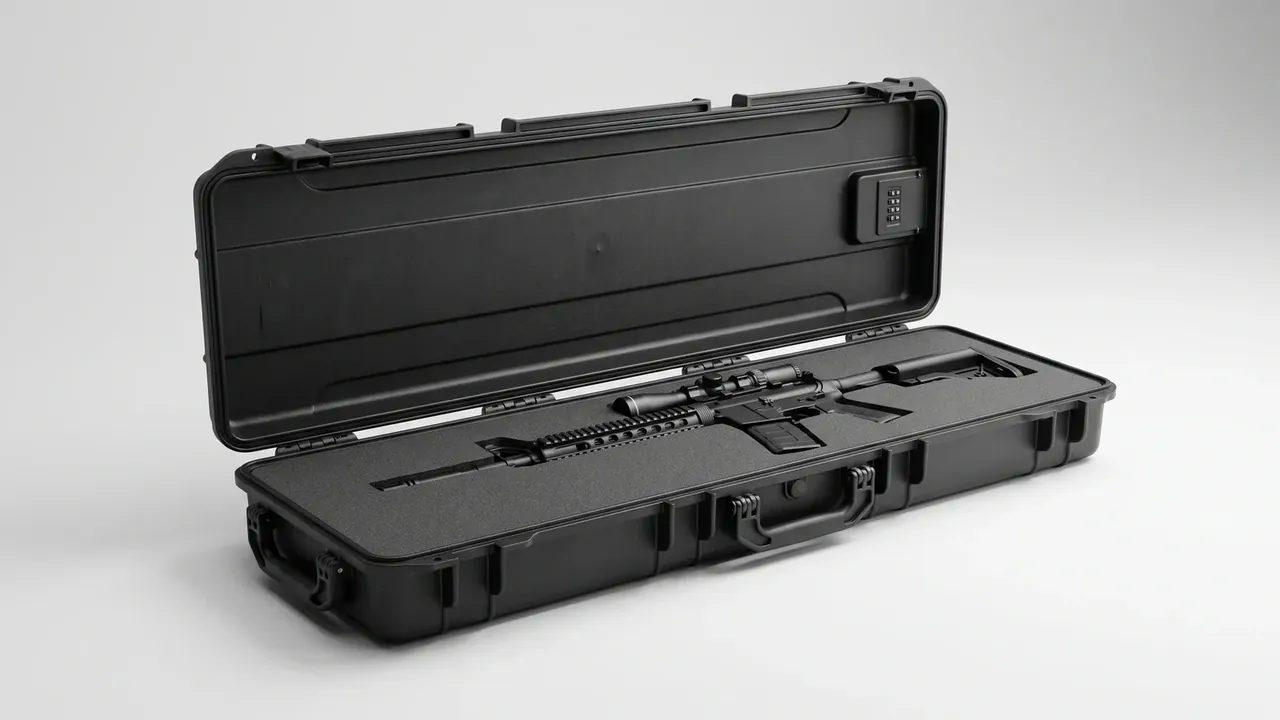
The egg-crate layer in the lid does the clamping, one way up only: peaks down, valleys over the pockets, 4 mm of compression at closing.
Open-cell foam has no place here. It gains 12% in weight and loses half its rebound, and fluid stays where neither rinse nor 45 minutes of air reaches.
5. Handover, seal numbers and six checks
Six lines at handover, each with a pass mark rather than a feel.
| Check | Pass mark | If it fails |
|---|---|---|
| Seal number | 12 digits match | Quarantine |
| Latches | 2 closed, audible snap | Reclose, re-check |
| Gasket | No roll, no set | Change on site |
| Liner | 4 pockets seated | Reset |
| Drain plugs | 2 fitted and flat | Refit, re-test |
| Outer wall | Scratch under 0.6 mm | Log and assess |
Racking runs 1.6 m clear, 3 tiers maximum, so 114 kg sits on the bottom Military Chemical Agent Container. Above that the ribs bow, a gap opens, and rinse water finds it.
At 18 turns a year the gasket is a consumable: change it at 12 months, not after a leak. At -25 °C set compression at 22%, since rubber returns slowly when cold.
Conclusion
Five move sets in a fixed order, each with its number, take the night shift off memory: 12 digits at the tailgate, 8 mm drains, 90 N at the latch, 22% in the cold. In that order, a Military Chemical Agent Container holds its seal.
This article discusses only the container (case body) side of specifications and design intent, and does not cover any handling, loading or use of the contents.
Related Reading
- Acceptance checks used on a decon line
- How a two-stage lid seal is built
- Restraint practice in supply transport
Related Products
- 8 Series — Gun Cases; Military Equipment Cases; Camera Equipment Cases; Drone Cases; Watch Cases; Knife Cases; First Aid Cases; Electronics Equipment Cases
- WL8-2812 PP Gun Case — model WL8-2812
- All protective cases and toolboxes: 7 series, 158 models