

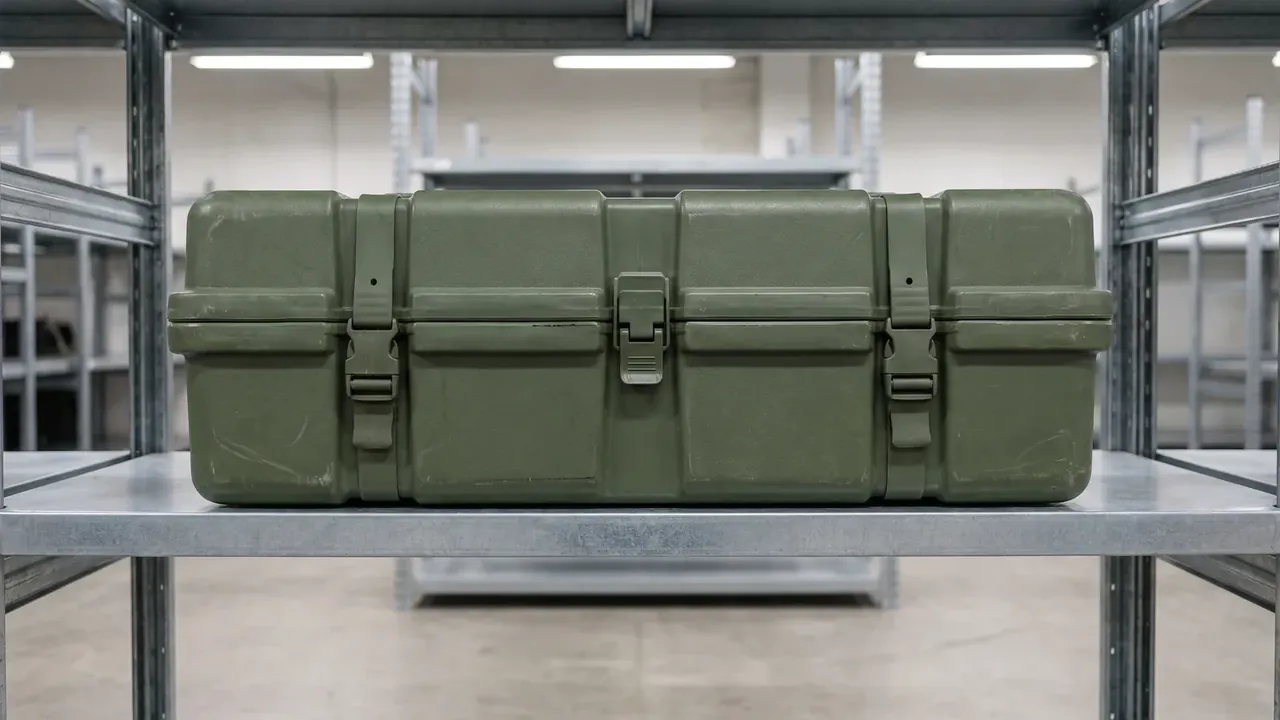
Quick answer: Military Equipment Case Factory sets an 8 mm rib and holds parting-line mismatch under 0.45 mm, checked at 4 layers for 12 h with slip under 1.3 mm.
Table of contents
- Locating rib height for the Military Equipment Case Factory
- Parting-line mismatch at the mould
- Slip readings after four-layer stacking
- Cavity tolerance across trial moulding rounds
- Rib-height release value for the production batch
- FAQ
1. Locating rib height for the Military Equipment Case Factory
At the fourth layer a locating rib has to absorb both the interlayer shear and the offset left by parting-line mismatch, so a rib that is slightly short accumulates into slip. The Military Equipment Case Factory draws the base at 690x480x300 mm outside, 615x410x225 mm inside and 5.0 mm wall thickness, and these figures fix how much base band the rib may occupy. Once wheel seats and stiffeners squeeze that band, the rib and its recess meet at a single point and shear passes down the shell wall through 4 layers over 12 h. Without enough rib height to collect the offset, slip appears first between the third and fourth layer, well above the single-tier reading. This batch therefore locks an 8 mm rib before revisiting parting-line mismatch rather than changing both in one moulding round.
Split the 8 mm rib: the upright section takes alignment and the root radius takes shear, with a relief flat left between them. The Military Equipment Case Factory uses 4 latches at 460 N each to press the lid to the datum face, so the lid stacking recess meets the rib of the layer above. After 3600 open-close cycles the latch force is rechecked, and 2 seal rings at 23% compression share one datum line with the rib on the drawing, so the spec sheet lists them together.
| Rib-height tier | Locating rib | Interlayer slip at 4 layers / 12 h |
|---|---|---|
| Tier one | 6 mm | 1.6 mm |
| Tier two | 7 mm | 1.4 mm |
| Tier three | 8 mm | 1.3 mm |
2. Parting-line mismatch at the mould
Parting-line mismatch is held to 0.45 mm or less, an order smaller than the rib height yet present through the whole stack. The upper and lower shells of the Military Equipment Case Factory close at the parting line, and once the mismatch grows the datum face of the base rib shifts so the four layers accumulate in one direction.
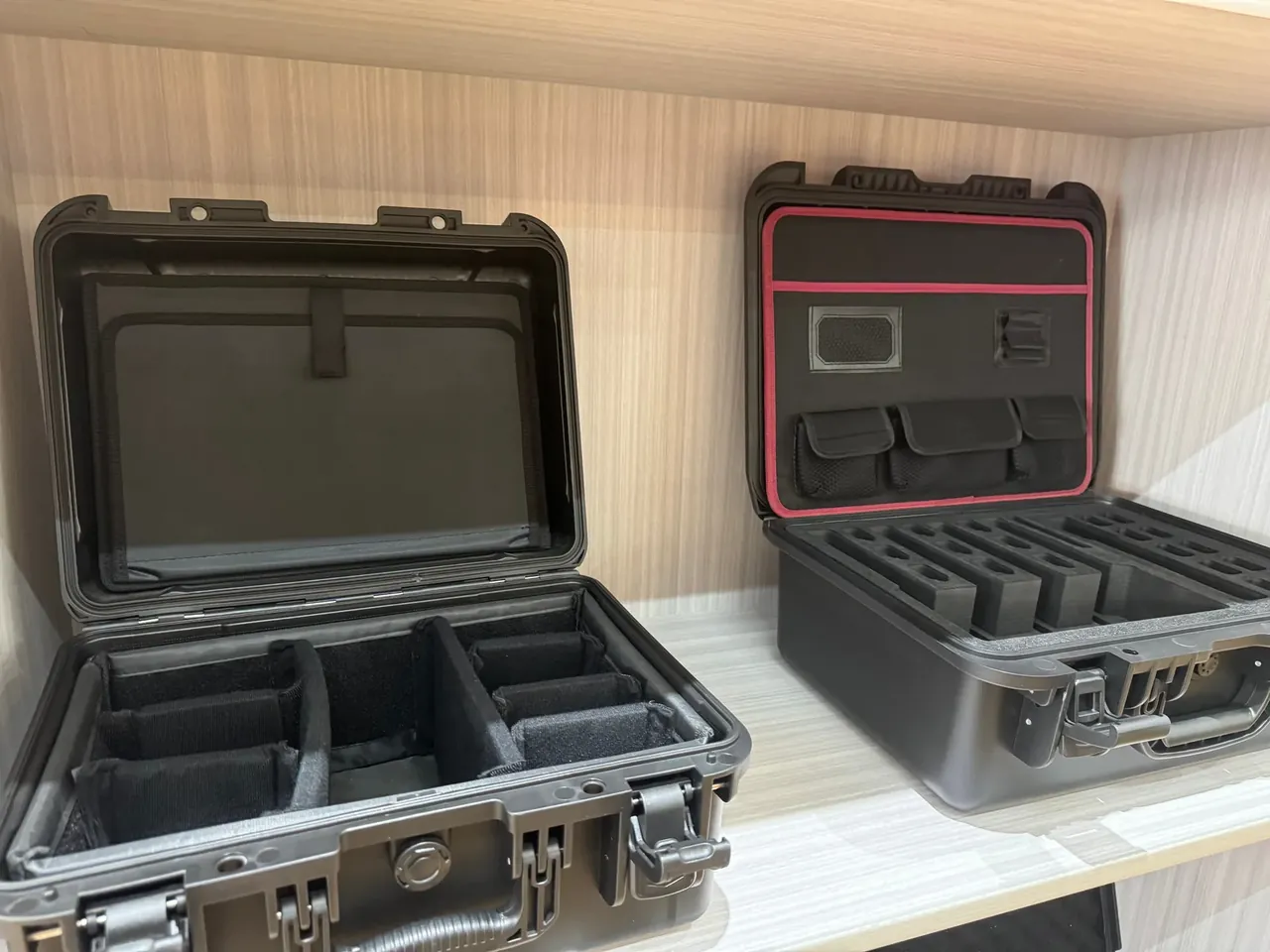
Mismatch and rib height are not independent: a large mismatch reduces rib-to-recess contact to a line and pushes the upper shell sideways, while a short rib makes the layers yield laterally under load. The Military Equipment Case Factory logs both on one trial sheet and reruns 3 rounds whenever either moves, verifying the shell-side reading against the IP67 immersion condition without writing the rating as achieved.
3. Slip readings after four-layer stacking
Slip after four-layer stacking is read twice, at the end of the 12 h loaded hold between the top and third layer, and after unloading at the rib root for residual give. The Military Equipment Case Factory fixes its criterion at slip of 1.3 mm or less after 4 layers / 12 h, and any layer over the line retires that rib tier with no retest. Samples stay closed with latches seated, the 690x480x300 mm shell is aligned by its long edge.
| Stacked layers | Hold time | Interlayer slip |
|---|---|---|
| 2 layers | 12 h | 0.7 mm |
| 3 layers | 12 h | 1.0 mm |
| 4 layers | 12 h | 1.3 mm |
4. Cavity tolerance across trial moulding rounds
Cavity tolerance across trial moulding rounds is the cell most often skipped: clean stacking only proves the rib kept layers aligned, while the 615x410x225 mm cavity holding +/-1.6 mm depends on whether mismatch pulled the wall inward. Once the 3 rounds are released the Military Equipment Case Factory measures cavity length, width and height on each shell alongside the latch state logged after 3600 cycles.
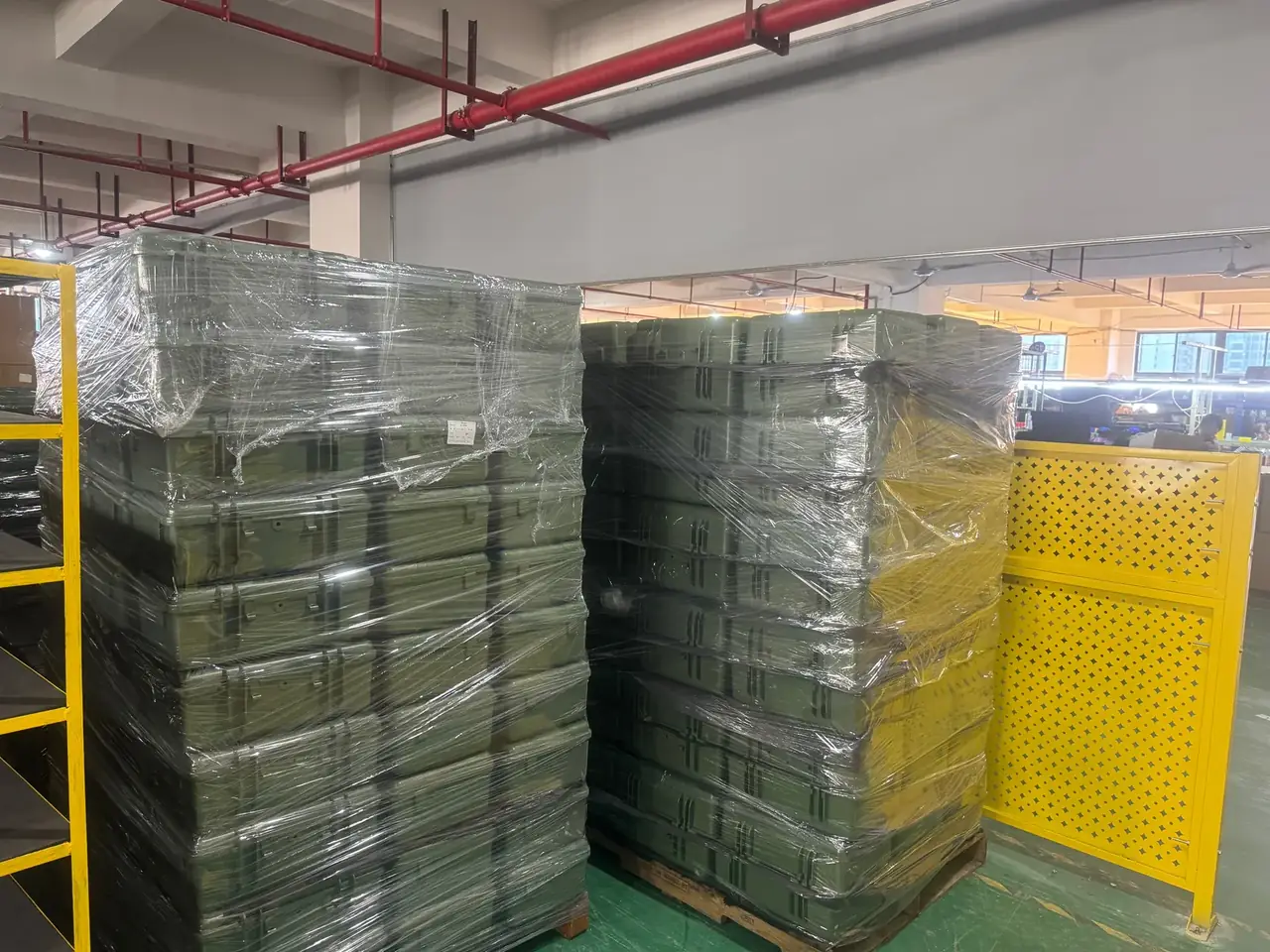
Slip of 1.3 mm or less and cavity tolerance of +/-1.6 mm move together: large slip implies the rib has taken a permanent set, while an out-of-tolerance cavity points to parting-line mismatch or wall thickness. Only when both sit inside limits are the 8 mm rib and 0.45 mm mismatch frozen as the production-batch configuration.
| Slip reading | Interlayer offset | Cavity tolerance |
|---|---|---|
| Reading one | 1.1 mm | +/-1.4 mm |
| Reading two | 1.2 mm | +/-1.5 mm |
| Reading three | 1.3 mm | +/-1.6 mm |
5. Rib-height release value for the production batch
At the release step only one set of numbers enters the production drawing. The production batch of the Military Equipment Case Factory converges on the lowest passing rib height and grants no range release.
The rib-height release value is the lowest tier whose layer-4 slip still holds 1.3 mm, and shorter lids do not move to production. Once set, the 690x480x300 mm outside, 615x410x225 mm inside and 5.0 mm wall drawing is locked with 2 seal rings at 23% compression and 4 latches at 460 N each. Later 3600-cycle and 3-round retests follow this one revision, so the Military Equipment Case Factory is released on shell evidence alone.
Conclusion
The stacking verdict for the Military Equipment Case Factory rests on three shell-side readings: an 8 mm locating rib, parting-line mismatch of 0.45 mm or less and a 4 layer / 12 h stack. Only when slip of 1.3 mm or less and cavity tolerance of +/-1.6 mm stand together does that tier enter the production-batch release sheet. JUNZHIJIA speaks through drawing tolerance and rig readings, and Kexin New Materials (Guangdong) Co., Ltd. files trial, cycling and stacking retests side by side for later batch comparison.
Related Reading
- How to choose a protective case OEM factory: ten audit points
- Build-to-print plastic case OEM manufacturer: IP67 acceptance and mould ownership
- OEM plastic box: contract production and branded delivery
- Drone case manufacturing factory: capability, process and verification points
Related Products
- 8 Series — Gun Cases; Military Equipment Cases; Camera Equipment Cases; Drone Cases; Watch Cases; Knife Cases; First Aid Cases; Electronics Equipment Cases
- WL8-2812 PP Gun Case — model WL8-2812
- All protective cases and toolboxes: 7 series, 158 models