

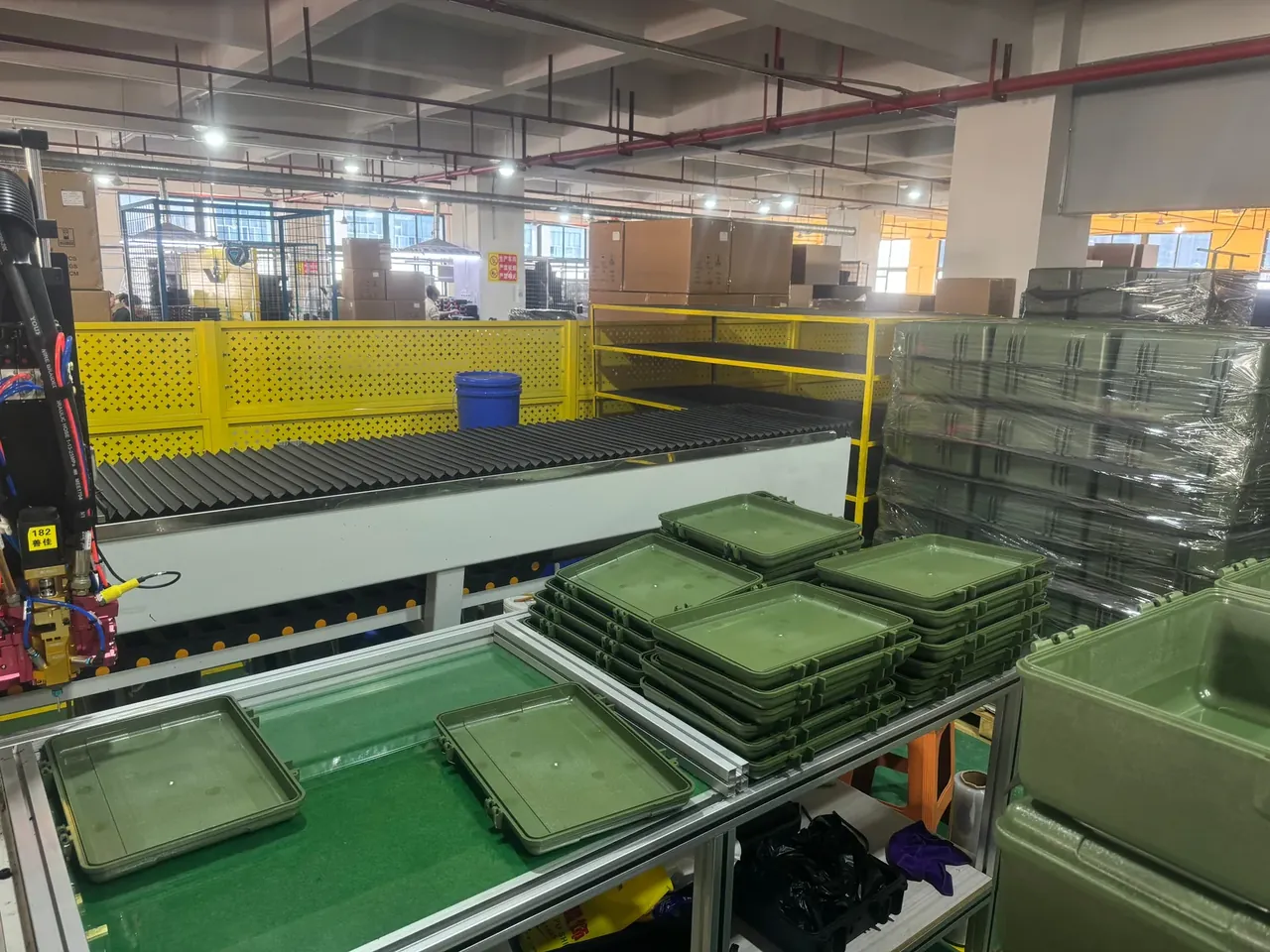
Quick answer: A Military Equipment Case with Telescopic Handle built on 2.8 mm tube walls and 208 mm rail spacing holds binding at 24 N after 5200 extension cycles.
Table of contents
- Tube wall thickness of the Military Equipment Case with Telescopic Handle
- Spacing of the base guide rails
- Binding resistance after extension cycles
- Handle sway under full-load retest
- Tube stop value for handle batches
- FAQ
1. Tube wall thickness of the Military Equipment Case with Telescopic Handle
Binding in a three-stage handle seldom originates at the lock; it traces to the fit between base guide-rail spacing and tube wall. The Military Equipment Case with Telescopic Handle fixes the outer tube wall at 2.8 mm, held between two base rails, so the 620 x 450 x 250 mm shell absorbs the lateral shove of handle travel only along this lower strip.
Shell thickness is 4.3 mm, but the tube is a separate 2.8 mm part seated on rail bosses and base ribs. The 550 x 385 x 180 mm cavity must give up room for the 208 mm rail gap, so wall and spacing are sized together. A load cell sits on the grip.
| Tube tier | Measured wall | Binding force after 5200 cycles |
|---|---|---|
| Thin 2.4 mm | 2.4 mm | 27.6 N, over limit |
| Nominal 2.8 mm | 2.8 mm | 21.3 N |
| Thick 3.2 mm | 3.2 mm | 19.8 N |
Nothing but wall thickness changes across these tiers. At 2.4 mm the reading hits 27.6 N beyond the 24 N cap.
2. Spacing of the base guide rails
Extension and retraction both run along two base rails; shift their spacing and the three tubes rub past on a skew. The Military Equipment Case with Telescopic Handle keeps a 208 mm clear gap between inner rail faces, letting the outer tube shoulders ride on an oil film. A R2 fillet at the rail foot holds up over 4000 lid cycles.
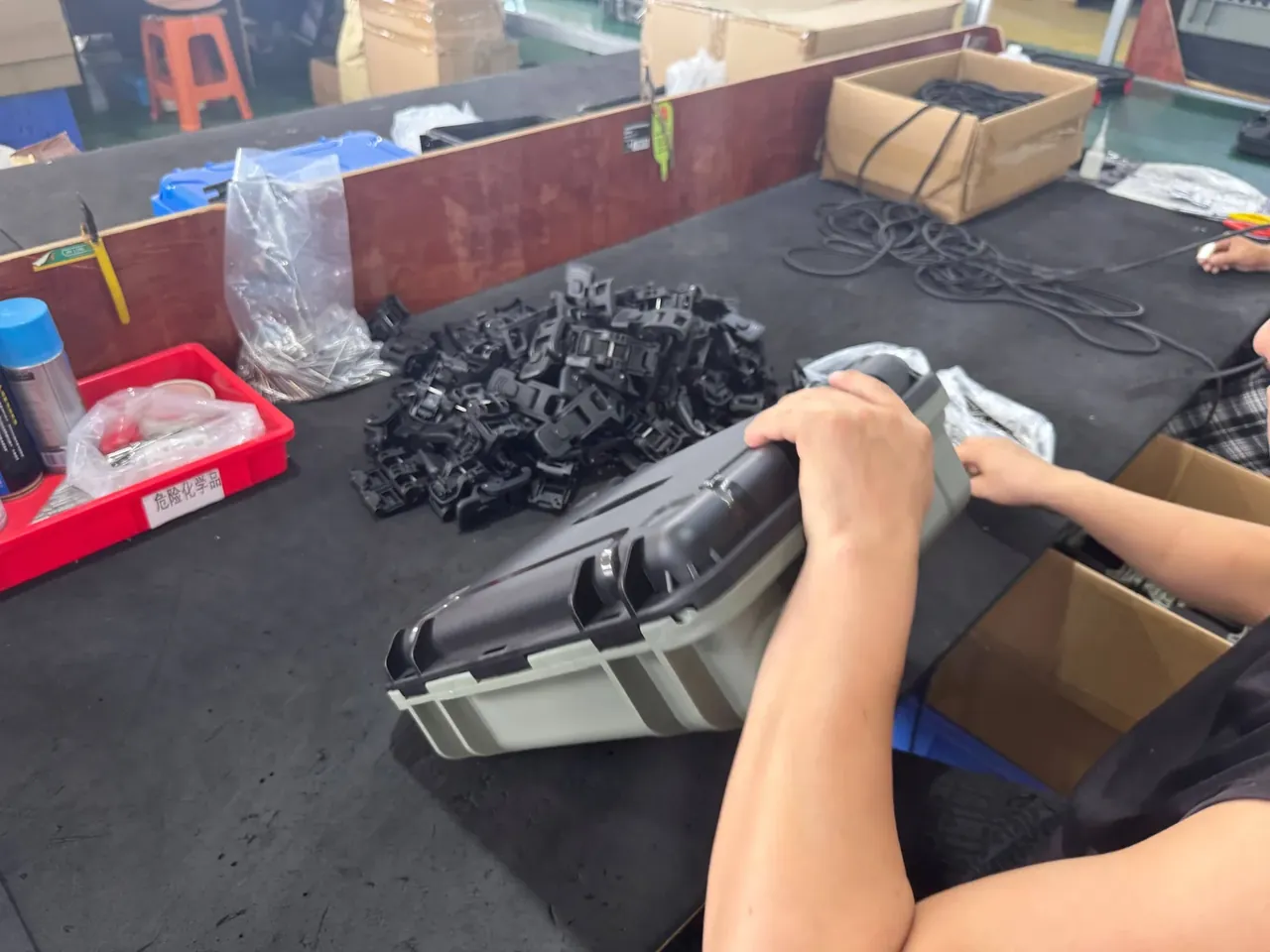
The rail face clears the slider by 0.4 mm, so sliding load stays off the tube. One gasket ring at 19% compression seals the flange; an IP67 benchmark seal check looks at flange contact alone.
3. Binding resistance after extension cycles
The rig drives full three-stage travel to and fro; the Military Equipment Case with Telescopic Handle logs 5200 strokes at 16 kg with the grip loaded, pausing at each 1000 to capture binding force. The load cell peaks as the handle moves from stowed to locked, and that peak is capped at 24 N. Early strokes barely shift while mouth and rails bed in; after 3000 the thin tubes climb, and by 5200 the two groups are far apart.
| Extension cycles | Nominal 2.8 mm binding | Thin 2.4 mm binding |
|---|---|---|
| 1000 cycles | 18.4 N | 19.7 N |
| 3000 cycles | 20.1 N | 23.6 N |
| 5200 cycles | 21.3 N | 27.6 N |
Separation appears only beyond 3000 strokes. The Military Equipment Case with Telescopic Handle is never signed off at 1000. Once the 5200 finish, the grip is pulled once more. The two latches open and the lid closes to 390 N apiece. A second peak is then taken. A spread above 1.5 N means a slack rail boss, not added binding.
4. Handle sway under full-load retest
Handles do not always extend on the exact centreline, and lateral movement under full load is the tougher check. The Military Equipment Case with Telescopic Handle carries 16 kg inside, drives the grip to full lock, and records the sideways travel of the innermost tube mouth off the base datum, capped at 1.1 mm. A loosened mouth shows as sway first; slider drag is a later symptom, so the sway column is judged after force.
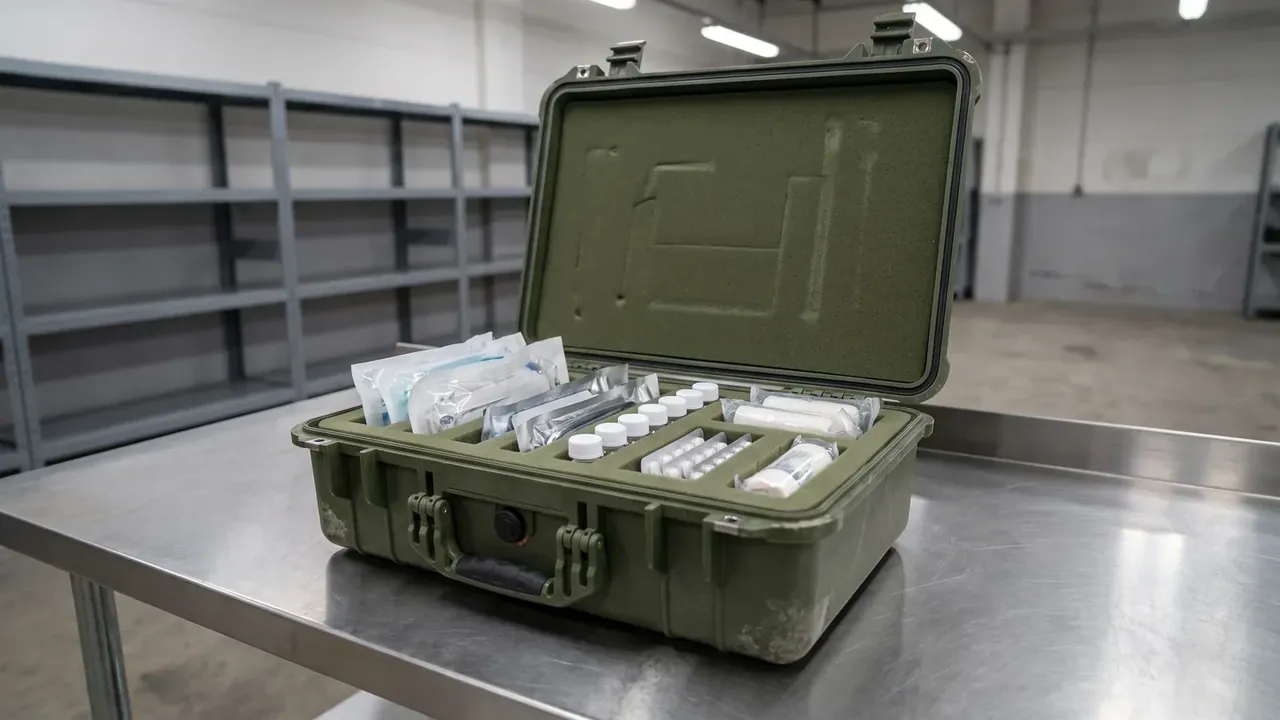
That same shell from the 5200-stroke run is reused, meaning the worn mouth takes another loaded side push. Dial gauges sit at grip and mouth of the Military Equipment Case with Telescopic Handle; zeroed empty at 6.9 kg and brought to 16 kg, the widest swing is the sway. The 2.8 mm tube gives 0.86 mm, the 2.4 mm tube 1.24 mm, the latter past 1.1 mm.
5. Tube stop value for handle batches
Once a tier's binding resistance passes 24 N, the cycles beyond that tier are archived on their own and left out of the accepted-sample mean. Tracing back, 2.4 mm reads 27.6 N at 5200 strokes while 2.8 mm stays at 21.3 N, making 2.8 mm the batch starting wall and dropping thinner tubes from the table.
| Binding band | Tube tier | Disposition |
|---|---|---|
| Within 24 N and sway within 1.1 mm | Nominal 2.8 mm | Release |
| Above 24 N | Thin 2.4 mm | Retest tube mouth |
| Sway beyond 1.1 mm | Reject zone | Whole batch rework |
A batch samples eight tubes for wall thickness under the release rule of the Military Equipment Case with Telescopic Handle: one below 2.6 mm is set aside, two on the line return the whole lot. JUNZHIJIA logs wall, 5200-stroke force and loaded sway on a single process card, and a resin or rail-boss swap demands another 5200-stroke run.
Conclusion
A 2.8 mm tube wall paired with 208 mm rail spacing keeps the Military Equipment Case with Telescopic Handle under 24 N binding and 1.1 mm sway through 5200 extension strokes, with the loaded retest covering side travel at 16 kg. JUNZHIJIA stores wall checks and the force stop value by tier. When specifying this handle shell, ask first for wall and spacing figures that can be verified.
Related Reading
- Case Telescopic Handle: Telescopic Handle Jamming
- Protective Case Handle Load: Grip Test at 20 kg
- Static and dynamic load validation of protective case handles
- Case Gasket Groove: Single vs Double Lip
Related Products
- 8 Series — Gun Cases; Military Equipment Cases; Camera Equipment Cases; Drone Cases; Watch Cases; Knife Cases; First Aid Cases; Electronics Equipment Cases
- WL8-2812 PP Gun Case — model WL8-2812
- All protective cases and toolboxes: 7 series, 158 models