

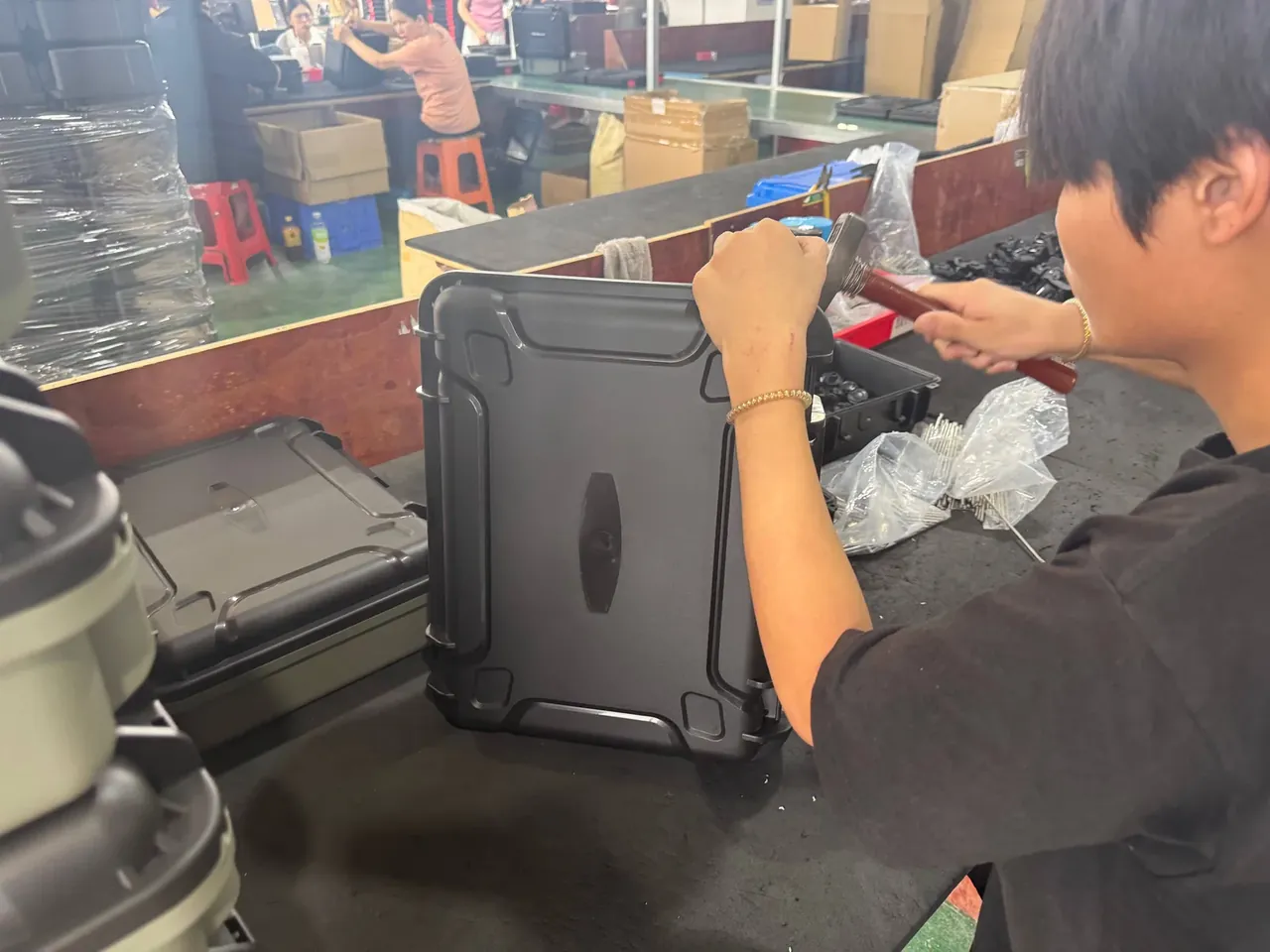
Quick answer: A Military Equipment Transit Case holds 1.8 mm diagonal deviation after 3 layers for 48 h, with 470 N latches staying closed after a 1.2 m drop.
Table of contents
- Military Equipment Transit Case: stacking interlock corner shear
- Rim gasket and lid stiffness
- Diagonal deviation after three-layer stacking
- Latch force retest for drop without release
- Sealing face recheck after hardware replacement
- FAQ
1. Military Equipment Transit Case: stacking interlock corner shear
A Military Equipment Transit Case measures 680×490×300 mm outside and 610×420×235 mm inside, with a 4.6 mm wall, 8.8 kg empty and 18 kg loaded. Stacked three layers high, the bottom lid carries the two shells above it.
When JUNZHIJIA reviews the interlock corners on a Military Equipment Transit Case, it first gauges the fit between corner and recess, then checks whether the 4.6 mm wall has thinned at the corner root. Corners take horizontal force while base and lid take vertical force; keeping the two paths separate stops the readings from masking each other.
| Stack layers | Dwell time | Diagonal criterion |
|---|---|---|
| 1 layer | Initial reading | Log the baseline diagonal length |
| 2 layers | 24 h | Deviation within 0.9 mm |
| 3 layers | 48 h | Deviation ≤1.8 mm, no residual lid shift |
2. Rim gasket and lid stiffness
Compressing the rim gasket to 25% is the number that ties IP66 to stacking stiffness on a Military Equipment Transit Case. Below 20% the corners break contact first and moisture works in through the gap after a 96 h salt spray; above 30% the lid will not seat and the latches need extra force to close.

Lid stiffness is not about panel thickness; it is about the rim staying flat under load. A Military Equipment Transit Case is rated from −30 ℃ to 60 ℃, and at the cold end the rubber stiffens so reaching 25% needs more closing force, while at the hot end compression set accelerates and the contact band narrows after 3500 cycles.
| Interlock area | Force type | Structural answer |
|---|---|---|
| Corner boss and recess | Three-layer horizontal shear | Root radius moulded into 4.6 mm wall |
| Full rim | Vertical load and sealing | Gasket at 25% compression |
| Lid panel centre | Bending from upper base | Lid ribs and rim support |
3. Diagonal deviation after three-layer stacking
Three layers for 48 h is the dwell set for the rim of a Military Equipment Transit Case, and the diagonal deviation must stay within 1.8 mm once that time is up.
Record the direction of the deviation, not just the number. A clockwise twist and a counter-clockwise one point to different sides of the interlock.
| Deviation reading | Probe position | What it means |
|---|---|---|
| ≤1.8 mm | Two diagonal ends | Three layers for 48 h pass stiffness |
| 0.6–1.8 mm | Four edge midpoints | Gasket stays evenly compressed |
| Over 1.8 mm | Diagonal repeat | Interlock corners and lid ribs need recheck |
4. Latch force retest for drop without release
After a 1.2 m drop, the criterion for a Military Equipment Transit Case is not whether the shell cracks but whether the four latches at 470 N each stay closed. Retest drops the shell once on each of six faces and reads latch holding force every time; once it falls below 470 N, replace the hardware instead of tightening screws, and do not expect one latch to recover the compression around the whole rim.
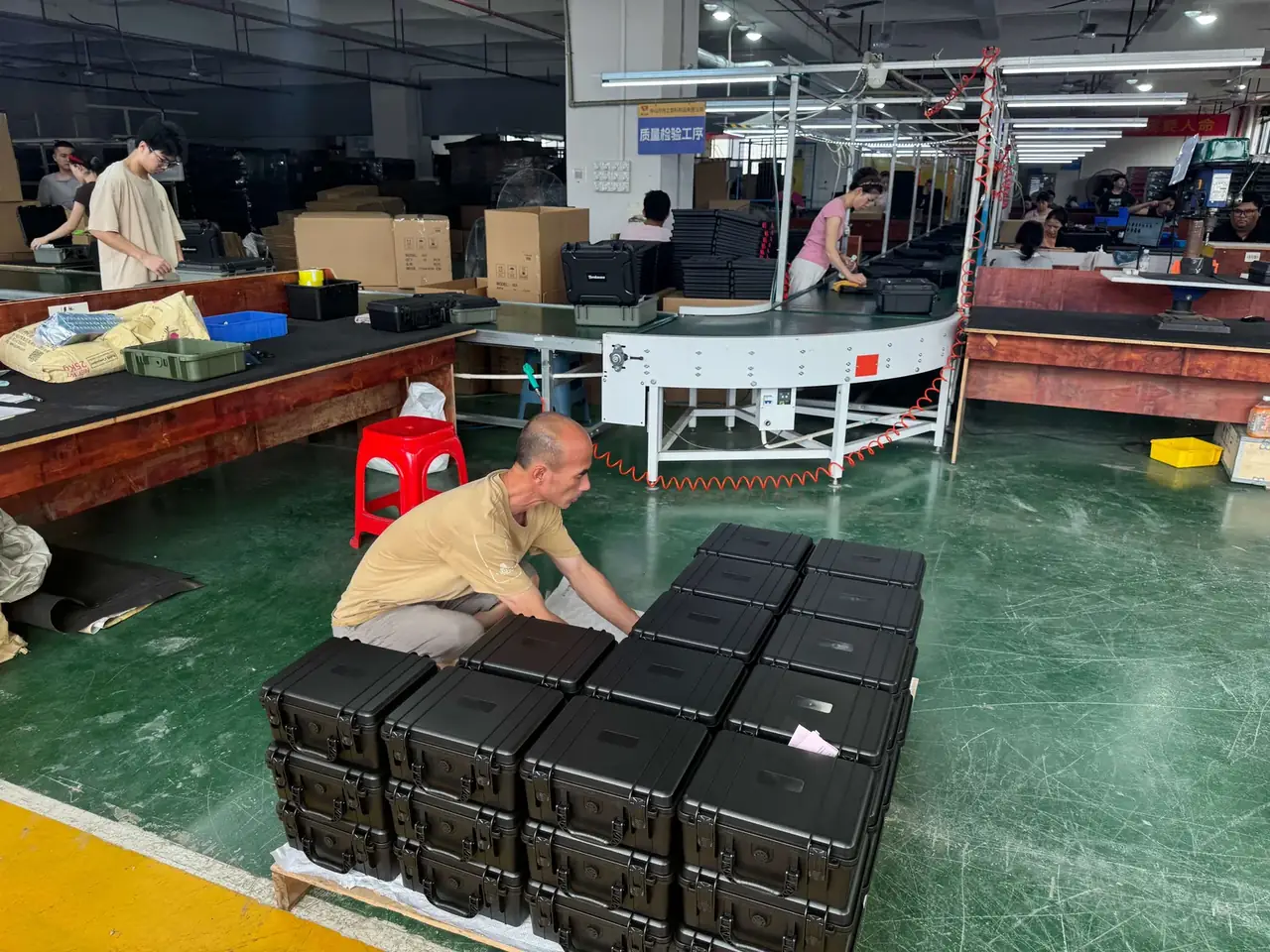
Hinge torque of 3.0 N·m and latch force of 470 N are matched on purpose: too much torque and rebound hits the latches hard, too little and the lid never seats so the gasket cannot compress. Both are retested after 3500 cycles, and a loose hinge first shows up as a wider gap on one rim side rather than a wobbling lid.
5. Sealing face recheck after hardware replacement
A Military Equipment Transit Case that has had latches or hinges replaced needs the sealing face walked again, not just the new hardware verified.
The recheck route is fixed. Wipe the rim clean first. Run a fingertip around the full perimeter to feel for a step. Gauge the closed gap between lid and shell at four corners and four edge midpoints. Set the case flat and press evenly, watching whether all eight points close together. Lift the gasket out and check whether its section has flattened past recovery. Refit it, close the shell once as a 3500-cycle sample would, and read whether the four latches hold evenly. Then inspect the hardware seat against a 96 h salt-spray sample for blanching. Only then run the IP66 spray retest and open the lid for moisture along the rim. Eight readings, not the shine of a new latch, decide whether the case stays in service.
Conclusion
On a Military Equipment Transit Case the interlock corners, gasket and lid stiffness are three links of one stacking chain, and no single link settles the whole shell. Once the 680×490×300 mm outside and 18 kg load are fixed, the 1.8 mm deviation over 3 layers for 48 h, 25% compression and 470 N latches become the three hard stops. Read them in order and the stacked and dropped condition of a Military Equipment Transit Case stays legible. Measure the corners, then the rim gap, then the hardware force; reverse that order and the readings hide one another.
Related Reading
- Specifications benchmarked to military-standard cases
- Line items on a case inspection checklist
- Sampling and rejection in batch incoming inspection
- Choosing latches and hinge hardware
Related Products
- 8 Series — Gun Cases; Military Equipment Cases; Camera Equipment Cases; Drone Cases; Watch Cases; Knife Cases; First Aid Cases; Electronics Equipment Cases
- WL8-2812 PP Gun Case — model WL8-2812
- All protective cases and toolboxes: 7 series, 158 models