

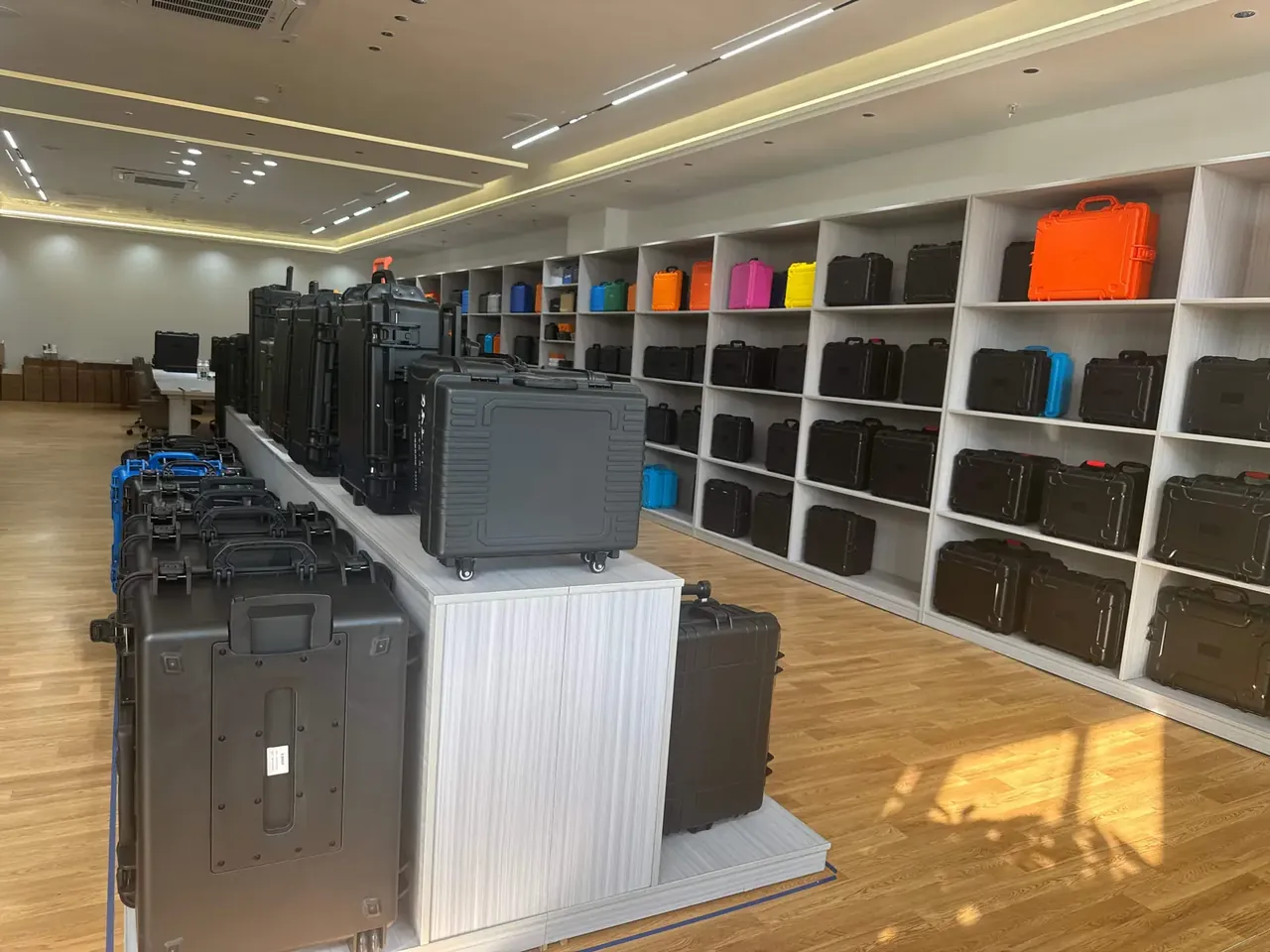
Quick answer: A Military Firearm Storage Box differs from a soft bag, a foam-filled generic case, a metal cabinet and one-way packaging in four places: cavity clearance, seconds per retrieval, stack layers, and whether sealing comes from a moulded lip or from filler.
Table of contents
- Where the Military Firearm Storage Box Sits Among Four Formats
- Cavity Fit Sets the Handling Rhythm
- Stack Height and Volume Efficiency
- Two Failure Paths: Sealing and Impact
- Three Cases Where Alternatives Win
- FAQ
1. Where the Military Firearm Storage Box Sits Among Four Formats
Four alternatives come up: a soft carry bag, a generic case with a cavity cut from foam, a metal drawer cabinet, and one-way honeycomb packaging. Each serves a rhythm; the Military Firearm Storage Box serves one — single-unit fit, repeated opening, stackable storage.
The box treats the contents outline as a design input: moulds leave 8–15 mm of clearance and the foam face is compressed another 10 percent, so nothing rattles and nothing must be dug out. Generic cases make the cavity large and cut fit on site at forty minutes a case.
| Format | Pull one unit | Stack layers | Unit weight |
|---|---|---|---|
| Military Firearm Storage Box | 6–9 s | 6 | 4.2 kg |
| Soft carry bag | 15–25 s | none | 1.8 kg |
| Generic case | 35–50 s | 4 | 11.6 kg |
| Metal cabinet | 12–20 s | n/a | 38 kg body |
2. Cavity Fit Sets the Handling Rhythm
Two layers of fit decide speed. The first is clearance. With closed-cell polyethylene at 30 kg per cubic metre, ten percent compression holds a unit through a 1.5 m drop; past 25 percent the foam compacts and the second drop has no cushion left. Inserts are moulded per model.
The second layer is motion. A fitted cavity takes three moves: open, lift, close; a loose cavity adds two, pushing filler aside and putting it back. At twenty retrievals a day the gap is eight minutes, forty hours a year.
3. Stack Height and Volume Efficiency
Six layers do not come from wall thickness alone. A 3.8 mm wall is only the start; the load path runs through base ribs and a 3 mm locating step in the lid, so side loads pass through the step and the body carries compression only.
Volume efficiency shows in air freight. Charged on volumetric weight, a fitted case reaches 78 percent utilisation against 54 percent, so the same shipment occupies 40 percent more space. Six layers assume 2.7 m of clear height and floor flatness within 3 mm.
4. Two Failure Paths: Sealing and Impact
Each leaks its own way. The box uses a double-lip gasket, each lip compressed 1.4 mm, and fails where one lip stops seating. A bag fails at stitch perforations, a generic case once its foam takes water, a cabinet when the door frame distorts.
Impact shows at 1.5 m on six faces, three edges and one corner: the moulded body recovers and keeps the mark on a rib, a generic case splits at the corner joint, a steel cabinet dents its door and pushes the latch out of register.
| Format | Sealing | After a 1.5 m drop | Repair |
|---|---|---|---|
| Military Firearm Storage Box | Double-lip gasket | Recovers | Gasket or latch |
| Soft carry bag | Coated fabric | Corner wears through | Patch |
| Generic case | Foam filler | Corner joint splits | New insert |
| Metal drawer cabinet | Door frame gasket | Door panel dents | Re-align door |
5. Three Cases Where Alternatives Win
One-way shipments unpacked on arrival are cheapest in honeycomb board and stretch film, at about one ninth the packaging cost of a Military Firearm Storage Box, no return leg to justify reuse.
Fixed indoor storage above 200 units suits a metal drawer cabinet: rigidity comes from structure, not a gasket, so nothing ages out, but it cannot move.
Below 1.5 kg per unit and six hours of carrying a day, a soft bag wins at 1.8 kg empty, though it cannot stack.
| Condition | Better fit |
|---|---|
| One-way shipment | One-way packaging |
| Fixed storage, 200 units or more | Metal cabinet |
| Under 1.5 kg, long carry | Soft carry bag |
| Repeated opening plus stacking | Military Firearm Storage Box |
Conclusion
The formats differ by design premise, not quality: the bag assumes light loads, the generic case assumes variety, the cabinet assumes it never moves, the Military Firearm Storage Box assumes single units, repeated opening and stacking. Weigh clearance, retrieval seconds, stack layers and volume utilisation, and on repeated use the arithmetic favours the Military Firearm Storage Box.
This article discusses only the container (case body) side of specifications and design intent, and does not cover any handling, loading or use of the contents.
Related Reading
- How to choose a Military Firearm Storage Box
- Custom and OEM process for a Military Firearm Storage Box
- What a Military Firearm Storage Box is made of
- Material comparison for firearm protective cases
Related Products
- 8 Series — Gun Cases; Military Equipment Cases; Camera Equipment Cases; Drone Cases; Watch Cases; Knife Cases; First Aid Cases; Electronics Equipment Cases
- WL8-2812 PP Gun Case — model WL8-2812
- All protective cases and toolboxes: 7 series, 158 models