

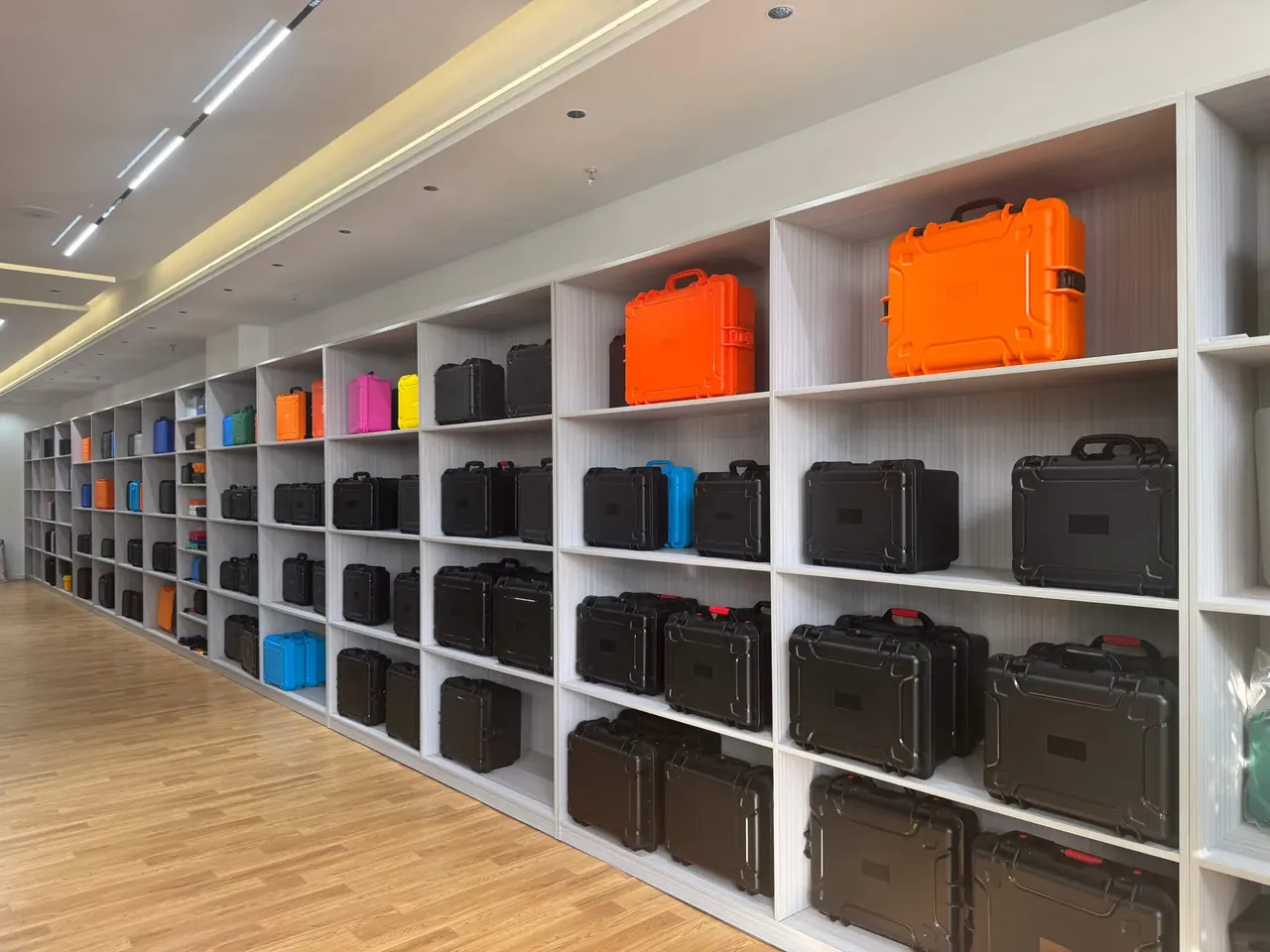
Quick answer: A Military Firearm Storage Box is specified in a fixed order: cavity and seating depth, wall thickness and rib layout, foam density and cushion depth, latch life and opening force, then stack height checked against static load. Order matters, because an outside-first approach usually forces a second mould.
Table of contents
- Cavity Size and Seating Depth
- Wall Thickness and Shell Stiffness
- Foam Density and Cushion Depth
- Latch Force and Hinge Fit
- Stack Height and Static Load
- FAQ
1. Cavity Size and Seating Depth
Start with the load, not the shell. A Military Firearm Storage Box is quoted in three dimension sets: cavity, outer shell, export carton. Cavity length is the load outline plus 8 to 12 mm per side and 3 to 5 mm of foam compression, so a 1120 mm item takes a 1160 mm cavity and an outer length near 1200 mm.
| Load outline | Cavity length | Outer length | Loaded weight |
|---|---|---|---|
| 780 mm | 820 mm | 860 mm | 8.5 kg |
| 1120 mm | 1160 mm | 1200 mm | 14.2 kg |
| 1450 mm | 1490 mm | 1530 mm | 21.6 kg |
Pockets in a Military Firearm Storage Box run 25 mm deep with 1.5 to 2 mm clearance per side; tighter grips in cold weather, looser stops locating anything. A 60 to 40 base-to-lid split keeps the centre of gravity low once the load passes 14 kg.
2. Wall Thickness and Shell Stiffness
Point load from fingers and corners, and stack load from the tiers above, ask different things of a Military Firearm Storage Box. Going from 2.6 mm to 3.4 mm wall adds roughly 22 percent shell weight while point-load resistance barely tracks it; ribs do that work.
At 90 to 110 mm rib pitch and 3.5 mm rib height, a 2.8 mm wall holds local deflection under 2 mm at a 200 N point load. Widen the pitch to 160 mm and the deflection doubles at the same thickness.
Polypropylene loses impact strength at minus 20 Celsius, so a body that survives a 1.2 m drop at room temperature can crack at a corner in a cold store. Ask for the low-temperature drop target in writing.
3. Foam Density and Cushion Depth
Foam in a Military Firearm Storage Box locates the load and cushions it, and those duties cannot be traded. Location comes from pocket geometry and cell wall thickness; cushioning comes from density and layer depth.
Split the cushion by impact direction: 30 mm at the base, 20 mm on the lid side, 15 mm on the side walls. Under a typical 1.2 m drop that split cuts peak acceleration reaching the load by about an order of magnitude. A 15 mm cell wall at Shore A 38 holds shape; below 10 mm the pocket lip rolls outward.
| Foam | Density | Behaviour | Where it fits |
|---|---|---|---|
| EPE | 28 kg/m³ | fast recovery, low set | general cushioning |
| EVA | 65 kg/m³ | hard, holds shape | thin, tight pockets |
| XPE | 45 kg/m³ | closed cell, low water uptake | humid stores |
4. Latch Force and Hinge Fit
Four openings a day for three years is about 4400 cycles, so specify 5000 with retention no lower than 80 percent of the initial holding force. A single latch at 25 to 40 N, doubled symmetrically, carries 22 kg by the handle without releasing and still opens one-handed in gloves. Above 60 N, users leave latches half engaged.
Hinges are a pin-and-bore question. A 5 mm stainless pin in 0.15 mm clearance is the usual pairing; at 0.3 mm the lid rocks when open.
5. Stack Height and Static Load
Static load on the bottom unit of a Military Firearm Storage Box is loaded weight times tiers times 1.5. At 21.6 kg loaded, four tiers give 130 kg and five tiers 162 kg. Put the figure in the purchase specification instead of testing a stack on the warehouse floor.
| Tiers | 14.2 kg loaded | 21.6 kg loaded |
|---|---|---|
| 3 | 64 kg | 97 kg |
| 4 | 85 kg | 130 kg |
| 5 | 107 kg | 162 kg |
A 6 mm step on the lid mating with a base recess holds offset within 5 mm, so a five-tier column stays square. After 30 days under load, permanent set in a Military Firearm Storage Box base should stay within 3 mm.
Conclusion
The five tests run in sequence: cavity and seating, wall and ribs, foam and cushion depth, latch and hinge life, then stack height against static load. Each step constrains the next. Followed in order, they keep a Military Firearm Storage Box matched to the job it actually has to do.
This article discusses only the container (case body) side of specifications and design intent, and does not cover any handling, loading or use of the contents.
Related Reading
- military-firearm-storage-case-specifications
- military-firearm-storage-case-maintenance
- Choosing a firearm storage case by scale
- What a Military Firearm Storage Box is
Related Products
- 8 Series — Gun Cases; Military Equipment Cases; Camera Equipment Cases; Drone Cases; Watch Cases; Knife Cases; First Aid Cases; Electronics Equipment Cases
- WL8-2812 PP Gun Case — model WL8-2812
- All protective cases and toolboxes: 7 series, 158 models