

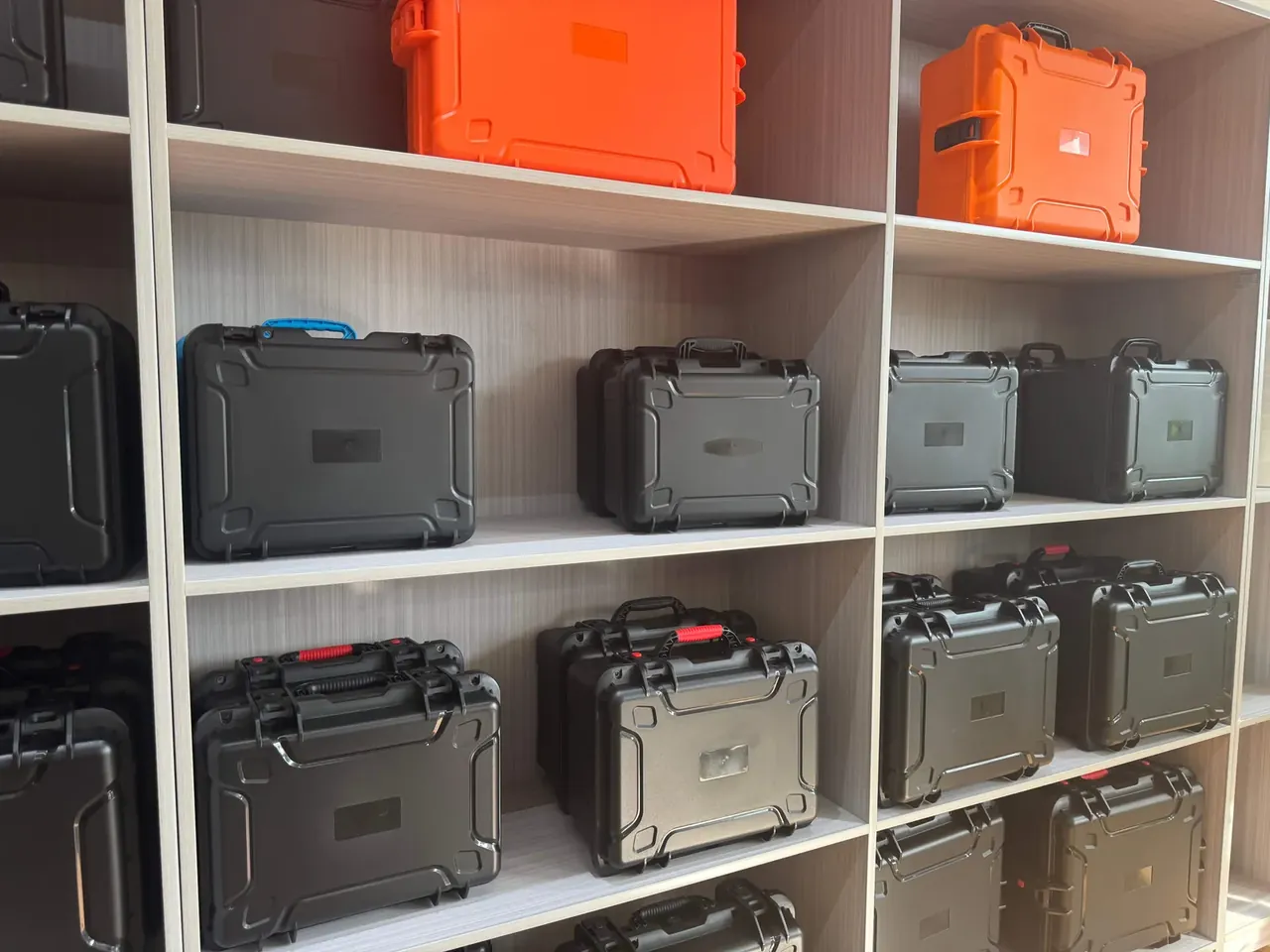
Quick answer: A Military Firearm Storage Case is specified by three linked numbers: cavity from contents plus 15 mm per side, external size from cavity plus twice the wall, and wall starting at 4.5 mm for rotomolding. Load is quoted at six-high stacking, 50 kg per tier, not per case.
Table of contents
- Dimension Chain for a Military Firearm Storage Case
- Wall Thickness and Rib Layout
- Stacking Load and Rating
- Latch Hinge and Gasket Groove Fits
- From Specification Sheet to Drawing and Inspection
- FAQ
1. Dimension Chain for a Military Firearm Storage Case
Size on a Military Firearm Storage Case is calculated, not measured off a sample. Take the largest outline of the contents, add 25 mm per side at the ends and 15 mm per side on width and height, and the cavity follows; add two walls and the rim flange, and the external size appears.
For contents 1150 mm long the cavity lands at 1200 by 360 by 150 mm, and with a 4.5 mm wall and an 18 mm flange the outside reads 1230 by 390 by 180 mm. Tolerance is layered: ±0.8 mm outside, ±1.2 mm inside, ±0.5 mm across the rim.
| Item | Value | Reason |
|---|---|---|
| End clearance | 25 mm per side | Lift-out space |
| External tolerance | ±0.8 mm | Pallet and rack fit |
| Cavity tolerance | ±1.2 mm | Absorbed by foam |
2. Wall Thickness and Rib Layout
Thickness balances impact against dead weight. Rotomolding runs 4.5 mm on the sides, 6 mm at the base and 9 mm at rib roots, uniform inside ±10 percent.
Injection moulding at 2.8 mm relies on ribs and suits sizes under 600 mm; past 900 mm tonnage and warpage stop cooperating. At equal load a rotomolded Military Firearm Storage Case weighs 11.5 kg against 8.2 kg, yet survives a -40 °C corner drop that forces the moulded version to 3.6 mm.
Ribs sit 12 mm high and 150 mm apart at 1.5 degrees of draft, continuous on any case over 900 mm.
| Zone | Rotomolded | Injection | Note |
|---|---|---|---|
| Side wall | 4.5 mm | 2.8 mm | Main load face |
| Base | 6.0 mm | 3.6 mm | Drop impact |
| Rib root | 9.0 mm | 4.5 mm | Stress concentration |
3. Stacking Load and Rating
Load is quoted at the stack. One unit weighs 11.5 kg empty and carries 38 kg, so 49.5 kg per tier; at six tiers the bottom lid takes 247.5 kg. With a 1.5 factor the proof load is 370 kg held 24 hours, and permanent deflection must stay under 3.5 mm.
Heat changes the answer: polyethylene loses about 25 percent of compressive modulus at 65 °C, so a top tier under summer tarpaulin sinks the base roughly 1 mm more. Drop to four tiers or lift the wall to 5.5 mm. It also takes a 1.2 m corner drop after four hours at -40 °C.
4. Latch Hinge and Gasket Groove Fits
Latch count follows the perimeter at one per 300 mm on the long sides, so a 1200 mm case gets three per side and one per end, eight in total; sparser spacing lets the gasket bulge and the middle span leaks first. Seat holes sit 22 mm in from the rim.
Hinge span stays under 450 mm, otherwise add a centre hinge. The groove is 8 mm wide and 6 mm deep for a 9.5 mm cord, giving 26 percent compression. M6 inserts must hold 1.5 kN in pull-out, and a Military Firearm Storage Case latch closes at 120 to 160 N.
| Fit | Value | Note |
|---|---|---|
| Latch pitch | 300 mm on long sides | Eight latches on 1200 mm |
| Hinge span | Under 450 mm | Centre hinge beyond |
| Gasket groove | 8 mm wide, 6 mm deep | Takes a 9.5 mm cord |
| M6 insert pull-out | 1.5 kN minimum | Hardware retention |
5. From Specification Sheet to Drawing and Inspection
A sheet for a Military Firearm Storage Case means nothing until it lands on drawing balloons. Give the outside, cavity, rim, spigot and latch holes their own numbers with tolerance. Five pieces are measured fully at first article, three per 500 in production, and the first article repeats after any mould change.
Wall thickness is read by ultrasonic gauge at nine points; any reading under 90 percent of nominal fails the run. Mould number, production date and material batch are moulded into the base.
Conclusion
Fixing the numbers on a Military Firearm Storage Case is a chain that can be recomputed: contents to cavity, cavity to external size, wall and ribs for stiffness, a stack check for load, latch and groove fits for sealing. Write tolerance, temperature and density into the sheet and the drawing stops bouncing between production and inspection. The tighter those figures are, the fewer surprises at six tiers and a -40 °C drop.
This article discusses only the container (case body) side of specifications and design intent, and does not cover any handling, loading or use of the contents.
Related Reading
- Inspection points and replacement limits for a Military Firearm Storage Case
- How size ranges are divided for protective cases
- How rotomolded cases are formed
- Applications of rotomolded military cases
Related Products
- 8 Series — Gun Cases; Military Equipment Cases; Camera Equipment Cases; Drone Cases; Watch Cases; Knife Cases; First Aid Cases; Electronics Equipment Cases
- WL8-2812 PP Gun Case — model WL8-2812
- All protective cases and toolboxes: 7 series, 158 models