

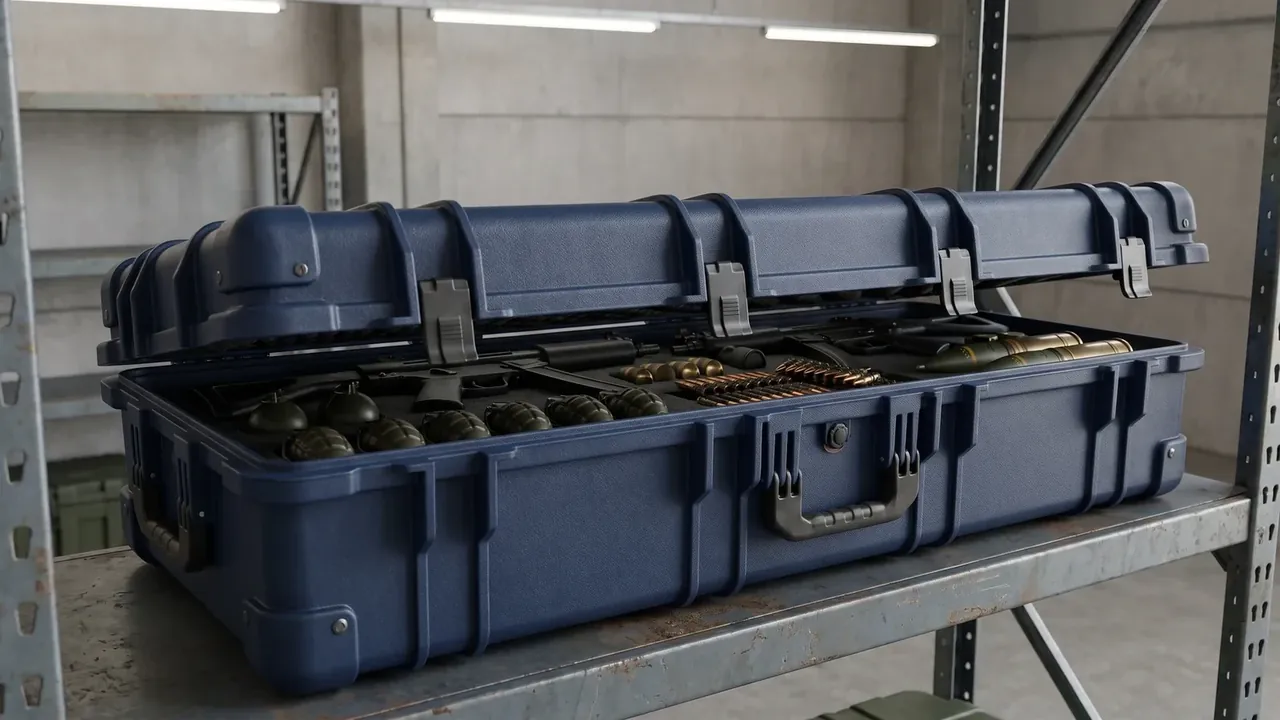
Quick answer: A Military Flight Case gains strength from five layers in sequence: frame, panel, edge trim, latches and seal. Trim decides where edge impact travels; gasket compression decides whether the rating holds.
Table of contents
- The Frame: Rotomoulding and Injection Moulding
- Wall Thickness and Ribs
- Aluminium Trim and Corner Caps
- Latches and Hinges
- Gasket Compression and Ingress Rating
- FAQ
1. The Frame: Rotomoulding and Injection Moulding
The frame of a Military Flight Case is the shell, formed in one piece. Rotomoulding turns an aluminium mould filled with powder biaxially at 280 °C for 12 minutes, so melt builds on the wall layer by layer; injection moulding presses melt into a cavity on a 1250 t machine. The outline can match, but wall distribution differs.
| Item | Rotomoulding | Injection moulding |
|---|---|---|
| Wall range | 3.5 to 6.0 mm, even | 2.5 to 3.5 mm, flow limited |
| Mould cost | RMB 30,000 to 60,000 | Above RMB 300,000 |
| Cycle | 20 to 30 minutes | 60 to 120 seconds |
| Economic batch | From 300 units | From 5000 units |
Rotomoulding suits thick walls; injection moulding wins on cycle, yet sinks appear past 3.5 mm.
2. Wall Thickness and Ribs
Stiffness comes from wall thickness and rib section modulus, not from resin grade. A rotomoulded shell runs 4.5 mm plus or minus 0.4 mm, an injection moulded shell 3.2 mm. Doubling the wall raises stiffness eightfold and doubles weight, so ribs are cheaper.
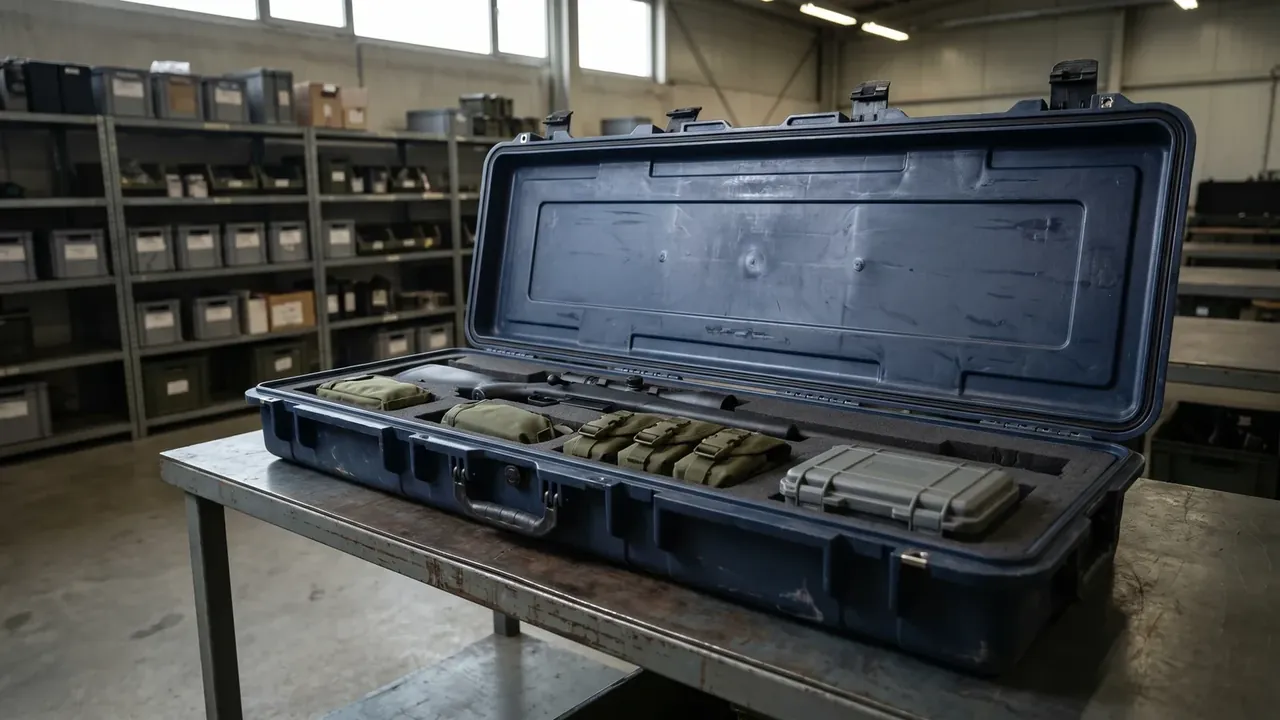
Three rib figures hold: 16 mm high, 2.6 mm thick, 85 mm apart, 1.5° draft. The rib-to-wall ratio stays near 0.6; above 0.7 the root sinks as it cools. One rib across a 400 mm span cuts centre deflection to about 40% of the flat value.
Rib direction is a trade-off: outward ribs bend better but contact the pallet on a line, inward ribs stack flat but eat cavity space.
3. Aluminium Trim and Corner Caps
On a Military Flight Case the edge fails first: impact concentrates at the flange, so trim turns a point load into a line along the extrusion.
Trim is 6063-T5 aluminium, 1.8 mm thick, wrapping the flange of both halves with 4 mm blind rivets at 45 mm centres. Past 60 mm the profile lifts between fixings and the edge peels; closer than 30 mm the holes weaken it. Anodising plus 96 hours of neutral salt spray is the usual finish.
A Military Flight Case uses eight corner caps in nylon with 30% glass fibre at 3 mm wall, each held by two screws and adhesive. The outside radius stays at 8 mm or more: smaller shatters, larger eats usable volume.
4. Latches and Hinges
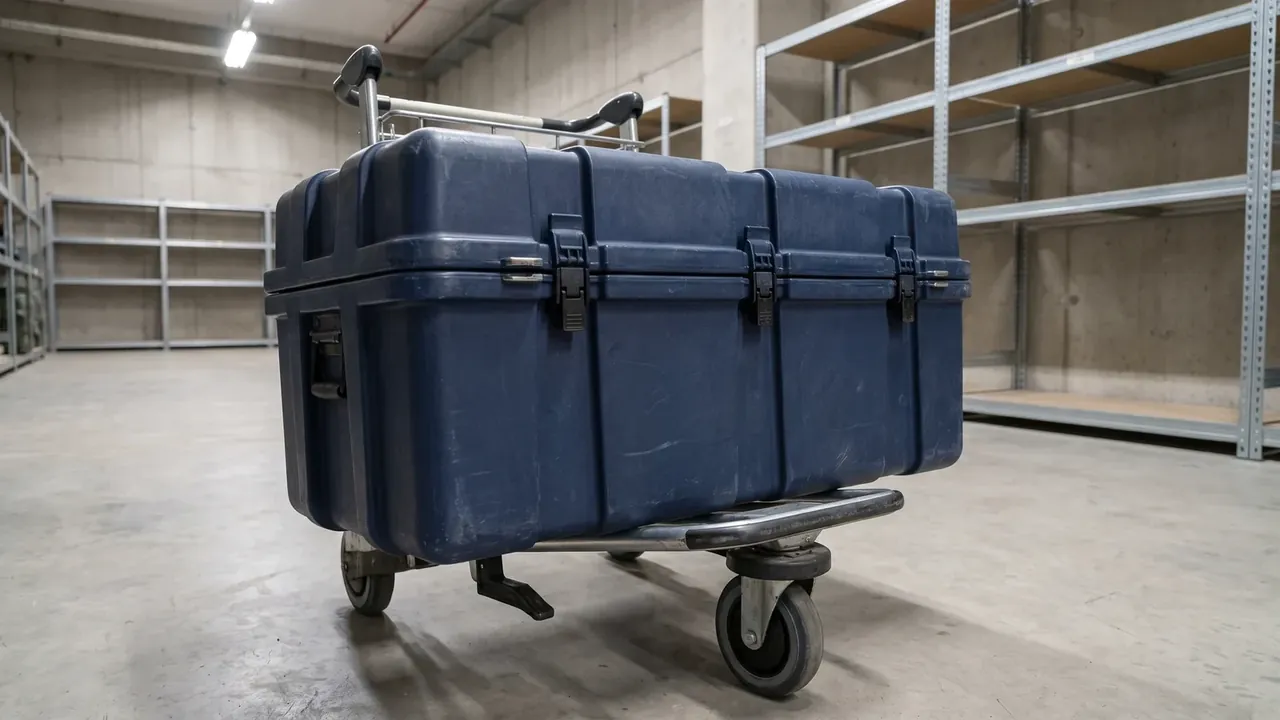
Latches are not meant to be as tight as possible; they must match gasket compression. Four sit evenly along the long side, pull force held between 200 and 240 N, an 8 mm padlock hole and a 5000-cycle life.
| Part | Material | Key size | Criterion |
|---|---|---|---|
| Latch | Glass-filled nylon, steel spring | 200 to 240 N | 15% loss at 5000 cycles |
| Hinge | 304 stainless pin | 6 mm pin, 105° opening | Axial play under 0.3 mm |
| Valve | Silicone diaphragm | Opens at 0.35 bar | Breathes both ways, no water |
Hinge failures come from axial play: a 6 mm pin in a 6.2 mm bore, held under 0.3 mm, keeps the lid from rocking; with more play the gasket is sheared every cycle. If the latch keeper sits 1 mm low, preload rests on gasket rebound, pull force drops below 150 N and the case stops sealing.
5. Gasket Compression and Ingress Rating
Sealing a Military Flight Case is not about filling the groove but holding recoverable compression. Most cases use an EPDM hollow O-profile of 9.5 mm section in a 7 mm groove at 28% compression, or 2.7 mm of squeeze.
Under 20% the cord cannot hold contact stress and a 30-minute immersion at 1 m leaks. Past 40% it takes a set above 20%, measured at 70 °C for 24 hours, and the lid bows.
An ingress rating belongs to the whole assembly: IP67 assumes pull force in band, hinge play within tolerance and the valve intact. If one fails, a tighter gasket changes nothing.
Conclusion
Read a Military Flight Case in one order: the frame sets wall and ribs, trim spreads edge load, latches keep the halves aligned, and the gasket turns that precision into an ingress rating at 28% compression. Loosen any link and the margin of the others is consumed: the fastest way to judge the craft in a Military Flight Case.
This article discusses only the container (case body) side of specifications and design intent, and does not cover any handling, loading or use of the contents.
Related Reading
- Sizing a flight case for air transport
- Where flight cases are deployed
- How rotational moulding works and where it stops
- Reference standards for air transport cases
Related Products
- 8 Series — Gun Cases; Military Equipment Cases; Camera Equipment Cases; Drone Cases; Watch Cases; Knife Cases; First Aid Cases; Electronics Equipment Cases
- WL8-2812 PP Gun Case — model WL8-2812
- All protective cases and toolboxes: 7 series, 158 models