

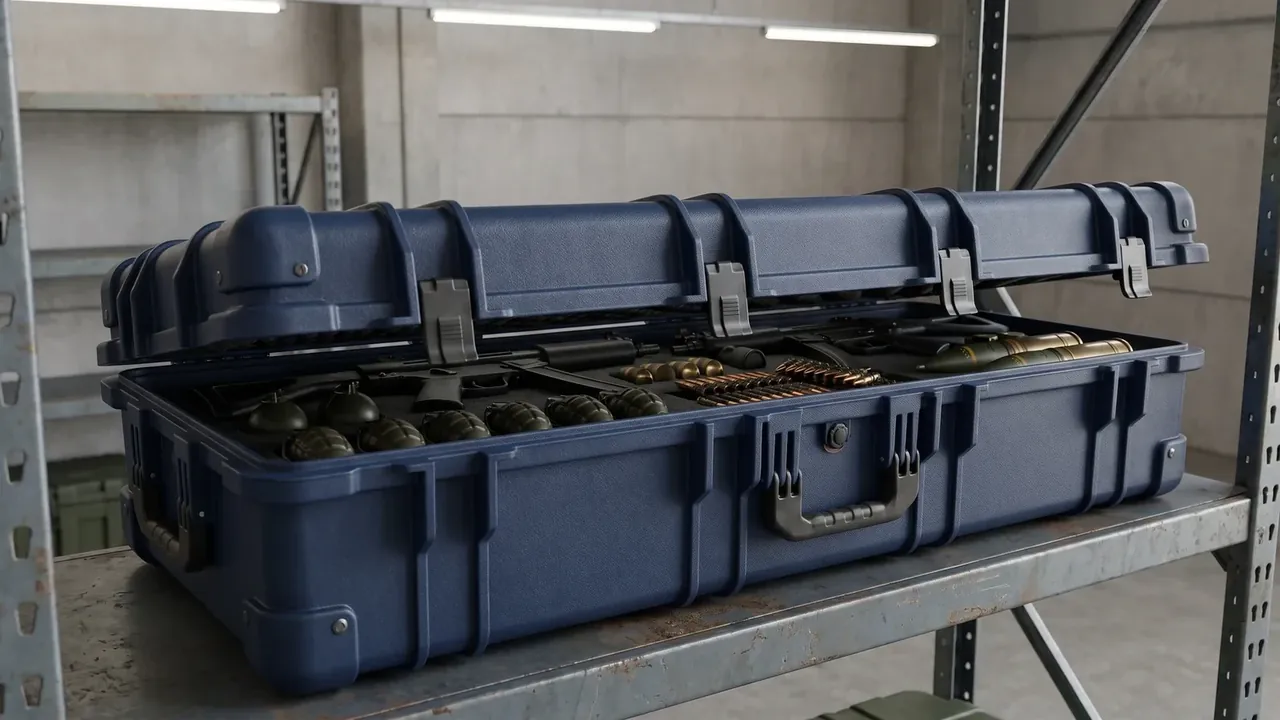
Quick answer: Maintain a military flight case by load path, not calendar: latches before every dispatch, gasket compression every 90 days, hinge pins once a year. Cross a limit and the part is replaced; a 20 mm crack or a wall under 4.0 mm means scrap.
Table of contents
- How to Set an Inspection Cycle for a Military Flight Case
- Gasket Compression and Ageing: What to Measure
- Latches and Hinges: Pull Force and Pin Clearance
- Shell and Liner: Repair or Scrap
- Spares and Records: Making the Cycle Survive
- FAQ
1. How to Set an Inspection Cycle for a Military Flight Case
Two variables set the interval: how often the case moves and how bad a failure would be. A military flight case shipped weekly against the restraint wall gets the shortest tier; a stored one gets an annual pass.
| Tier | Parts checked | Action | Pass criterion |
|---|---|---|---|
| Every dispatch | Latches, lid gap, case no. | Visual, hand feel, 30 s | No bent body, even gap |
| Every 7 days | Handle rivets, corner bumpers | Rock by hand, wipe salt | No movement, no crack |
| Every 90 days | Gasket, pull force | Feeler gauge, spring scale | Above 20 percent compression |
| Every 12 months | Pin clearance, wall | Pin removal, ultrasonic gauge | Not above 0.6 mm |
The 90-day tier vanishes first, needing an open lid and a bench. Bind it to the quarterly count.
2. Gasket Compression and Ageing: What to Measure
A gasket does not wear out; it flattens or hardens. Flattening leaves a pale band round the lid lip; hardening shows as slow rebound.
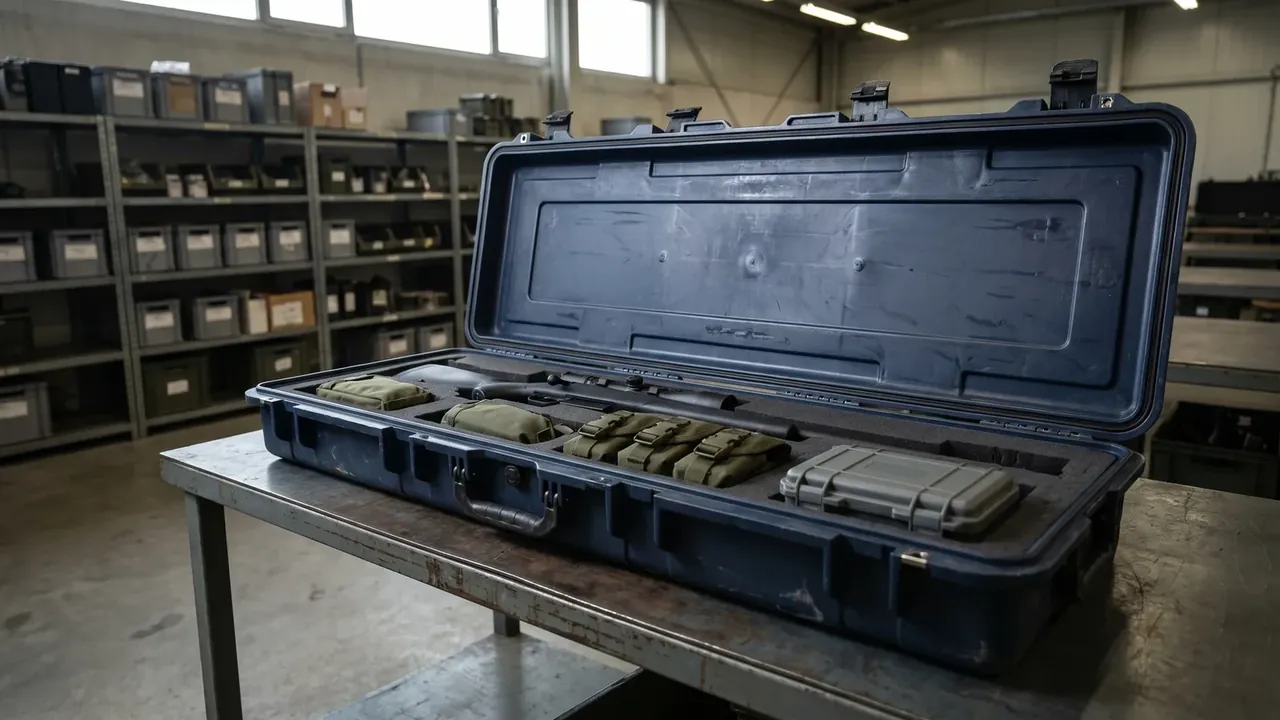
A new profile stands 9.5 mm free. Close the lid, wait ten minutes, take three feeler readings per edge; 6.5 to 7.0 mm means 26 to 31 percent compression. Above 7.4 mm, check latch pull force first. Hardness settles it: 65 Shore A new, 75 is the limit.
| Property | New part | Service limit | Action past limit |
|---|---|---|---|
| Free height | 9.5 mm | 8.6 mm | Replace |
| Closed height | 6.5 to 7.0 mm | 7.4 mm | Check latches first |
| Shore A hardness | 65 | 75 | Replace |
| Surface cracks | None | Single crack up to 2 mm | Replace |
3. Latches and Hinges: Pull Force and Pin Clearance
Latches carry no cargo; they press the lid onto the gasket. Even tightness beats maximum tightness: 120 to 150 N on a spring scale, within 20 N across four latches, or the lid tilts and flattens one side.
Adjust with the shim under the keeper, never by bending the body, which deforms at the pin. Past 0.8 mm of clearance a latch releases itself; change the pin.
Hinge pins are limited to 0.6 mm; beyond that the lid leans and seals one side only. Once a year drive the pin out, clean it, refit with silicone grease that stays fluid at minus 40 degrees Celsius.
A rivet head shifting 0.2 mm against the shell is already loose.
4. Shell and Liner: Repair or Scrap
Shells fall into three bands: serviceable, repairable with restrictions, scrap. Two questions decide: where the crack sits, how much wall is left.
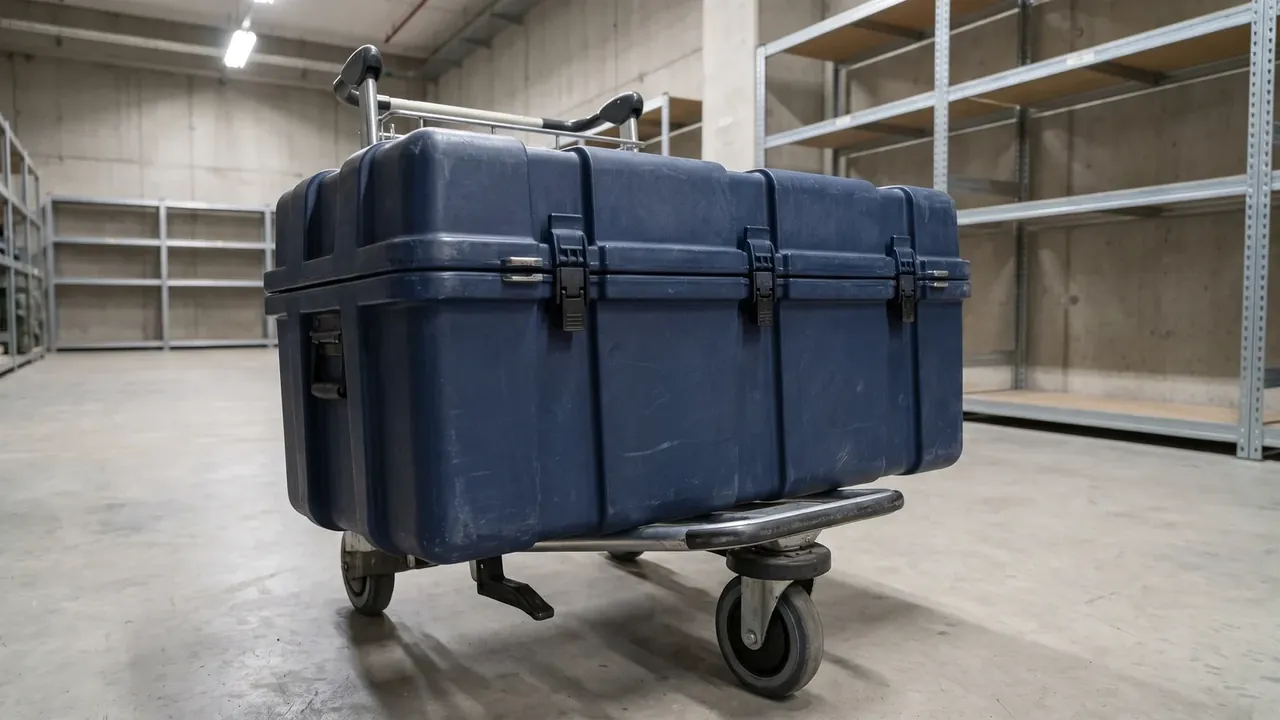
Wall is specified at 4.5 mm; below 4.0 mm the case is scrapped. A crack up to 20 mm that misses a rib can be welded at 260 degrees Celsius, then proven by three minutes in 100 mm of water. Rib cracks are scrapped at any length, since a weld holds sixty percent of parent strength. A liner past 15 percent compression set no longer grips.
| Defect | Limit | Action |
|---|---|---|
| Wall thinning | Below 4.0 mm | Scrap |
| Crack, no rib | Up to 20 mm | Weld, then immersion |
| Crack across rib | Any length | Scrap |
| Liner compression set | Above 15 percent | Replace liner |
| Bumper crack | Above 30 mm | Replace bumper |
5. Spares and Records: Making the Cycle Survive
Spares decide whether the cycle runs. Per 100 military flight cases a year takes roughly 12 gaskets, 8 latches, 20 pins and 6 bumpers, counted from 90-day rejections. Records keep four columns: case number, date, item, reading, and the reading is a number.
Conclusion
Four readable numbers carry the routine: compression, pull force, pin clearance, wall thickness. Each has a tool, an interval and a threshold, so any handler can repeat it. That is where the state of a military flight case is decided.
This article discusses only the container (case body) side of specifications and design intent, and does not cover any handling, loading or use of the contents.
Related Reading
- Sizing a military flight case for aircraft loading
- Using military flight cases in equipment airlift
- Routine care and damage handling for rotomolded cases
- Storage and recommissioning care for war reserve cases
Related Products
- 8 Series — Gun Cases; Military Equipment Cases; Camera Equipment Cases; Drone Cases; Watch Cases; Knife Cases; First Aid Cases; Electronics Equipment Cases
- WL8-2812 PP Gun Case — model WL8-2812
- All protective cases and toolboxes: 7 series, 158 models