

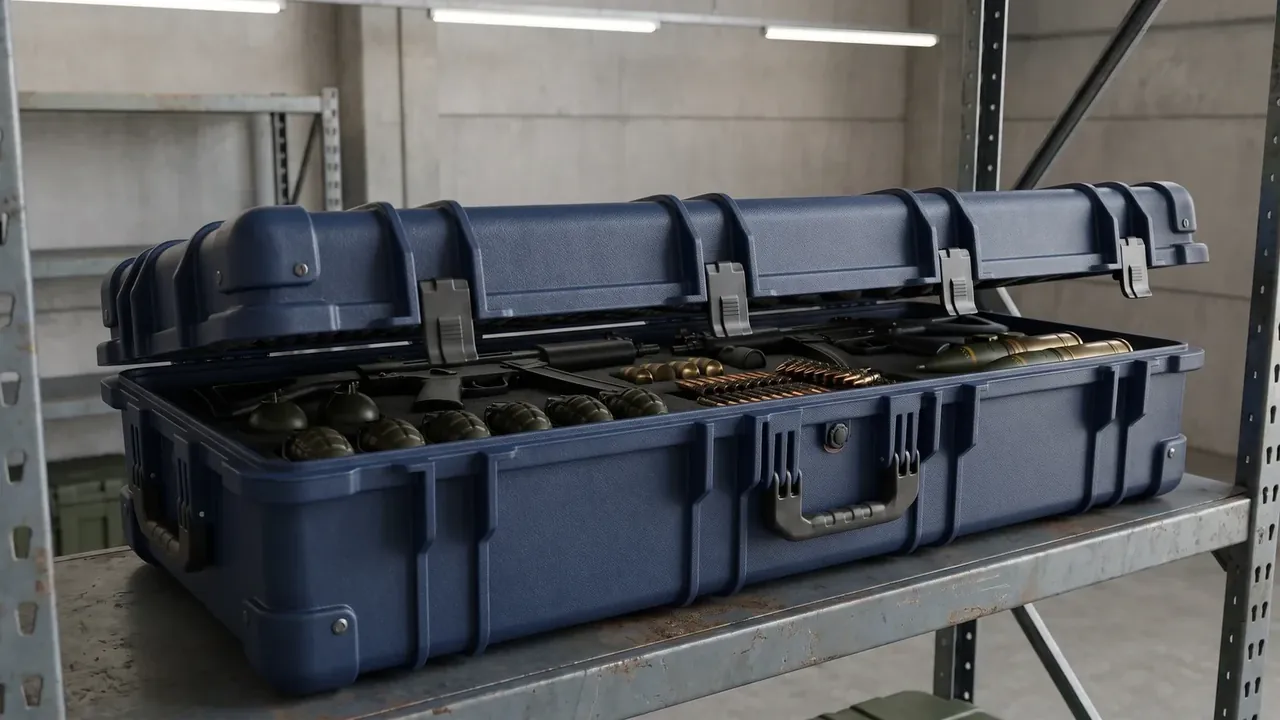
Quick answer: A military flight case is chosen by ordering five decisions, not by comparing datasheets. Margin, load, transport mode, sealing and certification run in that sequence, each constraining the next. Guess at any of them and the design returns to the door width.
Table of contents
- Five tests a military flight case must pass
- How much dimensional margin to leave
- Checking load capacity and stacking
- Wall thickness and sealing by transport mode
- Which certifications actually matter
- FAQ
1. Five tests a military flight case must pass
A military flight case is chosen by ordering five decisions. Margin decides whether it goes in, load whether it stacks three high, transport mode whether it survives vibration, sealing whether moisture enters, certification whether a third party has checked the other four.
The usual mistake is fixing a shell before the loading plan; door clearance and pallet grid then give way.
| Test | Threshold to design to |
|---|---|
| Margin | 30 mm per side, 15 mm above the load |
| Load | 210 kg static, under 2 mm creep |
| Mode | 8 kPa differential for air |
| Sealing | IP67, 30 minutes at 1 m |
| Certification | Drop, vibration, heat on the full case |
2. How much dimensional margin to leave
Margin sits in three places: load to cavity, shell to loading space, lid to working area. Mixed into one figure, the case fits and will not close.
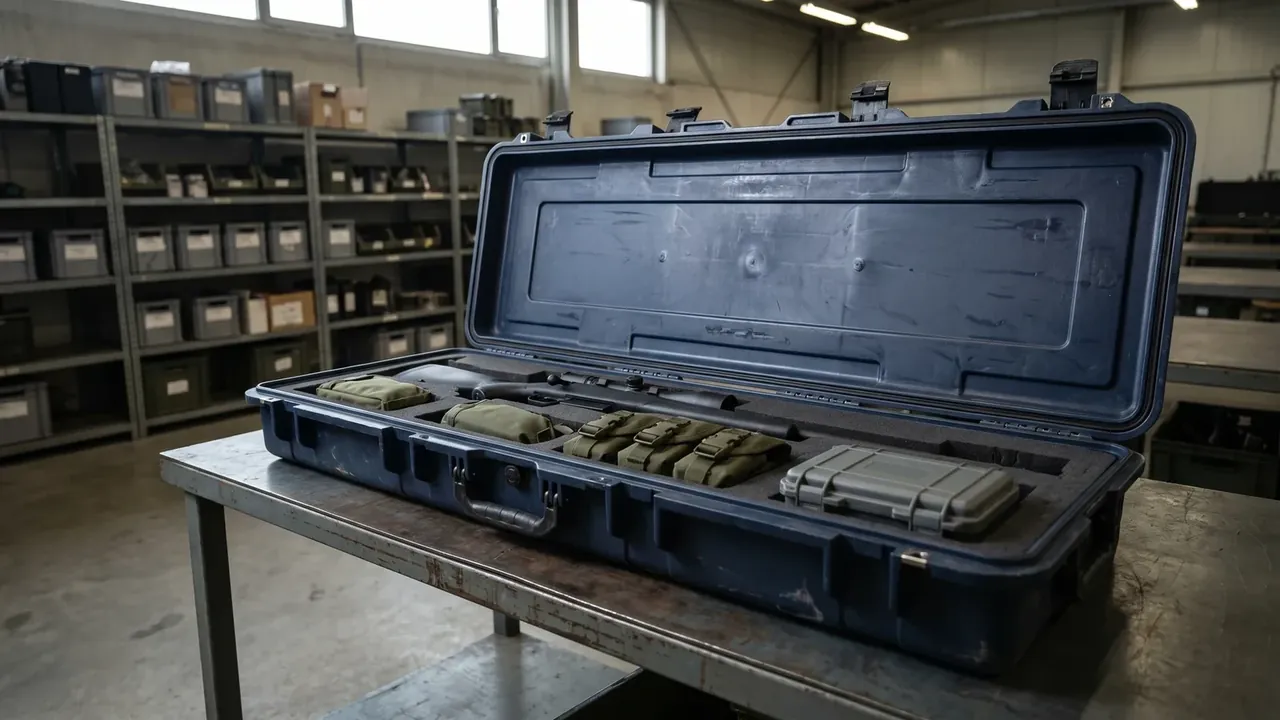
Cavity margin follows compressed foam: 35 mm polyethylene at sixty percent compression is 21 mm, so a drawing cut to nominal keeps usable space on paper only.
Between shell and loading space, 30 mm per side covers bumpers, latch lift and straps; a narrow cabin door pushes it to 50 mm.
Latches flat, handles retracted, bumpers flush: without those three, the same case measures differently at two factories.
3. Checking load capacity and stacking
Capacity splits into static and dynamic: time under load, and the transit peak. One factor cannot cover both.
Loaded to 70 kg and stacked three high, the bottom unit carries 140 kg; at a 1.5 creep factor the lid is checked at 210 kg for 24 hours at 40 °C.
Dynamic load is a corner drop at 1.2 times the loaded weight from 1.2 m: no corner cracks, latches that still cycle, a lid gap still within 2 mm.
| Load case | Pass value |
|---|---|
| Static stack, 210 kg, 24 hours at 40 °C | Under 2 mm deflection |
| Corner drop, 1.2 times weight from 1.2 m | No cracks, latches cycle |
Contact area matters as much as the number: a lid 1 mm out of flat costs about thirty percent of measured capacity.
4. Wall thickness and sealing by transport mode
Thickness follows the harshest leg: air is hard on pressure and handling, sea on salt and stacking, road on vibration.
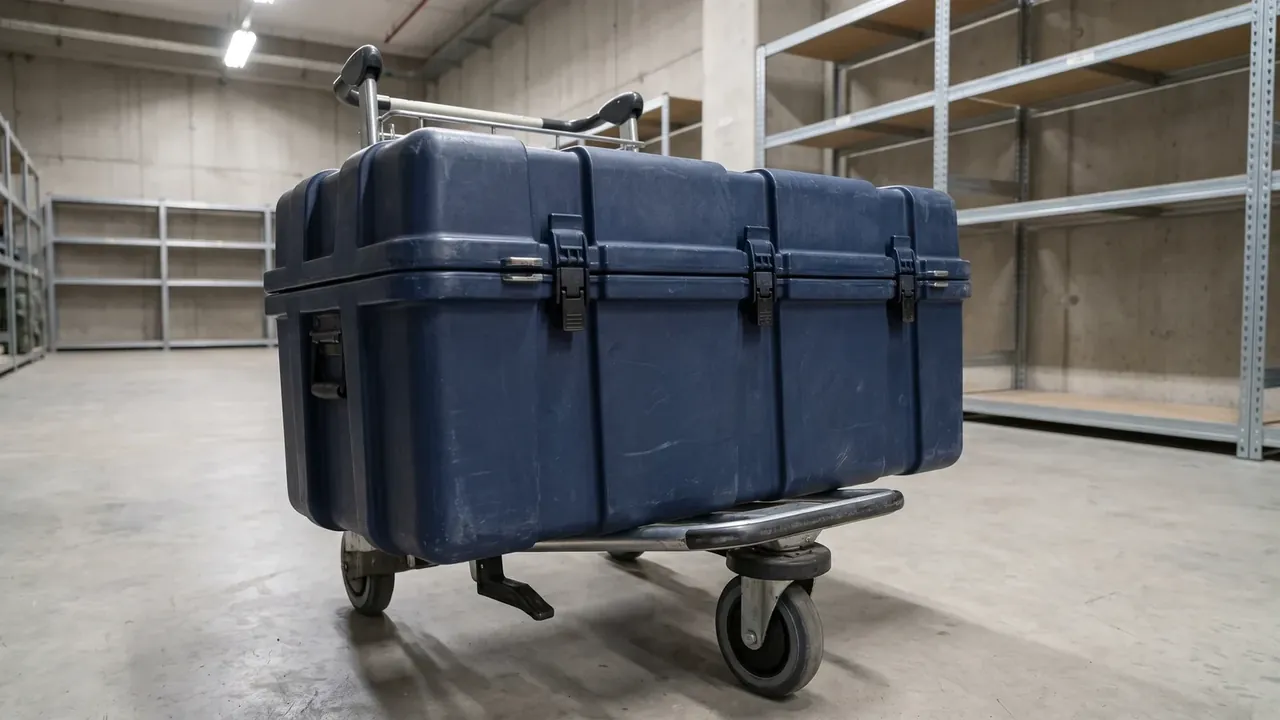
An air-first route takes a 3.5 mm wall, ribs at 25 mm, and a double lip with a valve opening at 8 kPa.
Sea and multimodal routes move to 4.5 mm, ribs at 20 mm, and 316 stainless checked to 96 hours of salt spray; five-high stacking needs half again the air rating.
| Mode | Wall | Rib pitch | Sealing |
|---|---|---|---|
| Air, loose | 3.5 mm | 25 mm | Double lip, 8 kPa valve |
| Road, truck | 4.0 mm | 22 mm | Single lip |
| Sea, container | 4.5 mm | 20 mm | Double lip, breather |
Build to the two largest legs; sea standard everywhere adds two kilos per unit, forty across twenty.
5. Which certifications actually matter
Certification has four layers: full-case testing, packaging transport standards, ingress rating, hazardous-goods approval.
MIL-STD-810H holds 71 °C and -51 °C for four hours each, runs five thermal cycles, and applies 40 g at 11 ms on three axes. The report must cover the assembled case, not coupons.
ATA 300 Category 1 covers drop, vibration and stacking, and ISTA 3A adds repeated drops. IP67 is thirty minutes at one metre.
Dangerous goods add UN drop and stack testing, tied to one design model, so a new size means a new test. Ask how models map to certificates before ordering.
Conclusion
Margin and load decide the frame, transport mode and sealing decide material and hardware, certification only confirms what was already chosen. Run the chain in that order and selection stops being a price comparison. Measured against the route, a military flight case stops generating rework at the door.
This article discusses only the container (case body) side of specifications and design intent, and does not cover any handling, loading or use of the contents.
Related Reading
- Sizing a military flight case to aircraft loading limits
- Military box selection: outer form, load and stacking
- Compliance and pressure equalization for military air transport cases
- Protective case sizing: cavity, outer form and margin
Related Products
- 8 Series — Gun Cases; Military Equipment Cases; Camera Equipment Cases; Drone Cases; Watch Cases; Knife Cases; First Aid Cases; Electronics Equipment Cases
- WL8-2812 PP Gun Case — model WL8-2812
- All protective cases and toolboxes: 7 series, 158 models