


Quick answer: A Military Medical Supplies Case holds base deflection to ≤1.6 mm across three stacked tiers via six base ribs and four corner supports.
Table of contents
- Stacking duty and the load path of a Military Medical Supplies Case
- Six base ribs and four corner supports
- Load distribution across stacked tiers
- Stress in load-bearing parts and handle pull
- Deflection limits and the full-duty envelope
- FAQ
1. Stacking duty and the load path of a Military Medical Supplies Case
A Military Medical Supplies Case spends much of its service life in stacks, and the bottom unit of a three-tier pile carries the two above it. The shell is 720×490×350 mm, the cavity 655×425×285 mm, wall thickness 4.8 mm, empty mass 9.6 kg, rated load 22 kg, giving 31.6 kg full. Three tiers put close to 95 kg on the lowest shell. Six longitudinal ribs therefore spread load along the length before passing it down. The acceptance figure is base deflection of no more than 1.6 mm. From −30 °C to 60 °C the shell stiffness shift is already inside the deflection margin.
Rib pitch is set against the 655 mm cavity span and kept clear of the corner seats, which are stepped bosses that catch the stacking feet above. Treating stackable as load-rated is a common mistake; here ribs take bending, seats carry force down, and the lid keeps only its seal.
Three tiers, six ribs, four seats: the stack rests on those counts.
2. Six base ribs and four corner supports
Viewed from inside, the six ribs run full length, and rib height with the 4.8 mm wall builds local inertia that breaks one wide panel into short spans. The four corner supports of a Military Medical Supplies Case sit at the rib ends, so load travels from rib to seat with almost no detour. At 9.6 kg empty the ribs are barely stressed; only at 22 kg loaded do they enter their design range.
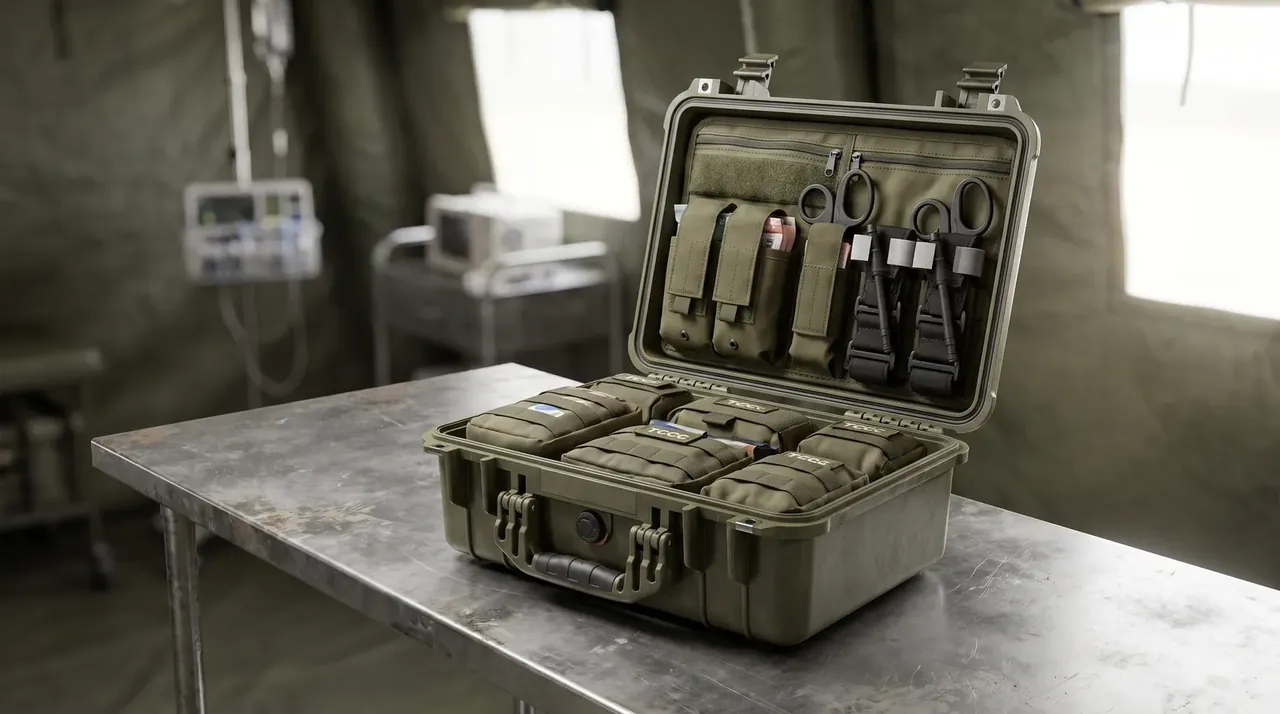
The 1.2 m drop criterion for a Military Medical Supplies Case runs this way: four guards catch the impact first, then feed force through the seats into the ribs, and a thin seat root would crack. Two handles at 480 N each sit mid-length on the shell; four latches at 500 N each press the lid onto the seal and stay engaged over 4000 cycles.
3. Load distribution across stacked tiers
Three tiers are not simply 31.6 kg times three, since each level sees a different total and offset. A Military Medical Supplies Case is read tier by tier: the top carries its own mass, the middle adds the top case, and the bottom takes both through four corner seats plus any alignment eccentricity. All three still meet the 1.6 mm cap.
| Stack tier | Cumulative load | Deflection limit |
|---|---|---|
| Top | 31.6 kg self weight | Not checked alone |
| Middle | About 63.2 kg combined | ≤0.9 mm |
| Bottom | About 94.8 kg combined | ≤1.6 mm |
Cumulative figures add one 31.6 kg case per tier, with the gauge at mid-span of the bottom base rather than on its wall, because the panel between ribs bends the most. The middle tier keeps the tightest margin at 0.9 mm.
4. Stress in load-bearing parts and handle pull
Load from the lid above crosses three bearing features: corner seat, base rib, corner guard, each relieving the one before. A Military Medical Supplies Case treats them as one chain — seats receive, ribs spread, guards divert landing shock — so a section change anywhere leaves a kink in the deflection curve. The two 480 N handles form a separate line into the shell.
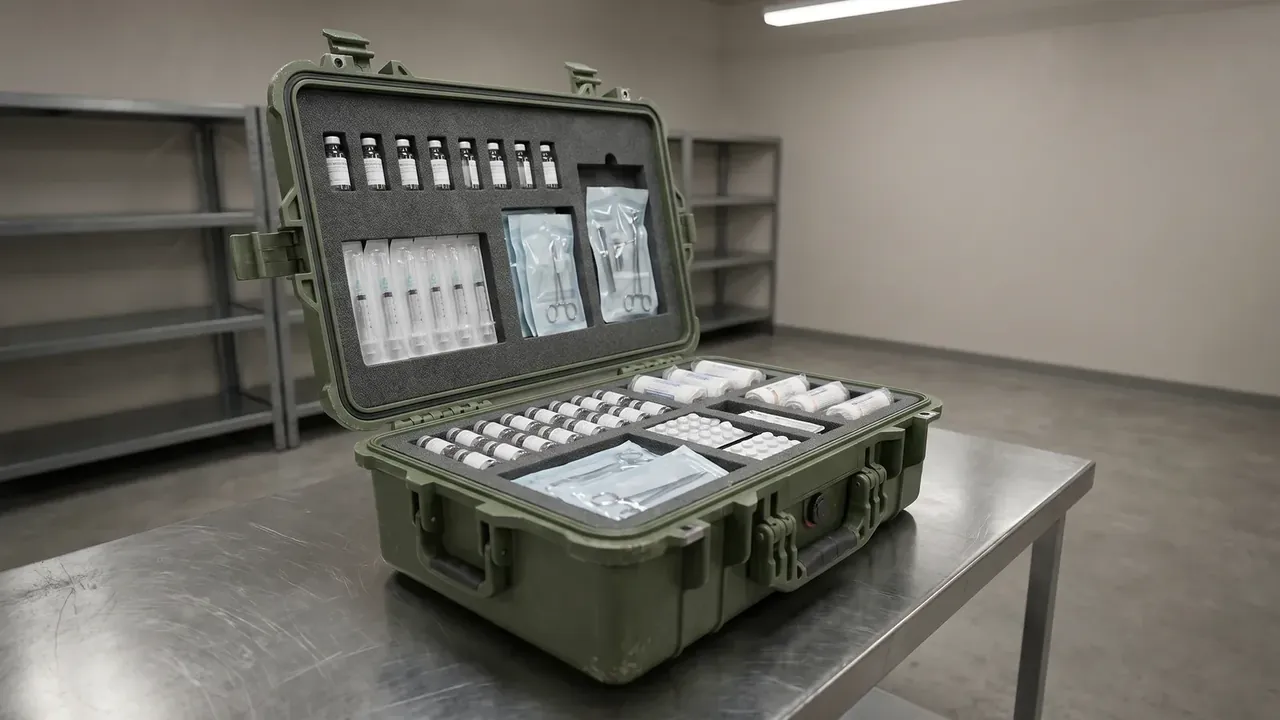
At 31.6 kg shared by two handles the static figure approaches 155 N per handle, and the 480 N rating leaves roughly three times that for out-of-step lifting. A Military Medical Supplies Case bridges each handle boss across two ribs, so lifting force travels through the shell and the sealing rim is not pulled out of shape.
| Bearing part | Load direction | Rating |
|---|---|---|
| Six base ribs | Vertical bending | Deflection ≤1.6 mm |
| Four corner guards | Landing shock | No crack after 1.2 m drop |
| Two handles | Lifting pull | 480 N each |
The rows follow the order force splits. Handle strength is written as a 480 N rating and a post-drop retention check, closable with a pull gauge and a drop tower.
5. Deflection limits and the full-duty envelope
Across the envelope, a Military Medical Supplies Case holds base deflection to ≤1.6 mm under three tiers, shows no guard cracking and no handle pull-out after a 1.2 m drop, seals to IP67, works from −30 °C to 60 °C, and survives 4000 open-close cycles. Deflection belongs to ribs and seats, IP67 to the mouth seal, guards to landing shock, and the 480 N handles and 500 N latches to lifting and closure; none lends another feature its margin.
| Deflection value | Test condition | Acceptance |
|---|---|---|
| ≤1.6 mm | Three tiers, 31.6 kg full case | Six ribs pass |
| No crack | After 1.2 m drop | Four guards pass |
| No pull-out | 480 N per handle | Two handles pass |
Each cell names who measures what under which condition, so sign-off on a Military Medical Supplies Case proceeds cell by cell. A general tool box quotes one loose load ceiling; separating deflection, guards and handles is what sets a stacking case apart.
Conclusion
A Military Medical Supplies Case carries a stack by spreading load through six ribs, guiding it down four corner seats, and letting guards absorb the landing hit, which keeps base deflection to ≤1.6 mm over three tiers. No cracking or pull-out after a 1.2 m drop is the floor that keeps it sound. For cases moved in stacks, pinning down deflection before handle rating beats a loose load claim.
Related Reading
- Specification criteria for a field medical case
- Structural points in selecting an emergency supply case
- Application scenarios for emergency equipment cases
- Stacking and acceptance of disaster emergency supply cases
Related Products
- 8 Series — Gun Cases; Military Equipment Cases; Camera Equipment Cases; Drone Cases; Watch Cases; Knife Cases; First Aid Cases; Electronics Equipment Cases
- WL8-2812 PP Gun Case — model WL8-2812
- All protective cases and toolboxes: 7 series, 158 models