

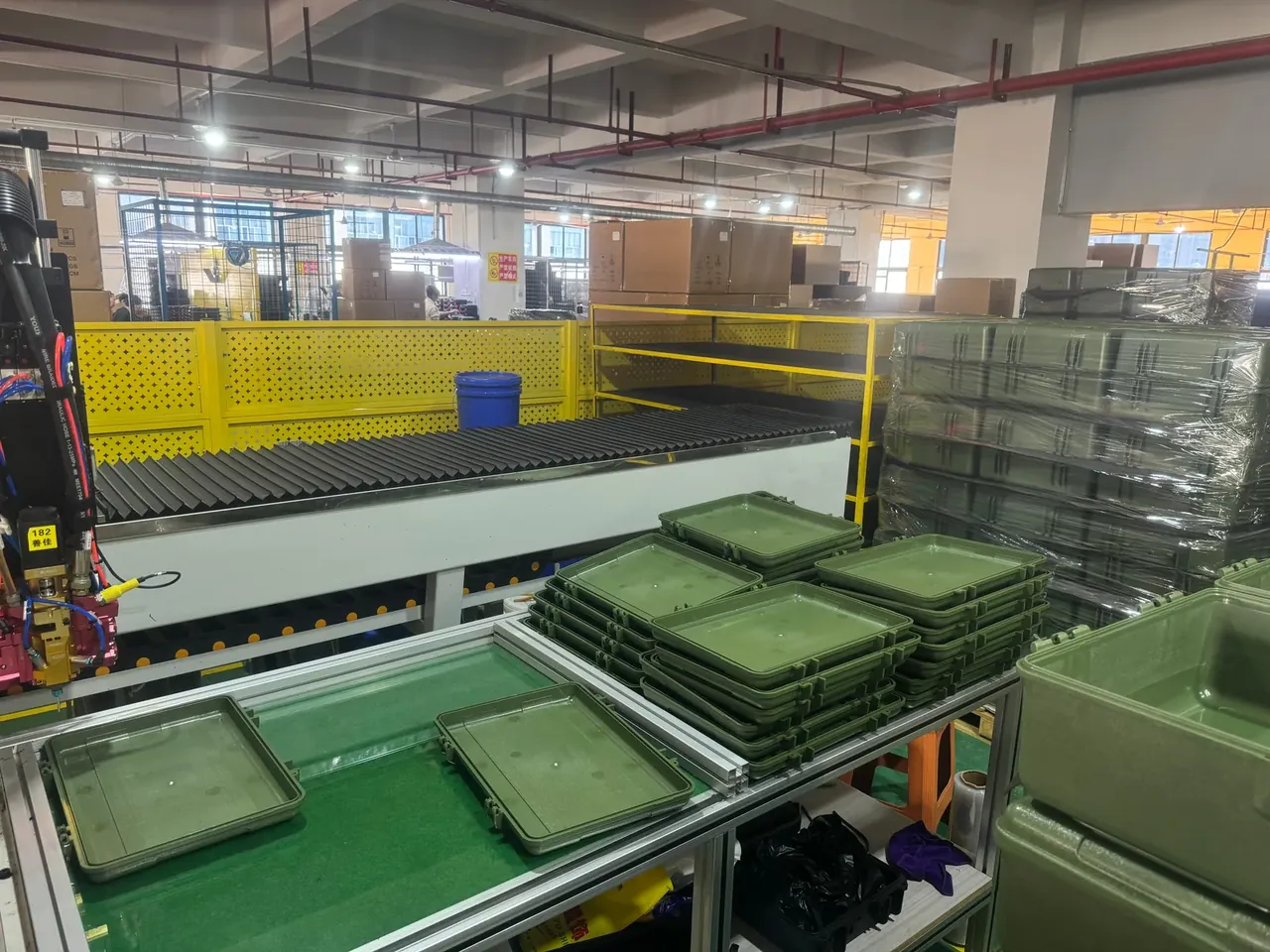
Quick answer: A Military Protective Case Supplier keeps seal compression spread to 1.8 points over 3 incoming lots and mouth pressure drop under 0.3 kPa / 10 min.
Table of contents
- Wall-thickness tolerance bands at a Military Protective Case Supplier
- Apportioning lid mating clearance
- Compression-rate spread across incoming material lots
- Pressure-drop readings in sampling rechecks
- Tolerance release line for delivery lots
- FAQ
1. Wall-thickness tolerance bands at a Military Protective Case Supplier
What slips first in a bulk delivery is not one shell's dimension but the spread of seal compression between incoming lots. When a Military Protective Case Supplier receives the drawing, the outer 620×450×265 mm, the cavity 550×385×195 mm and the wall of 4.6 mm are only nominal; what matters is how widely each moulded lot scatters. A thin wall leaves the gasket under-compressed at closure, a thick one forces the same latch stroke to absorb the excess. Narrowing the tolerance band pins down one variable of compression before anything else is tuned. JUNZHIJIA sorts lots into wall bands before discussing clearance, since three blended lots cannot be traced to one datum. The empty case at 7.2 kg and the loaded case at 18 kg both sit on the rig, because a loaded mouth springs open and sets the tolerance left.
We slice incoming material by measured wall value and log clearance and compression per band, not as one blended average. Which band a lot falls in and how far its compression sits from the middle decide whether it joins the datum. A Military Protective Case Supplier files the band table with the inspection card so a later review need not guess the incoming state.
The table sets each band beside its compression reading; inspectors check the first column against the drawing datum and never mix samples across bands.
| Tolerance band | Sampled wall | Compression |
|---|---|---|
| Thin | 4.6 mm minus tolerance | Low |
| Nominal | 4.6 mm | 22% |
| Thick | 4.6 mm plus tolerance | High |
Banding is not sorting out parts; it leaves a traceable line for the criteria that follow.
2. Apportioning lid mating clearance
Lid mating clearance decides how far the gasket is squeezed, and it has to be read together with the wall-thickness tolerance band. A Military Protective Case Supplier holds the ceiling at ≤0.4 mm because a two-pass gasket at 22% compression is sensitive to closure stroke: open the gap a little and the rate leaves the target band, with mouth pressure drop loosening alongside.
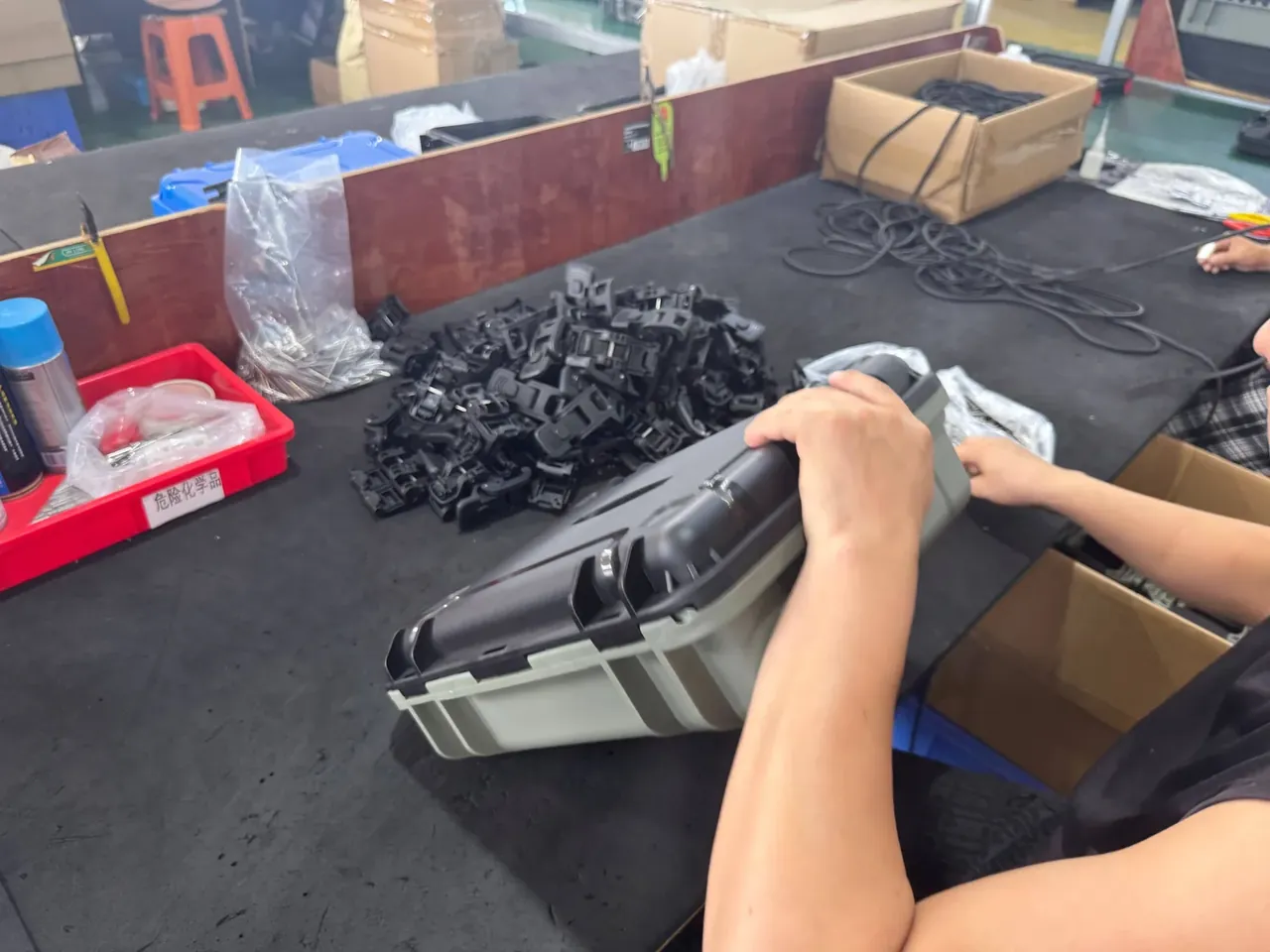
Clearance is spread across the lid-shell overlap. Four latches at 430 N each press the perimeter, and an uneven mating face leaves the corners with different compression. We run a feeler gauge around the rim and log the largest gap on that lot's card.
Temperature swing matters too: between −30 ℃ and 55 ℃ lid and shell shrink differently, so a gap that fits at room temperature may open at the cold end. The datum carries readings before and after the swing, and compression must hold the same band at both.
3. Compression-rate spread across incoming material lots
Three lots side by side say more than one lot's data. A Military Protective Case Supplier writes the compression-rate spread of ≤1.8 points as the delivery criterion: the highest minus the lowest lot rate must not exceed 1.8 points.
Spread is logged per lot, not per piece. The table puts three lots on one line; the max-minus-min value decides release.
| Incoming lot | Wall band | Compression |
|---|---|---|
| Lot one | Nominal | 22% |
| Lot two | Lower deviation | Low |
| Lot three | Upper deviation | High |
One table of three lots also shows which lot is drifting toward the band edge; the 32-piece average of one lot mistakes lot-to-lot drift for within-lot scatter. A Military Protective Case Supplier therefore keeps extremes per lot, not just the mean.
4. Pressure-drop readings in sampling rechecks
Once compression passes, the seal is rechecked by mouth pressure drop. A Military Protective Case Supplier samples 32 pieces per lot and records the drop over 10 min against ≤0.3 kPa / 10 min.
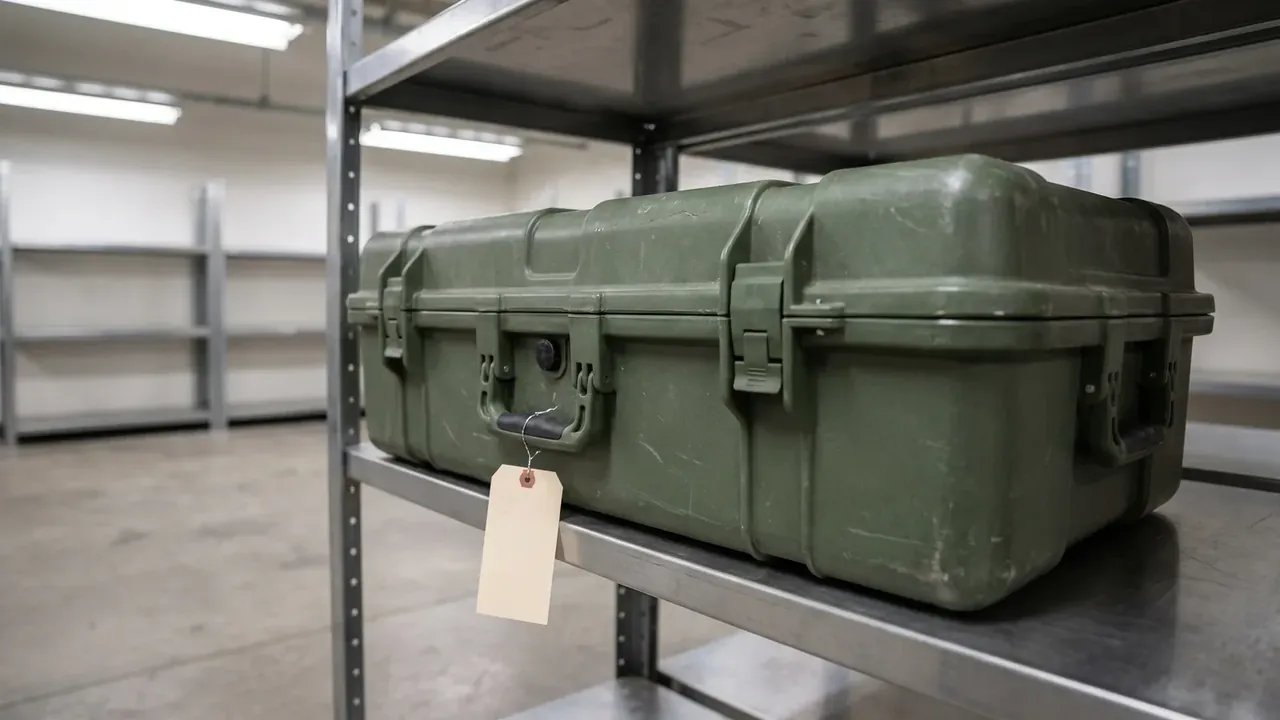
Compression rate measures how far the gasket is squeezed; pressure drop measures whether that squeeze sealed the mouth. A Military Protective Case Supplier logs both on one card to catch compression passing while drop crosses the line, or the reverse.
The recheck also carries cycling life: after 4200 open-close cycles the latches and gasket loosen and the drop reads slightly above the start. We log both drops side by side, and a post-cycle figure still holding 0.3 kPa / 10 min means the margin is adequate. IP67 enters the drawing only as a benchmark method, not a grade already obtained.
When the two readings disagree, check clearance first, then the incoming band.
5. Tolerance release line for delivery lots
The release line sits at a spread of 1.8 points; a lot that crosses is marked on its own and kept out of the datum. A Military Protective Case Supplier writes this criterion at the foot of the card and uses it to decide whether a batch ships or returns for a tool correction and fresh banding.
The release line rests on compression values, pressure-drop readings and band records. The table gathers the criteria for a tick in order.
| Compression value | Criterion | Drawing datum |
|---|---|---|
| Spread | Three-lot difference | ≤1.8 points |
| Per lot | Pieces | 32 pieces |
| Pressure drop | 10 min mouth change | ≤0.3 kPa / 10 min |
Writing the line into the datum removes piece-by-piece arguing at delivery. JUNZHIJIA keeps each lot's band, spread and drop in the outgoing record, so a review lines up on the same card.
Conclusion
Read the work of a Military Protective Case Supplier as four links in one chain: wall-thickness tolerance band, lid mating clearance, lot-to-lot spread and sampled pressure drop. The first two decide whether a single shell seals, the last two whether a whole delivery scatters. Put the ≤0.4 mm clearance, the ≤1.8-point spread and the ≤0.3 kPa / 10 min drop into one datum and a review need not argue piece by piece. JUNZHIJIA files each lot along that line, which makes the spread auditable.
Related Reading
- Military box vs military packing case: the boundary
- Tactical protective case parameters to verify
- Air transport case structure benchmarks
- Rotomolded case structure benchmarks
Related Products
- 8 Series — Gun Cases; Military Equipment Cases; Camera Equipment Cases; Drone Cases; Watch Cases; Knife Cases; First Aid Cases; Electronics Equipment Cases
- WL8-2812 PP Gun Case — model WL8-2812
- All protective cases and toolboxes: 7 series, 158 models